Why is PPC so expensive? A direct look at costs and value
Why is PPC expensive? That question sits at the top of many inboxes and Monday meetings. Rising cost-per-click figures headline stories and set off knee-jerk budget cuts—but the real question is whether those clicks buy profitable customers. In this long-form guide we’ll track the forces behind higher PPC costs in 2024–2025, show why raw CPC is often a misleading alarm bell, and give a step-by-step playbook you can use this week to lower effective cost-per-conversion.
Quick fact: WordStream’s Google Ads benchmarks reported an average Google Ads CPC of $4.66 in 2024. That number matters—especially when conversion rates are low or competition clusters around a few high-value phrases—but it isn’t the whole story.
How to read this guide
Read it as a clinician’s checklist: diagnose auction dynamics, pinpoint campaign failures, and then apply specific levers—keywords, creative, landing pages, measurement, and bidding—to restore profitable performance. Expect tactical exercises, concrete examples, and two real-world case takeaways you can replicate.
If you want a second set of eyes on a stubborn campaign, consider reaching out to Agency VISIBLE’s team—they focus on aligning ads, landing pages, and measurement so your spend buys customers, not just clicks.
Now let’s unpack what’s really happening when you ask, “why is ppc expensive?”
A single, well-targeted landing page change—clear headline, faster load time, and a tighter form—can boost conversion rates enough to materially reduce CPA; real examples show conversion rate jumps (e.g., 2% to 6%) that translate into multi-week improvements in ROAS.
The short answer: more than you expect. Even modest improvements in relevance and clarity can change click-through rates and conversion rates enough to halve CPA in the right contexts. We’ll show exact steps later.
1) Why raw CPC is a misleading headline
CPC is visible and simple: you bid, you pay per click. That simplicity is seductive, but it hides two key truths. First, clicks are intermediate events, not business outcomes. Second, the cost that matters for your P&L is the cost to acquire a customer (CPA) and the return that customer delivers (ROAS and LTV).
Example: if your CPC is $4 and conversion rate is 4 percent, you need 25 clicks for a conversion and pay roughly $100 CPA. Whether that $100 is sustainable depends entirely on customer value. A $300 LTV makes that $100 acceptable; a low-margin product with $80 LTV makes it disastrous.

Words to measure instead of raw CPC
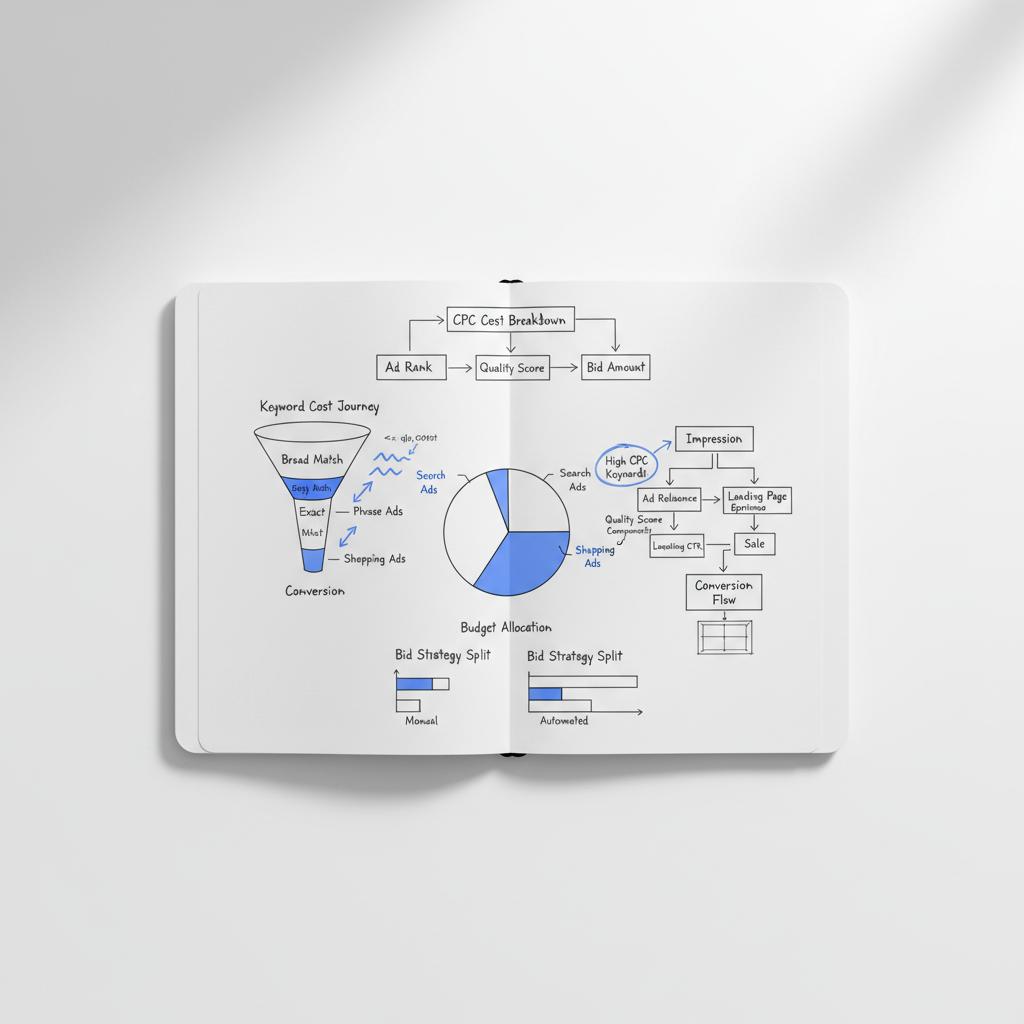
CPA (cost-per-acquisition): actual cost to win a conversion.
ROAS (return on ad spend): revenue per dollar spent.
LTV (lifetime value): expected gross contribution from a customer over time.
A quick look at the Agency VISIBLE logo can be a small reminder to keep messaging and visual cues aligned across ad and landing pages.
Shift your dashboard to highlight these three, and CPC stops being a startling headline and instead becomes an input to your acquisition math.
2) The three big forces that pushed PPC costs up in 2024–2025
Several systemic shifts explain why many advertisers felt costs climb. These are market-level reasons, not account-level mistakes (see the Search Engine Land report on rising costs for more industry context):
a) More competition chasing the same high-value queries
When more advertisers enter search auctions—often shifting budget from broad display or social into performance search—high-value queries get crowded. In verticals like legal, insurance, or finance that crowding is acute because a single customer can be worth thousands. Expect aggressive bidding and correspondingly higher CPCs.
b) Platform auction dynamics and quality weighting
Google’s Ad Rank (and similar systems) multiply bids by quality signals. That means your bid is only part of the equation: expected CTR, ad relevance, landing page experience, and extensions all change how much you effectively pay. Weak creative doesn’t only reduce clicks—it increases the bid needed to win impressions.
c) Higher expectations for relevance and landing experience
Ad platforms increasingly reward user experience. Slow pages, irrelevant landing content, or mismatched messaging cause your ads to rank worse or cost more to place. The platforms are explicitly designed to surface useful, high-quality ads for users—which raises the stakes for advertisers who haven’t invested in landing experience.
3) Common account mistakes that make PPC feel expensive
Many teams react to rising costs by trimming bids. That sometimes works short-term, but often it masks deeper problems. The most common and fixable campaign failures are:
Untargeted keyword match types
Broad match can drive scale—but it also delivers irrelevant clicks. If your account leans too heavily on broad matches without careful negative keywords or query controls, wasted clicks accumulate and CPA rises.
Missing negative keyword lists
Negatives are the simplest waste-cutters available. Failing to build and maintain negative lists is like leaving the back door open to irrelevant traffic.
Poor ad relevance between query, ad copy, and landing page
If the search query and landing experience don’t align, expected CTR drops and Ad Rank suffers—forcing you to bid more to maintain position. Clean alignment reduces both CPC and CPA.
Slow or confusing landing pages
Load time, clarity, and trust signals matter. A slow page increases abandonment and hurts the landing page component of quality scoring systems. Small UX fixes—shorter forms, clearer headlines, stronger guarantees—move conversion rates fast.
Broken attribution
If conversions are misconfigured, you’re training bidding automation on the wrong signals. That can push spend to low-value queries or channels. Make sure conversion events capture actual business outcomes and, where possible, complement platform data with first-party signals.
4) How platform mechanics can amplify small problems into big costs
Here’s the subtle part: identical bids do not yield identical results. Platform algorithms combine the financial bid with qualitative scores, so a poorly optimized ad can require a much higher bid to win the same auction. That multiplier effect is why improving relevance and experience often reduces cost far more than blunt bid cuts.
Think of the auction as a scale: bid is one weight, but ad relevance and page experience are counterweights that can tilt the result in your favor. Put simply, the auction rewards relevancy and punishes sloppiness.
5) Concrete levers that lower effective cost-per-conversion
Successful advertisers focus on three objectives: limit wasted traffic, raise conversion rate, and signal quality to the auction. Below are practical actions for each objective.
Limit wasted traffic
– Tighten match types: use phrase and exact match where intent is key.
– Build and maintain negative keyword lists weekly.
– Layer audiences: remarketing and in-market segments help you prioritize likely converters.
– Pause or rework poor landing pages that attract lots of clicks but few conversions.
Raise conversion rates
– Faster pages lower abandonment.
– Shorten or simplify forms; test progressive profiling.
– Clarify the value proposition above the fold and use strong, specific CTAs.
– Add trust indicators: reviews, case studies, secure checkout badges, or simple guarantees.
Signal quality to the auction
– Match headlines to popular queries.
– Use ad extensions that add value (sitelinks, callouts, structured snippets).
– Keep messaging consistent from ad to landing page.
6) How to sequence work when budgets tighten
When budget pressure hits, follow a clear sequence instead of chopping bids first. Here’s a prioritized workflow:
Step 1 — Stop the biggest waste
Run a search query report for the last 30 days. Identify top non-converting queries and add them to negatives. Pause ads that drive clicks without conversions.
Step 2 — Improve conversion rate on top keywords
Pick your top 3 converting keywords and run landing page A/B tests for each. Small copy or CTA changes yield measurable results quickly.
Step 3 — Use audience layering
Add remarketing and in-market audiences to your highest-intent campaigns and adjust bids. Bid up for recent visitors and bid down for lower-intent cohorts.
Step 4 — Consider automated bidding only when signal is strong
Switching to target CPA or ROAS is powerful but requires consistent conversion data. If you have fewer than the platform-recommended conversions per month, put automation on hold until you have stable events.
7) A concrete checklist you can run in one afternoon
– Export search queries and add negatives for obvious non-intent matches.
– Identify top 10 high-spend, low-conversion keywords and pause or re-evaluate creative.
– Test a new landing page for your top keyword with a clear headline and shorter form.
– Run a speed audit and fix any page taking longer than three seconds to load.
– Verify conversion tracking (events, goals, offline imports).
8) Two short case stories that show what works
Case: midsize retailer
This retailer’s CPCs were close to industry median, but conversions lagged. The team tightened keyword match types, added a focused negative list, and launched a single revised landing page for their top keyword. Conversion rate rose from 2% to 6%. CPC did not move much, but CPA fell by roughly two-thirds and ROAS improved enough to justify reinvestment. See similar examples on our projects page.
Case: local services brand
A local service provider saw many high-volume generic queries and low-quality traffic. After switching generic keywords to phrase match, adding strong negatives, and implementing a fast, single-purpose booking page, the client halved wasted traffic and observed a 40% improvement in booked appointments from paid search.
9) AI, automation, and attribution: what to watch in 2024–2025
Two trends deserve attention.
AI bidding and crowded signal spaces
Machine learning can boost efficiency by predicting moments of high conversion probability. But as more teams use similar automation signals, auctions can cluster and push up prices for those moments. Differentiation via unique creative and landing experiences becomes more valuable.
Attribution under privacy constraints
Platforms shift toward aggregated and probabilistic models to respect privacy, which can obscure conversion paths. Combine platform attribution with first-party data, server-side events, and offline conversions to maintain accurate bidding signals.
10) Small tests that yield actionable learning
Testing is cheap relative to the benefit when you structure experiments correctly:
– Hypothesis: Changing headline to match the search query will increase CTR by 10% and CR by 15%.
– Metric: track CTR and conversion rate for 14 days.
– Size: keep the test on the highest-volume ad group for clear signal.
Repeat for match-type shifts, audience layering, and form length. Log each test and its result so you build a library of validated playbooks.
11) Sample calculations you can run now
Use these templates to assess sustainability.
Example template: CPA calculation
Inputs: CPC = $4.00; CTR converts to 4% conversion rate.
Clicks required = 1 / 0.04 = 25 clicks per conversion.
CPA = 25 x $4 = $100.
Put that $100 against gross margin and LTV. If gross profit per customer is $150 and LTV is $300, $100 CPA is acceptable. If gross profit is $30, you must reduce CPA or increase LTV.
12) Practical timeline: what to expect and when
– Day 0–7: query cleanup, negative keywords, pause worst performers. Expect immediate reduction in wasted clicks.
– Week 1–4: landing page A/B tests and small creative swaps. Expect conversion improvements within a few weeks.
– Month 1–3: implement audience strategies and start limited automated bidding once conversion signals stabilize.
– Month 3+: attribution improvements and broader structural changes; these yield durable gains but require investment.
Day 0–7: query cleanup, negative keywords, pause worst performers. Expect immediate reduction in wasted clicks.

13) Metrics you should watch weekly
– CPA by campaign and keyword
– Conversion rate on landing pages
– ROAS by campaign and product
– Search impression share on top keywords (to see if bid changes hurt scale)
– Query report for new negatives
14) A/B test template you can paste into a spreadsheet
Columns: Test name | Hypothesis | Start date | End date | Traffic split | Primary metric | Secondary metric | Result | Notes
Example row: Headline-match | “Matching headline to query raises CTR” | 2025-01-15 | 2025-01-29 | 50/50 | CTR & Conversion rate | CTR+12%, CR+9% | Winner | Rollout to top 3 ad groups
15) Common questions answered (expanded)
Why do legal and finance keywords cost so much?
Because lifetime value is high. A single qualified client can bring thousands in revenue, so advertisers bid aggressively. That competition compresses available cheap impressions and pushes CPCs higher.
Will automatic bidding make my CPCs go down?
Automatic bidding can reduce CPA if the algorithm has accurate conversion data and enough events to learn from. But if conversion tracking is sparse or broken, automation may chase the wrong signals and increase wasted spend.
How fast can I expect improvements?
Cleanup actions like negative keywords often cut waste in days. Landing page optimizations show results in weeks. Attribution and structural account changes take months to stabilize—plan accordingly.
16) A final practical checklist to leave your desk with
1. Switch your dashboard view to CPA and ROAS, not CPC alone.
2. Export query reports and build your negative list.
3. Launch one landing page test for your top keyword.
4. Verify conversion tracking and offline attribution flows.
5. Reserve automated bidding until you have consistent signals.
17) Where Agency VISIBLE fits in
At Agency VISIBLE we often find campaigns trapped in CPC thinking. Shifting focus to conversion economics—CPA, ROAS, and LTV—plus hands-on fixes to landing pages and tracking produces durable improvements. If you’re stuck on a stubborn campaign, an external review often surfaces straightforward fixes you missed. Learn more about our design that converts approach.
Summary and next steps
PPC is not inherently too expensive; costs rise because competition, platform dynamics, and poor account hygiene amplify small problems. By focusing on conversion value, cleaning query traffic, improving landing experiences, and structuring small experiments, you can lower effective cost-per-conversion without simply slashing bids. Start with query cleanup and a single landing page test this week; those moves often deliver the fastest, most measurable wins.
Lower your real acquisition costs — get a focused campaign review
If you’d like help prioritizing tests or reviewing a campaign, talk to Agency VISIBLE—they help businesses align ads, landing pages, and measurement to lower real acquisition costs and grow sustainably.
Thanks for reading. Make one small change this week and measure the result—the auction rewards relevance.
CPCs rose because competition increased for high-value keywords, platform auction dynamics started rewarding stronger quality signals, and advertisers shifted more budget into search and shopping. In high-LTV verticals like legal and finance, advertisers are willing to bid aggressively, which drives auction prices up. Also, higher expectations for ad relevance and landing experience mean that poorly optimized ads pay more to compete.
Start with a query review and add negative keywords to stop waste. Tighten match types on the worst-performing terms, pause campaigns that spend heavily without converting, and launch a focused landing page test for your top keyword. Verify conversion tracking before using automated bidding. These steps often reduce wasted clicks quickly and improve CPA within days to weeks.
Ask for help when internal tests stop producing reliable improvements, when attribution is confusing or incomplete, or when you lack time and expertise to systematically test landing pages and account structure. A focused agency review—like a campaign audit from Agency VISIBLE—can surface obvious fixes, prioritize experiments, and help align measurement and bidding to real business outcomes.
References
- https://www.wordstream.com/blog/2025-google-ads-benchmarks
- https://searchengineland.com/google-ads-costs-rise-again-but-conversions-improve-report-455663
- https://www.webfx.com/blog/marketing/ppc-benchmarks-to-know/
- https://agencyvisible.com/contact/
- https://agencyvisible.com/projects/
- https://agencyvisible.com/design-that-converts-our-approach/