Why are Thumbtack leads so expensive? Understanding Thumbtack pricing and what to do about it
Thumbtack pricing shows up in your feed as a single dollar amount next to a job—$20, $50, $120 or more—and that number shapes how you think about value. But that sticker is only the start of the story. In this deep, practical guide you’ll learn what drives Thumbtack pricing, how to turn those leads into booked jobs, and which small changes reliably improve your returns.
Quick note: this is a practical walkthrough with examples and spreadsheets-ready calculations so you can test Thumbtack pricing for your own business without guessing.

How Thumbtack’s pay-per-lead model actually works

At its core, Thumbtack sells opportunities to pros on a pay-per-lead basis. You see a job, you see a price, and you decide whether to pay that price to contact the potential client. That marketplace mechanic—what we call Thumbtack pricing—is influenced by multiple forces: job value, local demand, seasonality, and how many pros are competing in that moment. A small, consistent logo can help clients remember who reached out.
Why the dollar amount varies so widely
There are a few consistent drivers behind lead price differences:
- Job value: A quick faucet repair has much lower Thumbtack pricing than a multi-day kitchen remodel.
- Geography: Dense cities with higher labor rates show higher Thumbtack pricing than small towns.
- Seasonality and category trends: HVAC and roofing lead prices spike during extreme weather; landscaping costs rise in spring.
- Local supply vs. demand: When reliable pros are scarce and request volume is high, Thumbtack pricing rises because pros will pay for fast bookings.
Industry surveys in 2024-2025 commonly reported a range of roughly $20–$200+ per lead depending on those factors; see an industry report on Thumbtack lead prices for details.
Non-exclusive leads: competition baked into the price
Most Thumbtack opportunities are non-exclusive. That immediately changes how you should think about Thumbtack pricing. When multiple pros see and pay for the same lead, the value of being first and persuasive increases. You’re effectively bidding for attention inside a short time window, and the market clears at whatever pros are willing to pay to win that chance.
That competitive pressure explains why two plumbers in the same town can see different effective results even if they pay similar Thumbtack pricing: speed, reviews, and message quality change conversion rates.
Price ≠ quality — conversion rate is the real metric
It’s tempting to assume that higher Thumbtack pricing means better-quality leads. Often there’s correlation—a homeowner requesting an immediate estimate for a remodel may be further along in their decision. But lead price does not guarantee hire probability.
Here’s the crucial math: cost per booked job = (total lead spend) / (number of booked jobs from those leads). If you pay $100 per lead and convert 1 of 10 leads, the cost per booked job is $1,000. If you pay $40 per lead and convert 1 of 4 leads, the cost per booked job is $160. Which is better depends on your margins and job economics.
How Thumbtack favors speed and conversion signals
Thumbtack pricing is only half the story—Thumbtack’s internal ranking rewards fast responders and profiles that demonstrate conversion ability. Signals include number of reviews, hire rate, and prior success on the platform. Faster replies get higher visibility in future opportunities, creating a positive cycle.
Imagine two roofers: one replies in two minutes with clear availability and insurance info; the other replies after a day with a generic message. The first roofer appears more professional and is far more likely to win the job. Thumbtack’s system amplifies that effect.
Needing help to measure results? If you want a tactical hand to build a tracking sheet or run a short test that measures Thumbtack pricing outcomes, contact Agency VISIBLE for a quick consult. They help small businesses turn lead data into decisions without overcomplicating the process.
How to calculate your true Thumbtack cost per booked job
Track a simple funnel: leads paid → leads contacted → consultations scheduled → jobs booked → jobs completed. For one month, log every paid lead and answer these questions: how many leads did I pay for, how many did I contact, how many resulted in a booked job, and how much did I spend?
Example: you buy 30 leads at an average Thumbtack pricing of $60. Spend = $1,800. You contact 24, schedule 8 consultations, and book 4 jobs. Conversion = 4/30 = 13%. Cost per booked job = $1,800 / 4 = $450. Then subtract job margin to see whether this channel is profitable.
Why conversion improvements beat obsessing over cheap leads
There are two ways to lower cost per booked job: buy cheaper leads, or increase the share of leads that convert. In most cases, conversion improvements deliver bigger gains. Cheap leads are cheap for reasons—low intent, weak descriptions, or non-urgent work—so the real approach is to improve the parts of the funnel you control: profile, response, messaging, and follow-up.
Small investments—better photos, templated replies, a faster response routine—often move the needle more than lowering maximum bid spend. That’s because Thumbtack pricing changes little if your conversion rate stays the same.
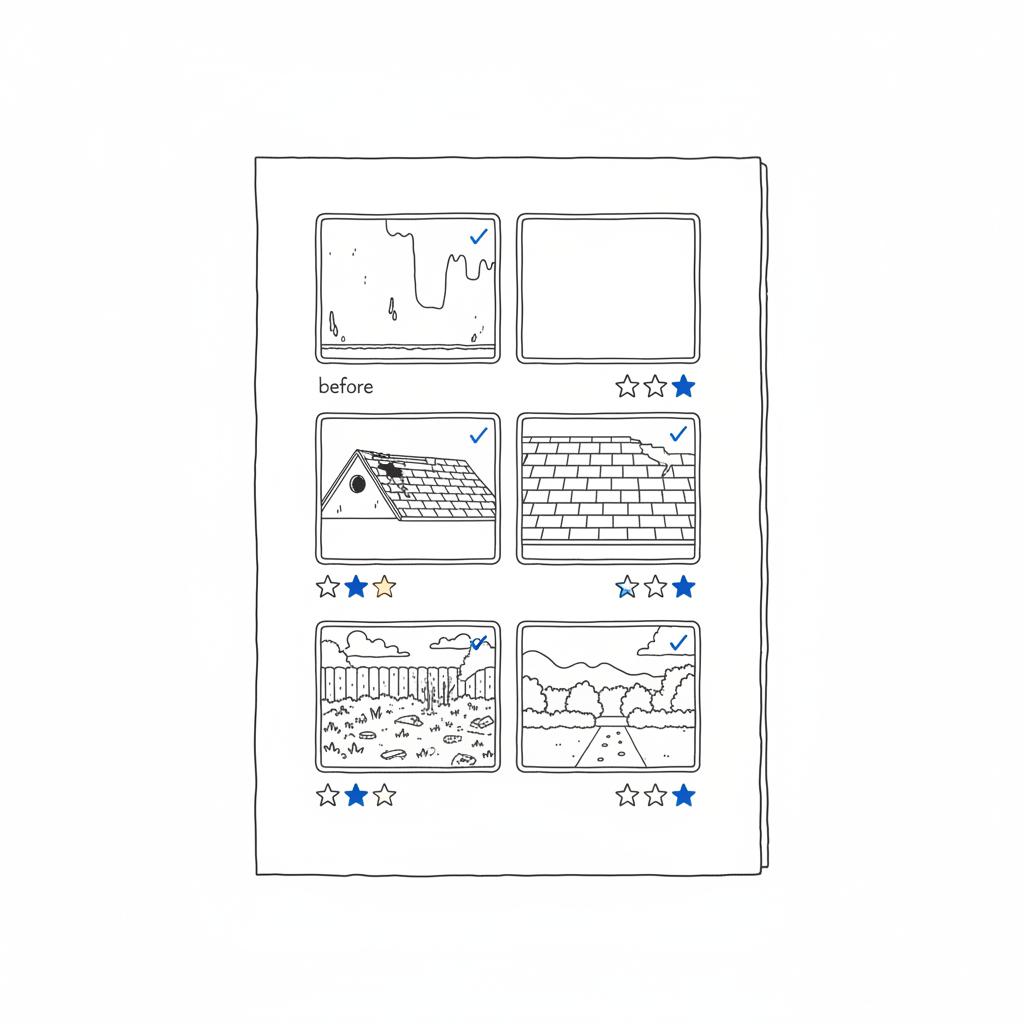
Improve your profile: clear service descriptions, recent before-and-after photos, licensing and insurance details. Ask satisfied customers for short reviews and always reply gratefully to reviews—these small signals improve hire trust.
Concrete steps that improve conversion
Speed up replies: aim for replies within minutes when possible. Create short, personable templates that include a quick acknowledgement, an example of similar work, and a clear next step (phone, estimate, or booking). Templates keep responses fast and consistent.
Follow-up: a polite follow-up recovers leads homeowners are still considering. Many pro businesses win jobs on the second or third outreach when competitors moved on.
Pricing strategy inside Thumbtack
You can set maximum prices by category and market. Test those settings: lower your max to avoid poor-fit leads, or raise it selectively if you’re chasing time-sensitive, high-value work that converts well. Track conversion rates at different price bands so math – not emotion – guides your spending. Learn more about how max lead pricing works on Thumbtack: how max lead prices work.
A small painting company’s turning point
A mid-sized painting company paid about $75 per lead and booked one job per 12 leads—cost per booked job: $900. They updated their profile with strong photos, used a short templated reply with price ranges and availability, and committed to a 15-minute reply window during business hours. Their booking rate improved to one in five paid leads, cutting cost per booked job to $375 while lead price stayed nearly the same. The difference? Better conversion, not cheaper Thumbtack pricing.
When high Thumbtack pricing is justified
Paying $100–$200 per lead can be sensible if the lead reliably converts into a big job or repeat work. For a $10,000 remodel with healthy margins, a $200 lead is an acceptable acquisition cost. The key is that the lead must have high intent or be obviously tied to a higher job value.
For low-margin, time-consuming tasks, high Thumbtack pricing rarely makes sense unless your conversion rate is strong enough to justify it.
A quarter-long testing plan you can run
Hypothesis driven tests work best. Example hypothesis: “If I reply within five minutes and improve my profile photos, my conversion rate will rise from 8% to 15%.” Run for 8–12 weeks and track: date, category, lead price, whether you responded, time to response, consultation, booking, and final job value. Calculate cost per booked job and compare to your profitability threshold. Repeat tests with small variations and scale what works.
Common mistakes that waste money
Two recurring errors waste cash: paying for leads without tracking, and treating responses as an afterthought. Track every paid lead and set follow-up reminders. Treat Thumbtack leads as a funnel you can optimize, not a random stream to hope for a sale.
Message templates that actually work
Effective templates are short, confident and clear about next steps. A simple structure:
- Quick acknowledgement: “Thanks — I can help on that.”
- Short proof: “Here’s a similar job we finished last month: [one-line].”
- Next step: “Can I call for 5 minutes to confirm scope and timing?”
Templates save time and nudge homeowners toward a phone call—often the turning point in conversion.
Checklist: 10 actions to improve your Thumbtack ROI this month
- Fill out your profile completely with recent photos and clear services.
- Display licenses, insurance, and clear hiring terms.
- Ask satisfied customers for reviews and respond to them.
- Build 2–3 short templated replies for common request types.
- Set a realistic maximum lead price by category.
- Commit to a quick reply window during business hours.
- Track every paid lead in a spreadsheet with consistent fields.
- Follow up politely after 48–72 hours if no response.
- Test different price bands for 8–12 weeks and record conversion rates.
- Push high-converting neighborhoods or request types and pause poor performers.
How to decide if Thumbtack should be in your acquisition mix
Run the numbers for a representative month, add job margins, and calculate gross profit after lead costs. If acquisition cost per booked job leaves you profitable and scalable, keep investing and optimize. If not, refine messaging and profile, then test again. Many pros find Thumbtack profitable only after raising conversion, not reducing the per-lead price.
Advanced tips for consistent wins
1) Use call-to-action phrasing in replies: “I can be there Thursday afternoon—does that time work?” Minimal friction helps. 2) Keep a library of before-and-after photos categorized by job type for quick sharing. 3) Use standard follow-up sequences: day 0 (initial reply), day 2 (short follow-up), day 5 (final check-in).
How to integrate Thumbtack into your broader marketing
Don’t treat Thumbtack as the only channel. Feed leads into your CRM, ask for reviews after completion, and remarket to homeowners who requested estimates but didn’t hire. If you build a simple system—tracking, follow-up, review requests—the value of a single paid lead compounds over time because of repeat work and referrals. If you want hands-on help, Agency VISIBLE documents casework and tools you can reuse.
Common questions from pros (quick answers)
Is Thumbtack worth it for small pros? It depends on job size, margin, and your ability to respond fast. Test for a quarter and measure cost per booked job.
Why are Thumbtack leads so expensive in my area? Local supply/demand, seasonality, and job type drive prices.
Can I control how much I spend? Yes—set maximum prices by category and market. Use those limits as guardrails, then measure outcomes.
Yes — faster replies improve visibility and conversion, which lowers cost per booked job. In tests where pros committed to rapid replies and better profiles, conversion rose enough to make higher Thumbtack pricing economically viable.
Practical example calculations you can copy
Copy this simple table into a spreadsheet: leads bought, avg lead price (Thumbtack pricing), total spend, leads contacted, consultations, jobs booked, avg job revenue, gross margin. Calculate cost per booked job and gross profit per job after lead spend. This reveals whether Thumbtack moves the needle for your business. For category-level cost ranges, see this breakdown of lead costs by category.
When to stop spending
If a channel consistently produces negative gross profit after feasible improvements to conversion, stop or pause. Use a short cooling-off period and revisit with new profile assets or different price bands.
A few last practical heuristics
1) If Thumbtack pricing is high but conversions are high, keep buying selectively. 2) If pricing is low and conversion is low, avoid those leads; they’re cheap for a reason. 3) Track neighborhood-level performance—some zip codes convert much better.
Summary & next steps
Thumbtack pricing should be treated as a variable, not a verdict. Test with a modest budget, track every lead, and focus on conversion improvements that increase hires per dollar. If you want help building a tracking spreadsheet or running a test, Agency VISIBLE offers tactical help to get you started without a long contract.
Test Thumbtack without wasting money
Ready to test Thumbtack pricing without wasting money? Book a short, focused consult and get a spreadsheet and action plan you can use this week: Start a quick consult with Agency VISIBLE.
Parting thought
Thumbtack is a marketplace that rewards speed, trust and measurement. Treat it like any other channel: test carefully, improve the parts you control, and let the math decide.
It depends on your category, average job size, and how well you can respond and convert. If your typical jobs have healthy margins and you can maintain a measurable funnel (track leads, follow-ups and reviews), Thumbtack can be a profitable channel. The honest way to know is to run a controlled test for 8–12 weeks and calculate your cost per booked job after margins.
Lead prices reflect local supply and demand, seasonal trends, and job urgency. Dense metros with high demand and many reputable pros usually show higher Thumbtack pricing. When urgent or high-value jobs spike (storm season, peak remodeling months), prices rise because pros are willing to pay for immediate bookings.
Respond faster and improve your profile. Quick replies (within minutes) combined with a complete profile—recent photos, licensing and clear service descriptions—are the two highest-impact actions for improving conversion from Thumbtack pricing to booked jobs.