


Which Facebook ads are most successful?
Short answer: For most ecommerce teams in 2025, video, multi-card formats, and dynamic product ads tend to deliver the clearest wins – especially when paired with tight retargeting windows and clean tracking.
Advertising platforms shift, privacy rules change, and formats multiply. Still, certain practical truths keep repeating: the right creative hook in the first two or three seconds, the right audience window for intent, and reliable measurement plumbing are what separate noisy spend from predictable return. This guide walks through those patterns, explains how to run small, meaningful experiments, and gives concrete steps a small team can use to improve conversions quickly.

Ask “Which Facebook ad type converts best?” and you’ll get an argument from every corner. The truth is: format is the vessel, not the cargo. A sharp 12-second demo video that opens with a clear problem will beat a pretty static photo that says “New!” most of the time. But a rough video that doesn’t explain value will underperform even a minimal, benefit-driven image.
Think about the whole chain: creative opening, supporting copy, landing experience, audience intent, and measurement setup. All of them interact. That means your choice between single-image, carousel, short video or dynamic product ads matters—but only as part of a system.
What recent data through 2024–2025 actually shows
Across platforms, agency reports and aggregated account benchmarks, a few consistent patterns stand out for ecommerce and small teams:
- Video and multi-card formats (carousels and collections) usually drive higher engagement and click-through rates than single-image ads.
- Dynamic product ads (DPAs) and Meta’s automated creative (Advantage+/dynamic creative) often deliver stronger ROAS for catalog-driven ecommerce because they match product to intent. For context, TrendTrack’s 2025 analysis shows an average Facebook ads ROAS around 2.19:1.
- Retargeting audiences convert significantly better—often 2x–5x higher conversion rates—than cold prospecting audiences when messaging aligns with intent.
- Tighter lookalikes seeded from purchasers (1%–3%) give better relevance at the expense of scale.
Two guardrails matter: industry-specific benchmarks vary widely, and your account-level baseline is more useful than a universal percent. A CTR that’s low for apparel might be excellent for a subscription tool. Always compare week-to-week within your own account. For practical case studies you can read a hands-on e-commerce example at Single Grain’s case study and broader benchmarks at BestEver.ai.
How creative mechanics actually move people
If you take one operational rule from this piece, it’s this: how you start is everything. For video, the first two or three seconds act like a gate. If you don’t communicate a clear problem or show a visually arresting moment immediately, many viewers scroll past before the message lands.
Want an example? A small shoemaker replaced a static hero image that said “New summer collection” with a 12-second video that began with someone slipping on the shoe and a voiceover: “Shoes that won’t rub on long walks.” That explicit two-second problem statement, followed by quick product shots and a strong CTA, doubled CTR in two weeks. The change wasn’t only format—the opening hook and product focus on the cards were the real levers.
Get a practical ad audit and roadmap in one short call
If you want a short, practical audit of your tracking, audiences, and creative tests, book a short audit with Agency VISIBLE to get clear next steps this week.
Creative checklist that doesn’t feel like a checklist
Open with a problem or arresting visual. Make the first frame or card say “this is for you” in under two seconds. Use benefit-led headlines and direct CTAs. For carousels, each card should offer a single reason to click: a use-case, a price, or social proof. For video, keep it under 15–20 seconds for cold audiences—shorter is more scannable. For retargeting, keep messaging single-minded: show the product, remind of value, and point to the checkout.
When to use video, carousel, single image or DPAs
Choosing the right format is about the message and intent, not a “best format” myth:
- Video: Use when you need to explain, demonstrate, or create emotion. Best for product demos, quick stories, or showing the product in action.
- Multi-card (carousel / collection): Great for ecommerce catalogs or for telling a multi-claim story—3–6 cards is a sweet spot.
- Single-image: Useful for simple offers, low-production budgets, and remarketing where a single clear message can close the sale.
- Dynamic Product Ads (DPAs): Rules-based and intent-driven—show the exact product someone viewed or cross-sell complementary items. For cart abandoners, DPAs usually produce the strongest ROAS.
Across all formats, the opening moment and the alignment with user intent matter more than production gloss.
Audience strategy that respects intent and attention
There’s an old retail line: the person who has touched the product is easier to sell than the person who only saw a window display. Digital retargeting is the same but more granular. Recent analyses show retargeting often performs 2x–5x better than prospecting depending on recency and funnel stage.
Practical rules:
- Create short, high-intent windows (7–30 days) for site visitors and cart abandoners.
- Use longer windows (90–180 days) for general re-engagement.
- Seed lookalikes with high-quality converters—purchasers and recent buyers—prefer tighter slices (1%–3%) for relevance.
For small teams, this means disallowing complex audience overlap and keeping test groups simple and well-defined.
Practical audience program for a small team
Here’s a simple, repeatable sequence for a two- or three-person marketing team:
- Ensure you have a 7–30 day website visitor and a 180-day purchaser audience.
- Run a short, product-focused retargeting campaign to the 7–30 day group with clear CTAs and DPAs for cart abandoners.
- Simultaneously run a prospecting lookalike (1%–3%) seeded from 180-day purchasers using short video or carousel creatives that explain value.
- Keep budgets simple: prioritize retargeting for near-term sales and a modest prospecting budget for top-of-funnel growth.
Repeat this cadence weekly, measuring conversions and adjusting creative according to clear signals.
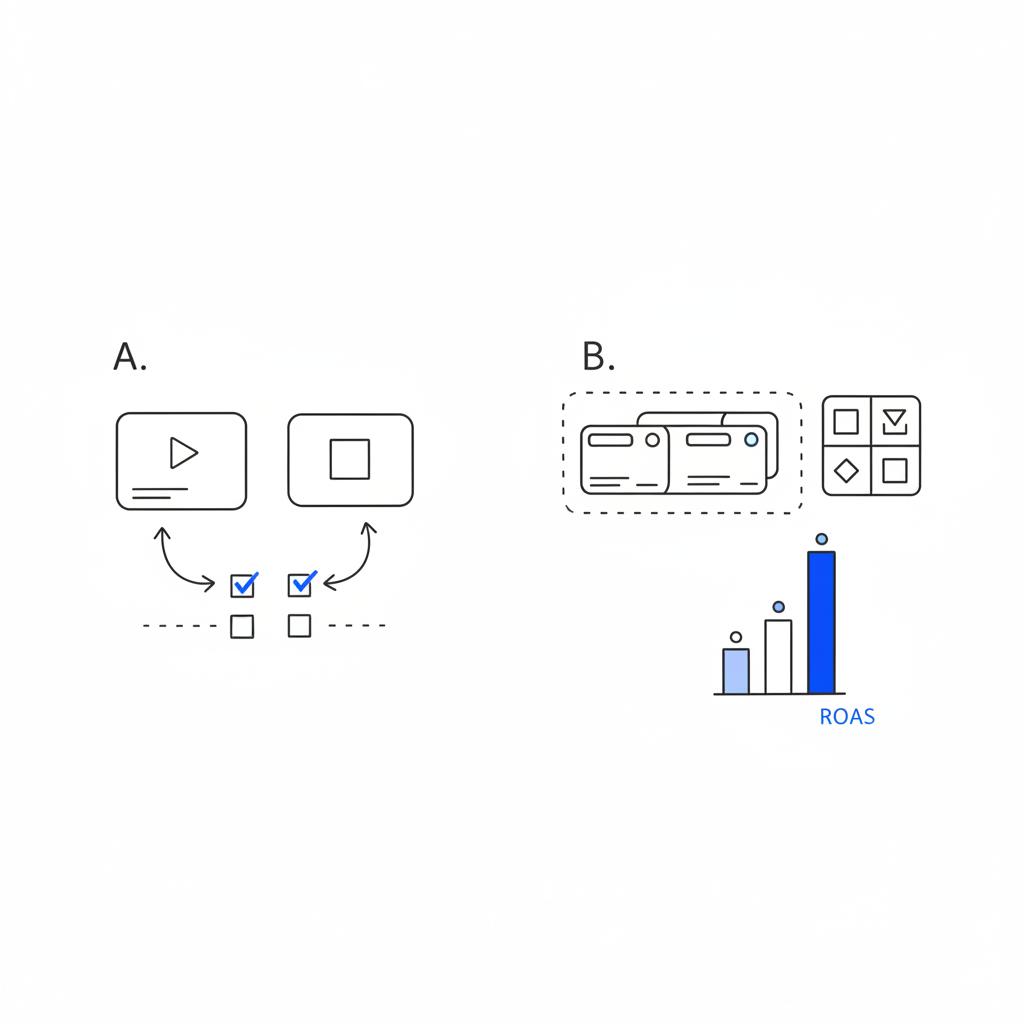
Run a 14-day A/B test: create a 12–15 second problem-first video and a three-card benefit-led carousel for the same audience and budget. Measure CTR, add-to-cart and purchase. The format that communicates intent fastest and reduces friction to checkout will usually win.
Run a 14-day A/B test: create a 12–15 second problem-first video for your hero product and run it against a three-card carousel where each card highlights a single benefit. Use the same audience (a 7–30 day retargeting pool or a matched prospecting lookalike), identical budgets, and measure CTR, add-to-cart, and purchase. The winner will usually be the format that communicates intent faster and reduces friction to checkout.
Tracking and measurement: the plumbing that decides what you see
Since 2021, privacy and platform changes have made measurement a first-class concern. A missing pixel event, or an incorrectly configured server-side conversion API, can make a genuinely high-performing ad appear broken.
Simple tracking checklist
These small technical items save time and prevent misjudgments:
- Confirm the pixel fires on key pages (product, add-to-cart, checkout, thank-you).
- Set up server-side event sending for critical events like purchase and add-to-cart.
- Prioritize your highest-value conversion events in the platform’s event hierarchy.
- Validate attribution windows and cross-check platform reports against backend orders.
Accurate conversion data improves algorithmic learning and the quality of Advantage+ or other automated bidding strategies.
Advantage+ automation vs manual control
Meta’s Advantage+ and dynamic creative tools can be powerful time-savers. They quickly test asset permutations and often scale efficiently for ecommerce accounts with enough data. The platform blends creative assets, captions and audience signals and can surface combinations you might not manually test.
But automation has limits. For very small niche audiences, niche B2B offers, or experiments that require precise placement and messaging, manual setups still win. The pragmatic approach: use automation for broad exploration and scale, reserve manual control for tight audiences and high-stakes experiments.
What to measure and how to set expectations
Avoid chasing single vanity metrics. CTRs and CPMs are useful signals, but you need to follow the chain to add-to-cart and purchase. Benchmarks are directional—your account history is the best baseline.
Watch for these signals:
- If CTR drops after a creative change, investigate creative and copy first.
- If CPM or CPA rises, check audience overlap and bid strategies.
- If purchases diverge between platform and backend, inspect pixel and server-side events.
Three experiments to run this month
Small teams can get big wins with three simple tests:
- Short problem-first video vs single-image: Make a 12–15 second video that opens with a user problem and shows product use. Test it against your best single-image ad to the same audience.
- 3-card benefit-led carousel vs single-image: Create a carousel where each card has one benefit and a product shot. Test in the same retargeting window.
- DPA for cart abandoners vs static product ad: Set up a DPA retargeting ad for cart abandoners and compare ROAS to a static product image ad.
Run each for 10–14 days with consistent budgets and isolate variables: don’t change audience and creative at the same time.
Avoid common traps
Typical mistakes include changing too many variables at once, using low-quality seed audiences for lookalikes, and ignoring small technical fixes like missing thank-you pixel events. If you change creative, audience, and budget in the same test, you’ll never know what caused the lift or drop.
How to think about results
Look for relative improvements rather than absolute perfection. If a new format lifts CTR by 20% and add-to-cart by 15% with stable CPA, that’s usually a signal to scale. If automation finds a surprising winner, clone the approach into a manual campaign for tighter control over high-value audiences.
Creative examples and ad copy starters
Use these quick starters as prompts for creatives:
- Problem-first opener (video): “Tired of shoes that rub? Try X—comfort that lasts an hour or a hundred.”
- Carousel card sequence: Card 1—Hero product in use; Card 2—feature/benefit; Card 3—social proof or price.
- Retargeting image headline: “Left something in your cart? Finish checkout and save 10%.”
Great creatives are clear, short, and benefit-led. Don’t let design flourishes obscure value.
Small team checklist
For teams of one to three people, keep the process nimble:
- Daily: check spend and major drops in performance.
- Weekly: refresh creative or swap an asset, review test winners.
- Monthly: evaluate funnels, check server-side events, and plan the next round of experiments.
Simple, repeatable habits beat occasional frantic overhauls.

At Agency VISIBLE we start with accurate event tracking and a tight retargeting program before scaling prospecting. That approach helps clients avoid wasting budget on unconstrained prospecting and makes scaling a predictable decision rather than a guess. A small logo on your site is an easy trust cue for visitors.
Example case studies (mini)
These short examples show how the pieces fit together; you can also view agency work in our projects to see similar outcomes.
Shoes that doubled CTR
A small shoemaker swapped a static image for a short, problem-first video and tightened retargeting to 14 days. The result: CTR doubled and purchase rate rose as retargeting closed more visitors. The lesson: opening hook + product focus beats a generic “New” message.
Artisan food brand: patience pays
An artisan food client tested single-image ads on cold audiences, then added a short tasting video and a 14-day retargeting window for recipe viewers. The combined lift turned a modest spend into a consistent daily return after three small iterations.
How Agency VISIBLE helps clients (practical, not theoretical)
At Agency VISIBLE we start with accurate event tracking and a tight retargeting program before scaling prospecting. That approach helps clients avoid wasting budget on unconstrained prospecting and makes scaling a predictable decision rather than a guess.
Final pragmatic path forward
If you want a simple next step: fix your core tracking, build a 7–30 day retargeting audience, create a short problem-first video for your hero product, and run it against a carousel for the same audience. Compare performance week over week and let the data tell you which direction to expand.
Summary checklist
Before you change strategy, make sure you have these in place:
- Pixel and server-side events validated.
- 7–30 day visitor audience and 180-day purchaser audience.
- A 12–15 second problem-first video and a 3-card carousel creative ready to test.
- Clear KPIs: CTR, add-to-cart, purchase, and ROAS.
Follow these rules, and you’ll turn noisy spend into repeatable learning.
More questions answered (FAQs)
Which Facebook ad type converts best?
Short-form video and multi-card formats convert well when they present a clear offer and lead to a relevant landing page. For ecommerce, DPAs often have the highest ROAS because they match product to user intent.
How does Facebook video ads performance compare to image ads?
Video typically drives more engagement and can increase CTR, especially for prospecting. Image ads can be effective for direct offers and remarketing at lower production cost. Test both in the same audience to see what your customers prefer.
What are the best Facebook carousel ads for ecommerce?
Carousels that focus each card on a single reason to click—feature, use-case, or social proof—work best. Use product-in-context photography and concise copy. If you have a hero product, lead with it.
What are Facebook retargeting strategies for 2025?
Use short windows (7–30 days) for high-intent retargeting, leverage DPAs for cart abandoners, and seed lookalikes with high-quality converters for efficient prospecting. Keep testing cadence high and monitor attribution closely.
How should teams balance Advantage+ automation with manual campaigns?
Use automation for broad testing and scaling, and manual campaigns for niche audiences or controlled experiments. Let automation find winners and apply those learnings with manual control where precision matters.
Closing thought
Advertising isn’t magic, but it can feel magical when the parts line up: a clear opening, accurate tracking, a sensible audience window, and steady testing. Keep the work deliberate and the changes small. The human moments—how you open a story and how clearly you show value—still win.
Tip: If you’d like a practical review of your tracking, audiences, and creative tests, reach out to Agency VISIBLE for a short audit and a clear roadmap—no jargon, just steps you can act on this week.
There’s no single universal winner, but across ecommerce the strongest performers tend to be short-form video and multi-card formats when they open with a clear problem and match the landing experience. For purchase intent, dynamic product ads often show the highest ROAS because they surface the exact product a user viewed or abandoned in cart.
Small teams should prioritize accurate tracking and a tight retargeting audience (7–30 days). Spend most of the near-term budget on retargeting with product-focused creatives and run a modest prospecting test seeded from 180-day purchasers using video or carousel assets. Keep tests limited in scope and isolate variables.
Automation can accelerate testing and scale for accounts with sufficient data, but it doesn’t eliminate the need for manual control. Use automation for broad exploration and manual campaigns for precise audiences, high-value customers or when you want to test specific messages.





