Where is the best place to advertise for truck drivers?
Hiring drivers today is part human conversation and part precise channel mix. In a market that moves fast, understanding where to advertise for truck drivers matters more than ever. This article lays out a practical, step-by-step approach to truck driver recruitment so you can spend less time guessing and more time putting drivers behind the wheel.
Why the mix matters
Think of recruitment like running a mixed fleet. You wouldn’t send the same truck on every route—each has a purpose. The same goes for advertising. Some channels give high relevance, some supply scale, and others build your brand for the long run. A balanced approach to truck driver recruitment spreads risk and improves results.
Different channels play different roles: niche CDL boards attract ready-to-hire candidates, programmatic distribution gives reliable volume at scale, social platforms reach local and younger drivers, driving school partnerships speed up time-to-productivity, and referral programs tend to deliver the best quality-to-cost hires. The goal is not to pick one winner but to build the right combination for your fleet and routes.

Start with the question: what kind of driver do you need?
Before you spend a dollar, answer these basics: Are you hiring long-haul OTR drivers or local pickup-and-delivery drivers? Do you need specialized endorsements (HAZMAT, tanker, oversize)? How many seats must you fill monthly? Your answers determine where to advertise for truck drivers and how to structure your funnel.
Get a practical hiring funnel audit
Need a quick channel audit or examples from past projects? Visit the Agency Visible homepage to see how an audit can highlight low-hanging improvements.
Small local fleets usually win with Facebook local community posts, one or two niche CDL boards, and strong referrals. Mid-size and larger carriers benefit from layering programmatic distribution over niche channels, running targeted social ads for local awareness, and building school partnerships to maintain steady flow. For specialized roles, prioritize niche forums and direct outreach to training partners.
Agency Visible often recommends starting with a quick channel audit: compare applicant volume, cost-per-applicant and first-year retention across your top three channels for a single role. That gives a reality check and points to low-hanging improvements without a big upfront investment.
Recruiting is measurable work. Track what matters and treat channels as experiments.
Run the same job posting on a niche CDL board and a small targeted Facebook campaign for two weeks, offer a time-limited referral bonus, and track applicants, hires and 90-day retention. That three-way split reveals which channels give volume, relevance and staying power.
Niche job boards and industry communities: quality over quantity
Niche CDL boards and trucking forums remain one of the most reliable places to advertise for truck drivers when relevance matters. These sites attract people who already understand industry terminology and certification, which means fewer unqualified applications and higher conversion-to-hire ratios.
When you need drivers with HAZMAT endorsements or tanker experience, niche boards let you ask focused screening questions up front. That saves recruiter time and shortens time-to-fill for specialized roles. In practice: shifting ad spend from general job boards to industry-specific sites often lowers churn and improves first-year retention.
How to use niche boards effectively
– Use clear, specific job titles and list required endorsements up front.
– Add a short paragraph about route patterns and home time so drivers can self-select.
– Use call-to-action lines like “Text or call for a quick pre-screen” to speed responses.
Programmatic distribution: scale, automation and the need for guardrails
Programmatic job platforms automatically place your posting across dozens or hundreds of sites, using bidding algorithms to find applicants at a lower average cost. For carriers with steady hiring needs, programmatic distribution can be a powerful backbone for your advertising strategy. For reading on cost-effective channels and outreach, see this analysis on cost-effective recruitment channels.
That said, programmatic is not plug-and-play. Auto-bidding can place listings on low-quality inventory. Monitor applicant quality by source, set exclusion lists for placements you don’t trust, and review channel performance weekly. Programmatic is best used as a volume engine combined with at least one high-relevance source.
Best practices for programmatic campaigns
– Start with conservative budgets and raise as you validate sources.
– Require source tracking so you can calculate cost-per-hire by channel.
– Use geo-targeting to limit placements to your realistic hiring radius or proven lanes.
Social media: local reach, stories and younger drivers
Social platforms are essential for local hiring and employer branding. Facebook remains a dependable channel for local recruitment: community groups, targeted ads by city or county, and boosted posts can quickly generate applicants for local routes.
Short-form video platforms like TikTok and Instagram Reels are less traditional but highly effective for storytelling. A 30- to 60-second clip showing a day-in-the-life, an honest look at terminal operations, or an on-camera testimonial from a trainer can humanize your company. Early evidence shows these channels reach younger candidates and those open to company-paid training. Treat short-form video as a branding play and measure hires separately from likes and follows.
What to post on social
– Short, candid videos: 30–60 seconds of a real day, not glossy productions.
– Local success stories: highlight drivers who live nearby.
– Clear CTAs: “Apply now — training available” or “Text to speak with a recruiter.”
Driving schools and paid training partnerships: speed and retention
Partnering with local truck driving schools is one of the most direct routes to fill seats quickly. Students from these programs often enter your pipeline with clear expectations and a faster path into productive driving when onboarding is structured.
Successful partnerships usually include some combination of tuition support, a required service period, and a phased mentoring plan once the new driver arrives. This structure shortens time-to-productivity and improves early retention because students understand the value exchange and receive support during their first months on the road.
Designing a training partnership
– Offer a clear tuition assistance agreement with defined milestones.
– Build a two-week orientation followed by in-cab mentoring for 30–90 days.
– Track retention at 30, 60 and 90 days and compare to hires from other channels.
Referral programs: the high-quality core
Referrals typically produce the highest quality drivers and the best retention. Drivers refer people who fit the culture and understand the demands of the job. The trade-off is you must manage the program actively: fair and staged payouts, easy tracking, and clear rules. (See referral hire rates in recent industry reporting: referral hire rates.)
A commonly effective payout schedule is staggered: a portion on hire, another payment at 90 days, and a final payment at six months or one year. This encourages longer-term retention rather than quick hires for a one-off bonus.
Referral program tips
– Make the rules simple and transparent.
– Automate payout tracking when possible.
– Promote successful referrals publicly to encourage participation.
What to measure — the metrics that really matter
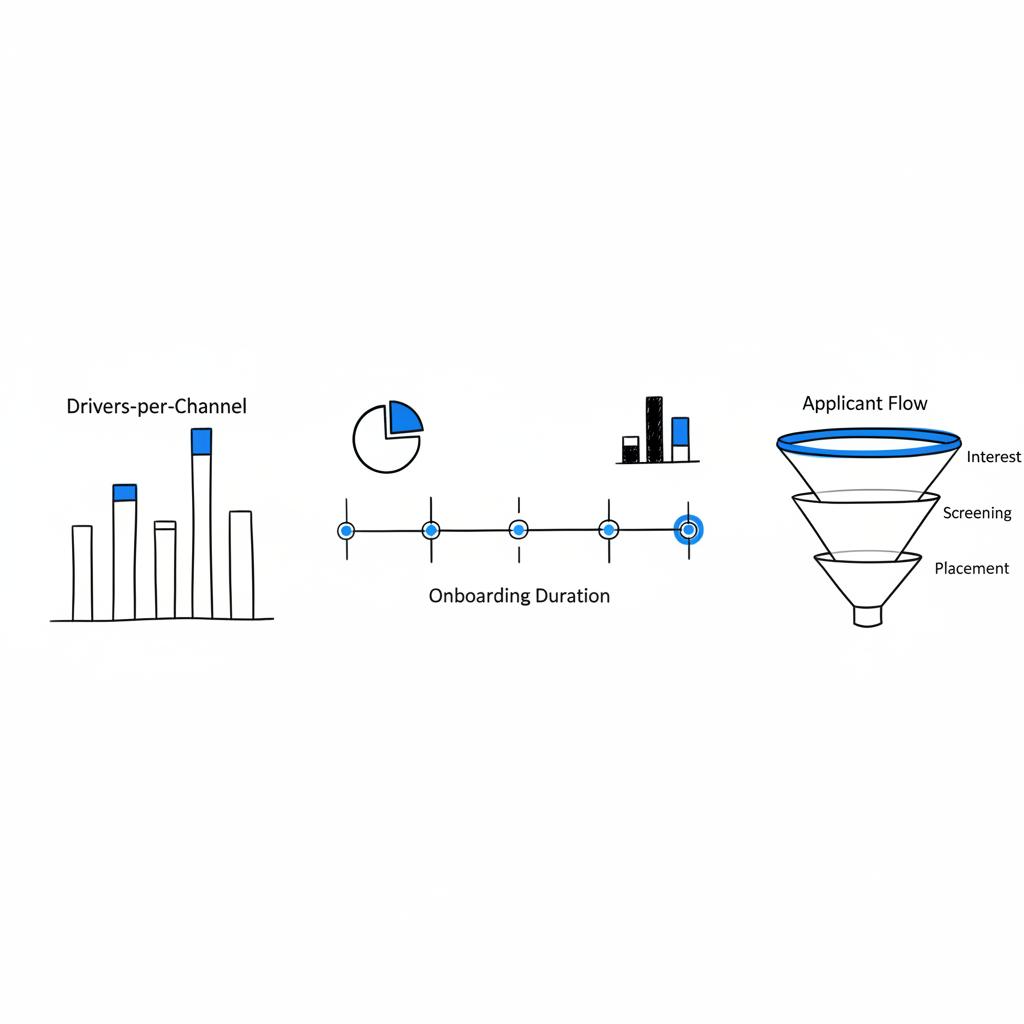
Tracking is where strategy turns into results. The core metrics to follow are applicants-per-channel, cost-per-applicant, cost-per-hire, time-to-fill, and first-year retention. Segment those by route type (OTR, regional, local) and driver type (company driver versus owner-operator) and the numbers become actionable. For context on the cost impact of churn, industry reporting highlights the estimated cost of losing one driver.
Applicants-per-channel shows where volume is coming from. Cost-per-applicant helps rank efficiency. Cost-per-hire reveals the real financial impact. Time-to-fill shows speed. First-year retention shows long-term value.
How to benchmark
– Use a sample role (e.g., local city driver) and run the same posting across three channels for 4–6 weeks.
– Compare applicants, hires and 90-day retention to see real differences.
– Focus on what matters for your business: if downtime costs are high, prioritize time-to-fill; if churn costs you more, prioritize retention.
Typical cost ranges and why they vary
Cost-per-hire varies by fleet size, geography and role complexity. Smaller carriers often pay more per hire because they run smaller campaigns. Larger fleets usually get better economics through programmatic scale. Expect higher costs in tight labor markets and for specialized roles.
As a frame of reference: straightforward company driver roles often fall in lower-thousands for cost-per-hire at smaller fleets. Larger fleets can push that number down with scale. Remember: cheaper hires who churn quickly are not savings.
How to decide where to advertise for truck drivers — a simple decision flow
Decide based on three practical factors: role type, hiring volume, and geography.
– If you run a small local fleet: focus on Facebook, one or two niche boards and referrals.
– If you run a mid-sized or larger fleet: combine programmatic distribution, niche boards and driving school partnerships with social branding.
– If you need specialist skills: prioritize niche boards, targeted outreach, and direct training partnerships.
Sample hiring funnel and realistic timeline
Top of funnel: awareness via programmatic and social.
Middle: application, phone screen and in-person or virtual interview.
Bottom: onboarding, mentorship and early retention monitoring.
For a local route, a strong referral stream plus active social ads can often fill a seat in 2–4 weeks. OTR roles with required endorsements commonly take 6–8 weeks or longer.
Practical tips for better campaigns (human and tactical)
– Clear CTAs: tell applicants what will happen next.
– Short video: show real trucks, terminals and trainers.
– Simple application: avoid long, multi-page forms.
– Fast follow-up: reply in 24–48 hours where possible.
Screen for reality early—ask about endorsements, home time preferences and experience. Quick phone screens save time for both sides and keep strong candidates engaged.
Onboarding is recruitment too
Invest in the first 90 days. Mentors, phased routes and clear expectations reduce early churn. Drivers who feel supported stay longer.
Employer branding — honest stories win
Branding doesn’t mean slick productions. It means truthfully showing how work gets done. Short clips from your maintenance bay, a driver’s honest comment about home time, or a dispatcher explaining how routes are planned answer the real questions drivers have. Quick tip: keep your logo visible in your recruiting creative so candidates recognize your brand early.
Drivers compare culture, equipment and treatment as much as pay. If you can show the day-to-day honestly, you make it easier for candidates to choose you.
Where cost savings usually hide
Often the biggest savings come from improving process, not cutting ad spend. Speed up response times, simplify interview scheduling, and fix onboarding friction to lower effective cost-per-hire.
Automate confirmations and reminders, but keep human touch in phone screens and mentorship. Fixing the candidate journey often produces faster returns than moving budget between ad channels.
Emerging questions and data gaps
Two open areas to track: precise cost-per-hire benchmarks by fleet size and region, and the long-term retention value of hires sourced from short-form video platforms like TikTok. Track these hires separately and be ready to adapt as data comes in.
Quick experiments you can run this month
Try this simple test: post the same role on a niche board, run a small targeted Facebook campaign for two weeks, and offer a limited-time referral bonus. Track applicants, hires and 90-day retention. Small experiments reveal patterns fast.
Final practical checklist
– Identify role and hiring volume.
– Choose core channels: niche board + programmatic or niche + Facebook for local.
– Set tracking and benchmarks.
– Run a two-week test and measure applicants, cost-per-hire and 90-day retention.
– Invest in onboarding and mentorship.
Answers to common questions
How much should I budget per hire? It depends on fleet size and role. Small fleets often see higher per-hire costs. Larger fleets benefit from programmatic scale. Measure channel cost-per-hire and compare to retention to know real value.
Should I stop using general job boards? Not necessarily. They can deliver volume for entry-level roles, but they usually have lower relevance than niche CDL sites. Use them as part of a balanced approach and compare source quality.
Is TikTok worth testing? Yes, if you can commit to short, authentic content and track hires separately. It can help attract younger candidates and build brand over time.
How do I recruit owner-operators? Owner-operators value autonomy, consistent load offers and clear pay. Target owner-operator communities, owner-operator-specific job boards, and direct recruiter outreach rather than broad programmatic channels.
How do I measure referral ROI? Track referral source at application, tie payouts to retention milestones and compare the lifetime value of referred hires to other hires. Stage payments to keep incentives aligned with retention.
Hiring drivers is person-to-person work. Measure your channels, test, and keep the candidate experience human. That’s how you build a steady, reliable pipeline for your fleet.
Budget depends on fleet size and role. Small local fleets often pay more per hire because campaigns are smaller; larger carriers get better averages through scale and programmatic distribution. A practical approach is to measure cost-per-hire per channel, include administrative time and onboarding costs, and compare that figure to 90-day retention to assess real value.
Yes, TikTok and short-form video can be worth testing if you can commit to producing short, authentic content. These platforms are effective for employer branding and for reaching younger candidates who may be open to paid training. Treat these channels as experimental: track hires separately from engagement metrics and measure retention over time.
A small local fleet should focus on Facebook community posts and targeted ads, one or two niche CDL job boards, and a well-managed referral program. This mix balances volume and relevance without requiring heavy ad tech. Pair these channels with fast follow-up and simple applications to convert candidates quickly.
References
- https://agencyvisible.com/contact/
- https://agencyvisible.com/
- https://agencyvisible.com/projects/
- https://www.thetrucker.com/trucking-news/business/2024-snapshot-shows-estimated-cost-of-losing-one-driver-reaching-12799
- https://sasusergroups.org/analytics/cost-effective-recruitment-channels-and-outreach-for-truck-driver-hiring/
- https://www.backgroundchecks.com/transportation/recruitment-retention-in-transportation-in-2024?srsltid=AfmBOopu29IaSN-CuybAmqtrQZOy_l-tSSz7WiFtTFO61rHVhgcxbrJ9