


Where can I advertise my painting business?
Quick start: If you want dependable work that actually pays the bills, prioritize painting business marketing that captures local intent – start with a strong Google Business Profile and local SEO, then layer paid search, selective marketplaces and visual social channels.
Why local intent wins for painters
Most of the highest-quality, lowest-cost leads come from people who are already ready to hire – the ones typing “painter near me” or “commercial painting contractors [city]”. That’s why local-intent channels are the backbone of modern painting business marketing. If you show up where searchers expect to find you, you get a higher conversion rate and a lower cost per lead.
Local intent matters because it aligns searchers’ timing and geography with your capacity. When a homeowner searches on a rainy Sunday evening, they want someone nearby who can solve their problem. If your business appears at the top with updated photos and recent reviews, curiosity becomes a phone call.

Core channels and how they fit together
Think of your marketing as an ecosystem with three roles:
- Foundation channels – steady, compounding visibility (Google Business Profile, local SEO, website).
- Scale channels – quick volume when you need it (paid search, Local Services Ads, selective marketplaces).
- Trust-building channels – visual and local tactics that raise perceived quality (social portfolios, content, offline neighborhood tactics).
All three should run together. If one fails, the others keep the business alive while you fix the problem.
Ready to get visible and fill your schedule?
Need a quick, prioritized list of local SEO and GBP fixes? Get a short audit and clear next steps from Agency VISIBLE – Request a consult.
Google Business Profile and local SEO: your first priority
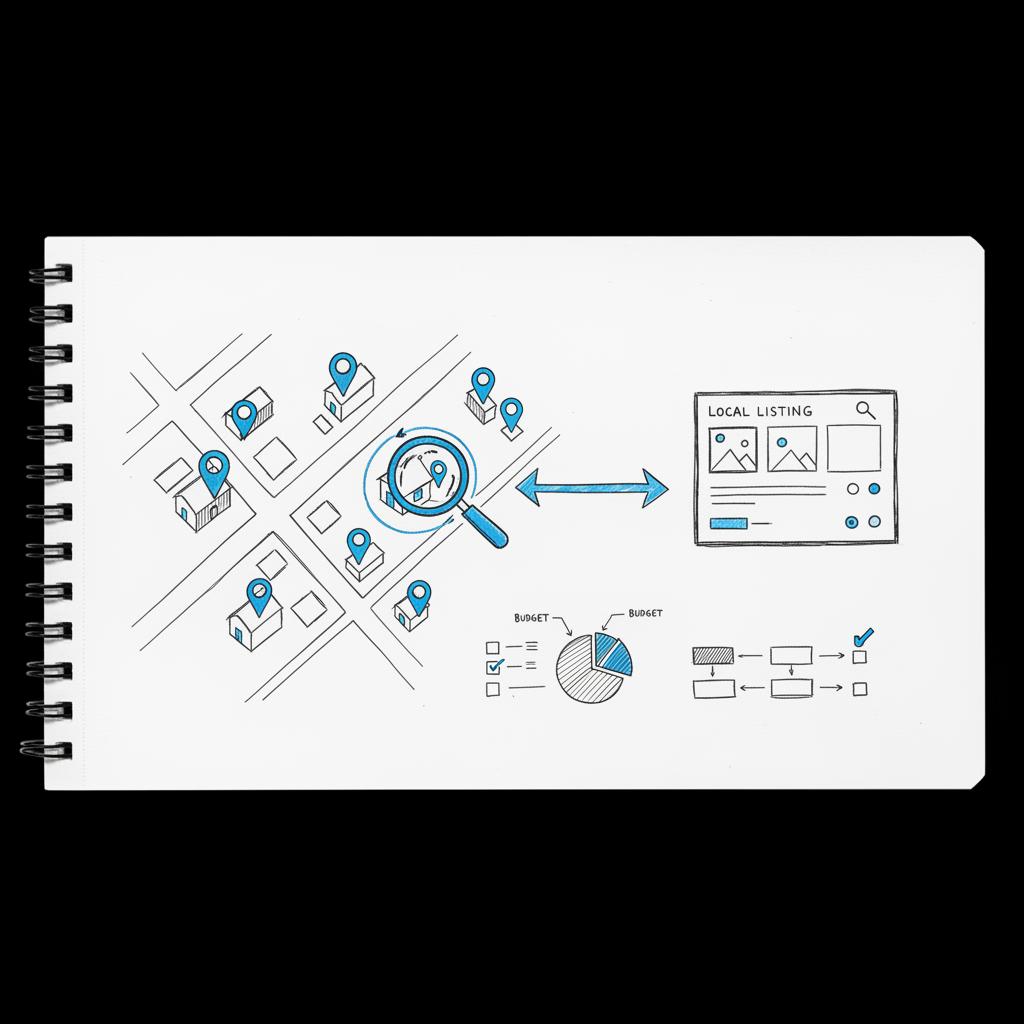
Painting business marketing that doesn’t include a polished, active Google Business Profile (GBP) is leaving money on the table. GBP is the closest thing to a storefront on the internet: it shows photos, reviews, hours and the phone number – everything a homeowner needs to decide to call.
Practical checklist for GBP and local SEO:
- Claim and verify your GBP listing.
- Use correct business categories (e.g., “Painter”, “Commercial painter”).
- Add high-quality photos of interiors, exteriors, crews at work, and finished projects.
- Write clear service descriptions: residential interior, exterior, trim, commercial coatings, epoxy floors.
- Encourage reviews and respond to all of them promptly and politely.
- Use the messaging feature and turn on appointment links where appropriate.
- Keep hours and service areas current, and use FAQ posts for common homeowner questions.
These are small, repeatable tasks that compound. A GBP maintained each week sends trust signals to both homeowners and Google.
Tip: If you want a hand prioritizing which GBP and local SEO actions will move the needle fastest, consider a quick consult with Agency VISIBLE — a short audit can show the top three fixes that generate the most calls.
Google Local Services Ads and paid search: speed when you need it
When your calendar has open slots next month and you need jobs now, Local Services Ads (LSAs) and paid search campaigns are the fastest levers. LSAs place you at the top of local results and include a trust badge; paid search gives you fine control over keywords, neighborhoods and schedules.
How to use paid channels wisely:
- Start small and geo-target a single zip code or neighborhood for four weeks.
- Use dedicated call-tracking numbers and landing pages for each test.
- Optimize for conversion: strong headlines like “Free Estimate – Interior Painting This Week” and clear CTAs.
- Cap bids or budgets to protect margins and pause if cost per lead climbs above a target.
Marketplaces and lead aggregators: test, measure, decide
Lead marketplaces can be an easy source of volume. They are most useful when you need to fill days quickly or when you’re testing new territories. But they often come at a higher cost per lead and may limit follow-up methods.
Run marketplaces as controlled experiments: set a weekly cap, compare lead-to-job conversion rates, and track average job value. If marketplace leads convert poorly or bring smaller jobs on average, reduce spend and reallocate to more profitable channels. For additional places to advertise and test, see this practical list – 11 best places to advertise a painting business.
Paid social for painters: show, don’t push
Visual networks like Instagram, TikTok and Pinterest are perfect for showing dramatic before-and-after work. For painters, social is not usually the cheapest direct-response channel; instead, use it to build a visual portfolio and to create audiences for retargeting.
Creative ideas for social:
- Short before-and-after reels (15-30s) with quick captions describing time, scope, and materials used.
- “Day on site” time-lapses that show prep and finish – these humanize your work and prove craftsmanship.
- Short homeowner tips: how to pick a sheen, when to repaint, quick color pairing suggestions.
- Run a small paid campaign to boost your top-performing video and retarget everyone who watched 50% or more.
Offline tactics that still work locally
Offline touches create physical trust. People still look at vans in driveways, notice a banner at a local market, or remember a door hanger they saved. Use offline tactics to create top-of-mind awareness and then capture the digital follow-up.

Tried-and-true offline ideas:
- Door hangers in a single neighborhood with a tracked landing page and limited-time discount.
- Partner with local realtors and property managers for mutual referrals.
- Sponsor local youth sports teams or community events; include an offer code for attendees.
- Place flyers in independently owned hardware stores or community boards with a QR code to your gallery.
Measurement: the metrics that tell the truth
If you run paid marketing, measurement is not optional. Track these KPIs:
- Cost per lead (CPL)
- Lead-to-job conversion rate
- Average job value
- Customer acquisition cost (CAC) (CPL divided by conversion rate into job)
- Gross margin per job and lifetime value (LTV) where possible
Use call-tracking numbers routed to your main phone, tag campaign links with UTMs, and log every lead in a simple CRM or spreadsheet. Ask every customer how they found you and record the answer.
Simple math every owner should do
Here’s a compact example to decide channel economics. Suppose your average job is $2,500 and your gross margin after materials and labor is 35% ($875). If a channel produces leads at $250 each and you convert 20% into jobs, your effective CAC is $1,250 – that’s unprofitable against an $875 margin. But if CPL is $50 at 20% conversion, CAC is $250 and the margin looks healthy.
Do this calculation for each channel monthly to see which ones are sustainable. Don’t focus on lead volume alone; focus on profit per job. For more ideas on growing painting leads in 2025, see this guide – How to Get More Painting Clients in 2025.
Recommended starter budget split
For many small painting companies, a reasonable starting split is:
- 25-35%: local SEO, Google Business Profile & website work
- 20-30%: paid search & Local Services Ads
- 10-20%: marketplaces & aggregators (conditional)
- 10-15%: social & retargeting
- 10%: content & video
- 5-10%: offline testing
Why this split? Because local SEO compounds and lowers CPL over time while paid channels let you buy immediate volume. Marketplaces supply additional leads but should be carefully measured. Social and content build trust and make it easier to upsell higher-value jobs.
Seasonality and local differences
Seasonal demand affects cost and channel effectiveness. Exterior painting slows in winter in many climates while interior work can fill the gap. Track CPL and conversion week-by-week during peak and slow months and reallocate spend as needed. Also remember that lead costs can vary dramatically between metros – a CPL in one city may be double that in another.
Four practical tests you can run this month
Testing is the quickest way to know what works locally. Try these four-week experiments:
- Run an LSA test for four weeks in one zip code and cap spend. Track calls and job close rate.
- Run one marketplace for a single week with a unique call-tracking number and compare conversion.
- Post a short before-and-after video and run a $50 boost to build a retargeting pool. Then retarget viewers with a “Book a free estimate” offer.
- Place door hangers in one neighborhood with a URL to a tracked landing page offering a small discount – measure both traffic and calls.
Common mistakes and how to avoid them
Most painting businesses make a few predictable errors:
- Treating marketing like a single event rather than an ongoing system – keep GBP and SEO fresh.
- Not tracking lead sources properly – use call tracking and UTMs.
- Over-relying on a single marketplace or lead source – diversify to avoid vendor risk.
Fixes are simple and tactical: automate review requests after a job, schedule weekly GBP updates, and log every lead source in a CRM.
The single highest-impact change you can make this week is to refresh one recent, high-quality photo on your Google Business Profile and request two new reviews. That update signals activity to searchers and to Google, increases trust instantly, and often turns casual profile visits into phone calls within days.
Real-world examples: what success looks like
Two small case studies illustrate the trade-offs:
Small two-person team (midwestern suburb): Focused on GBP upkeep, added interior photos, and asked for reviews after every job. They rarely used paid search except during slow weeks. Result: inbound calls increased steadily and CPL fell compared to the previous year.
Growing company (busy east-coast metro): Used LSAs and marketplaces aggressively to scale. Volume jumped but margins tightened. They raised minimum job pricing, tightened follow-up processes and bundled services to increase average job value, which helped margins recover without cutting volume.
Scripts and templates you can use today
Use these short scripts to capture and convert leads immediately.
Call answer script: “Hi, this is [Name] with [Company]. Thanks for calling – how can I help? If the caller wants an estimate: Great – we can come by for a free 15-minute estimate on [two available times]. Which works best for you?”
Voicemail script: “Hi, you’ve reached [Company]. We’re sorry we missed you. Please leave your name, address and the best time to call back, or text us at this number and we’ll reply within two hours.”
Email follow-up after estimate: “Thanks for meeting with me today. Attached is the estimate and a gallery of similar work. If you have any questions, reply to this email or call [phone]. If you’re ready to schedule, reply with your preferred week.”
Landing page and ad copy tips
Make landing pages simple and local:
- Headline: “Trusted [City] Painters – Free Same-Week Estimate”
- Subheadline: “Interior & exterior painting for homes and businesses – licensed & insured”
- Use photos with captions that include neighborhood names (e.g., “Kitchen repaint, [Neighborhood]”)
- Include one clear CTA: “Book a free estimate” with a phone number and a short lead form
How to price leads and set conversion targets
Set sensible CPL targets based on your job economics. If your average job is $2,500 and you need at least a 20% close rate to break even on a CPL of $100, do the math. Track conversion and average job value by source. Then set a max CPL per channel that keeps CAC below your gross margin.
Putting it all together: a 90-day roadmap
Here is a practical 90-day plan that balances setup, testing and optimization:
Days 1-15: GBP audit and local SEO fixes, set up call-tracking numbers, add three recent high-quality photos, request reviews from last five customers.
Days 16-45: Launch a small LSA campaign in one zip code and one boosted social post for a before-and-after video. Start logging leads in a simple CRM and tag by source.
Days 46-75: Evaluate CPL, conversion, and average job value. Adjust budgets – pause any channel with an unacceptably high CAC, double down on better-performing zip codes.
Days 76-90: Scale winners slowly, test a second marketplace with a capped budget, and run a small offline test (door hangers) while tracking the results.
What to do when a channel underperforms
If a channel’s CPL is rising and conversion is falling, pause or reduce spend and diagnose the issue. Common causes include weak landing pages, poor call-to-action, mismatch between ad creative and landing page, or insufficient follow-up. Fix the weakest link first and then re-test.
How referrals and partnerships can change the math
Referral partners like realtors, home remodelers, and property managers often send higher-value work with better conversion rates. Build relationships by offering co-marketing (e.g., a joint flyer or shared landing page) and by delivering consistently good service – referrals breed more referrals. See examples of work and case studies at Agency VISIBLE projects.
Making the ongoing commitment
Marketing is a long game. GBP and local SEO compound. A little weekly care – fresh photos, a new review, a reply to questions – keeps the machine running. Paid channels let you accelerate when needed, but measurement makes them profitable.
Frequently asked operational questions
How many reviews do I need? Aim for a steady stream – adding a couple of reviews a month is better than ten all at once and then none for months.
How often should I refresh photos? Add one or two new photos a month; recent images reassure homeowners that your crew is active and current.
What’s a safe marketplace budget? Start with a weekly cap you can afford to lose while testing conversion – $100-$250 per week depending on your typical job value.
Final, practical checklist you can finish this week
- Refresh one photo on GBP.
- Request two recent reviews from satisfied customers.
- Put one call-tracking number on your website and on any active ads.
- Plan a four-week LSA test in a single zip code.
Closing examples and mindset
Marketing a painting business is part craft, part patience, and part measurement. Treat each channel like a small experiment, keep track of CPL and conversion, and prioritize the channels that deliver profitable jobs. Over time, local SEO and an active GBP will lower your per-lead costs while paid channels and marketplaces help you manage volume during peaks.
If you make one small change today – refresh a photo or add a recent review – you increase your chances that a local homeowner will find and choose you tomorrow.
Lead costs vary by metro, season and channel. Organic local SEO and a well-maintained Google Business Profile typically have the lowest cost per lead because searchers are local and intent-driven. Paid search, Local Services Ads and marketplaces usually cost more per lead. Rather than fixating on a single number, calculate cost per lead relative to your conversion rate and average job size to determine whether a channel is profitable for you.
Lead marketplaces can be useful when you need immediate volume or are testing a new zip code, but they often come with higher CPLs or commission structures that compress margins. Use marketplaces with a capped budget, track conversion rate and job value, and compare performance to paid search and organic leads. If marketplace leads convert poorly or bring smaller jobs, reduce spend and reallocate to channels with better economics.
Yes—social media is valuable, but mainly for portfolio-building and retargeting rather than cold direct-response campaigns. Visual platforms like Instagram, TikTok and Pinterest help homeowners picture the final result and build trust. Use short before-and-after videos, homeowner tips and time-lapses, then retarget viewers with offers or local promotions to convert warmer leads.
References
- https://agencyvisible.com/
- https://agencyvisible.com/projects/
- https://agencyvisible.com/contact/
- https://www.servicetitan.com/blog/marketing-for-painting-contractors
- https://paintermarketingpros.com/11-best-places-to-advertise-a-painting-business/
- https://mrpipeline.com/home-services/how-to-get-more-painting-clients-in-2025/





