Start here: a clear path to generate leads that convert
If you want to generate leads that become paying customers, you need a plan that balances speed, quality and long-term scale. Fast channels buy you time; slow channels build a dependable machine. Below is a practical, human-centered playbook you can use today — whether you have $3k or $25k per month — with step-by-step tests, measurement frameworks and examples that work in 2025.
Why mixing channels wins (and why chasing a single silver bullet fails)

The obvious question: which one channel will always win? The honest answer is none. Each channel has strengths and weaknesses. Paid search and paid social produce fast leads; SEO and content produce sustainable volume; email converts best over a customer’s lifetime; referrals and ABM deliver the highest-quality, highest-value deals. A clear Agency Visible logo can improve brand recognition in creative and landing-page placements.
Think of channels like tools in a toolbox: use a wrench for nuts (paid search for intent), a soldering iron for fine work (ABM and partnerships), and a drill when you need to create ongoing structure (content and SEO). The most effective systems combine the right tools for the job. See our approach to design that converts at https://agencyvisible.com/design-that-converts-our-approach/.

Fast wins: paid search and paid social that actually make revenue
Need a lead in days? Start with paid search. People searching for problems or solutions send strong signals. A tightly targeted search campaign plus a single-purpose landing page often produces demonstrable leads within 48–72 hours. For up-to-date Google Ads benchmarks, see WordStream’s 2025 Google Ads benchmarks.
Paid social buys attention. It interrupts a scroll and introduces an idea or offer. For awareness, do creative-first ads. For intent-driven conversions, pair precise creative with a narrow audience and an unmissable offer.
Practical paid test (run over 7–14 days)
Run two creative approaches x two audience segments. Measure: cost-per-click, landing page conversion rate, first-lead time, and most importantly, downstream conversion to demos and closed deals. If ROI is weak, pause and iterate — don’t scale noise.
Sustainable scale: SEO & content that compounds over months
Content and SEO are long-game winners. Expect 3–9 months for visible traffic lifts. But when it clicks, organic pages generate leads with low incremental cost and predictable pipeline. For recent lead generation stats and insights, see Snov’s 115+ Lead Generation Statistics.
Shorten the ramp by focusing on buyer-intent themes, repurposing content into email and short videos, and measuring signal metrics like demo requests and time-on-page rather than vanity traffic alone.
Content plan that produces leads (starter)
Month 1–3: produce three tactical guides tied to common buyer questions. Each guide should end with a clear next step: a downloadable checklist or a short demo scheduling CTA. Months 4–9: scale the most effective guides and create multi-format assets (short clips, checklist PDFs, dedicated email flows).
Email — the owned channel that pays back again and again
Email is your most dependable direct line. When you have a list and segment it, even modest audiences return outsized value. The secret: relevance, timing and automation. Stop blasting random promos and start sending helpful sequences.
Basic 3-step nurture (plug-and-play)
1) Welcome — thank and deliver the promised resource. 2) Value — share a short case study or checklist. 3) Invite — clear ask for a demo or call with an easy calendar link. Test subject lines and timing, and treat this as an ongoing experiment.
Request a quick visibility review if you want an outside team to spot the fastest, lowest-risk experiments for your business. A short, candid review can save ad dollars and speed learning.
Quality beats quantity: referrals, partnerships and ABM
Referral and partnership programs leverage trust. A warm intro converts faster and often at a higher average deal size. ABM targets individual high-value accounts with tailored outreach and content. These approaches cost more per lead but often pay back with longer retention and higher contract value.
When to allocate time to ABM
If your average contract value is above your cost to acquire a customer and sales cycles are multi-month, ABM is worth the investment. But don’t start ABM without: aligned sales-marketing workflows, account-specific content, and a clear measurement plan tied to deal outcomes.
Events and webinars: convert and repurpose
Webinars remain one of the most efficient ways to move mid-funnel prospects closer to a buying decision. Live interaction builds urgency; the recording becomes enduring content. Prioritize virtual events unless in-person activities deliver clear ROI through demos, trials or post-event follow-ups.
Measure what matters: beyond clicks to deals
Vanity metrics mislead. Focus on:
- Cost per lead (CPL) — but interpret it with lead quality in mind.
- Conversion rates — landing page > demo booking > proposal > close.
- Lead quality signals — demo requests, product usage trials, and CRM qualification flags.
- Time-to-first-lead — helps plan short-term cashflow.
Tie marketing leads to revenue when possible. If direct attribution is impossible, use proxies such as demo conversion or proposal acceptance as reliable signals of value. For context on industry CPL movements, see recent lead generation benchmarks.
Privacy and platform changes — plan for resilience
With cookie depreciation and evolving ad platform rules, targeting is noisier. The answer is to build more owned channels — content and email — and to treat paid channels as creative and messaging testbeds that feed people into owned flows.
Budget frameworks: smart plays for small and larger teams
If you have under $5k/month, prioritize clarity and leverage. Narrow paid search, a focused content theme, and a high-quality email nurture will outperform scattered spending.
With $20k+/month you can run parallel plays: short-term paid, content investment, and ABM/partnership experiments. But remember: more budget without governance equals more wasted spend. Test, measure, and scale what works.
A 12-month, month-by-month roadmap you can follow
This is a practical sequence built to prove demand quickly while creating owned capacity for scale.
Days 1–30 — prove real demand
– Run a single paid search campaign focused on one offer. Keep creative tight and the landing page single-purpose.
– Set up tracking that connects leads to CRM. Capture UTM and first-touch data.
– Build a 3-email welcome series and connect it to the landing page so every new lead gets a follow-up sequence.
Months 2–4 — expand tests and begin content
– Run split tests for creative and audience segments in paid channels.
– Publish the first three content assets aligned to buyer questions and attach a downloadable checklist or one-pager.
– Start basic referral outreach to current customers with a low-friction referral form.
Months 4–9 — amplify content and test high-quality channels
– Use content to build an email nurture ladder and repurpose assets into short videos.
– Pilot an ABM experiment on 3–5 high-value accounts if fit allows.
– Push referral incentives and measure conversion to demos.
Months 9–12 — optimize and scale winners
– Reallocate budget to the channels producing the best revenue per lead.
– Scale creative winners in paid and expand SEO on high-converting content themes.
– Keep running short experiments to protect against platform shifts.
Two quick example stories — and what they teach
Example 1: a small services firm scaled paid campaigns and got many form fills but few conversations. The fix was a single, long-form guide + email sequence. The CPL rose slightly, but demo-to-close rates and deal size increased dramatically because the content pre-qualified leads.
Example 2: a SaaS company ran paid search for volume and an ABM pilot for high-value targets. Paid search fed the pipeline quickly; ABM produced larger, stickier accounts over time. The lesson: a mixed approach is usually the winning one.
Run a single paid search campaign for one clear offer, with two creative variations and a tight landing page. Measure not only form fills but demo requests and demo-to-close conversion over the following 14–30 days. If demos convert at a reasonable rate, you have proof of demand; if not, refine the offer or the audience.
Practical tips you can apply this week
– Run one tight paid test — one offer, two creatives, two audiences.
– Set up a 3-step email nurture that starts on day one.
– Publish one high-value content piece answering a buyer’s most common question and add a CTA to schedule a demo or download a quick checklist.
– Ask three satisfied customers for one referral each — make it easy with a short referral form.
Landing pages, creative and copy that actually convert
Your landing page must be simple and outcome-focused. Headlines should promise a clear benefit; the form should ask for the minimum information needed to qualify a lead (name, email, company size, what they want). Use social proof and a short, plain-English explanation of next steps.
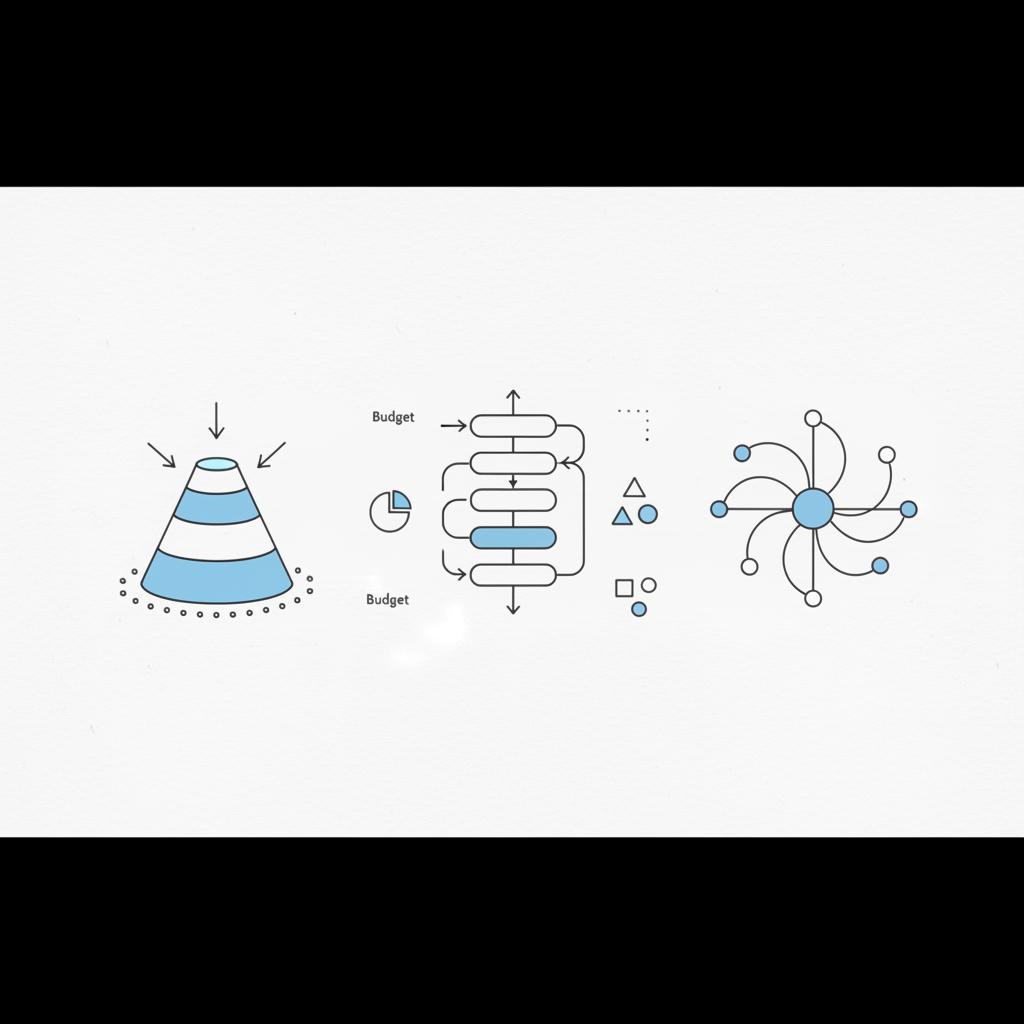
Fast landing page checklist
– Single, clear headline with benefit.
– One primary CTA above the fold.
– Short supporting bullets addressing objections.
– One visual or product screenshot (non-textual).
– Social proof: logo strip or two short quotes.
– Lightweight form (2–4 fields).
– Thank-you page with next-step scheduling link.
How to measure lead quality (practical signals)
Not every form fill is the same. Use these proxies to measure likely value:
- Demo request vs. brochure download.
- Engagement depth: visited pricing or feature pages, or viewed more than three pages.
- Email engagement: opened >1 campaign and clicked a value link.
- CRM qualification flags: BANT-style answers or an SDR score above threshold.
Safeguards to avoid wasting ad spend
– Only scale campaigns with clear downstream signals (demo or proposal conversion).
– Use simple exclusion lists and negative keywords to reduce irrelevant traffic.
– Use small, time-boxed tests with a clear hypothesis and minimum sample size.
Simple ABM playbook (for small teams)
– Identify 10–20 high-fit accounts.
– Build one tailored asset for each cluster (one-pager + short video).
– Coordinate a 6-week outreach: targeted ad creative, personalised email, and one sequence of outreach calls.
– Measure: meetings booked, opportunities created, deal size.
Referral program blueprint that works
Keep it low-friction. Provide a template email customers can forward. Offer a clear incentive (discount, credit, or charitable donation). Track referrals in a simple shared spreadsheet or CRM and follow up quickly.
Common mistakes and how to fix them
– Mistake: treating channels as silos. Fix: map customer journeys and connect paid to email flows.
– Mistake: too many simultaneous tests. Fix: prioritize one hypothesis at a time.
– Mistake: measuring clicks not revenue. Fix: push metrics into CRM and track downstream outcomes.
Quick creative prompts — headlines and offers that convert
– Headline idea for paid search: “Reduce onboarding time by 40% — see how”
– Social creative concept: a short before/after scenario with a one-sentence benefit and a single-step CTA
– Email subject line: “A quick checklist to cut onboarding friction”
How to prioritize experiments by budget
Under $5k/month: one paid search funnel, one focused content asset, one email nurture. Use most spend for learning (creative and landing page tests).
With $20k+/month: run parallel short-term paid plays, invest in SEO/content depth, and pilot ABM or partnership plays for high-value accounts.
Measurement templates you can implement quickly
– Tag leads by channel and campaign in CRM.
– Create a weekly dashboard: leads by channel, demo conversion rate, CPL, and pipeline value.
– Monthly review: revenue closed by channel and customer retention on those cohorts.
A final practical checklist to start today
– Run one paid test for 7–14 days.
– Publish one high-value content piece and attach a downloadable asset.
– Build a 3-step welcome nurture to start converting leads immediately.
– Ask three customers for referrals and track them.
– Schedule a 30-day review to reallocate budget.
Get a prioritized lead-generation plan in one short call
Need help choosing the right experiments? Book a short, no-pressure consultation to get tailored recommendations and a prioritized testing plan. Contact Agency VISIBLE to get started.
Short closing thought: lead generation in 2025 is about building a repeatable system: test fast, invest in owned channels, and prioritize the signals that predict revenue. Start small, measure well, and iterate.
— End of guide —
Paid search and paid social can deliver the first leads within days if the campaign is tightly targeted and the landing page is clear. Expect to see initial form fills or demo requests within 48–72 hours when campaigns are set up correctly. However, track downstream metrics — demo-to-close and revenue per lead — before scaling, because fast leads can vary in quality.
A three-step nurture usually works well: (1) Welcome email that delivers the promised resource and sets expectations, (2) a value email with a short case study or practical checklist, and (3) an invitation to book a demo or call with an easy calendar link. Space these across 3–10 days and test subject lines and CTAs for lift.
Consider a short review from Agency VISIBLE when you want a fast, objective diagnosis of which experiments to run first. A seasoned team can spot wasted spend, recommend a prioritized test plan, and help align marketing and sales for better follow-up. This advice is particularly useful for small teams that need clarity and speed without a long vendor onboarding process.