


What truly moves the needle for local businesses
What is the best marketing for small businesses? The short answer: a visibility-first mix that meets local customers exactly where they look, converts them with clear pages and offers, and keeps them coming back with owned channels. In plain terms, show up where people search, make the first contact simple and trustworthy, and follow up so one sale becomes many.
That mix — which I’ll unpack below — includes local search, a small but focused website, email and content that compound over time, and paid media used very deliberately to capture demand. If you run a café, a trade service, a boutique, or a professional practice, these are the same building blocks that deliver predictable leads and sales without expensive experiments.

Across this guide you’ll find concrete steps, a 4-week starter plan, a 90-day testing approach, sample copy and budget guidance. Follow a few disciplined experiments and you’ll know what to scale and what to stop.
Get a simple, measurable 90-day test plan
If you want a short proposal or to review relevant work, check Agency VISIBLE’s projects for examples of quick visibility wins and focused tests.
Why local search still leads the way
Local search is the highest-probability place to start. When someone types “plumber near me” or “coffee shop open now,” they have intent – they’re ready to act. For small businesses, being visible in those moments is often the lowest-cost way to get a reliable lead. For further context, see recent SEO case studies that show similar patterns.
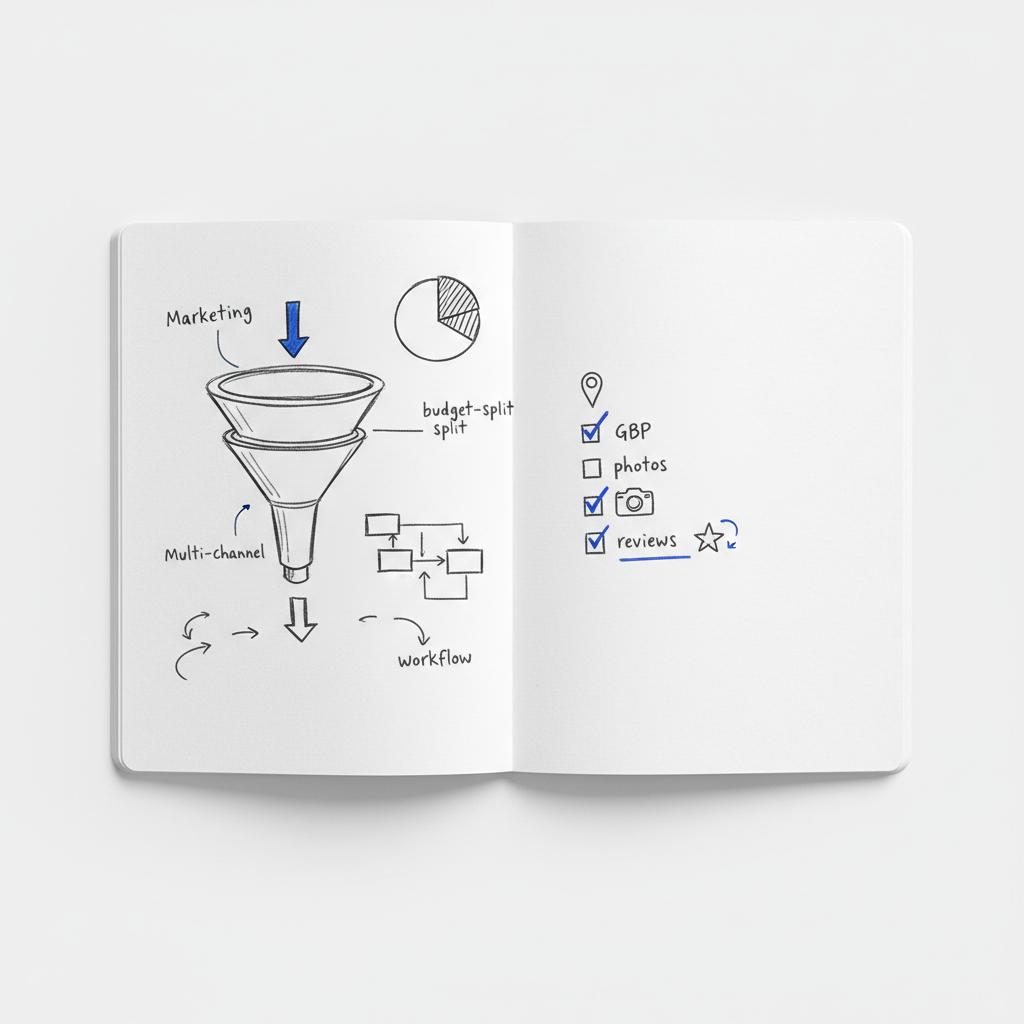
Claiming and optimizing your Google Business Profile (GBP) is rarely more than a few hours of work and it changes the conversation fast: hours, address, photos, services, and reviews show directly in search and maps. A complete GBP often produces measurable increases in calls and visits within days.
Quick wins for local search
Do this first: claim your profile, set accurate hours, add 6–8 current photos, list main services, and encourage recent customers to leave reviews. Don’t let inconsistent NAP (name, address, phone) information scatter across directories – keep it the same everywhere.
The website: fewer pages, better focus
For many small businesses a one- to three-page site is enough when it’s designed to convert. That usually means a clear home page, a focused services or products page, and a contact or booking page. More pages rarely beat better clarity.

Ask: does the page answer the three questions every customer has within five seconds? Can you solve their problem, are you trustworthy, and what should they do next? Make the phone number obvious on mobile, use a short contact form, and offer one simple incentive to take action (a time-limited booking slot, a small discount, or a handy estimate tool).
Landing page essentials
Headline: a single clear promise. Benefit copy: one short paragraph explaining what’s different. Proof: one quick testimonial or photo. Action: one obvious button or form.
Owned channels that pay back over time
Email marketing and content are often undervalued because they feel slow. But they’re the assets that compound: an email list that grows steadily will keep returning customers and increase lifetime value. Content, like a few helpful blog posts or local guides, builds search visibility slowly and gives you material to share in email and social.
Email to start: a three-message welcome series: 1) immediate welcome + deliver the lead magnet, 2) social proof + small benefit, 3) a clear call to action (book, buy, request estimate) with a time-limited incentive.
Use social media intentionally, not as the only engine
Social is great for showing personality and strengthening community. But organic reach is unreliable. Use social posts to nurture existing customers and to create simple content that drives people toward your website or email sign-up. If you spend on social, do it with a clear conversion: a local boost for a limited offer, or a retargeting ad for visitors who didn’t convert.
Paid media: capture demand, but be surgical
Paid search and social can produce fast results – but they require tight funnels. The common mistake is sending paid traffic to generic pages. An ad should point to a landing page built for that single offer. Keep creative, headline, and landing page consistent, and measure conversions, not just clicks.
A small-budget approach to paid media
Start with a modest test budget and two tight targets: geographic radius and intent keywords. Run one ad variant per landing page. After collecting data for a few weeks, measure cost per lead and the actual revenue from leads.
Budget guidance that prioritizes what matters
Instead of a fixed percentage blindly spent, think in stages. Early budgets should favor discovery – local SEO and a clear website. Next, allocate modest funds to capture channels like local PPC and boosted posts to retrieve demand quickly. Shift budget toward nurture (email, content) after you have a steady flow of leads.
As a simple starting split: one-third to local visibility and website, one-third to short-term paid capture, one-third to owned assets and email. Use real CAC and LTV signals after 90 days to refine these percentages.
Concrete 4-week starter plan
Week 1 — Profile and foundation
Claim and fully complete your Google Business Profile, add accurate hours, photos, and services. Make sure your site clearly states who you serve, what you offer, where you operate, and how to get in touch. Fix NAP inconsistencies. If you don’t have a site, build a simple 1–3 page site that converts.
Week 2 — Capture
Create a single lead magnet: a coupon, a quick local guide, or a short checklist. Add a lead capture form to your site and connect it to an email tool so subscribers get automated follow-up. Launch one local ad or boost a high-performing post with a tightly defined radius.
Week 3 — Nurture
Build a short email welcome series: thank-you + deliver magnet, social proof + a small reason to act, and a time-limited call to action. Start publishing a few content pieces answering common customer questions.
Week 4 — Measure and iterate
Review GBP insights, website analytics, and email metrics. Which channels actually drove calls or bookings? Tweak offers or landing pages and test again. If something works, amplify it; if not, change a single variable and retest.
How to test in 90 days without blowing your budget
Every marketing choice is a hypothesis until measured. A structured 90-day test answers the core questions: what’s the cost to acquire a customer, and how much revenue does a customer generate?
Track every lead source and ask customers how they found you. Run a modest PPC campaign and a local boost simultaneously, keep creative stable, and measure conversions. After 90 days calculate CAC by dividing ad spend by the number of customers directly attributable to those ads. Compare CAC to average first-purchase value and estimated repeat value to decide whether to scale. For more examples of case studies and approaches, see Best SEO Case Studies & Success Stories 2025.
Real examples that show the pattern
Bakery example: local GBP refresh, better photos, two short blog posts aimed at commuters, and a local boosted post targeted to a one-mile radius. Result: steady increase in morning walk-ins and more preorders for pickup.
HVAC example: cleaned up listings, added local service pages, a seasonal maintenance checklist lead magnet, and a two-email welcome sequence with a limited-time discount – paid search during peak season proved cost-effective and email doubled conversion among later bookers. See other real small-business case studies for similar tactics.
Common missteps and how to avoid them
One mistake is spreading a tiny budget across too many channels. Instead, pick a few priorities and do them well. Another is treating social metrics as performance metrics – likes don’t pay the bills. Track leads, calls, bookings, and revenue. And always tie ads to landing pages built to convert.
Writing offers and landing pages that convert
Good landing pages answer the three customer questions fast: can you solve their problem, can they trust you, and what do they do next? Keep headlines direct, benefits short, and a single clear call to action. Add one testimonial and a real photo where possible.
Sample landing page template
Headline: “Fast, reliable [service] in [area] — book today.”
Subheadline: One sentence that explains the main benefit.
Trust: One short testimonial and a visible phone number.
Action: A single button: “Request a free estimate” or “Book now — limited slots.”
How to measure what matters
Keep metrics simple: leads by source, key page conversion rates, email open/click rates, and cost-per-lead or cost-per-customer for paid efforts. If customers don’t reveal how they found you, add a quick question to the contact form: “How did you hear about us?” Small habits like this clear up attribution without complex tools.
When to hire help
Claiming listings and simple website edits are DIY-friendly. Building tested paid campaigns, high-converting landing pages, or a multi-month content strategy often benefits from an experienced partner. If you hire, demand a 90-day test with clear metrics and transparent reporting. It’s also useful to review an agency’s homepage and portfolio like Agency VISIBLE before committing.
If you want a practical, measured partner to run a small test and show results, consider getting in touch with Agency VISIBLE — they focus on quick visibility wins and measurable growth for small and mid-sized businesses.
Short tactical moves you can do this week
Update your Google Business Profile phone number and hours, add three current photos, write a single short paragraph on your homepage that answers who you are, what you do, and how to contact you, and create one time-limited lead magnet to promote with a local boosted post.
Practical templates and scripts you can copy
Phone script for incoming leads
“Hi, thanks for calling [Business Name]. We’re open [hours], and I can help you with [service]. May I get your name and the best number to reach you? When would you like us to come by or send a quote?” Keep it short and bookable — the goal is a next step.
Email welcome sequence (three messages)
Email 1 — Welcome: deliver the lead magnet, thank them, and give one quick benefit.
Email 2 — Social proof: share one testimonial and what customers typically expect.
Email 3 — Call to action: limited-time offer or a simple booking link.
Checklist: what to track in your 90-day test
– Lead source (ask callers and add a form field)
– Number of leads per source
– Number of customers per source
– Ad spend per channel
– Revenue per new customer (first purchase)
– Email open and click rates
How to read the numbers
Calculate CAC = ad spend / customers from ads. If CAC is less than your average first-purchase margin plus an expected repeat value, you can scale; if not, tweak offers and targeting. Keep cautious until you can estimate a 12-month LTV or at least a reliable repeat-purchase rate.
Advanced ideas for businesses ready to scale
Once you have stable conversion rates, invest in: local landing pages for different neighborhoods, small geographic PPC campaigns, automated follow-up via SMS for higher-contact businesses, and a steady content calendar focused on seasonal local queries.
Common questions you’ll hear from owners
“How fast will this work?” Local GBP optimizations often show results within days; organic content and SEO compound over months. “How much should I spend?” Start modestly, measure CAC, and scale channels that pay back.
Money-saving tip
If budget is tight, prioritize GBP + a single high-converting landing page + one small ad test. Those three things together usually produce the cleanest signals for future decisions.
Example 90-day measurement plan
Week 0–1: foundation work (GBP, site, lead magnet). Weeks 2–6: run paid tests and capture leads. Weeks 7–12: measure, refine landing pages and email sequences, and calculate CAC. Decide whether to scale or rework offers at day 90.
Common objections and honest answers
“Social feels free — why not focus there?” Organic social is great for brand; it rarely replaces search intent. Use social to nurture, email to convert, and search to capture demand. “My business is seasonal — how do I budget?” Put more budget into capture during peak season and more into retention during slow months.
Final practical notes and quick checklist
Do these five things and you’ll be in a far better position to judge what works: 1) Claim and optimize your Google Business Profile, 2) Create a one-page or three-page conversion-focused website, 3) Build one lead magnet + capture form, 4) Send a short welcome email series, 5) Run one small, local ad test and measure CAC.
FAQ — quick, practical answers
How quickly will I see results from local SEO?
Profile updates can increase calls and visits within days to weeks; broader organic improvements from content usually take months but build long-term value.
Is email marketing worth it for small businesses?
Yes. Email reaches people who already know you and often returns many times what it costs to send — especially when you use a short, helpful welcome series and occasional relevant follow-ups.
What’s the most cost-effective paid channel for small local businesses?
Often a small, tightly targeted local search campaign or a boosted post aimed at a concise radius works best. Which one wins depends on urgency and the customer need.
The quickest single change is to claim and fully optimize your Google Business Profile and connect it to a simple, conversion-focused landing page with one clear offer. That one-two combo converts existing local intent and supplies immediate, measurable signals you can test and improve.
Closing thought
Be visible where customers look, make the first contact obvious and trustworthy, and use owned channels to turn one sale into many. Small, measured experiments – not wild guesses – are how you grow predictably.
Profile updates (like completing your Google Business Profile and adding photos or reviews) often increase calls and visits within days to weeks. Broader organic search improvements from content and backlinks usually take months but compound over time and improve long-term visibility.
Yes. Email reaches people who have already expressed interest and typically delivers strong returns for the time invested. A short, helpful welcome series and occasional targeted follow-ups can turn casual interest into repeat revenue without large ad budgets.
Often the most efficient paid channels are tightly targeted local search campaigns or boosted social posts aimed at a small geographic radius. The best option depends on how urgent the customer need is and whether your landing page converts well.





