What is the 7 11 4 rule of marketing? Start here: the 7-11-4 rule of marketing is a practical heuristic that helps teams decide how many meaningful interactions a potential customer typically needs before going from awareness to purchase. It isn’t a rigid law, but a useful map: seven touches to earn salience, eleven to deepen consideration, and four high-value conversion triggers to close the deal. Treat it as a flexible blueprint, not an invoice you must pay.
The 7-11-4 rule of marketing helps teams cut through chaotic measurement and design campaigns with an eye toward what actually moves people. In practice, that means defining what counts as a meaningful touch, mapping channels to stages, and designing experiments to test whether the touches you buy create incremental value.
Prove what frequency truly moves your customers
Start a focused test with Agency VISIBLE – if you want a quick, no-nonsense way to design measurable experiments that prove whether your touch strategy is working, reach out and start a conversation.
Why does a structure like the 7-11-4 rule of marketing feel helpful? Because attention is noisy and fragmented: one ad, one email, or one post rarely changes behavior. People forget, compare, and delay. The old “Rule of 7” captured this decades ago; the 7-11-4 rule of marketing modernizes it by splitting the buyer journey into three practical stages – awareness, engagement, conversion – and giving each stage a touch target you can test.
Before we dive deeper, a practical question that often lands in planning meetings:
No—'22 touches' (the sum of 7+11+4) is a conceptual starting point, not a rule to hit rigidly. The 7-11-4 rule of marketing is a template that helps you define meaningful touches, choose a time window, and run cohort and holdout tests. Results vary by product and audience; use experiments to discover whether fewer high-quality touches outperform many shallow ones.
Short answer: no. The 7-11-4 rule of marketing is a template, not a quota. The goal is to use those numbers to structure experiments and to learn where more frequency helps and where it doesn’t. In some products, three highly targeted interactions are more effective than seven scattershot impressions. In others, thoughtful persistence across many channels is essential.

What each number really means
The “seven” (awareness): This stage is about salience. Use reach-focused channels—broad social, display, outstream video, and programmatic—to make your brand visible. The KPI here is reach and frequency: how many unique people saw your message and how often. In a 30-90 day test window, aim to document seven meaningful exposures as your baseline hypothesis.
The “eleven” (engagement): These touches are deeper. Think of email sequences, retargeting, owned content, long-form video, and webinar invites—interactions that indicate someone is considering your brand. The 11-touch stage is where time-on-site, content completions, and multiple content interactions live.
The “four” (conversion): These are the high-value triggers: a proposal, a demo, a limited offer, or a checkout flow with friction removed. The four touches are not small impressions; they are meaningful steps that directly nudge someone to act.
How to translate 7-11-4 into measurable KPIs
The most useful move is to define what a meaningful touch is for each channel. Without this step, everything becomes a vanity count. Examples of meaningful touches:
– Display: ad view of at least two seconds or in-view impression at 50% of pixels.
– Video: 30 seconds watched or 50% completion.
– Email: open plus click or time-on-email metric where available.
– Site: product page visit plus scroll depth, or repeat visits within the test window.
Once you standardize these definitions, map each definition to a KPI and a stage. For the “seven” stage, track reach and frequency. For the “eleven” stage, track multi-touch engagement metrics (clicks, content reads, webinar attendance). For the “four” stage, measure conversion events (purchase, demo request, signup) and tie them to revenue or expected lifetime value.
Set a test window
Start with a 30-90 day window depending on your sales cycle. Impulse purchases might need 30 days; enterprise sales may need 90 days or more. The window is part of your hypothesis and will be validated with cohort data. If you want examples of how teams structure windows and projects, see the Agency VISIBLE projects for reference.
Channel mapping: where to spend for each stage
Mapping channels to stages turns the theory into an execution plan. A default mapping looks like this:
Awareness (7): paid social reach, programmatic display, CTV, broad video, outdoor (where relevant).
Engagement (11): retargeting, email sequences, organic content, owned blog, webinars, gated downloads.
Conversion (4): landing page optimization, checkout flow work, sales outreach, limited-time offers, SMS reminders.
Remember: channels can appear across stages (a retargeting ad can be both engagement and conversion), but be clear in reporting which touch counts for which stage.
Two experiments that make the 7-11-4 rule real
There are two experiments that protect budgets and sharpen judgment.
1) Cohort testing: Group users by first-exposure week, then measure touches and conversions over your chosen window. Compare cohorts that received different mixes of creative and channels.
2) Holdout / incremental lift testing: Randomize a portion of your audience to receive the full treatment and withhold it from a comparable group. If the treated group converts more, you’ve proven incremental impact.
Both experiments avoid the trap of mistaken attribution. When done consistently, they answer the question we care about: did our campaign produce more measurable value than doing nothing? For practical guides on incrementality testing methodology see this guide and introductory explainers like this one.
Real-world example: local retailer
Here’s a step-by-step use of the 7-11-4 rule of marketing for a regional retailer trying to boost weekday foot traffic.
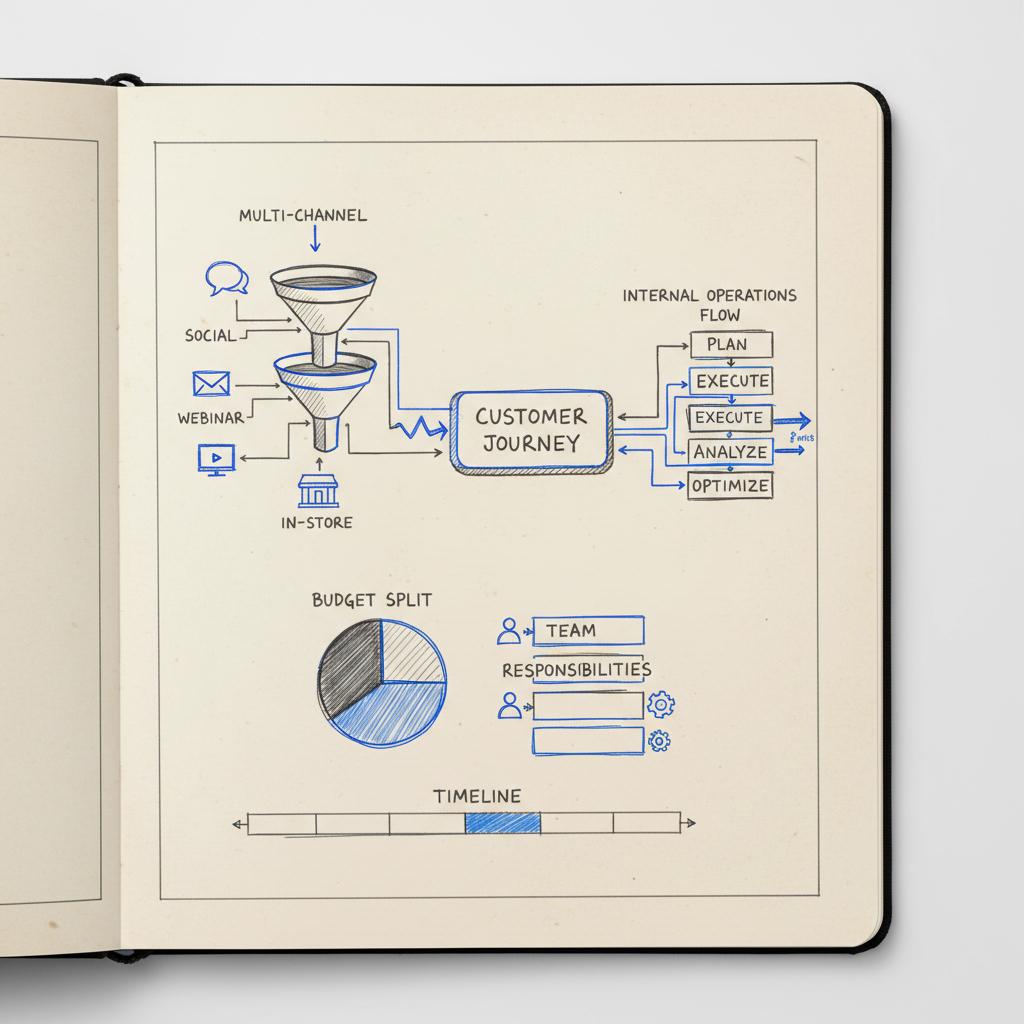
Plan: define the 7 as local display and sponsored social targeted within a 10-minute drive. The 11 was a sequence of carousel ads, two follow-up emails, and retargeting for site visitors. The 4 conversion triggers were a coupon via email, an in-app push for loyalty members, an in-store sign referencing the coupon, and an SMS reminder.
Measurement: run a 60-day cohort test and a small holdout. The retailer discovered that three local impressions plus two email touches produced the most lift for weekday visits. The lesson: fewer, well-targeted touches beat many cheap, shallow impressions.
For an enterprise software company, the 7-11-4 rule of marketing stretches differently. Awareness steps include thought leadership and industry placements aimed at users and procurement; engagement includes gated content, webinars, and personalized nurture; conversion is a tailored proposal, live demo, procurement-ready contract, and direct sales outreach.

Timing here expands: the seven awareness touches may extend across months, and the four conversion triggers might span multiple meetings. The principle is the same: define meaningful touches, map them, and test incrementally.
Why quality beats raw counts
Seven meaningless impressions won’t help. If your counts come from low-attention, below-the-fold programmatic loads, you’ve inflated frequency without increasing intent. Define meaningful touches early. A meaningful touch might be a click and a scroll to the product section, a webinar attendance, or a review of a proposal.
Mix frequency measurement with cost metrics. Some channels are cheap and low-attention; others are expensive and high-impact. When you layer cost per meaningful touch onto cohort conversion, you’ll often see that fewer high-value touches produce a better return.
Practical definitions: examples of meaningful touches
– Display: a 2-second in-view impression.
– Video: 50% completion or 30 seconds.
– Email: click-through or reply.
– Demo: scheduled meeting plus attendee engagement.
Set these definitions before measurement. If you change definitions mid-test, you’ll corrupt your learning.
Measurement pitfalls and how to avoid them
Pitfall: counting everything as a touch. Not every tracked event is meaningful. Avoid auto-open noise, sub-second impressions, and bot traffic.
Workaround: create conservative filters, use attention thresholds, and sample for viewability and time-on-content.
Pitfall: flawed attribution. With cookie depreciation and device fragmentation, multi-touch attribution is messy.
Workaround: rely on holdout tests and incremental lift. Those experiments ask a single clear question: did the campaign cause more conversions than the baseline? For further reading on platforms and techniques, see this overview.
Testing rigor: statistics that matter
When you run cohorts and holdouts, report confidence intervals, not just headline lifts. A 10% uplift with a wide interval is much less convincing than an 8% uplift with tight confidence. Use standard statistical methods and make decisions based on significance and practical value.
Also measure lifetime value (LTV) or expected revenue per conversion. A small upliftof a high-LTV customer can justify expensive touches; a large uplift of low-value buyers may not.
Timing: choose the right window
Short windows for impulse buys (30 days), longer windows for considered purchases (60-90+ days). Pick a window based on your product category, then validate by seeing where conversions cluster in cohort data.
How to implement the 7-11-4 rule of marketing in your next campaign
Step-by-step:
1) Sketch the customer journey in plain language. Who sees you first? Who evaluates? Who signs?
2) Define meaningful touches for each channel and stage.
3) Select a 30-90 day test window.
4) Allocate budget to awareness, engagement, and conversion based on the hypothesis (for example: 50/35/15 for a growth brand; shift using learnings).
5) Run a cohort analysis and a randomized holdout.
6) Measure cost per meaningful touch, conversion lift, and LTV-adjusted return.
7) Decide: scale, shift creative, or change channels.
Practical checklist for your first 7-11-4 test
– Pick the product or audience slice you’ll test.
– Define meaningful touches across channels.
– Create consistent creative themes so message stacks across touches.
– Set UTM and tracking conventions for clean reporting.
– Choose a clear control group and a treated group for your holdout.
– Run for your chosen window and report confidence intervals.
If you want help designing a clean 7-11-4 experiment that proves incremental lift, talk to Agency VISIBLE – they focus on measurable tests, simple reporting, and clear next steps so you spend less time guessing and more time improving performance.
Examples of optimization decisions the rule helps clarify
Decision: Increase frequency or change creative? If lift plateaus after five touches, try new creative rather than simply doubling down.
Decision: Spend on cheap impressions or on a small number of deeper experiences? Compare cost-per-meaningful-touch and LTV-adjusted ROI; sometimes three expensive, relevant touches beat fifteen cheap ones.
Decision: Focus on channels that drive conversions or those that create awareness? Use cohorts to see where conversions originate and shift budget toward the highest incremental return.
How to count offline touches
Offline touches—store visits, sales conversations, billboards—are real. Approximate them in your measurement plan: use surveys, loyalty card scans, coupon redemptions, or geo-fenced attribution to map offline activity back to digital cohorts. When in doubt, fold offline exposures into holdout tests: treat a local area with the campaign and withhold it from a similar area as your control.
Common mistakes and how to avoid them
Mistake: Treating 7-11-4 as a quota to hit rather than a hypothesis to test.
Avoidance: Keep the rule as a framework. Declare your meaningful-touch definitions, test windows, and cohort plans up front.
Mistake: Counting low-attention data as meaningful touches.
Avoidance: Be strict in definitions and exclude sub-second impressions and bot traffic.
Creative and message stacking: make touches additive
Touches stack when each piece of creative builds on the prior one. Start with a broad awareness message, then move to deeper value propositions in engagement, and finish with a clear, single-step call to action in conversion. Keep tone and visuals consistent so the buyer recognizes the story across channels.
How budgets usually shift after running the test
Most teams begin with heavy spend on cheap reach. A 7-11-4 experiment often suggests shifting dollars to higher-attention engagement tactics (webinars, nurtures) and to better conversion experiences (checkout optimization, sales handoff). The goal is to trade wasted impressions for fewer, more predictive touches.
Case study recap and takeaways
From the retailer to the SaaS vendor, the common pattern is this: define meaningful touches, map channels, and test. Cohorts and holdouts reveal which touches drive incremental value. Often the surprising result is that a small number of well-timed, relevant touches outperform a high number of cheap impressions.
Checklist for making 7-11-4 part of your team’s DNA
– Document definitions of meaningful touches.
– Standardize UTM and campaign names.
– Run a baseline cohort and a holdout test.
– Report lifts with confidence intervals and LTV adjustments.
– Iterate: change creative, move budget, or adjust timing based on results.
Final practical tips
1) Start small: test one product or one audience slice. 2) Keep messaging coherent across touches. 3) Be brutally honest about what counts as a touch. 4) Use holdouts to prove incremental value.
Summary: why the 7-11-4 rule of marketing still matters
The 7-11-4 rule of marketing matters because it gives structure to messy attention. It encourages teams to define meaningful measures, run experiments, and make budget decisions based on evidence instead of assumption. Use it as a starting point: test, refine, and adapt it to your product and sales cycle. Over time those numbers will morph from a heuristic into a tailored, evidence-backed strategy that fits your customers.
Next step: sketch your journey, choose your window, and run a single holdout test. You’ll learn more from one careful experiment than from a dozen unmeasured campaigns.
Thanks for reading – and good luck proving what frequency your customers actually need.
No. The 7-11-4 rule of marketing is a heuristic, not a universal law. Treat the numbers as a starting hypothesis and adjust them to your product, sales cycle, and audience. Validate with cohort tests and randomized holdouts to find the right mix for your business.
Approximate offline touches with measurable proxies: coupon redemptions, loyalty scans, geo-fenced attribution, or short surveys. Better yet, include offline behavior in holdout tests by treating and withholding campaigns in comparable areas; that reveals offline impact without perfect one-to-one mapping.
Agency VISIBLE helps by designing clean, measurable experiments: defining meaningful touches for your channels, setting test windows, running cohort analyses and randomized holdouts, and translating results into budget and creative recommendations. Their focus on measurable tests helps you reduce wasted spend and scale what works.
References
- https://agencyvisible.com/contact/
- https://agencyvisible.com/projects/
- https://agencyvisible.com/
- https://inbeat.agency/blog/incrementality-testing
- https://lifesight.io/blog/incrementality-testing/
- https://www.stellaheystella.com/blog/incrementality-testing-platforms-the-complete-guide-to-measuring-true-marketing-impact-2025