


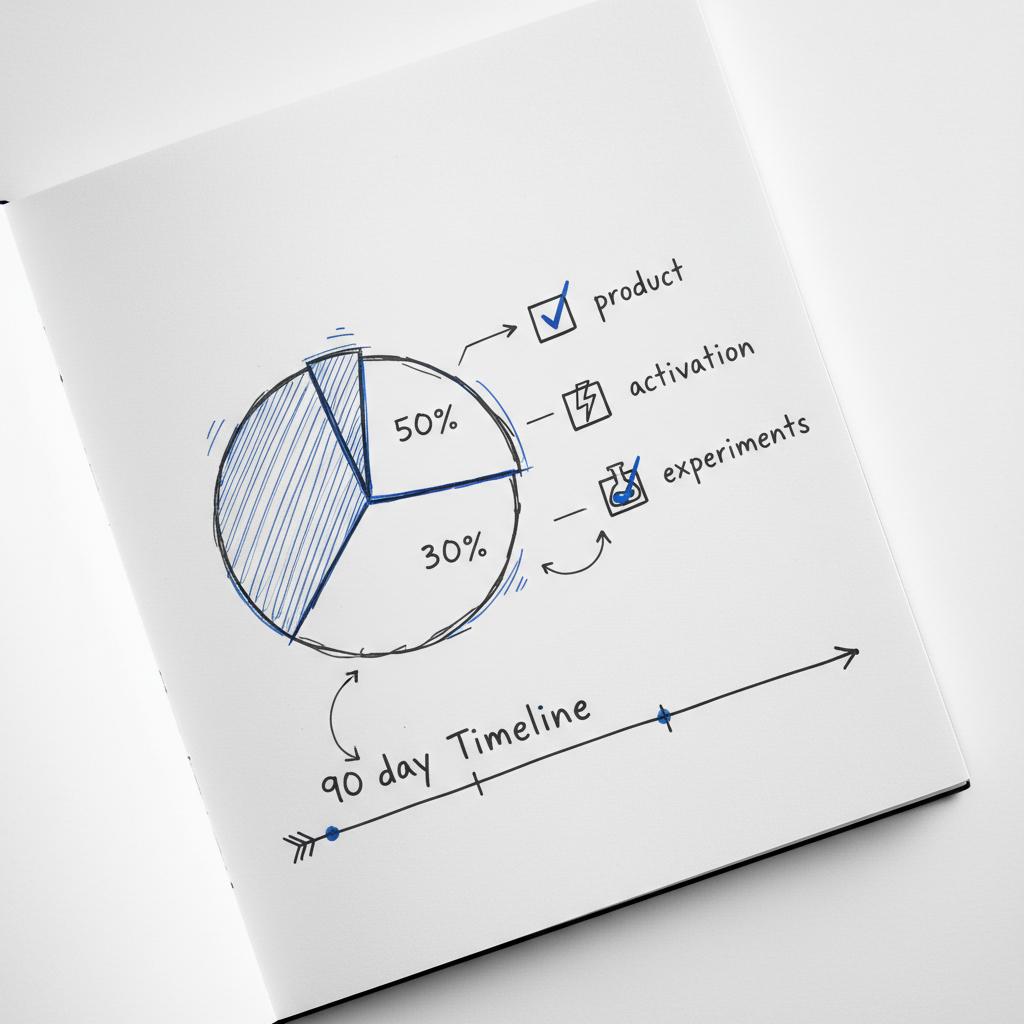
Every team needs a compass. The 50/30/20 branding split gives you one that’s simple, defensible, and directly actionable: put half your effort into the core brand and product, allocate thirty percent to activation and customer experience, and reserve twenty percent for experiments and long-term brand bets. In practice, that means protecting the work that makes customers remember you while still funding the campaigns and tactics that pay the bills this quarter.
Why a rule like the 50/30/20 branding split matters
Marketing and advertising reward what shows results quickly. That bias can starve the slow-moving work that actually makes acquisition cheaper and retention higher over time. The 50/30/20 branding framework borrows the elegance of a personal finance heuristic and translates it into a budgeting and activity guideline: it’s a simple allocation that forces deliberate trade-offs between product, activation, and invention. (See typical marketing budget allocations.)
For small and mid-sized companies, the framework is especially useful because it turns abstract research into an everyday operating habit. The work of Binet and Field and other effectiveness studies make the case for brand investment; this rule gives teams a way to act on that evidence without losing sight of immediate revenue.

Across the rest of this article you’ll find a practical playbook: how to map current spend into these buckets, what KPIs to use for each, how to run tighter experiments, and how to report the split to stakeholders so it becomes defensible rather than arbitrary. For examples of applied work, see Agency VISIBLE’s projects.
Want an outside pair of eyes as you set this up? We suggest a short consultation—talk to Agency VISIBLE to map a 50/30/20 baseline to your business and turn the rule into measurable work.
One last caveat before we dig in: the 50/30/20 branding split is a guide, not a law. Some businesses will tweak it—startups searching for product-market fit may shift more into experimentation; mature brands may allocate more to product and brand. The crucial idea is intention: choose a split and measure it.
Let’s start with measurement—because you can’t manage what you don’t measure.
The right KPIs for each bucket
Each allocation needs its own set of indicators. Treat these as pragmatic signals rather than perfect truths.
KPIs for the 50% core brand & product bucket
Focus on long-term health and foundational evidence:
- Awareness and consideration metrics (brand lift studies, search demand over time)
- Retention and engagement (DAU/MAU, churn, active users)
- Customer Lifetime Value (LTV) and repeat purchase rates
- Qualitative signals (user interviews, NPS themes, onboarding feedback)
KPIs for the 30% activation bucket
These must be slick and short-term focused:
- Cost to acquire customers (CAC) and cohort ROMI
- Conversion rates at funnel steps (landing, signup, checkout)
- Revenue by channel and payback periods
- Lead velocity and sales-assisted conversion metrics for B2B
KPIs for the 20% experimentation bucket
Be okay with fuzzier outcomes early on. Use signal-based thinking:
- Brand-lift survey changes and awareness shifts in test markets
- Early engagement metrics for new content or community pilots
- Change in CAC or conversion when novel creative runs
- Qualitative wins that point to product opportunities
When you collect these signals together, they form a triangulated view. No single metric is decisive; the combination is what convinces stakeholders.
When you collect these signals together, they form a triangulated view. No single metric is decisive; the combination is what convinces stakeholders.
How to map current spend into the 50/30/20 branding buckets
Start with a truth-telling exercise. The easiest approach is coarse-grained: list major initiatives, campaigns, and team budgets, then assign each to one of the three buckets. Don’t try to tag every credit card line yet—go for the big pots that move the needle.
Ask these questions as you map each item: Does this work primarily improve product or brand equity? Does it convert attention into revenue now? Is it an experiment with unknown payoff? Your answers decide the bucket.
Common surprises: product work listed as “ops,” content teams spending most of their time making tactical ad assets, or experimentation buried in a marketing manager’s “misc” budget. This mapping reveals intent vs. reality and often sparks the most valuable conversations.
Make the rule operational: create simple guardrails that define which activities live in each bucket, assign owners, protect a minimum of the 50% core budget from ad-hoc reallocation, and require a brief written rationale with a sunset date for any temporary shifts. Run short monthly reviews focused on measurable KPIs and document decisions so changes are reversible and accountable.
Answer: Make the rule operational. Create guardrails (a list of activities that belong in each bucket), set owners for each portion, and enforce a simple approval process for reassigning funds. When changes are needed, require a short written rationale and a sunset date so temporary shifts don’t become permanent by accident.
Example: how a small subscription business applies 50/30/20 branding
Scenario: a subscription snack box with modest monthly revenue wants to scale while protecting customer satisfaction. Here’s how the split looks in practice:
- 50%: Product improvements (simplify onboarding, better product descriptions), a hero content piece explaining the brand story, and a pricing experiment tied to retention.
- 30%: Paid social campaigns targeting lookalike audiences, improved checkout flows, and abandoned cart email sequences.
- 20%: Branded mini-documentary about origin stories, an influencer micro-pilot in a new region, and a user community test for repeat purchase incentives.
Each twenty percent dollar is an informed bet: the documentary is meant to increase organic discovery and referral over 6-12 months; the influencer pilot tests an acquisition channel without risking operational stability.
Adjusting the split for stage and sector
Different businesses need different tilts. Early-stage startups may move to a 40/30/30 split to discover product-market fit faster. An enterprise SaaS business with long sales cycles may place more weight on product and thought leadership inside the fifty percent, while a D2C brand may center the fifty percent on packaging, hero content, and in-store merchandising. See debates like 50/30/20 vs 30/50/20 for how teams think about tilts.
Industry norms matter. B2B often needs more nurturing and account-based activation in the thirty percent; B2C leans into high-volume performance tactics there. But in every case, the three buckets help teams have the right conversations instead of defaulting to the easiest spend.
Practical implementation steps (a checklist for the first 90 days)
Follow a pragmatic 90-day plan to move from intention to measurable reality:
Days 1–14: Map and measure
- Inventory major spend and projects and assign them to the 50/30/20 branding buckets.
- Identify owners for each bucket and set baseline KPIs.
- Create a simple dashboard that tracks one primary KPI per bucket.
Days 15–45: Guardrails and quick wins
- Define clear examples of what belongs in each bucket and publish the guardrails.
- Protect a minimum of the 50% core budget from ad-hoc reallocation without a leadership check.
- Run one high-priority product fix and one activation optimization with tight success criteria.
Days 46–90: Experimentation and reporting
- Launch one disciplined experiment with a hypothesis, expected outcomes, and a brief post-mortem plan.
- Hold a monthly cross-functional review for each bucket (no more than 30–45 minutes).
- Document decisions and publish a short summary for stakeholders explaining the split and expected timelines for impact.
How to run better experiments inside the 20% bucket
Treat the twenty percent as a learning fund. Use the following disciplines to make experiments scalable and useful:
- Limit experiments to a small number of hypotheses (2–4) at a time.
- Predefine success criteria and what “graduation” to activation or product looks like.
- Keep experiments timeboxed and budgeted, and require a concise post-mortem with learning and next steps.
- Accept failure as data—record it and reuse the insight.
Over time, moving successful experiments into the thirty or fifty percent creates a pipeline of proven ideas, which is how invention becomes sustainable growth.
Reporting and telling a coherent story to stakeholders
Leaders want a simple narrative. Don’t drown them in dashboards. Show the allocation, explain what each dollar aims to do, and present both early signals and projected timelines. Use one or two representative metrics per bucket and a short one-page explanation of why the split is right for now.
For finance teams, include ROMI and payback timelines. For brand stakeholders, show shifts in awareness and qualitative feedback. When you weave together short-term and long-term metrics, the distribution becomes defensible because it’s tied to measurable outcomes.
Common mistakes and how to avoid them
Several predictable mistakes undermine the value of the 50/30/20 branding approach:
- Mistaking activity for progress. More campaigns don’t equal brand health—measure outcomes, not just outputs.
- Dumping scraps into experimentation. Treat the twenty percent as a real budget with clear hypotheses and timelines.
- Letting short-term pressure empty the fifty percent. Protect strategic investments with a minimal approval process.
Guard against these by setting clear KPIs, publishing guardrails, and holding short—but regular—reviews where trade-offs are documented.
Case study: a modest turnaround from protecting the fifty percent
A niche consumer brand plateaued: CAC was steady but retention fell. The team shifted to protect the fifty percent—investing in clearer messaging, onboarding redesign, and a hero content piece that explained the product’s emotional value. Within three quarters, retention improved, CAC softened slightly, and organic referrals began to rise. The lesson: protecting long-term work magnified the impact of short-term activation.
How granular should you be?
Start coarse. Categorize major spend first and refine later. The goal is to create a habit—a deliberate distribution that forces conversation about long-term value. Once orchestration is in place, you can drill down to line items.
What to do when budgets are tight
If every dollar counts, the 50/30/20 branding rule still helps because it forces prioritization. Make the fifty percent surgical: one strong piece of positioning, one product fix with measurable impact, or one short research sprint. Make the thirty percent ruthlessly efficient by using cohort analysis and doubling down on the highest ROMI channels. Keep the twenty percent tiny but intentional—one disciplined experiment at a time.
Practical templates: guardrails, dashboard, and experiment brief
Here are short templates to make the rule operational right away.
Guardrails template
- 50% includes: positioning, hero content, product feature work tied to retention, pricing experiments, onboarding redesigns.
- 30% includes: paid acquisition, conversion optimization, CRM flows, in-store activation, sales enablement.
- 20% includes: brand pilots, new creative formats, community pilots, product discovery tests.
Dashboard template (one metric per bucket)
- 50%: 90-day retention or change in LTV.
- 30%: cohort ROMI or CAC per channel.
- 20%: directional brand lift or engagement delta for the pilot.
Experiment brief (one page)
- Hypothesis: (what you expect)
- Success criteria: (numeric goal)
- Budget & timeline: (dollars and weeks)
- Owner & stakeholders
- Post-mortem plan: (how you’ll record and share learnings)
Culture and leadership: why the rule succeeds or fails
The 50/30/20 branding split is cultural, not merely financial. It succeeds when leaders value both evidence and curiosity—rewarding short-term wins while recognizing patient investments. Teams should celebrate small experiment wins and also acknowledge slow-moving gains. Without leadership signaling that long-term brand work matters, the distribution will drift toward short-term convenience.
Final thoughts and a modest checklist to keep you honest
The 50/30/20 branding rule is not a magic formula. It’s a disciplined habit that nudges teams toward balance: protect the work that creates future demand, fund the work that pays today, and reserve a place for discovery. If it helps your team stop chasing only the easiest wins and instead build a durable engine of growth, it’s done its job.
Remember: balance is a practice. Protect your product and positioning, be ruthless about activation efficiency, and treat experimentation as a learning engine. Over time, these habits will show up in the numbers and, more quietly, in the way customers remember you.

Appendix — quick FAQ recap and next steps: map existing spend, set owners, protect the fifty percent, run one experiment, and hold a monthly review. Ninety days is long enough to get meaningful signals and update the plan.
Article produced for practical use: adopt the split that matches your business stage, measure what matters, and iterate. Good luck—and be curious.
Make the 50/30/20 split work for your business
Ready to map your brand budget and make the 50/30/20 branding split actionable? Start a short planning session with Agency VISIBLE to get a tailored baseline and a 90-day playbook: Start a conversation with Agency VISIBLE.
Treat the 50/30/20 branding split as a compass, not a strict rule. Use it to create intentional trade-offs. Early-stage startups might shift more toward experimentation (e.g., 40/30/30), while mature businesses could keep a stronger emphasis on core product and brand. Whatever you choose, document the rationale and set time-bound reviews so temporary changes don’t become permanent by accident.
Use different KPIs for each bucket: for the 50% core brand and product track retention, LTV, and awareness signals; for the 30% activation bucket monitor CAC, cohort ROMI, and conversion rates; and for the 20% experimentation bucket look at brand lift, engagement deltas, and early directional signals. Combine these measures to form a triangulated view rather than relying on a single metric.
Yes—Agency VISIBLE uses the 50/30/20 branding rule as a practical starting point with clients. They can help map existing spend, set guardrails, define KPIs, and create a 90-day playbook tailored to your stage and sector. If you want a hands-on partner to turn the framework into actionable work, start a conversation via Agency VISIBLE’s contact page.
References
- https://www.investopedia.com/ask/answers/022916/what-502030-budget-rule.asp
- https://improvado.io/blog/marketing-budget-allocation
- https://www.linkedin.com/posts/seanwachsman_503020-vs-305020-this-is-the-recommended-activity-7322579089783955457-np71
- https://agencyvisible.com/projects/
- https://agencyvisible.com/contact/
- https://agencyvisible.com/





