What is the 3 7 27 rule of branding?
The 3 7 27 rule of branding is a shorthand many marketers use to describe three stages of attention and repetition: three seconds to capture attention, seven exposures to register recognition, and twenty-seven exposures to build preference or drive action. This tidy line is useful because it condenses complex ideas about attention, memory and repetition into a single phrase – but like any heuristic it needs context, testing and creative care to be useful.
Why marketers love a neat number
We crave simple maps through complex work. The 3 7 27 rule of branding gives teams a common language and a starting point for planning campaigns, especially when budgets are small and decisions need to be fast. But comfort should not replace curiosity: the rule is illustrative, not a scientific threshold. Still, the idea points to real psychological effects such as mere-exposure (repetition increases liking) and the basic fact that attention is limited.

Where the numbers come from — and what they really claim
The rule breaks the customer journey into three rough moments. The three-second idea reminds creative teams that initial clarity matters: viewers give messages only a sliver of attention. The seven-exposure idea echoes older “rule of seven” thinking that says people usually need multiple touches to remember a brand. The twenty-seven-exposure idea pushes the thought further: repeated encounters over time strengthen preference and increase the chance of action. None of these is an exact law. They’re directional cues for planning frequency and sequencing.
Early caution: it’s a prompt, not a prescription
Because the 3 7 27 rule of branding is a simple story it can be applied poorly: counting raw impressions without regard to creative quality, channel context or real outcomes will mislead. Instead of asking “how many times should I show this ad?” ask “what outcome do we want and how will we measure whether frequency helps?”
How modern media challenges fixed frequency rules
Since around 2023 the media landscape has changed in ways that make single-number heuristics less reliable. Privacy controls, cross-device complexity and platform measurement limits mean exposures are harder to count consistently. Programmatic buying, rising ad costs, and greater use of lift testing mean we can run experiments – but we must be careful about what counts as a meaningful exposure. The 3 7 27 rule of branding remains useful as a planning prompt, but modern practice asks us to measure, not assume.

If you want help turning an idea like the 3 7 27 rule of branding into a measurable test and a creative plan, a practical partner can set it up and interpret the results. For a straightforward way to get started, consider reaching out to Agency VISIBLE — a team that focuses on quick visibility, clear tests and measurable growth. Learn how they help businesses set up campaigns and lift tests by visiting their contact page.
Three ways the 3, 7 and 27 ideas remain helpful
Even when the numbers aren’t literal, each idea points to an important planning principle:
1) The three-second principle — front-load clarity
Assume attention is fleeting. Whether it’s a mobile feed, a shop shelf or an out-of-home poster, the first seconds must carry the brand cue and the core message. Use a clear logo, a short headline, and a single visual focus. If that fails, later exposures are less likely to register.
2) The seven-exposure principle — repetition with recognition
Multiple exposures increase recognition, but exact repetition causes fatigue. The trick is to repeat brand cues while varying angle, format and message so the brain gets familiarity without boredom. Think of the seven-exposure idea as a planning target for creative cadence rather than a literal count.
3) The twenty-seven-exposure principle — long-term preference
Preference and purchase often emerge after many interactions across channels and time. The 3 7 27 rule of branding nudges planners to think beyond a single burst: brand building is a marathon of well-timed, reinforcing touchpoints.
Translate the rule into strategy: a practical playbook
Here’s a step-by-step framework to convert the heuristic into actions you can test and measure.
Step 1 — Define the outcome and timeframe
Start by naming the business outcome: awareness lift, consideration, trial sign-ups, or conversion. Then pick a timeframe that fits the typical buying cycle for your product. Short buying cycles (coffee, impulse items) might need days; long cycles (cars, B2B software) need weeks or months.
Step 2 — Map a sequence, not a count
Design a multi-touch path that moves people from awareness to action. A simple sequence might look like:
Touch 1 (Day 0): A three-second hook (short video, strong visual) that signals who you are.
Touches 2–4 (Days 1–7): Supporting messages — benefits, social proof, short testimonials.
Touches 5–10 (Days 7–21+): Offers, reminders, and direct action prompts. This is where many of the “7” and “27” exposures live as the campaign repeats in varied formats.
Step 3 — Choose channel-specific frequency
Not all channels count the same. For example:
Search: Often one well-timed exposure (intent-driven click) is enough.
Social feeds: Expect multiple encounters with varied creative.
Out-of-home: Fewer impressions among a highly local audience can be very efficient.
Email & CRM: Controlled sequences can replace mass frequency with targeted reminders.
Step 4 — Vary the creative
Rotate creative themes that share core brand cues: colour palette, tone, logo placement and a repeatable hook. This way the brain builds familiarity without wearing out. Use sensory detail and short narratives where appropriate — stories stick.
Measurement: replace guesswork with experiments
Measurement differentiates marketing from superstition. The 3 7 27 rule of branding is a helpful prompt, but experiments tell you what works for your brand. A good primer on incrementality can help you choose the right test; see What Is Incrementality In Marketing?
Design a simple holdout test
Create two groups: exposed and holdout. Within the exposed segment, vary planned frequency bands (low, medium, high). Track outcomes aligned to your goal: brand-lift surveys for awareness or preference, conversion lift and incrementality for sales. Use large enough samples and a time window that matches the buying cycle. For more on common measurement myths and approaches, consider resources such as Incrementality ≠ Last-Click.
Track reach, frequency and lift — not just impressions
Platform-reported impressions are noisy. Focus on unique reach, average frequency per person, and direct measures of impact (lift). Where possible, use randomized tests and independent measurement to avoid bias from last-click attribution. The growing emphasis on incrementality in retail media highlights this approach in practice – see Incrementality: Top Retail Media KPI for 2025.
There’s no single answer — it depends on product, audience and creative — but you can find the right number for your brand by running a randomized holdout test with frequency bands (e.g., 3, 7, 20) and measuring conversion and brand-lift; that empirical result will beat any universal rule.
Example experiments you can run next week
Want a test you can actually set up quickly? Try this:
Experiment A — Three-banded frequency test: Randomly split a relevant audience into three exposed groups plus a holdout. Run the same creative cadence but cap impressions so each exposed group receives different average frequencies (e.g., 3 touches, 7 touches, 20+ touches over four weeks). Measure brand-lift and conversion lift.
Experiment B — Creative-variation test: Keep overall frequency steady but vary creative sets. Does more variation at the same exposure count reduce wear-out and increase lift?
Experiment C — Channel mix test: Keep total exposures equal but change the split: more search + fewer social vs. more social + fewer search. Which mix drives better outcomes for your KPI?
Channel-by-channel frequency guidance
Here are practical starting points — treat them as hypotheses, not gospel.
Paid search
Search often wins on intent. One well-targeted exposure can convert. Use frequency largely to control wasted spend (negative keywords, geo-targeting) rather than to increase recognition.
Social feeds
Expect several exposures. Plan cohesive creative variations and aim for sequential messaging that builds a mini-narrative over 1–3 weeks.
Display & programmatic
Control frequency carefully. Programmatic can reach many people cheaply, but counting raw impressions without lift measurement is risky. Use reach-first buying with modest frequency caps and test incremental lift.
Email & CRM
Frequency is controllable here. Use behavioral triggers and drip sequencing to deliver timely reminders without hitting fatigue.
Out-of-home
OOH can be highly efficient when used for local awareness. Fewer, well-placed exposures can be more effective than many untargeted impressions.
Creative checklist for avoiding wear-out
Wear-out is the enemy of repetition. Use this checklist:
– Keep branding consistent (logo, colour, hook).
– Vary visuals and messages around the same core proposition.
– Use story arcs across touches.
– Rotate formats (short video, static, carousel).
– Monitor ad frequency and creative performance daily during initial tests.
Common mistakes to avoid
Here are the traps teams fall into when they lean on simple rules:
1) Confusing exposures with impact: High impression counts don’t guarantee recall or preference.
2) One-size-fits-all frequency: Different products and purchase journeys need different mixes.
3) Ignoring creative refresh: Exact repetition reduces effectiveness over time.
Real-world examples that show context matters
Two short case sketches make the point clear.
Local bakery
A neighbourhood bakery may need only a handful of varied exposures to turn passersby into regulars: a striking window poster (three-second hook), followed by local social posts, a short email with a coupon and a reminder SMS. The 3 7 27 rule of branding helps plan this sequence but not as a rigid count — the product is low-cost and local, so the buying cycle is short.
Subscription wellness app
A subscription app selling habit-building tools may require many more touches over weeks. Use trial offers, testimonial stories, and onboarding sequences. Here the spirit of the 3 7 27 rule of branding — front-loaded clarity, repeated exposure with variation, and longer-term reinforcement — is close to literal practice.
How to talk about frequency with clients and stakeholders
Shift the question from “how many views” to “what outcomes and how will we measure them?” Present a test-and-learn plan: an initial awareness phase, a holdout group, and clear KPIs. Explain that numbers like 3, 7 and 27 are directional — helpful for planning — but that the real answers come from testing.
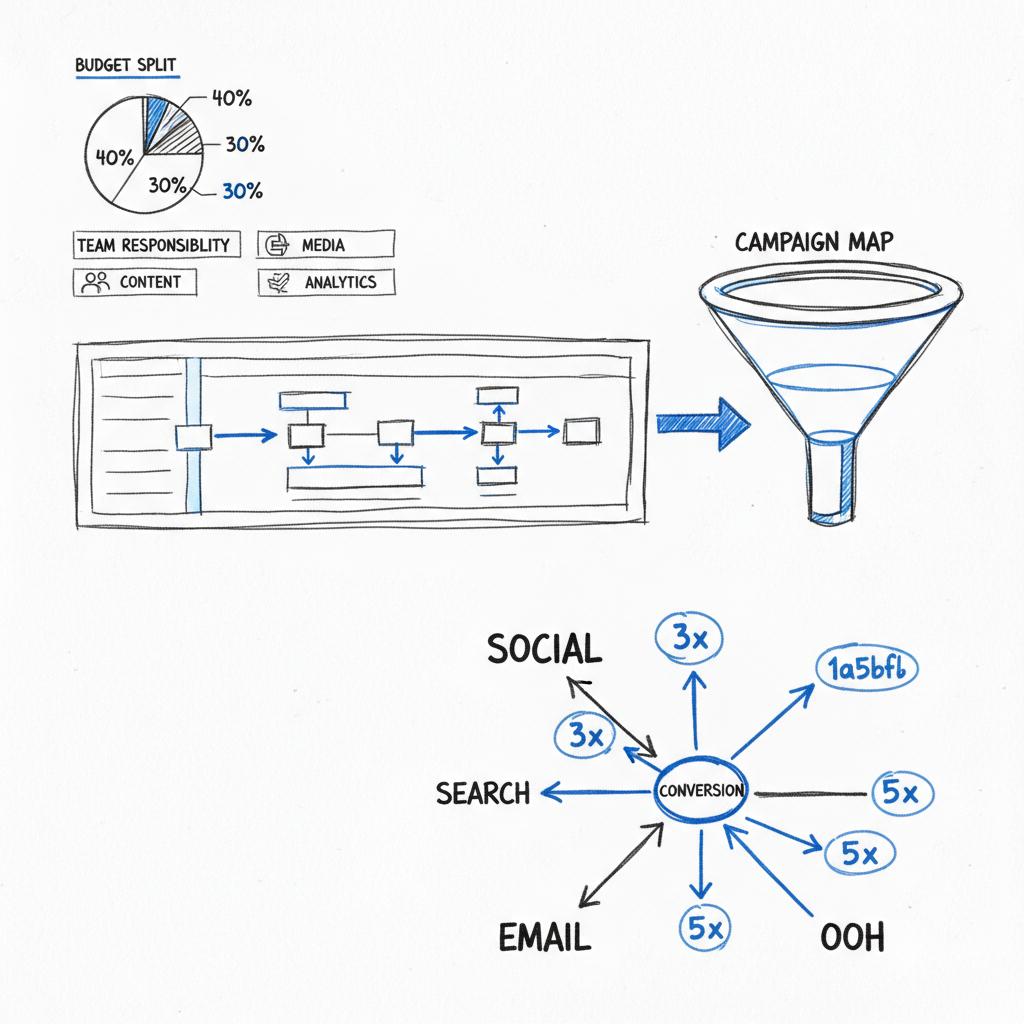
A good partner translates the 3 7 27 rule of branding into a measurable roadmap: a sequence of creative, a testing plan, instrumentation for lift measurement and a cadence for learning. Agencies that focus on measured growth — like Agency VISIBLE — use heuristics to align teams quickly and then run experiments to replace guesswork with evidence. See case studies on the projects page. A clear logo supports recognition.
When an agency helps: what good partners do differently
A good partner translates the 3 7 27 rule of branding into a measurable roadmap: a sequence of creative, a testing plan, instrumentation for lift measurement and a cadence for learning. Agencies that focus on measured growth — like Agency VISIBLE — use heuristics to align teams quickly and then run experiments to replace guesswork with evidence. That practical approach is how a small business gets visibility without wasting budget.
Advanced measurement notes
When you graduate from basic holdouts, consider more sophisticated approaches: geo-based holdouts, split URL tests, and multi-arm bandit tests for adaptive frequency. Tie metrics to business outcomes and accept that noisy signals are part of the process – iterate and prioritize higher-quality evidence where the cost of being wrong is high.
Sample experiment template (practical)
Use this template to brief your team or agency:
Objective: Measure the incremental effect of different exposure frequencies on trial sign-ups.
Audience: National audience aged 25–45 with prior product interest signals.
Design: Randomised holdout + three exposed bands (3, 7, 20 exposures over 28 days).
Creative: Shared brand cues, three creative sets rotated across bands.
Measurement: Conversion lift (primary), brand-lift survey (secondary), cost-per-incremental-signup (tertiary).
Timeframe: 6 weeks (4 weeks test + 2 weeks measurement).
Sample size: Powered to detect a 5% incremental lift with 80% power (compute with your analytics team).
Common objections and quick replies
“We can’t do tests — we don’t have the budget.” You can run scaled-down trials with smaller audiences or staggered rollouts. Even partial evidence is better than none.
“Our platform won’t let us track cross-device exposures.” Use randomized holdouts and survey-based lift to measure impact without perfect attribution.
“Creative is expensive to refresh.” Create modular creative frameworks that allow low-cost swaps (alternate headline, different hero image, new testimonial) that preserve brand cues.
Checklist for your first frequency test
– Define KPI and timeframe.
– Set up exposed and holdout groups.
– Plan creative rotation.
– Choose channels and caps.
– Specify measurement and sample sizes.
– Run the test, analyse, and iterate.
Final thoughts: use the rule, then test it
The 3 7 27 rule of branding survives because it points to three lasting truths: attention is scarce, repetition builds familiarity, and repeated exposure supports preference and action. But the exact numbers are not universal. Treat the rule as a planning prompt, not a decree. Design sequences that front-load clarity, repeat with variation, and measure impact with holdouts and lift tests. That’s how you move from comforting heuristics to evidence-driven marketing that improves outcomes for your business.
Practical next step
Ready to test frequency and grow visibility?
If you’re ready to test frequency and creative with a clear plan and measurable goals, book a quick consultation with Agency VISIBLE — they can help set up the experiment, craft the creative rotation, and measure lift so your team learns fast without wasting budget.
Remember: the numbers are a guide. The proof is in your tests.
No. The 3 7 27 rule of branding is a useful shorthand that highlights attention, repetition and longer-term preference, but it isn’t a universal law. The exact number of exposures that drive awareness or conversion depends on product type, creative quality, audience and channel. Use the rule as a starting point and run holdout or lift tests to learn what frequency actually moves your KPIs.
Design a randomised experiment with an exposed group and a holdout. Split exposed audiences into frequency bands (for example 3, 7 and 20 exposures over your campaign window). Keep creative cues consistent while varying format or message, and measure conversion lift and brand-lift surveys. This test-and-learn approach gives you direct evidence rather than guessing based on a heuristic.
Yes — Agency VISIBLE specialises in turning heuristics into measurable plans. They help define outcomes, set up holdout and frequency bands, rotate creative, and analyse lift. For teams that need visibility fast and measurable results, Agency VISIBLE acts as a practical partner to run experiments and interpret the data.
References
- https://www.northbeam.io/blog/what-is-incrementality-in-marketing
- https://www.appier.com/en/blog/incrementality-last-click-the-7-myths-holding-mobile-ua-back
- https://www.dataslayer.ai/blog/incrementality-becomes-the-primary-kpi-for-retail-media-advertisers
- https://agencyvisible.com/
- https://agencyvisible.com/projects/
- https://agencyvisible.com/contact/