Which TikTok ads work best – and why
TikTok ads arrive like a song hook in a busy café: short, demanding attention, and influential if they land at the right moment. In this guide we’ll walk through the formats, budgets, creative practice, testing routines, and measurement approaches that separate ads that merely run from ads that actually move people. If you want to turn views into action, you’ll learn which TikTok ads fit each business goal and how to test them faster.
Quick note on language: this article uses TikTok ads repeatedly because they’re the heart of what we’re explaining. You’ll see practical tips you can apply immediately – not just theory.
The five families of TikTok ads, explained simply
TikTok’s ad stack is built around viewer moments. Each format answers a different question on the customer journey:
In-Feed ads – blend into the For You feed and drive clicks, app installs, and short-term conversions. They look like native posts and work best for direct-response goals.
TopView – a full-screen first impression that commands attention. Ideal for broad reach and brand recall when you want to announce product drops or major launches.
Branded Hashtag Challenges – invite people to create. They produce user-generated content (UGC), social proof, and high organic reach when they catch on.
Branded Effects – custom AR lenses and stickers that creators can use. They’re playful, encourage sharing, and extend creative possibilities for creators and brands.
Spark Ads – amplify organic posts (brand or creator) with paid reach while keeping native engagement and comments. Spark Ads preserve authenticity and often outperform heavily produced cuts because they keep the original post’s signals intact.

How to pick the best TikTok ads for your objective
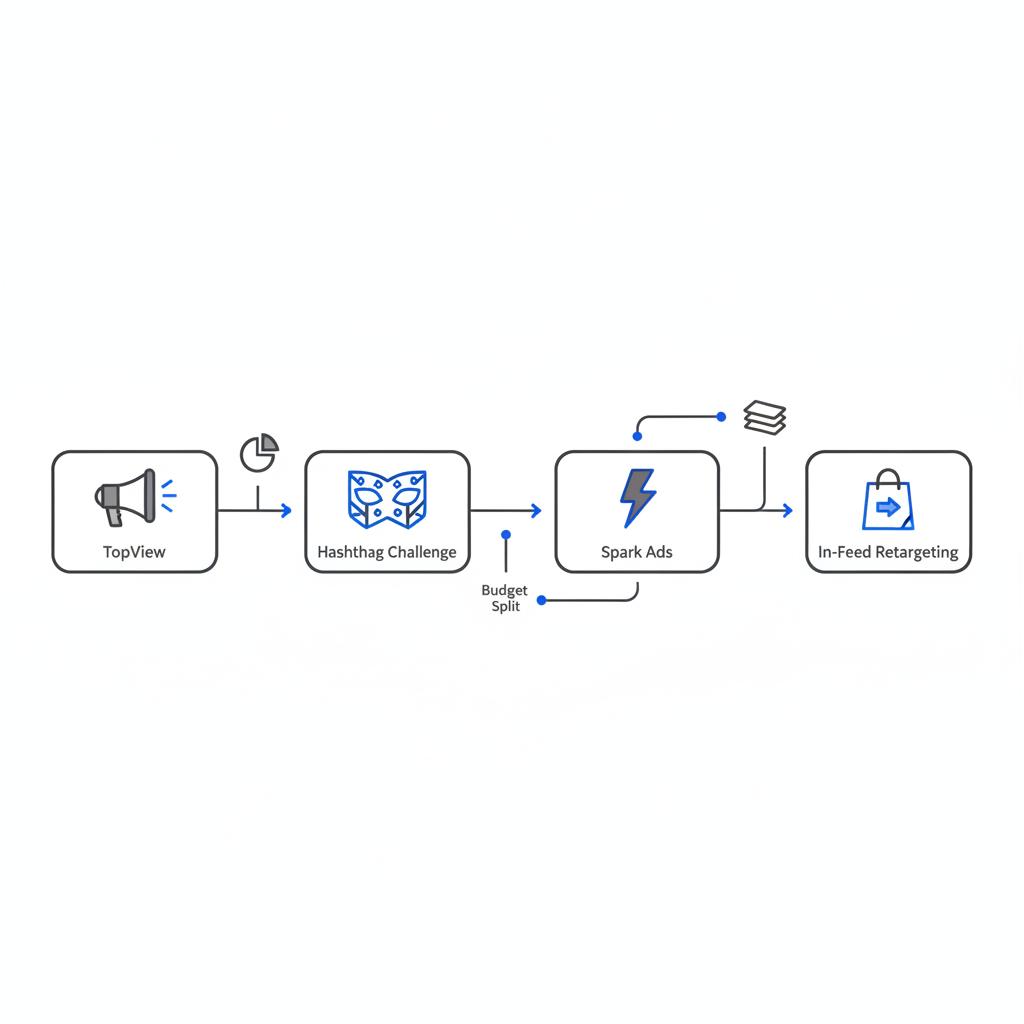
If your core goal is awareness, pick TopView or a Branded Hashtag Challenge. If your goal is community and UGC, choose Branded Effects and Hashtag Challenges. If you want direct sales and clicks, In-Feed and Spark Ads usually deliver the cleanest paths to conversion.
Most winning campaigns use more than one format. Awareness builds interest, UGC gives social proof, and In‑Feed/Spark Ads close the loop.
Benchmarks you can actually use
Benchmarks are a reference, not the final verdict. Here are practical ranges many advertisers saw in 2024-2025 for TikTok ads:
- CPM: commonly $3-$8
- CTR (In-Feed): typically 0.5-1.2% – creative can push this higher
- Conversion rate: often under 1% for general e-commerce without highly tuned creative and landing pages; higher for impulse purchases and gaming
Use these numbers like a thermometer. If you’re far outside them, the creative, offer, or landing experience is usually the issue – not the platform. For additional benchmark context see industry breakdowns such as TikTok Ads Benchmarks for CTR, CR and CPM and broader statistics summaries like TikTok Ads Statistics 2025.
Prioritize creative over hyper-targeting
One rule stands above the rest: early on, creative quality matters more than narrow targeting. TikTok’s delivery system rewards content that earns engagement. A great creative with broad targeting will usually beat a poor creative to a micro-targeted audience.
Key creative elements for TikTok ads:
- Hook within the first 1-3 seconds – say something that makes people stop.
- Native sound – music, voiceover, or on-screen creator audio that feels like the platform.
- Vertical framing – shoot vertical to fill the screen naturally.
- Brand presence early but subtle – show the product without making it feel like a commercial.
- Clear next action – show what to do rather than just telling viewers to “shop now.”
Testing approach: fast, simple, repeatable
Test multiple creative concepts against a broad audience first. Don’t spend weeks building tiny audience segments before you know which idea works. Run 3-5 creative variants, let the platform collect enough signal, then scale winners with targeted budgets.
When a creator-made clip performs organically, use Spark Ads to amplify it rather than recreating a polished ad. Spark Ads keep the original authenticity and comments intact. TikTok’s own guidance on creator-driven performance can be helpful for framing creator collaboration – see the TikTok Creator Advantage.
For teams wanting tactical help sequencing awareness and performance formats, contact Agency VISIBLE for a concise plan. A short conversation can highlight where to test TopView vs In-Feed and how to preserve authenticity while scaling.
Map your TikTok ad sequence in one short conversation
Talk to our team and we’ll map the sequence that fits your goals – from TopView for launch to Spark Ads for scalable conversion. Start a short conversation with Agency VISIBLE.
Budgeting – a practical split
Start broad on prospecting and keep a steady retargeting allocation. A simple rule of thumb:
- Prospecting: 60-75% of early spend
- Retargeting: 25-40% (steady, lower-cost bids)
- Always reserve some budget for creative refreshes and Spark Ads to boost winners
Think of prospecting as planting seeds and retargeting as watering them.
Quick levers that move metrics fast
When performance stalls, try these immediate fixes for TikTok ads:
- Rotate creatives every 7-10 days.
- Shorten underperforming videos – shorter clips can increase completion rates.
- Use Spark Ads to push proven organic posts.
- Try Branded Effects or Hashtag Challenges to generate UGC and social proof.
Attribution: the messy but necessary conversation
Attribution on TikTok ads is noisy. View-through credit is common – giving partial conversion credit to people who saw an ad but did not click. The only clean way to judge incremental impact is randomized holdouts or proper A/B tests run across meaningful time windows.
Yes — often. Short, native hooks that create immediate curiosity or a strong emotional reaction typically outperform longer, repurposed commercials on TikTok. The platform prioritizes early engagement signals, so a crisp 3-second idea that stops people from scrolling is more likely to produce useful learning and better downstream metrics.
Yes – often. Short, sharp hooks that feel native usually outperform long, polished commercial cuts on TikTok. Why? Because the platform’s feed rewards content that earns early engagement. A 3-second idea that makes someone stop and tap will usually create more learning signal than a 30-second cut that feels like TV repurposed.
Creative playbook you can use today
Start with one clear promise and one clear action. Your creative brief should answer three questions:
- Why will someone stop scrolling?
- What should they feel or do while watching?
- What should they do after the ad ends?
Create variations that change one thing at a time: opening hook, audio, or cut length. Run these variations across a broad audience. When a creator-made clip performs well, scale it with Spark Ads.
Benchmarks by objective – a quick reference
Pair your expectations with the format you choose:
- Awareness (TopView): high reach, higher view-throughs, lower CTRs – success = reach & recall
- Community (Hashtag & Effects): success = UGC volume & engagement
- Performance (In-Feed & Spark): success = CTR, CPA, ROAS
Again – use CPMs, CTRs, and conversion rates as context not as final judgment.
A tactical A/B checklist that actually helps
Follow this step-by-step test plan for TikTok ads:
- Test creatives first against broad audiences.
- If a creative wins, run audience slices to find where it scales best.
- Isolate one variable per experiment – audio or hook, not both.
- Use Spark Ads to validate and scale organic winners.
- Measure both short-term conversions and longer-term cohorts.
Three short case studies: awareness into conversion
Case studies 1 – Lifestyle brand: TopView + Spark sequence
A lifestyle brand used a cinematic TopView to launch a seasonal drop. The ad had a crisp three-second visual hook and then showed the product in a real-use moment. TopView built reach and high view-throughs. The brand followed with Spark Ads promoting the best organic posts and offered a limited-time discount to viewers who had seen the TopView. The result: the combined sequence produced a multi-point lift in conversion versus a direct-to-In-Feed-only approach.
Case study 2 – Household product: Hashtag challenge + Branded Effect
A direct-to-consumer household brand seeded a Branded Hashtag Challenge with micro-influencers. It included a simple Branded Effect that visually highlighted the product benefit. Creator videos spread, and the brand amplified top posts with Spark Ads while running conversion-focused In-Feed offers to people who interacted with the challenge. The campaign produced lots of UGC and a noticeable uptick in purchases among engaged users.
Case study 3 – Niche subscription: awareness vs performance split test
A subscription service split its budget: half to awareness placements (TopView + Hashtag) and half to In‑Feed performance ads. Users exposed to awareness formats then shown conversion ads converted at a higher rate than users shown only conversion ads. Cohort analysis confirmed incremental lift from sequencing.
Common pitfalls and how to avoid them
Teams fall into a few repeatable traps with TikTok ads:
- Over-segmentation early: Narrowing audiences before creative wins wastes budget.
- Repurposed TV spots: A 15-second cut from TV usually underperforms – make content for the feed.
- Poor landing experience: A fast, clear landing page is essential; otherwise you lose momentum.
Practical fixes: start broad, prioritize creative tests, keep landing pages fast and focused, and use Spark Ads to scale authentic creative.
Measurement and longer-term rigor
If you can run holdout A/B tests, do it. Randomized control trials yield the cleanest incremental insights. If a full holdout isn’t possible, use cohort analysis and longer windows to capture the platform’s impact over time. Always be mindful of attribution window differences across tools and partners.
Operational tips many teams miss
Don’t treat every clip like an ad. Often the best-performing content is a small, authentic clip of someone explaining why they like a product. Give creators control and keep a fast cadence: what worked three months ago may not work today. Keep a living document of assets and test results so knowledge compounds rather than dissipates.
Creative script templates for TikTok ads
Use these short templates as starting points:
Template A – 3-Second Hook (Direct Response)
0-3s: Shock or quick benefit (“This melted my stains in 10 seconds!”)
3-10s: Quick demo or reaction
10-15s: Clear next action (“Tap to claim 20% off”)
Template B – Story + Social Proof (UGC)
0-2s: Relatable problem
2-8s: Quick demonstration by a creator
8-15s: Social proof + CTA
Template C – Awareness (TopView friendly)
0-3s: Visual hook
3-10s: Brand moment and key benefit
10-20s: Emotional close and subtle CTA
Budget allocation examples by business size
Example conservatively scaled plan for small teams running TikTok ads:
- Small test (monthly $2,000-5,000): 70% prospecting, 20% retargeting, 10% creative refresh & Spark Ads
- Mid-size (monthly $10,000-30,000): 60% prospecting, 30% retargeting, 10% experimentation & branded effects
Adjust these depending on performance and LTV expectations.
How to read metrics without panicking
Metrics tell a story, and you should read them across dimensions. If CPM looks high but your view-through is strong and your retargeted CPA is acceptable relative to LTV, the channel can still be winning. If CTR is low (<0.5% for In‑Feed), start with creative hooks. If conversion rate is low but CTR is healthy, diagnose landing pages and checkout flow.
Checklist: Launching a TikTok ad test in 24-72 hours
- Pick 3-5 creative concepts and produce short vertical cuts.
- Set broad prospecting audiences.
- Install and verify the TikTok pixel.
- Allocate 60-75% budget to prospecting, rest to retargeting.
- Run test for a minimum viable learning period (few days depending on spend).
- Scale top performers and use Spark Ads to amplify organic winners.
When TikTok outperforms other channels
TikTok ads shine when the creative is culturally fluent and when the platform reaches new audience pockets other channels don’t. For many brands, TikTok drives discovery and first-time purchases at scale. If your brand needs to be seen by new buyers who respond to social proof and creative hooks, TikTok often wins.
When TikTok might not be the best fit
For very long B2B sales cycles and high-ticket enterprise purchases, TikTok ads alone may not be sufficient. Those verticals still benefit from awareness-style placements on TikTok, but conversion often happens later through other touchpoints. Use TikTok ads to introduce your brand and build interest, then shepherd prospects with retention and sales teams.
Three do-it-now ideas you can test this week
- Make a 3-second hook demo and run it as an In‑Feed test against a 10-15s storytelling ad.
- Boost an organic creator post with Spark Ads rather than remaking it.
- Experiment with a micro Hashtag Challenge seeded by 5 micro-influencers and measure UGC volume.
Common questions marketers ask about TikTok ads
We’ll answer three of the most common and practical questions in the FAQ below. They cover small budgets, format-to-conversion mapping, and where to spend early dollars.
Closing thought
TikTok rewards cultural fluency. The ads that feel native, earn attention, and invite participation almost always outperform ads that look like polished interruptions. Start with creative tests, give the platform room to learn, and then sequence formats to guide people from awareness to action.
Yes. TikTok ads can be effective on small budgets when you prioritize strong, native creative and use Spark Ads to amplify organic winners. Small budgets benefit from a few short, punchy concepts with vertical framing and native sound. Start broad on audience and use the pixel to capture signals you can retarget later.
In-Feed ads and Spark Ads are typically the most direct routes to conversions because they integrate well with landing links and call-to-action flows. However, awareness formats like TopView and Branded Hashtag Challenges often improve conversion efficiency when used earlier in the funnel — they build recall and engagement that later performance ads can convert.
Early on, invest in creative. Give multiple creative concepts space to perform against broad audiences before refining targeting. Once you know which creative resonates, refine audience segments and allocate more budget to the best-performing combinations. If you’d like hands-on help, Agency VISIBLE can map creative sequencing and targeting for your brand.