What are the 7 P’s and 7 C’s in marketing?
If you have ever tried to build a marketing plan from scratch, you’ve probably heard of the 7 Ps and 7 Cs in marketing. These two frameworks act like complementary maps: one shows how your company builds and delivers offerings, the other shows how customers see, feel and decide. Use both and you get a practical route from idea to visible, measurable impact.
The rest of this article walks through each element, explains how to map each P to one or more Cs, and offers hands-on steps, measurable goals and testing ideas that you can apply immediately. Expect clear examples, a short agency vignette, and actionable checklists to keep things usable-not academic.
Turn your marketing map into measurable experiments
Want help applying these maps to your business? If you’d rather not do the mapping alone, talk to Agency VISIBLE about a short alignment sprint that turns the 7 Ps and 7 Cs in marketing into a one-page plan and a first experiment.
Why these frameworks matter
At their core, the 7 Ps and 7 Cs in marketing are about alignment. The 7 Ps (Product, Price, Place, Promotion, People, Process, Physical evidence) give teams an operational checklist. The 7 Cs (Customer, Cost, Convenience, Communication, Content, Context, Connection) flip that checklist into the customer’s perspective. Together they ensure you build something deliverable that customers actually want and can use.
Both views are useful. The Ps help you design and operate. The Cs force you to ask: will a real person find this relevant, affordable and trustworthy? When you combine both, you reduce the risk of launching a great product no one adopts or pushing a campaign that doesn’t remove real friction.

Where the 7 Ps come from — and what they cover
The 7 Ps expanded the classic marketing mix (the 4 Ps) to reflect modern service and operational realities. Here’s a quick breakdown. Tip: a clear, consistent logo helps readers recognise the source and builds trust across channels.
Product
Product is the offering: features, packaging, range, the problem it solves. When you think Product, you define what you build and how you name it.
Price
Price includes list price, discounts, payment terms, perceived value and pricing psychology.
Place
Place is where and how the product is distributed: a website, marketplace, retailer or direct-to-consumer channel.
Promotion
Promotion covers messaging and channels used to inform and persuade—ads, PR, content, social, partnerships.
People
People recognizes that staff, partners and front-line reps shape experience, reputation and satisfaction.
Process
Process calls out the steps a customer moves through: discover, buy, receive, use and support.
Physical evidence
Physical evidence is tangible proof: packaging, receipts, website visuals, a storefront or the unboxing moment.
And the 7 Cs — what they add
The 7 Ps and 7 Cs in marketing work best together because each C reframes a P from the customer’s seat:
Customer
Customer forces you to define buyer jobs, pains, gains and scenarios instead of listing product features.
Cost
Cost reframes price to include total cost of ownership: money, time, effort, emotional cost and perceived risk.
Convenience
Convenience replaces Place and asks how easy it is to discover, buy and use the product.
Communication
Communication broadens Promotion into ongoing, two-way dialogue—customer questions, feedback loops and community interaction.
Content
Content is the information the customer needs across the journey: how-tos, reviews, specs and stories that persuade.
Context
Context is the situation where content appears—device, page, intent, moment and social surroundings that shape interpretation.
Connection
Connection includes relationships, networks, endorsements and community signals that influence trust and discovery.
Mapping each P to one or more Cs: a practical exercise
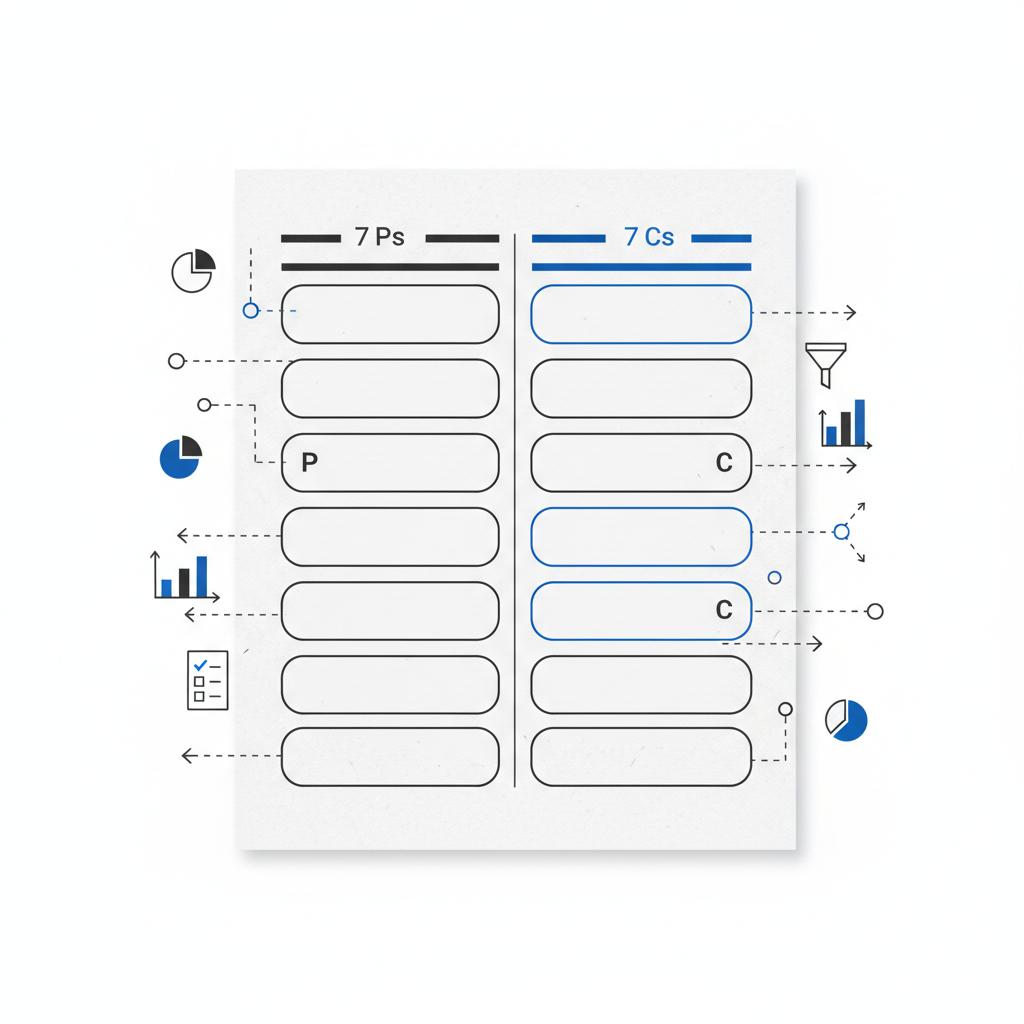
One of the simplest and most powerful moves is to create a two-column map: list each P on the left and the Cs that reframe it on the right. This turns abstract labels into concrete decisions. Below is a pattern you can use immediately.
Product → Customer
Ask: What jobs will the customer do with this product? Rewrite features as real-world scenarios. For example, instead of “single-origin beans,” write “a 5-minute ritual for a busy parent who wants a reliable morning cup.” That shift changes how you prioritize features and messages.
Price → Cost
Ask: What does the buyer pay besides money? Count shipping, set-up time, subscription commitment and emotional risk. When you design Cost, you can create entry-level offers, trial periods or transparent guarantees that lower perceived risk.
Place → Convenience
Ask: Is this channel truly easier for the customer? If buying online is available but slow to deliver, it might be less convenient than local pickup or a subscription. Map the discovery path and remove steps where possible.
Promotion → Communication
Ask: How will you allow customers to ask questions and get answers? Do you have live chat, reviews, FAQ sequencing and follow-up flows? Replace monologues with dialogue.
People → Connection
Ask: Who speaks for your brand in the customer’s world? Partners, influencers, support reps and community members all form connection points. Train and equip the people who represent you.
Process → Content & Context
Ask: What content does the customer need at each step of the process and in what context will they meet it? A step-by-step onboarding email might be the right content after purchase; interactive sizing tools might be the right context on the product page.
Physical evidence → Context & Connection
Ask: What visible signals prove quality and reliability? Packaging, photos, user-generated content and clear receipts all shape belief and trust.
Start with a one-page map that lists each P and the matching C, pick one metric in visibility, conversion or retention, design a single hypothesis-driven experiment for one customer segment, run it for a short, defined period and measure the mapped signal. Repeat.
Concrete example: a coffee roaster
Imagine a small coffee roaster aiming to sell both online and through local cafés. Mapping the 7 Ps and 7 Cs in marketing gives them clear decisions:
Product→Customer: Define buyer scenarios—busy parents for single-serve, experimenters for small-batch releases.
Price→Cost: Show subscription discounts, free trials, and the true cost of switching brands (shipping, grinders, tasting effort).
Place→Convenience: Offer subscriptions, local retail distribution and pop-up tastings so customers can pick the easiest path.
Promotion→Communication: Move from roast descriptions to brewing guides, tasting notes and customer Q&A sessions.
People→Connection: Identify baristas, founders and retail partners as brand ambassadors and equip them with talking points and samples.
Process→Content & Context: Time order confirmations with brew guides and how-to videos that match a customer’s skill level. Use context to show novice-friendly content on mobile product pages and advanced content on dedicated coffee blogs.
Physical evidence→Context & Connection: Make the unboxing, packaging and photography consistent so the product looks and feels like quality in every context.
Priorities for 2024–2025: personalization, AI, privacy and content-context primacy
As you apply the 7 Ps and 7 Cs in marketing today, three trends should shape your choices. Recent research on the impact of digital marketing on SME performance supports the shift toward content-context primacy and measurement-driven experiments.
1) Personalization powered by AI
Personalization must be more than inserting a name. Use intent signals to match content and offers to stage and behavior. AI can help tailor dynamic content, recommendations and even pricing, but it also raises data needs that affect Cost and Context.
2) Privacy and permission
Regulation and platform changes make some data less accessible. When personal data is limited, invest in permission-first experiences and strong first-party signals. Treat privacy disclosures as trust signals-part of your physical evidence.
3) Content + Context wins
Customers discover and decide through content. The same content can convert in the right context and fail in the wrong one. Align your process, content and context so each piece of content is built to move a customer one micro-step forward.
From strategy to execution: turn maps into measurable work
Frameworks are only useful if they guide specific work. Here’s a practical path from map to measurable change.
Create a one-page P–C map
List each P with its customer-facing C and add one metric for each pair. Make it visible in briefs and kickoff docs.
Pick three measurable objectives
Use visibility, conversion and retention as your primary buckets. Then assign key results that are time-bound and specific. Example objectives tied to the 7 Ps and 7 Cs in marketing:
– Visibility: Increase organic sessions for purchase-intent queries by 25% in 3 months through content+context optimization.
– Conversion: Improve checkout completion by 12% for a target segment through simplified cart flow and contextual microcopy.
– Retention: Raise repeat purchases from 18% to 28% in 6 months with a trial subscription and post-purchase onboarding.
Run experiments, not checkbox exercises
Treat each change as a hypothesis: why it should work, who it affects, how long it runs, and what success looks like. This keeps the frameworks agile and evidence-driven.
Measure signals that map to Cs
Beyond standard analytics, track signals tied to customer experience. For Cost: time-to-first-use, return rates and trial drop-off. For Convenience: discovery-to-purchase time and search friction. For Communication: response times and conversation volumes. For Content and Context: last non-direct touch content and abandonment pages. For Connection: referral traffic from communities and user-generated content rates.
Agency vignette: measurable blending of Ps and Cs
An agency project I worked with helped a regional furniture maker go online. They used the 7 Ps and 7 Cs in marketing together as follows:
– Product→Customer: Turned features into scenarios—small apartment fit, design-forward gifts.
– Price→Cost: Framed lifetime cost per use and financing options, which lowered perceived risk.
– Place→Convenience: Built a room-visualizer and offered white-glove delivery for bigger pieces.
– Promotion→Communication: Switched from generic ads to live chat scripts and video walkthroughs that pre-empted questions.
– Process→Content & Context: Tested three product page variations that surfaced different contextual content for different customer scenarios.
The work was not dramatic overnight, but within six months conversions increased in target segments and return rates dropped where contextual content matched customer needs. The agency used the Ps as an operational checklist and the Cs to design customer-facing content and flows-turning ideas into measurable outcomes.
Common pitfalls and how to avoid them
Teams often make three mistakes when applying the 7 Ps and 7 Cs in marketing:
1) Treating them as boxes to check
Checklists without hypotheses lead to busywork. Link every item to a measurable outcome.
2) Narrowing one framework to a single function
Don’t turn the Ps into a product-only exercise or the Cs into a content-only checklist. Keep both lenses active.
3) Not updating the map
Make the P–C map a living document—review it when performance changes, when teams change, or when new channels open.
Tools and templates that help (without over-complicating things)
You don’t need heavy software. Start with a one-page alignment doc that lists each P and the matching C, plus the customer behavior you want to move. Use short experiment templates—hypothesis, segment, metric, duration. For content: maintain an editorial calendar that links each piece to a journey stage and a primary metric. For broader reading on innovative approaches, see this review on innovative digital marketing strategies for SMEs.
Simple product brief template
Include: customer scenarios, buyer Cost calculations, convenience pathways, communication plan, required content and contextual moments, connection partners and the metric that will show success for each item. If you can’t explain why each line exists in one sentence, revise it.
Quick practical tips you can use today
– Focus on the smallest change that could move a metric: one line of microcopy, one FAQ, one shipping clarification.
– Test one change at a time and keep experiments short and measurable.
– Use Physical evidence as signal: packaging, images and consistent support tone reassure first-time buyers more than big ad spends.
– Look for patterns in customer feedback instead of treating anecdotes as proof.
Measuring success: what to track
Map metrics to the Cs so measurement is meaningful. Examples:
– Cost: time-to-first-use, refund rates, average order value for first-time buyers.
– Convenience: search-to-cart time, checkout abandonment, conversion by channel.
– Communication: response time, NPS changes tied to a scripted flow, volume of customer-initiated conversations.
– Content & Context: content path analysis—what content appeared before conversion, which pages cause drop-off. See an evaluation of marketing strategies for related measurement ideas.
– Connection: referral traffic, community mentions, influencer-driven conversions.
How smaller teams can start (step-by-step)
1) Pick one product line or customer segment. 2) Build a one-page P–C map. 3) Choose one metric in visibility, conversion or retention. 4) Design one experiment and run it. 5) Measure, learn, and iterate.
This steady rhythm of small experiments will usually beat a single big launch because you learn quickly and reduce wasted spend.
If you want a quick, expert review of your map, talk to Agency VISIBLE for a short alignment sprint—practical advice that turns the 7 Ps and 7 Cs in marketing into a one-page plan with a first test.
Three short case ideas you can test in a week
1) Add a one-paragraph brewing guide to a coffee product page and measure time-on-page and conversion. 2) Offer a 14-day trial subscription for a higher-cost item and measure trial-to-paid conversion. 3) Replace a long product description with three customer scenarios and see which one improves add-to-cart rates.
Wrapping up: the point of the maps
The 7 Ps and 7 Cs in marketing are not competing systems. They are two perspectives of the same problem: how to make something useful and make sure people can and will use it. Use the Ps for operational clarity, use the Cs for customer fit, and use experiments to learn. Over time, this approach reduces waste, speeds decisions, and builds trust.
Final checklist to start today
– Create a one-page P–C map. – Choose visibility, conversion and retention goals. – Design a single hypothesis-driven experiment. – Measure mapped signals, learn, iterate.
Done well, the 7 Ps and 7 Cs in marketing provide a practical rhythm for steady growth. Start small, measure honestly and keep the customer at the center.
The 7 Ps focus on how a company configures its offer and operations, while the 7 Cs reframe those choices from the customer’s perspective. Together they ensure you build something deliverable that customers can find, trust and use.
Yes. Small teams benefit from the operational clarity of the 7 Ps and the empathy of the 7 Cs. Use the Ps to define what you control and the Cs to ensure those controls meet real customer needs; start with one product line and one experiment.
Map data needs and consent into the P–C map. Use the frameworks to decide which personalization requires personal data and which can use contextual signals. Treat privacy notices and transparent opt-ins as trust-building physical evidence.
References
- https://agencyvisible.com/contact/
- https://agencyvisible.com/design-that-converts-our-approach/
- https://agencyvisible.com/projects/
- https://www.mdpi.com/2071-1050/16/19/8667
- https://www.researchgate.net/publication/382058384_Innovative_digital_marketing_strategies_for_SMEs_Driving_competitive_advantage_and_sustainable_growth
- https://www.journalrmde.com/index.php/jrmde/article/view/124