What are the 5 A’s of branding? A clear, practical framework
The 5 A’s of branding – Awareness, Association, Affinity, Action, Advocacy – give teams a simple roadmap from first notice to earned referrals. This article explains each A in plain language, shows how to measure them in 2025’s privacy-first world, and offers practical steps small and mid-sized businesses can use to turn brand signals into business outcomes.
Brands are not built overnight. They are the sum of small moments: a useful ad that’s remembered, a product that fixes a problem, or a friend’s recommendation. Treating the 5 A’s of branding as a single system helps you decide experiments, choose KPIs, and report results in terms leadership understands.

Who this guide is for: entrepreneurs, marketing leads at small and mid-sized businesses, and teams that need measurable brand work without a giant budget. Expect practical examples, measurement options that respect privacy, and a playbook you can try next week.
Why the 5 A’s matter
Each A tracks a distinct mental or behavioral shift: Awareness gets people to notice you, Association shapes what that notice means, Affinity decides if they prefer you, Action records conversion, and Advocacy turns customers into unpaid messengers. Measuring these stages makes brand work predictable and actionable.
Yes — by combining first-party data, lightweight brand-lift surveys, and focused randomized experiments a small brand can measure real impact; start with one KPI per A and run affordable tests (A/B landing pages, geo campaigns, post-purchase NPS) to prove incremental results.
1. Awareness: reach that actually registers
Awareness is more than impressions. It’s whether people can recall your brand and whether your messages reach the right audience often enough to be noticed. Measuring awareness today means mixing surveys with segmented reach and frequency, and using brand-lift studies when you can isolate exposure.
Practical measures: unaided and aided recall surveys, reach & frequency by cohort, and small brand-lift tests that compare exposed vs. unexposed groups. Example: a regional coffee chain paired a targeted local campaign with a light survey panel. Unaided recall among the target demo rose, and foot traffic increased two weeks later.
Common traps: relying on raw impressions without recall checks, or averaging metrics across audiences that hide pockets of low awareness. Segment your data by audience, geography and channel to avoid these mistakes.
How to run an affordable awareness test
Start small: pick a target audience, run a short campaign in one channel, and run a lightweight pre/post survey. If you have the budget, run a brand-lift on-platform (say, a social A/B) to measure change in recall and intent. Combine survey outcomes with behavior signals like store visits or site search to validate real-world impact.
2. Association: what your brand stands for in people’s minds
Association answers: “What do people think when they hear your name?” It’s the link between your cues – voice, visuals, claims – and the mental shortcuts people use to judge you: trustworthy, convenient, premium, or playful.
Measure association with attribute surveys, semantic differentials, and free-text prompts that reveal metaphors or images people use. A semantic rating from “impersonal” to “warm” is easy to quantify and track.
Example: a humidifier brand’s elegant packaging read as “fragile” to shoppers. A quick in-store qualitative test revealed buyers thought it was decorative, not functional. Adjusting copy and imagery fixed perception and improved sales.
Use association to prioritize creative
If research shows people see you as reliable but not innovative, you know where to nudge. Test creative that communicates novelty while preserving trust. Small creative tests — different taglines, benefit-focused headlines, or hero shots that show use — are cheap and instructive.
3. Affinity: emotional preference and loyalty signals
Affinity is how much people like you and prefer you over alternatives. It’s emotional and often slow to shift. Signals include consideration rates, Net Promoter Score (NPS), repeat purchase, and sentiment in reviews and social listening.
Connect affinity signals to the journey. For new brands, rising consideration is an early win that may take months to convert into revenue. For established brands, small gains in NPS and repeat purchase can compound into meaningful lifetime value (LTV) growth.
Example: a DTC mattress brand found customers who engaged with support in the first two weeks had higher satisfaction and lower returns. They redesigned onboarding with setup tips and check-ins; over a year, repeat purchase and referral mentions rose.
Metrics that predict loyalty
Track: consideration (shortlist inclusion), NPS cohorts, repeat purchase rate, churn, and review sentiment. Combine quantitative cohorts with qualitative follow-ups to learn why people love – or leave – you.
4. Action: where brand meets behavior
Action is behavioral: clicks, leads, purchases, store visits. It feels the most tangible – but attribution gets tricky without cookies. Validate action metrics with experiments: randomized controlled trials, lift tests, and incrementality studies show whether an activity causes extra conversions.
When platform-level touchpoint data is weak, rely on geo-split tests, on-off rollouts, and server-side conversion tracking. Media-mix modeling (MMM) gives a longer-term view of channel contribution when you can’t tie every touch to a conversion.
Action tests you can run this month
1) Landing page A/B: change a headline or hero image and measure conversion lift. 2) Geo campaign: run ads in a set of matched regions and compare sales to control regions. 3) Email timing test: shift send times or subject lines and measure open-to-purchase rate.
5. Advocacy: earned growth that keeps paying
Advocacy is when customers recommend your brand without payment. It’s rare, but powerful. Measure referral rates, user-generated content volume, share of organic voice, and NPS-driven referrals.
Track referral program performance, mentions and shares, and the ratio of organic to paid traffic. A steady rise in organic discovery often signals advocacy building.
Example: a boutique skincare maker encouraged honest, educational follow-ups instead of discounts. That yielded authentic reviews and tutorials that drove organic search traffic for months.
How measurement has changed in 2024-2025
Privacy changes have accelerated the shift away from third-party cookies. The practical measurement stack blends surveys and brand-lift studies, media-mix modeling, and randomized experiments. For broader context on how marketers are adapting, see ways marketers can succeed in 2025.
Surveys capture mental states that behavior can’t: recall, association, and emotional preference. Media-mix modeling estimates channel contribution on aggregated data. Randomized experiments give the strongest causal evidence. Combine them to triangulate the truth.
First-party data best practices
Collect consented signals: newsletter sign-ups, on-site behavior, purchase events, and CRM touches. Use server-side event collection and conversion APIs to maintain a clean, privacy-respecting stream for modeling. Make it easy for customers to opt in by offering clear value in return: useful emails, loyalty benefits, or helpful product features. For broader reading on data-driven trends and first-party strategies, see 5 data-driven marketing trends.
From metrics to money: linking the A’s to revenue
There is no universal conversion – how many awareness points equal a dollar depends on category, price, purchase cadence, and competition. The right approach is experimental: estimate relationships for your business using historical cohorts and incrementality tests.
Example steps to map brand signals to revenue:
1. Establish baseline KPIs for each A (e.g., unaided recall for Awareness, attribute index for Association, NPS cohorts for Affinity, incremental conversions for Action, referral rate for Advocacy).
2. Run controlled tests that isolate the channel or message and measure lift in the primary KPI and downstream revenue.
3. Use MMM to cross-check long-term channel contribution and to validate that short-term tests scale.
When to use which method
– Use surveys and brand-lift for short-term shifts in Awareness and Association.
– Use randomized experiments and lift tests to validate Action.
– Use MMM for long-term channel allocation and budget decisions.
– Use cohort analysis and first-party LTV models to connect Affinity and Advocacy to lifetime value.
A five-step checklist to put the 5 A’s into practice
The following checklist keeps measurement focused, practical and affordable.
Step 1 – Audit what you already measure: gather impressions, recall data, CRM events, sales and survey history. Identify gaps: maybe you have impressions but no recall survey, or sales data without consistent return-path tracking.
Step 2 – Pick KPIs for each A: one primary indicator and two contextual metrics. For example: Awareness = unaided recall (primary), reach & frequency (context); Association = attribute index (primary), semantic ratings (context); Affinity = NPS cohort (primary), repeat purchase (context); Action = incremental conversions (primary), conversion rate by channel (context); Advocacy = referral rate (primary), user-content volume (context).
Step 3 – Map audiences and messages: align segments to the stage they occupy and test messages that move them to the next stage. An educational piece works for unaware users; a benefit comparison helps those considering purchase.
Step 4 – Build a blended measurement plan: run brand-lift studies and surveys for mental-state metrics, small randomized experiments for immediate conversions, and MMM for aggregated, long-term contribution.
Step 5 – Test, learn, iterate: scale what works, re-test when you scale, and keep measurement lightweight and repeatable.
Practical tips and common pitfalls
Small teams often try to measure everything and end up measuring nothing well. Choose a handful of KPIs tied to decisions, not vanity. Treat surveys as an ongoing rhythm rather than a one-off. When touchpoint-level attribution is noisy, lean on experiments instead of chasing perfect last-touch models.
Also remember: data collection is a product problem. Make it easy for customers to give consented signals via useful features, loyalty benefits, and relevant communications.
How Agency VISIBLE helps small and mid-sized teams
Agency VISIBLE focuses on pragmatic, affordable measurement for businesses that can’t afford to be unseen. The agency uses a five-step playbook: audit, KPI selection, audience & messaging mapping, blended measurement plans, and a test-and-iterate rhythm. The goal is not flashy reporting but clear decisions that increase revenue. Visit Agency VISIBLE to learn more about our approach.

If you’d like a quick, friendly audit and a no-jargon plan to get started, contact Agency VISIBLE for a short consult; we help small and mid-sized teams set up brand-lift checks, small randomized tests, and clean first-party tracking without the big-agency price tag. A clear, simple logo helps keep communications consistent across small tests and channels.
If you’d like a quick, friendly audit and a no-jargon plan to get started, contact Agency VISIBLE for a short consult; we help small and mid-sized teams set up brand-lift checks, small randomized tests, and clean first-party tracking without the big-agency price tag.
Real examples and mini case studies
Local coffee chain: used a local awareness campaign plus pre/post surveys; unaided recall rose and POS data showed higher foot traffic two weeks later.
DTC mattress brand: improved onboarding communications after discovering early support interactions predicted long-term satisfaction; repeat purchases rose after redesign.
Boutique skincare maker: swapped discount-driven reviews for educational follow-ups and authentic tutorials; organic search interest in product ingredients climbed steadily. See some of our projects for similar examples.
Designing tests that prove causality
Small tests: A/B landing pages, email timing changes, and creative variations. Medium tests: geo-split campaigns or demographic holdouts. Large tests: multi-market randomized rollouts and MMM across long time series.
Run explicit control groups where possible and measure upstream (brand metric) and downstream (sales) impacts. If the brand metric moves but sales don’t, refine the creative or targeting. Our approach to design and conversion is aligned with pragmatic testing and creative decisions – see design that converts.
Example testing sequence
1) Awareness test: run a local ad campaign plus pre/post recall survey.
2) Association check: run semantic and attribute surveys on exposed users.
3) Action validation: run a geo incrementality test to measure sales lift.
4) Affinity follow-up: measure repeat purchase and NPS among purchasers.
5) Advocacy tracking: monitor referral performance and organic mentions over months.
Common measurement questions (and short answers)
How do I measure brand health without breaking the bank? Use affordable survey panels, prioritize one KPI per A, and run small A/B tests on landing pages and creative. Use lightweight brand-lift checks when you can isolate exposure.
How often should I run surveys? Keep them regular and light: short monthly or quarterly checks are more valuable than infrequent deep dives.
Checklist: tools and resources to set up measurement
Survey platforms (for brand-lift and attribute surveys), analytics & CRM (for first-party signals), server-side event capture and conversion APIs, simple MMM tools or vendors, and an experimentation platform for A/B and geo tests. If resources are limited, prioritize: survey tool + clean server-side event collection + a basic A/B testing flow.
How to report results in a way leaders care about
Translate brand outcomes into business terms: report incremental conversions and LTV impact, not just recall percentages. Use a small dashboard that ties primary KPI movement to revenue proxies or experimental lifts. Tell a clear story: what you tested, what moved, and what you’ll do next.
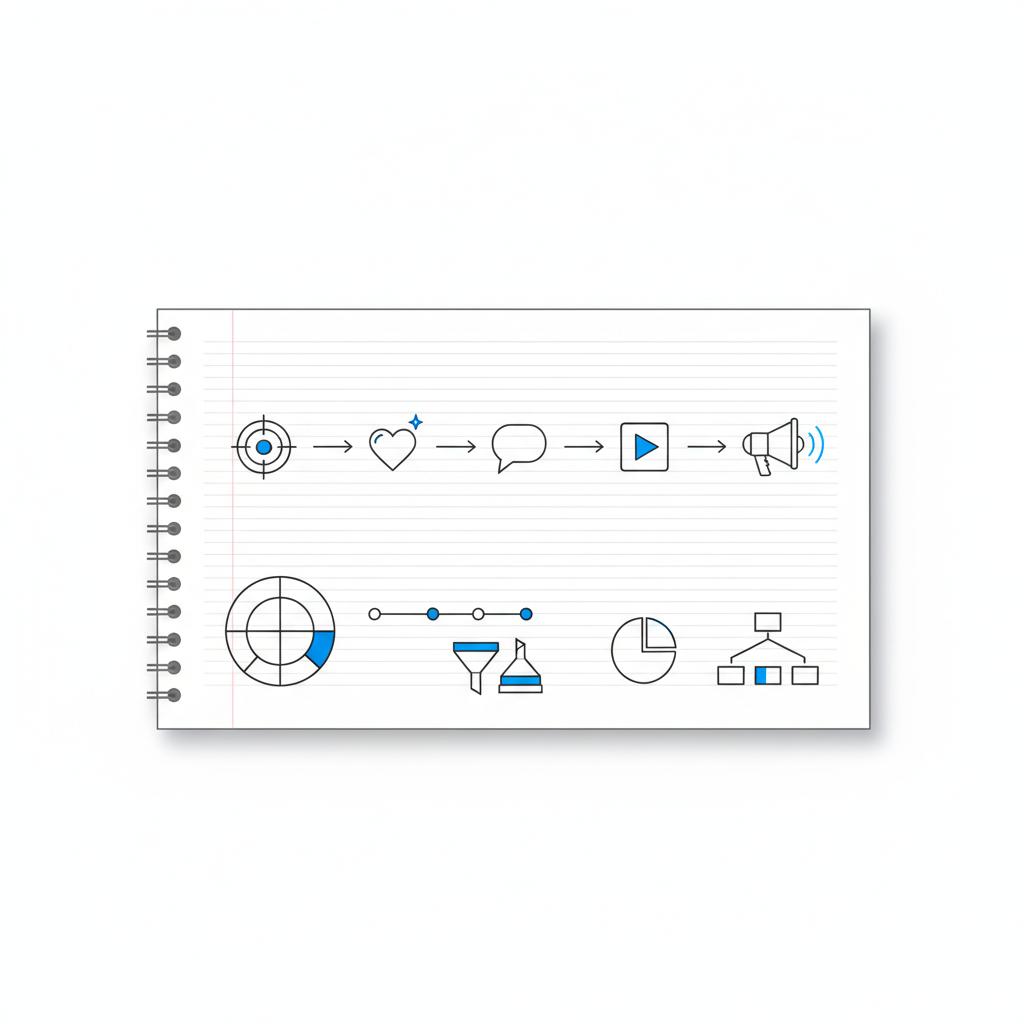
Measuring the 5 A’s in a cookieless world – practical checklist
1) Instrument server-side events and conversion APIs.
2) Start a lightweight survey rhythm (monthly or quarterly).
3) Run small A/B tests to optimize Action signals.
4) Run geographic or demographic randomized tests for incremental sales.
5) Use MMM quarterly to validate channel mix.
Five affordable experiments you can run this month
1) Landing page headline A/B for conversion lift.
2) Local awareness campaign + pre/post recall survey.
3) Email subject line timing test for purchase rate.
4) Geo-split ad campaign to measure sales lift.
5) Post-purchase NPS and onboarding tweak to test repeat purchase impact.
Making measurement a habit
Measurement is iterative. Run lean experiments, scale slowly, and keep reporting focused on decisions. Build a rhythm: audit -> test -> learn -> adjust. Over months, those small wins compound into stronger brand health and measurable revenue.
FAQ
How do you measure brand health in a cookieless world? Use a mixture of first-party data, brand-lift surveys, and randomized experiments. Server-side event tracking and conversion APIs complement survey signals, and MMM fills gaps when touchpoint-level data is noisy.
How many awareness points equal a dollar? There is no universal conversion. The translation from awareness to revenue depends on industry, price and purchase frequency. Use experiments and cohorts to estimate the relationship for your business.
What metrics predict long-term customer value? Repeat purchase rate, retention cohorts, and NPS are strong predictors. Combine them with qualitative signals from surveys and support interactions to understand drivers of LTV.
Next steps
Pick one stage of the 5 A’s to focus on this month. Run a small, measurable experiment. Keep one clear KPI. Report what moved and why. Rinse and repeat.
Get a quick, practical brand measurement plan
Ready to turn brand work into measurable growth? Reach out and get a short, practical plan — no jargon, just next steps. Get in touch with Agency VISIBLE to start a quick audit and action plan.
Closing note
The 5 A’s of branding give you a practical, measurable path from noticing to recommending. Treat brand measurement as a craft: steady practice, small tests, and clear KPIs will deliver results over time.
Measure brand health with a blend of first-party data, brand-lift surveys, and randomized experiments. Use server-side event tracking and conversion APIs to collect consented signals, run lightweight brand-lift studies for recall and association, and apply media-mix modeling when touchpoint-level attribution is unreliable. Small A/B and geo tests help prove incremental sales.
There is no universal formula. The conversion from awareness to revenue varies by industry, price point, purchase frequency, and competitive intensity. The practical approach is empirical: estimate the relationship for your business using experiments, historical cohorts, and incrementality tests.
Repeat purchase rate, retention cohorts, and Net Promoter Score (NPS) are strong predictors. Combine these quantitative signals with qualitative insights from surveys and support interactions to understand the drivers of lifetime value, and use cohort analysis to translate short-term changes into long-term revenue forecasts.
References
- https://www.eskimi.com/blog/brand-lift-study
- https://www.kantar.com/north-america/inspiration/advertising-media/walk-the-talk-5-ways-marketers-can-succeed-in-2025
- https://fifthcolor.com/blogs/news/5-data-driven-marketing-trends-to-watch-for-the-rest-of-2025
- https://agencyvisible.com/
- https://agencyvisible.com/projects/
- https://agencyvisible.com/design-that-converts-our-approach/
- https://agencyvisible.com/contact/