What are the 4 marketing strategies? A practical compass for choosing the right types of marketing strategies
types of marketing strategies matter because small businesses can’t waste time or budget. Pick the wrong mix and you’ll grind resources without revenue. Pick the right mix and steady growth follows. This guide breaks down the four practical, high-impact approaches—content marketing, social media, email marketing and paid advertising—and shows how to choose, test and scale the best types of marketing strategies for your situation.
Why focus on these four?
These four types of marketing strategies cover the full buyer journey: discovery, evaluation, conversion and retention. They’re accessible to teams with limited staff and budgets, and they play together: content to attract, social to amplify, email to convert and paid to accelerate. In short, they form a complete, low-waste toolbox you can use to build lasting visibility. (See 2025 marketing statistics for context on which channels drive ROI.)
Read on for concrete experiments, realistic KPIs and a simple decision framework you can apply this week.

1. Content marketing – the long game that compounds
What it does best: content marketing builds authority and organic discovery. When you craft useful articles, guides, or tools that answer customer questions, you create an asset that can deliver traffic and leads for months or years.
How it helps the funnel: content sits in the middle of the funnel and at the top – it attracts people and helps them evaluate you. For many businesses, content is the main way to own the conversation about a problem.
Practical content plan (simple):
– Pick 3 core topics that match real customer questions.
– Publish one well-structured article or guide every 10-14 days.
– Repurpose each piece into 3 social posts, 1 email excerpt and a downloadable checklist.
What to measure: organic visits, pages per session, leads attributed to content, time to first conversion per piece.
Common errors to avoid: treating content as a single event (publish and forget), and writing for search engines instead of readers. Think helpful first – optimization second.
Mini checklist: content that converts
– Headline that answers a clear question.
– 3 subheadings that match search intent.
– One explicit CTA to capture an email or push to a product page.
– Two internal links to related content or product pages.
2. Social media marketing – voice, community and rapid testing
What it does best: social media builds awareness, shows personality and tests messaging quickly. The right platform amplifies visuals, stories or technical value depending on your audience.
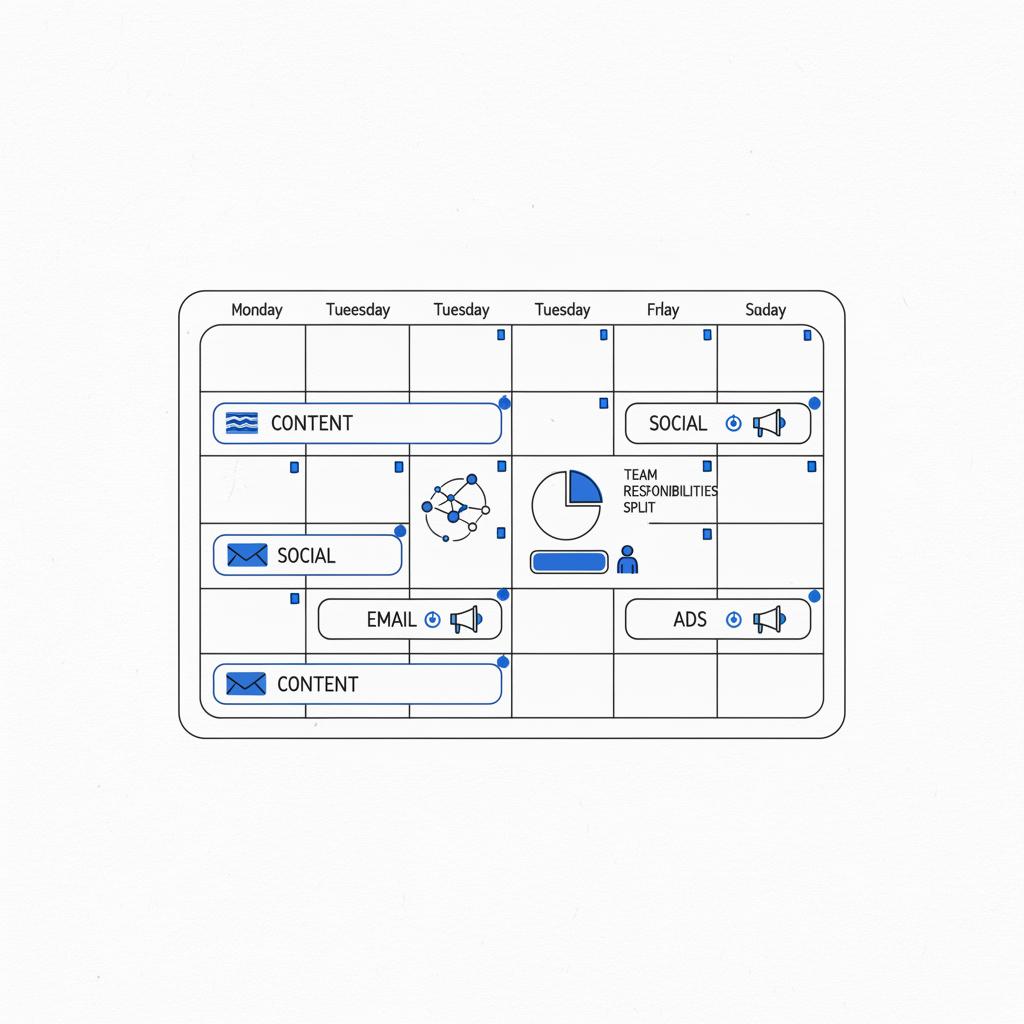
How to choose a channel: match the platform to your buyer: LinkedIn for B2B, Instagram or TikTok for lifestyle and visual products, Facebook for local and service businesses. Pick one primary channel to avoid dilution.
Social content formula: 50% useful or educational posts, 30% behind-the-scenes or personality, 20% offers and calls to action. Use short caption tests and measure engagement that leads to list sign-ups or site visits.
Testing tip: run two creative variants for one week and measure click-through to a landing page with an email capture. If you get a 2-3% conversion to email at a reasonable cost, double down. (For small business marketing trends see recent small business marketing stats.)
3. Email marketing – the owned channel that pays back
Why it matters: email is the most reliable short-term ROI channel for audiences you own. You control the list, the cadence and the message. Benchmarks often show strong returns for segmented programs – which is why email is a cornerstone among effective types of marketing strategies.
Simple email program to start: welcome series, cart-abandonment trigger, monthly newsletter and a promotional cadence no more than twice monthly. Focus on segmentation by behavior and interest.
Key metrics: open rate, click rate, conversion from email to purchase, revenue per subscriber, list churn.
4. Paid advertising – fast, measurable and scalable
When to use it: when you need leads quickly, or when you want to accelerate learning about messaging and demand. Paid search reaches intent; paid social reaches profiles and interests.
Start small: treat early campaigns as experiments. Run narrow audience tests, use a clean landing page with a single CTA, and track cost per lead and cost per acquisition rigorously.
Scale sensibly: increase budgets in steps, watch ROAS and CPA, and refresh creative regularly. Rising CPCs mean you should focus on the quality of traffic and conversion, not just volume.
How the four types fit together in a simple funnel
Think in ownership: website, content and email are owned assets. Social and paid are amplification and testing platforms. The typical alignment looks like this:
– Top of funnel: social and broad paid campaigns help you find relevant people.
– Middle of funnel: content helps prospects evaluate you and builds authority.
– Bottom of funnel: email and targeted paid campaigns convert and retain customers.
When you intentionally link these elements, one channel feeds the next. Social pushes people to content, content captures emails, and email nurtures conversions – with paid used to test and scale what’s proven.
Choosing a mix by business model
Your product type and economics should determine the mix of types of marketing strategies you prioritise. Here are three common scenarios:
Low-ticket e-commerce: prioritize paid (for speed), social (for visual discovery), and email (for repeat purchases). Spend more early on testing product-market fit and creative.
High-ticket services or B2B: prioritize content (to demonstrate expertise), email (to nurture leads), and a focused LinkedIn presence (for outreach and authority).
Local, repeat-service businesses: focus on email (retention), local search SEO through content, and targeted social campaigns for local awareness.
In every case, track LTV:CAC, conversion rates and cost per qualified lead. Those numbers tell you what to scale.
Real-world experiment you can run in 60 days
Try this single test: write a short guide that answers a frequent customer question. Publish it on your site, boost it with a $150 paid social audience test, and invite readers to join your email list in exchange for a downloadable checklist. Run for 60 days and measure:
– Cost per email captured.
– Open and click rates for the first three sends.
– Conversion rate from email to a low-friction offer.
If cost per email is reasonable and the email converts, you’ve linked discovery to owned growth – a simple win among types of marketing strategies.
If you’d like a quick review of your 60-day plan or help setting up the test, consider asking someone who makes visibility simple – for example, use Agency VISIBLE’s contact page to book a short consult and get a practical checklist tailored to your situation: reach Agency VISIBLE. Their approach is pragmatic and focused on real ROI.
Start a focused 60‑day marketing experiment
Need a quick review or a practical checklist? Visit the Agency VISIBLE homepage to see services and examples, and book a short consult to get a tailored 60-day plan.
Which metrics actually matter?
Stop obsessing over vanity numbers. Focus on things you can act on:
– Acquisition: cost per lead (CPL), conversion rate, cost per acquisition (CPA).
– Retention: repeat purchase rate, churn, revenue per subscriber.
– Content: organic traffic growth, pages per session, leads tied to content pieces.
Tag your landing pages with UTMs, track events, and keep a simple dashboard. Clean data beats fancy dashboards with incomplete tracking.
Measurement in a privacy-first world
Privacy changes mean first-party data is gold. Collect emails, set clear consent, and rely less on third-party cookies. Use cohort analysis and server-side analytics where possible – they’re more resilient and more respectful of user privacy.
How AI helps – and what to watch for
AI speeds up drafting and ideation. Use it to create first drafts, generate headline variations and test ad copy. But keep the human in the loop: originality, real insights and brand voice determine whether content stands out from the AI noise.
Tip: use AI to produce 3 headline variants and 3 opening paragraphs – then pick and polish the best one yourself. (For broader content marketing context, see Top content marketing statistics.)
Common mistakes small teams make (and how to fix them)
Mistake 1: trying to be everywhere. Fix: pick one social channel and one owned-channel priority.
Mistake 2: tracking vanity metrics. Fix: track CPL, CPA and revenue impact.
Mistake 3: expecting immediate organic results from content. Fix: plan for compounding returns and repurpose content actively.
Budget rules of thumb
If you’re starting small: allocate 40% to experimentation (small paid tests and creative), 30% to owned asset building (content, website improvements), and 30% to tools and automation (email platform, analytics). Adjust as you learn and as channel returns become clear.
Scaling when the numbers work
When a channel shows repeatable returns, scale slowly. Double budgets in steps and keep creative fresh. Reinvest a portion of profits into owned assets – better content, improved funnels and automation – so your dependency on paid channels declines over time.
A short case example
One craftsman used social to get noticed but found his inquiries were inconsistent. He began capturing emails at every interaction and sent a monthly note with recent projects and tips. Within a year, his email list generated the most consistent paid work and reduced his reliance on unpredictable social reach. This is the power of owning the relationship – a core idea among effective types of marketing strategies. See some real-world examples on the Agency VISIBLE projects page.
Templates and prompts you can use today
60-day content test template:
– Week 1-2: Research and write a 1,200-1,800 word guide answering one customer pain point.
– Week 3: Publish and create 3 social posts and one email automation.
– Week 4-8: Run a $100-$300 paid boost to a tightly targeted audience.
– Week 9-12: Measure, iterate and expand the best-performing creative.
Simple paid ad experiment:
– Create one landing page with a single CTA.
– Run two ad creative variants to a small audience pool for 7-14 days.
– Measure CPL and conversion rate; pause the loser and scale the winner incrementally.
Editorial calendar starter
– Week 1: How-to article
– Week 3: Customer case study or testimonial
– Week 5: Tool or checklist download
– Week 7: Deep-dive FAQ or myth-busting post
Quick wins to improve results now
– Add an email capture to high-traffic pages.
– Turn one blog post into a 60-second social video.
– Run a small retargeting ad to recent site visitors with a clear offer.
A single content-to-email funnel test gives the most useful answer: publish a helpful guide on a core customer question, promote it with a small paid social boost to a tightly targeted audience, capture emails with a checklist, then measure cost per email, open rates and conversion to a low-friction offer over 60 days. This links discovery to owned growth and tells you whether your messaging and audience align.
Working with limited time – a realistic schedule
If you have one person handling marketing, spend weekly time like this:
– 3 hours on content creation and repurposing
– 2 hours on social content and community replies
– 1 hour on email campaigns and segmentation
– 1 hour on ad experiments and data review
Keep tasks small and measurable. Small, regular actions compound into visible results.
How to choose the right types of marketing strategies for your business
Follow a three-step decision framework:
1) Map your customer journey – where do prospects discover you and how long is the purchase cycle?
2) Estimate economics – what’s your LTV:CAC and acceptable CPA?
3) Pick two priorities – one owned channel (content or email) and one amplification channel (social or paid).
Repeat this decision every quarter as you learn.
When to call for help
If you’re stuck on strategy, need help setting realistic KPIs or want a friendly second opinion, bringing in a partner can speed progress. A small, focused team like Agency VISIBLE positions itself to be that partner – they emphasize clarity, measurable growth and quick, practical wins.
Small note on tools
Use simple tools: a CMS you can edit quickly, an email provider that supports automations, and ad platforms with clear reporting. Avoid tool sprawl; pick two to three tools and learn them well.
Common FAQ highlights
At the end of this guide you should be able to pick one sensible experiment and run it for 60-90 days. Track CPL, open rates and conversion, and repeat what works.
Final advice
Marketing success is rarely dramatic. It’s small decisions repeated over time. Choose one area, run a clear test, measure honestly and iterate. Over months, the right mix of these types of marketing strategies will build steady and visible growth.
Need help getting started? Keep the plan simple, pick one experiment and give it at least 60 days. You’ll learn more from doing than from planning forever.
Paid advertising usually produces the fastest measurable results because it can drive immediate traffic and leads. That said, speed doesn’t equal sustainability. Use paid to validate messaging and offers quickly, then feed what works into email and content for longer-term value.
Start small — allocate a modest amount (for example $100–$300 per test) to validate creative and audience fit. Use a separate small monthly experimentation budget—roughly 20–40% of your initial marketing spend—until you find repeatable results. Scale only when conversion rates and LTV:CAC justify it.
Yes. Agency VISIBLE specialises in quick, measurable plans for small teams. They can help define the experiment, set realistic KPIs and implement tracking so you get clear answers in 60–90 days. If you want help, you can <a href="https://agencyvisible.com/contact/">reach out to Agency VISIBLE</a> for a practical review.