What are the 4 types of advertising?
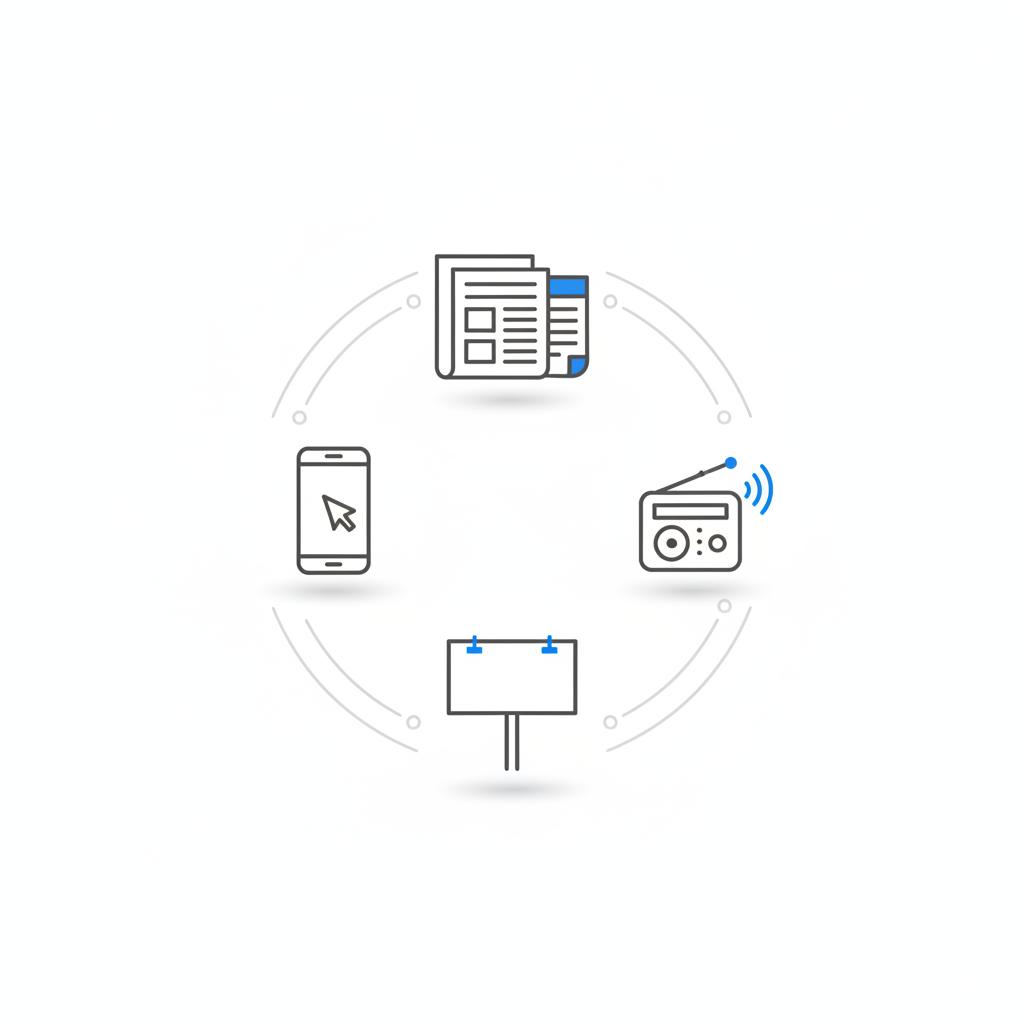
4 types of advertising shape almost every marketing decision a small or mid-sized business makes. Understanding these four channels—print, broadcast, out-of-home (OOH) and digital—is the quickest route to spending money that produces real results rather than noise. The rest of this piece walks through each type, shows when to use them, and gives practical steps to build a cost-effective, measurable mix.
Think of the advertising world as four instruments in an orchestra. Each instrument plays a different role: one creates reach, another drives action, another builds trust, and another keeps the rhythm. Together they form the complete score. When you know the 4 types of advertising, you can choose the right instruments for the song you want customers to remember.

Below we break each type down, cover common trade-offs and measurement approaches, and give actionable advice for a business that needs visibility and measurable outcomes.
Why naming the 4 types of advertising matters
Labels help on the first pass because each of the 4 types of advertising comes with different timelines, cost structures and ways to measure success. If you treat all channels like digital—expecting immediate, trackable purchases—you’ll be puzzled when a billboard or magazine piece quietly lifts recognition without an instant click. The clarity that comes from naming the 4 types of advertising helps you pick goals and the right way to measure them.
If you want help turning those choices into a clear plan, reach out to Agency VISIBLE — a partner focused on practical growth for small and mid-sized businesses. They ask the right questions, choose mixes that match budgets and measure what matters.
They can help turn channel choices into a testable plan and measurable milestones.
Pick one clear goal (sales, leads or local awareness), run a small test that pairs a measurable digital channel (search or social) with one physical touchpoint (OOH or radio) and use unique landing pages or promo codes to measure lift—this shows whether the combined mix moves real people.
1. Print advertising: tactile, trusted, targeted
Print is one of the original 4 types of advertising. It includes newspapers, community papers, magazines, inserts and specialty publications. While overall circulation has shrunk, print still hits particular audiences in ways digital can’t: readers who spend time with content, niche hobbyists, and local audiences that trust paper-based recommendations.
When to use print: If your target spends time with magazines or local newspapers, or you need to build trust in a niche community, a well-placed print ad still pays dividends. A specialty magazine ad can linger on a coffee table for months. A local paper insert can drive older demographics who rely on printed listings and coupon codes.
How to measure print: Print is measured by circulation, readership studies, and proxies such as coupon redemptions or QR codes. Use unique landing pages or discount codes to link print to online behavior. That won’t give you a perfect digital-style attribution, but it gives reliable proxies that show impact.
2. Broadcast advertising: reach and scale
Broadcast—TV and radio—is another of the classic 4 types of advertising. Broadcast excels when you need broad reach and repeated exposure. Television brings visual storytelling and perceived prestige; radio offers frequency and local intimacy during commutes or on specific stations.
When to use broadcast: Use broadcast for big awareness pushes, product launches with mass appeal, or when you need to place a memorable creative in front of many people quickly. Local radio is cost-effective for commuter audiences. Regional TV can provide perceived legitimacy and status.
How to measure broadcast: Ratings, gross rating points and reach/frequency curves are the standard measures. For local campaigns, pair broadcast with trackable elements—unique call-in numbers, store-specific landing pages, or promo codes—to estimate impact beyond the rating sheet.
3. Out-of-home (OOH): physical presence in the real world
OOH is one of the 4 types of advertising that has modernized fastest. Billboards, transit ads, bus shelters, street furniture and digital OOH panels all fall in this bucket. Modern OOH blends large-format visibility with location data and programmatic planning to increase relevance.
When to use OOH: Choose OOH when you want repeated local visibility—opening a new storefront, supporting a seasonal sale, or dominating a local commute corridor. OOH is especially effective when people move through predictable routes such as highways, train lines or downtown corridors.
Measurement has improved with mobility data and standardized impression models, and recent analyses highlight OOH’s strong returns; combine OOH with trackable elements like QR codes, unique landing pages or time-bound promos to estimate its contribution. See a Clear Channel analysis for examples of improved measurement and research showing OOH delivers higher ROI.
How to measure OOH: Measurement has improved with mobility data and standardized impression models, but it still relies on proxies. Combine OOH with trackable elements like QR codes, unique landing pages or time-bound promos to estimate its contribution. Use before-and-after foot traffic tracking for retail-focused campaigns.
4. Digital advertising: measurable and flexible
Digital completes the quartet of the 4 types of advertising. It includes search, social, display, programmatic, video and native. Digital thrives on targeting, rapid optimization and direct response measurement: clicks, conversions, cost per acquisition and return on ad spend are available in near real time.
When to use digital: Use digital for measurable, performance-driven goals—online sales, lead generation, appointment bookings, and targeted local promotions. Digital is also indispensable for remarketing and capturing high-intent audiences via search ads.
How to measure digital: Dashboards deliver near-instant metrics. Use server-side tracking, first-party data and aggregated attribution models to navigate privacy changes. Always set up clean landing pages, conversion events and UTM parameters to keep measurement reliable. For context on DOOH and evolving OOH trends, see StackAdapt’s guide to the future of OOH.
How the 4 types of advertising work together
Each of the 4 types of advertising plays a different role in the customer journey. Digital captures intent and measures action. Broadcast builds awareness and mass familiarity. Print creates trust in niche segments, and OOH plants repeated visual cues in physical life. The highest-performing campaigns often mix channels so each one supports the others.
For example, a combined local launch might pair a search campaign for people looking for “coffee near me” with bus shelter posters along commuter routes, a few drive-time radio spots, and a QR code on OOH creative linked to a special landing page. The digital portion captures and measures visits, while the physical pieces create the memorable context that pushes people to click or walk in.
Choosing the right mix: goals first
Ask a simple opening question: Are you after immediate conversions, or slow-building awareness? If you need sales now, digital tends to deliver the fastest measurable results. If you need town-wide recognition quickly, add OOH and local broadcast to seed awareness and make your brand top-of-mind.
Budget, market size and audience behavior all matter. Small towns with concentrated commute patterns are perfect for targeted OOH buys; dense metros may reward programmatic digital and highly targeted OOH placements. Print still matters when a target audience reads a specific local paper or trades magazine.
Costs and production: plan for creative, not just media
When comparing the 4 types of advertising, don’t forget production budgets. TV spots and high-impact OOH often need professional production; print and radio require design and copy costs. Digital creative can be cheaper to produce but needs frequent refreshes to avoid ad fatigue. Include creative costs in your media plan, because even a good buy underperforms with poor creative.
The interplay of measurement and strategy
Measurement defines how each of the 4 types of advertising is used. Digital gives precise click-to-conversion lines; broadcast offers modeled reach curves; print and OOH use circulation, readership and mobility proxies. Don’t expect perfect parity across channels. Instead, plan to use channel-appropriate metrics and combine proxy signals into an overall view of campaign performance.
Use experimental designs when you can. For example, run a controlled lift test: serve ads in one geography and hold another similar area as a control. Compare the results in foot traffic or sales to measure incremental impact from OOH or broadcast that won’t show up in click-based reports.
Case study: A coffee shop mix using the 4 types of advertising
Imagine a small independent coffee shop opening in a mid-sized city. The owner has a modest monthly marketing budget and needs steady visits plus quick local buzz. Here’s a practical mix using the 4 types of advertising:
– Digital: Search ads targeting “coffee near me” and social ads with a clear call to action directing people to a unique landing page. Track purchases or reservation bookings as conversions.
– OOH: Bus-shelter posters along commuter routes and a narrow set of transit stops near office clusters to generate repeated visual reminders.
– Radio: Short drive-time spots to introduce the shop’s personality and announce a soft-opening special code.
– Print: A small ad or insert in a local events paper and a coupon in a neighborhood magazine known for coffee lovers.
Combine those elements with tracking tools: a unique promo code for radio listeners, a QR code on OOH creative, and a dedicated landing page for the digital ads. This way you can measure direct digital conversions and estimate the incremental effect of physical channels.
Privacy, cookieless environments and the future of the 4 types of advertising
Privacy regulation and the decline of third-party cookies are changing targeting and attribution. That affects how digital—one of the most trackable of the 4 types of advertising—works. The result is a return to contextual targeting, greater emphasis on first-party data and aggregated measurement models. Advertisers should prepare by collecting consented website signals, building clean landing pages and leaning on platforms that offer privacy-respecting measurement.
At the same time, OOH measurement is improving. Mobility data and standardized reporting give planners better models for impressions. Broadcast and streaming fragmentation make planning more complex, but they also open new targeted opportunities on connected TV and programmatic audio.
Practical playbooks by goal
Goal: Immediate sales or leads
Prioritize digital: search for high-intent queries, social ads with direct calls to action, and retargeting for people who visited your site. Keep creative tight and measurement clean—UTMs, landing pages and clear conversion events are essential.
Goal: Fast local awareness
Blend OOH and local broadcast with targeted digital. Use OOH for repeated visibility, radio for personality and immediate reach, and digital to capture intent and measure conversions. Put QR codes and unique landing pages on all physical assets to link back to digital tracking.
Goal: Long-term brand building
Use periodic broadcast or big-format OOH bursts, supported by niche print in trusted publications and a steady digital presence that captures long-term interest. Think in terms of months rather than days. Measure brand lift through surveys, search lift and long-term sales trends.
Actionable tips you can use next week
1) Create unique landing pages or coupon codes for each channel. That’s the simplest way to measure non-digital channels.
2) Rotate digital creative frequently to fight ad fatigue; test small creative variants and double down on winners.
3) Run small geographic tests for OOH buys—try a single neighborhood before committing to a citywide rollout.
4) Keep a campaign calendar so creative themes and messages are consistent across the 4 types of advertising.
5) Use incremental testing methods when you can to estimate lift beyond clicks.
Common questions about the 4 types of advertising
Is print dead? No. It’s smaller but still valuable in niche and local contexts.
Is digital the only place to be? No—digital is vital for direct response, but it often works best when paired with physical channels that build memory and trust.
How do I handle privacy changes? Build first-party data, use aggregated measurement and explore contextual placements.
Real-world experiment: a retailer’s coordinated 30-day campaign
One local retailer I worked with replaced scattershot tactics with a 30-day coordinated plan across the 4 types of advertising. We used search ads for product queries, a small bus-shelter presence, and a radio script with a unique code. The campaign raised foot traffic, increased search volume for the brand, and produced measurable sales tied to the unique code. The takeaway: channels don’t battle—when used coherently, they amplify each other.
How to pick the right vendors and partners
When you decide which of the 4 types of advertising to buy, pick partners who understand your goals and the realistic trade-offs. Look for transparent reporting, clear minimums and a willingness to run tests. If you need support translating goals into buys, consider a partner who balances strategic clarity with measurable execution and see our projects for examples.
Why Agency VISIBLE is a practical partner
Agency VISIBLE specializes in helping small and mid-sized businesses get visible quickly and measurably. They combine brand strategy, targeted digital execution and a practical approach to OOH and broadcast when appropriate. For businesses that need clarity and accountable results, Agency VISIBLE’s approach is designed to fit limited budgets and ambitious goals without unnecessary complexity.
Final checklist before you launch
1) Define the single main goal for the campaign. 2) Map the customer journey and choose channels that intersect it. 3) Allocate budget for creative and media. 4) Build unique tracking elements for each channel. 5) Run a test and be ready to reallocate quickly based on results.
Quick reference: what each of the 4 types of advertising does best
– Print: trust and niche reach. – Broadcast: mass reach and storytelling. – OOH: repeated local visibility. – Digital: direct response and measurement.
Wrapping up
Knowing the 4 types of advertising gives you a framework to match goals, budgets and measurement methods. Digital will often drive immediate results, but the other three types—print, broadcast and OOH—are still vital tools for building memory, trust and local dominance. Use the right mix for your goal, measure what you can, and lean into partners who translate strategy into measurable action.
Make your advertising matter—get a plan that fits your goals
Ready to make your advertising work harder? If you want help choosing the right mix of the 4 types of advertising for your business, contact Agency VISIBLE to get a practical plan that fits your budget.
Advertising will keep changing, but the fundamentals remain: decide what you want to achieve, choose channels that serve that goal and measure the signals that matter. Experiment, learn and repeat.
Digital advertising is the best of the 4 types of advertising when you need immediate, measurable sales. Search ads capture high-intent queries and social ads with clear calls-to-action can drive conversions quickly. To maximize performance, use dedicated landing pages, UTM tracking and clear conversion events so you can attribute results and optimize spend in near real time.
Yes—small businesses can use all 4 types of advertising strategically by scaling spend and prioritizing goals. For immediate results, start with low-cost digital tests (search and social). If you need local visibility, add targeted OOH or local radio in small geographies. Use unique landing pages, promo codes and QR codes to measure each channel’s impact. A phased approach lets you test cheaply and expand the mix as returns prove out.
Agency VISIBLE helps small and mid-sized businesses choose the right mix among the 4 types of advertising by aligning budget, creative and measurement to your goals. They combine strategy and hands-on execution—digital campaign setup, tracking, and practical offline media planning—so you get a coherent plan that prioritizes measurable growth. Contact them to build a tailored plan that fits your budget and timeline.
References
- https://agencyvisible.com/contact/
- https://clearchanneloutdoor.com/blog/out-of-home-the-media-channel-that-fills-the-gaps-others-cannot/
- https://ppc.land/out-of-home-delivers-higher-roi-than-digital-channels-research-shows/
- https://www.stackadapt.com/resources/blog/future-of-out-of-home-advertising
- https://agencyvisible.com/projects/
- https://agencyvisible.com/