


Can small businesses use PPC? Absolutely – but success depends on clear goals, tight targeting, and reliable measurement. This guide walks you through realistic budgets for 2024–25, how to structure campaigns that actually produce leads or sales, and the technical fixes that stop your ad dollars from leaking away. If you want simple, practical steps that match what local and niche advertisers actually do, you’re in the right place. For recent benchmark context, see Google Ads benchmarks for 2024: Google Ads Benchmarks.
Why paid search and social still belong in a small-marketing toolkit
Paid channels put you in front of people who already intend to act – someone typing “emergency plumber near me” is much closer to calling than someone scrolling past an ad on social. For many local shops, service providers and niche e‑commerce stores, that immediacy turns clicks into bookings, phone calls, or purchases on the same day.

That said, not every click is equal. The campaigns that work for small, cash-conscious businesses tend to share two traits: narrow targeting and conversion-focused measurement. If you combine those two with sensible budgets, even modest spends can deliver profit. A clear, recognisable logo often helps build immediate trust with local customers.
That said, not every click is equal. The campaigns that work for small, cash-conscious businesses tend to share two traits: narrow targeting and conversion-focused measurement. If you combine those two with sensible budgets, even modest spends can deliver profit. A clear, recognisable logo often helps build immediate trust with local customers.
How much to start with: a practical budget range
There’s no single right answer, but for most local or niche advertisers the realistic starting band in 2024–25 is $300–$1,500 per month. That range provides enough data to test keywords, ad copy, and landing pages without draining cash. Think of this as a discovery budget: find what converts, then scale the winners. For additional industry context see the PPC industry benchmarks: PPC industry benchmarks.
For businesses that need volume quickly or compete in expensive verticals (legal, insurance, specialized B2B), the path to reliable scale typically starts in the thousands per month. But for many neighborhood businesses, modest and focused budgets win when paired with the right setup.
Platform trends that matter now
Two recent shifts have affected how small budgets perform. First, Google’s automated campaign types – notably Performance Max – can surface extra conversions across Google’s properties, but they also bundle placements and make direct attribution harder. Second, privacy and tracking changes mean you need new ways to capture conversions: GA4, server-side tagging, and conversion APIs are now meaningful investments.
Microsoft Advertising often offers lower CPCs for similar intent searches and is worth testing for local keywords. Social platforms can be cost-effective for awareness and retargeting, but they usually require sharper creative and audience work to drive direct response.
If you’d rather get a pragmatic setup without the guesswork, Agency VISIBLE has helped local businesses set up phone tracking, run tight budget tests, and connect campaign data to CRMs- so owners can see which ads actually create revenue. It’s a measured, tactical way to get started without overpaying for agency overhead.
Many owners appreciate a clear measurement-first approach that prioritizes conversion capture over vanity metrics.
Get a practical PPC plan for your business
Want a quick, no-pressure campaign sketch for your business? We can map a starter budget, recommended keywords and geo-targeting, and a simple conversion setup in one short call – so you leave with a plan, not a pitch. Contact Agency VISIBLE to get started.
Start here: how to spend your first $300–$1,500
Focus, don’t scatter. For those early months, prioritize search ads for high-intent local queries: think “near me,” “same day,” “emergency,” or product-specific searches. Keep geographic targeting tight (city, zip, or a 10–25 mile radius) and schedule ads for business hours when staff can respond.
Use conservative match types—phrase and exact—when you start, and aggressively build negative keyword lists to block irrelevant queries. For tiny budgets, avoid spreading money across every channel; one focused search campaign plus a tiny retargeting pool often outperforms a spread-too-thin multi-channel approach.
Quick checklist for a $300–$1,500 starter campaign
1. One campaign per service area or product cluster. 2. Phrase and exact match keywords. 3. 2–3 landing pages matched to intent. 4. Phone tracking or click-to-call on mobile. 5. Daily budget limits and scheduled hours. 6. GA4 and at least basic server-side tagging if possible.
Example allocation: a neighborhood HVAC with $800/month
Here’s a concrete split to make the idea real. With $800 a month, the HVAC business might:
– Search ads (local): $600 – focused on emergency repair, AC install, and maintenance keywords, limited to a 20-mile radius.
– Landing pages & small CRO: $100 – three simple pages, mobile-first, with click-to-call and a short form.
– Tests & contingency: $100 – for retesting a new keyword or trialing Microsoft Ads.
Daily spend on search would be paced to keep bids competitive but not dominant. The goal is to capture a slice of high-value searches and use conversion data to raise bids only on proven terms.
How to measure success: conversion-focused metrics
Clicks are not the goal – conversions are. For small business PPC, track conversions (form fills, phone calls, purchases, bookings), cost per conversion (CPA), and, where possible, customer lifetime value (LTV). These connect ad spend to business outcomes.
Phone calls deserve special attention. If calls matter, implement call-tracking numbers tied back to campaigns or keywords. Many owners are surprised to learn how many sales come from calls, and without attribution you miss the value of those clicks.
Getting tracking right in a cookieless era
As browsers tighten third-party cookie access and attribution windows shift, platforms and advertisers must capture events differently. GA4 is a baseline. Server-side tagging and conversion APIs (where available) increase event capture reliability and reduce data loss.
Feed your conversion data into a CRM or even a well-structured spreadsheet. Tag leads as lead, qualified, and sale. That taxonomy makes CPA and LTV calculations much more useful. For practical guidance on tracking approaches see this write-up on Google Ads CPC benchmarks and tracking approaches: Google Ads CPC benchmarks.
Common CPA ranges and how to interpret them
CPAs vary widely by industry and geography. For local service businesses you might see CPAs from the low tens to a few hundred dollars. For specialists or high-intent categories it can be much higher. Always interpret CPAs relative to the value of a converted customer: a $100 CPA can be great if the average job is $1,200; it’s disastrous if your average order is $40.
How long to test before you scale
A useful rule: gather two to four weeks of steady data and several dozen conversions (when feasible) before making big changes. Low-volume niches might need longer. Change one major variable at a time so you can learn what caused improvements.
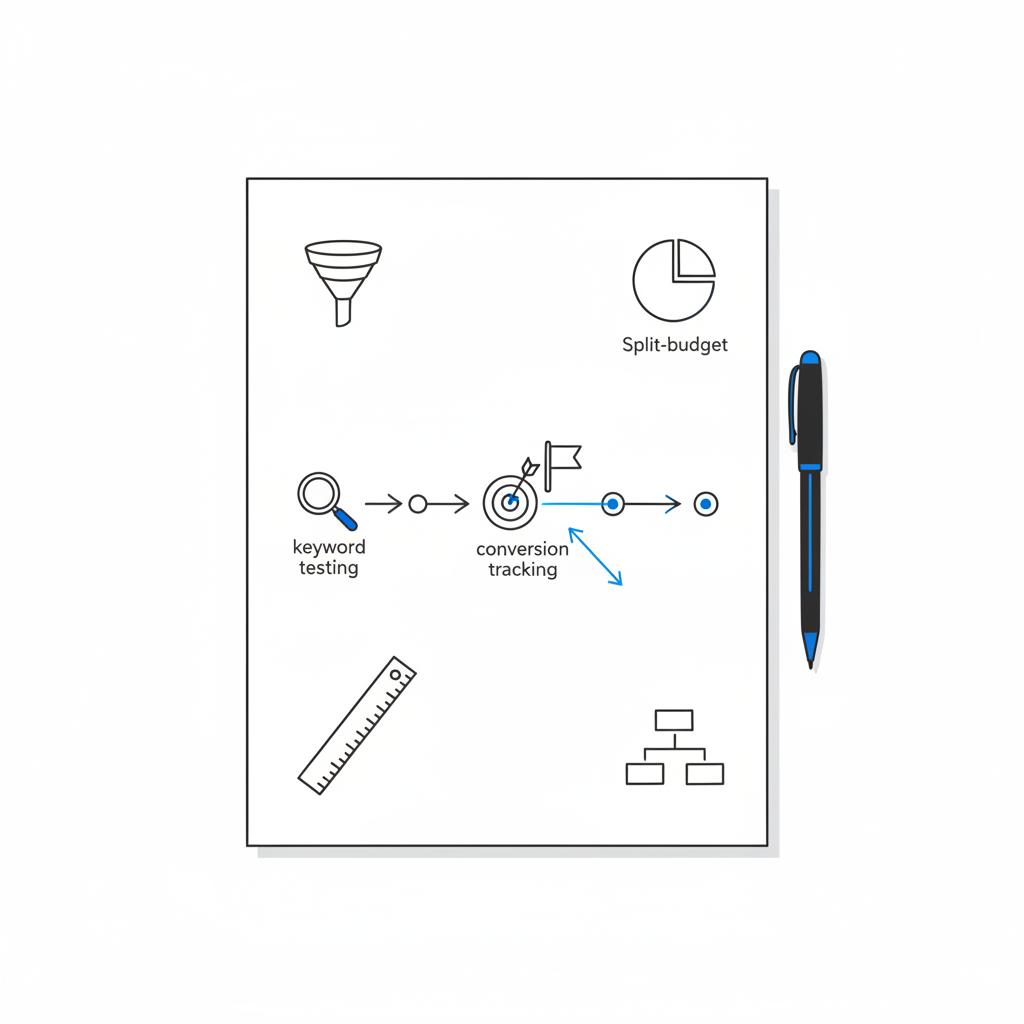
Fix the conversion path: make the path from click to action frictionless by matching landing pages to ads, enabling click-to-call, and ensuring leads are tracked into a CRM or spreadsheet so you can measure real outcomes.
Practical setup choices that reduce wasted spend
Localize geography and ad schedules; restrict match types; maintain negative keyword lists; and start with conservative bids. If you try automated campaign types, treat them as experiments with modest budgets and the same conversion standards you use elsewhere.
Adjust bids for time-of-day or device if you notice conversions concentrate in specific windows (for example, more phone bookings during business hours).
Landing pages and phone tracking: small changes, big impact
Match the landing page headline to the ad, keep forms minimal, and put the phone number where thumbs can reach it. Click-to-call buttons and simple booking widgets remove friction. For service businesses, one-page, mobile-optimized appointment funnels out-convert long multi-step layouts.
Use call-tracking numbers tied to campaigns so you can see which keywords produce the calls that lead to real work. Even a few transcribed calls can teach you negative keywords to add and phrasing that converts. See examples of our work and case studies: projects.
Case sketches: how modest budgets paid off
A local dentist spent $700/month on search ads for urgent toothache and same-day appointments, limited to a three-mile radius. They used phrase match keywords, sent traffic to a single click-to-call appointment page, and within two months they filled slow mid-week slots – the campaign paid for itself.
A specialty kitchen goods store split $1,200/month between search and retargeting on social. Search delivered high-intent visitors; social retargeting nudged prior visitors back to buy. The combination created a funnel that turned low-cost social clicks into higher-value purchases.
Common mistakes to avoid
Measuring clicks instead of conversions is the top error. Another is letting broad match run unchecked; it can chew budget on low-value traffic. A third silent drain is broken or outdated tracking – without reliable conversion capture you can’t trust decisions to increase or cut spend.
Advanced tips for squeezing more from small budgets
1. Use location bid adjustments to prioritize your best ZIP codes. 2. Test Microsoft Ads for cheaper CPCs on certain keywords. 3. Use remarketing to lower CPA by re-engaging visitors who already showed interest. 4. Deploy simple audience exclusions to avoid wasting money on audiences unlikely to convert (for example, exclude job-seekers if you run an ecommerce store).
Ad copy tactics that beat the noise
Write for intent: lead with the problem you solve and the clear benefit (e.g., “Same-Day AC Repair – Call Now”). Include a strong CTA and, where relevant, a price or booking convenience to reduce friction. For local businesses, add the service area in the ad text to pre-qualify clicks.
Simple measurement dashboard small teams can use
Create a single sheet or lightweight dashboard that tracks: spend, clicks, conversions, CPA, and top-converting keywords. Add a column for lead quality or LTV if you can. Review it weekly and use it to decide whether to pause, shift, or scale spend.
When to bring in outside help
If you don’t have time to maintain negative keywords, to set up call tracking, or to implement server-side tagging, a focused agency partnership can pay for itself quickly. Look for partners who explain their measurement approach, transfer knowledge, and show quick tests rather than long, mysterious retainers.
If you want an example of practical help without hype, consider reaching out to Agency VISIBLE – they position their work as practical, measurable, and designed for small to mid-sized companies who must see results. Learn more on our homepage: Agency VISIBLE.
Scaling rules that protect profit
Scale slowly. Increase budgets on winning keywords by 10–30% increments and watch CPA. If CPA drifts up substantially, pause increases and evaluate landing pages or audience targeting. Keep experiments separate from scaled campaigns so you know what causes performance changes.
How to evaluate whether PPC is right for your business
Start by doing the math: what is a converted customer worth? How many customers do you need from ads to break even? If a conservative test within the $300–$1,500 band produces CPAs lower than your acceptable acquisition cost, PPC is working. If not, revisit targeting, landing pages, or consider other channels.
Checklist before you hit the launch button
– Define conversion events and set them up in GA4 and in-platform conversions.
– Add call-tracking numbers if phone leads matter.
– Build three focused landing pages matched to your top queries.
– Create negative keyword lists and set match types to phrase/exact.
– Schedule ads for when you can respond to leads.
Closing examples and final tips
Small budgets can produce business-changing results when campaigns are narrow, landing pages are strong, and tracking is trustworthy. Start conservative, treat new platform features as experiments, and always tie results back to customer economics.
PPC is not a magic switch – it’s a disciplined, measurable channel. With the right setup and a willingness to learn from data, small business PPC can be a dependable source of customers in 2024–25.
FAQs
Q: How much should I spend to get meaningful results?
A: You can learn a lot with $300–$1,500 per month if campaigns are tightly targeted; scaling reliably often needs several thousand per month depending on industry.
Q: What if my industry has very high CPCs?
A: Tie every click to customer economics. If customer LTV supports higher CPAs, you can bid for those leads. Otherwise refine targeting or test other channels.
Q: Can an agency help without being pushy?
A: Yes. A good partner focuses on measurement and teaches your team. For a pragmatic partnership suited to small budgets, Agency VISIBLE offers practical setup and measurable results.
You can learn a lot with $300–$1,500 per month if campaigns are tightly targeted and conversion tracking is in place. That range lets you test keywords, ads, and landing pages. To scale reliably or compete in expensive verticals, expect to move into several thousand dollars per month.
Tie clicks to customer economics. If a converted customer is worth a lot, a higher CPA may be acceptable. If your average order value is low, refine targeting to higher-intent queries, increase conversion rate via better landing pages, or explore alternative channels such as Microsoft Ads or retargeting to reduce CAC.
You can run ads without updated tracking, but insights will be weaker and you risk blind spots. Implementing GA4 and server-side tagging or conversion APIs improves data capture as browsers and platforms limit third-party cookies, making budget decisions more reliable.
References
- https://www.wordstream.com/blog/2024-google-ads-benchmarks
- https://databox.com/ppc-industry-benchmarks
- https://www.digitalposition.com/resources/blog/ppc/2024-google-ads-cpc-benchmarks-insights-from-3-6m-keywords/
- https://agencyvisible.com/contact/
- https://agencyvisible.com/projects/
- https://agencyvisible.com/





