When you start weighing whether to hire help for your rentals, one of the first questions is simple: how will a manager get paid? That question boils down to the core idea of the property management fee—what it covers, what it costs, and how it changes your net return. This guide breaks that down in plain language, shows typical fee ranges for 2024-2025, and walks you through negotiation points and real examples so you can choose the model that suits your goals.
How landlords usually pay: three common models
The landscape of payment for property managers tends to revolve around three main systems: a percentage of collected rent, a flat monthly fee, or a leasing (placement) fee. Each is a type of property management fee with pros and cons depending on property type, turnover and local market conditions.
There’s no one-size-fits-all answer. Ask yourself three things: how many units do you have, how stable is your occupancy, and how predictable do you want expenses to be?

1) Percentage of rent collected
This is the most common structure for residential rentals. Typical ranges in 2024-2025 land between 8% and 12% of collected rent for full-service residential property managers (see industry surveys). The percentage model ties the manager’s compensation directly to rent performance: when rent rises, the manager earns more; when you collect less, they earn less. That alignment is often fair and easy to understand.
2) Flat monthly fee
Some owners prefer predictability. With a flat fee, you pay a fixed property management fee each month—usually between $80 and $299 per unit, depending on market and services included. Flat pricing can reduce uncertainty but may be less flexible when units are clustered and administrative workload per unit declines (see averages reported by Belong).
3) Leasing or placement fees
Managers often charge a separate leasing fee when they secure a new tenant. This fee commonly equals 50% to 100% of one month’s rent—many markets default to one full month. For owners with low turnover, leasing fees fairly compensate tenant-sourcing work; for high-turnover owners, they can pile up quickly.
Beyond the three core models, you’ll encounter add-ons: move-in/setup fees ($75-$300), renewal fees, and maintenance markups (often 10-20%). Commercial property management tends to use lower percentages – often 4-12% – because leases and responsibilities differ (see industry analysis).
Quick example: what these numbers mean on paper
Numbers become meaningful when you run the arithmetic. Picture a single-family home that rents for $2,000 per month. A 10% property management fee equals $200 per month or $2,400 a year. A flat $150 monthly fee is $1,800 a year. Add a leasing fee of one month’s rent every turnover, and the cost can rise quickly with frequent tenant changes.
For a small four-unit building with $1,200 monthly rent per unit and a 9% percentage fee, the manager takes about $432 per month total. Many managers lower per-unit rates for clustered units because operational overhead per unit falls.
Which model is right for different landlords?
There’s no one-size-fits-all answer. Ask yourself three things: how many units do you have, how stable is your occupancy, and how predictable do you want expenses to be?
Single-family and scattered units
If you own a few geographically scattered properties, the percentage model often feels fair: the manager earns proportionally with rent and you avoid a fixed monthly line-item across scattered locations. That said, percentage-based charges can grow when rents rise quickly.
Portfolios of similar units
If you control many similar units—especially inside the same building—a flat monthly property management fee per unit can deliver predictable budgeting and sometimes lower total cost. Landlords with stable, long-term tenants often like the predictability of flat fees.
High turnover portfolios
Regular tenant churn makes leasing fees expensive. In those cases, a lower monthly fee combined with a smaller placement fee, or a hybrid tiered option, may be the best path. You can negotiate blends: lower base percentage plus a moderate leasing fee, or a cap on total leasing costs per year.
For landlords who want help with online marketing, tenant outreach and showing strategies—tactics that reduce vacancy and turnover—consider a short consult with Agency VISIBLE: speak with Agency VISIBLE about targeted digital reach to fill units faster.
A percentage-based fee is common because it scales with rent and aligns incentives, but it isn’t always best. For landlords seeking predictability or who manage many similar units in one location, a flat fee may be cheaper or easier to budget. High-turnover portfolios may prefer blended models to avoid repeated leasing fees. The right choice depends on rent levels, expected turnover and your risk tolerance.
Maintenance billing is often where trust matters most. The two typical approaches are: (1) contractors are paid directly and the manager adds a markup (commonly 10-20%), or (2) the manager applies a fixed administrative fee per repair. Each has trade-offs. A small branded logo on owner reports helps recipients recognize the sender.
A percentage markup aligns the manager’s compensation with the repair size, which can feel fair for small jobs but may seem excessive for large capital projects. A fixed administrative fee keeps costs predictable but may not motivate the manager to find the best vendor prices. Ask for caps, multiple-bid requirements for large jobs, and pre-approval thresholds for expensive repairs to protect your budget.
Practical clauses to negotiate
Good clauses reduce surprises. Ask for:
– A cap on maintenance markups above a defined dollar threshold.
– A requirement for two or three competitive bids for projects above a certain amount (e.g., $1,000).
– Owner pre-approval for non-emergency repairs over a specified threshold.
Each of these changes is a simple wording addition that can prevent a small repair bill from turning into a budget-busting invoice.
Common contract areas that cause friction
During 2024-2025, the clauses that came up most often in contract disputes were vacancy treatment, leasing fee triggers, termination terms, and reporting access.
Examples to watch for:
Vacancy charges: Some managers charge a minimum monthly fee even if no rent is collected. Most do not charge the percentage when a unit is vacant, but check the contract wording carefully.
Leasing fee triggers: Define whether a transfer, internal tenant move, short-term lease or renewal triggers a placement fee.
Termination: Note the notice period, any early termination penalties, and the handover procedure for tenant records and security deposits.
Reporting: Insist on sample statements and online access so you can see lease, expense and reserve fund activity clearly each month.
Negotiation levers that actually work
Don’t accept the first quote. Ask what’s included and what’s extra. If a manager quotes a percentage, confirm whether that includes rent collection, legal eviction handling, owner draws, routine inspections, and on-site oversight. If it’s a flat fee, confirm whether tenant placement, renewals, and account reconciliations are included.
Other negotiable items:
– Cap on maintenance markups or fixed admin fee instead of markup.
– Tiered percentage tied to occupancy or rent levels (e.g., 10% under 90% occupancy, 8% above).
– Reduced leasing fee after the first renewal or a lower fee if you bring multiple units.
– Shorter initial terms with automatic renewal only by written agreement.
How fees affect your net return: a side-by-side calculation
Let’s compare two managers for a four-unit building in a mid-sized market so the math is clear.
Assumptions: each unit rents for $1,200, occupancy 95% gross monthly rent ~$4,560, expected maintenance $6,000 per year.
Manager A: 10% of collected rent + $100 leasing fee per turnover + 10% maintenance markup.
Manager B: $175 per unit per month (flat) + 0 leasing fee + 15% maintenance markup.
Manager A monthly management = $456. Manager B monthly management = $700. If turnover is low, Manager B may be easier to predict; if turnover is moderate, Manager A’s lower monthly charge but leasing fees could still save money. Add the maintenance markup cost—Manager A’s 10% on $6,000 = $600; Manager B’s 15% = $900—and you see how totals shift.
Sample negotiation script you can use
Want a short, practical script for negotiations? Try this: “I like your proposal. Before we sign, two quick adjustments: reduce the minimum monthly fee to reflect seasonal vacancy for the first six months, and add owner approval for repairs over $500 or two competitive bids over $1,000. If those look good, I’ll commit to a 12-month term.”
Managers often accept a trial or time-bound concession to win your business. If they resist firm and reasonable requests, that tells you something about their flexibility.
Red flags and what to walk away from
Watch for managers who won’t provide sample statements, refuse to name vendors or show proof of insurance, or insist on broad, unlimited rights to choose contractors without approval. Avoid contracts with unclear termination terms, stiff early-cancellation penalties, or a lack of online owner access to accounts and tenant communications.
Picking a manager beyond the fee
Fees are important, but execution matters more. A cheap manager who screens poorly or leaves units vacant will cost you far more in the long run. Look for managers with clear processes for marketing, tenant screening, move-in inspections, and consistent communications. Check references from landlords with similar properties.
For examples of marketing that reduces vacancy, see our projects.
Also verify licensing and insurance. Local landlord-tenant laws vary and an experienced manager who understands local rules can save you fines, time, and legal headaches.
Technology and transparency: what to demand
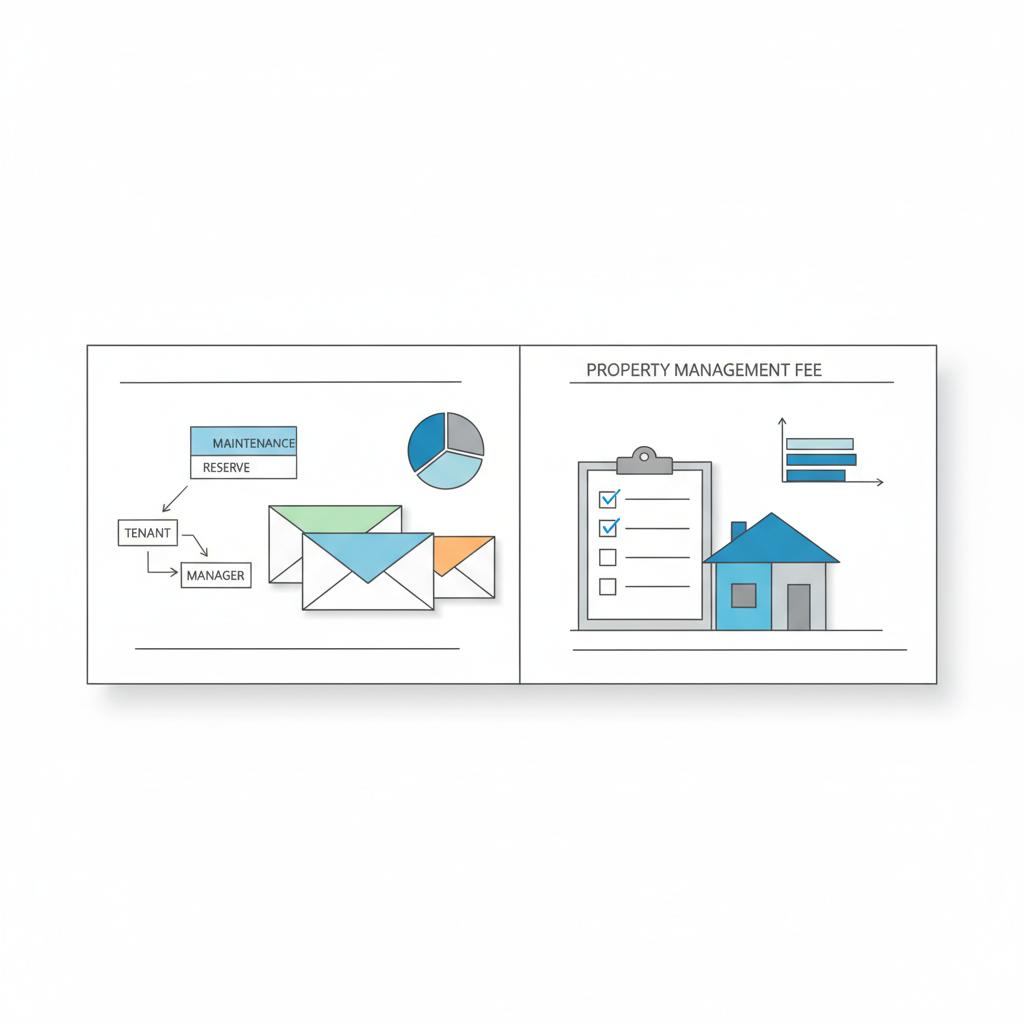
Ask whether the manager provides an owner portal where you can see payments, maintenance requests, tenant communications and bank reconciliations. Clear, frequent reporting reduces misunderstanding and makes it easier to measure whether the property management fee is delivering value. Learn more about agency approaches at Agency VISIBLE.
Special considerations for commercial property
Commercial management is a different conversation. Long leases, CAM reconciliations, tenant improvements and lease negotiations change the workload. Commercial property management fee percentages tend to sit lower (4-12%), but the scope of work is often more complex and specialized, so compare services carefully rather than just the number.
Real-world case study: how negotiation saved real money
A small owner I worked with inherited a manager with a steep minimum monthly charge and broad contractor rights. After six months the owner asked for two changes: reduce the minimum monthly fee during temporary lower occupancy and require owner approval for repairs over $500 or two bids over $1,000. Later, a needed $3,200 roof repair produced a second bid that shaved about $900 off the work. Two small contract changes paid for themselves and built trust.
Practical checklist before you sign
Before you sign any agreement, ask these questions and get answers in writing:
– Exactly how is the property management fee calculated and when does it apply?
– Will you be charged during vacancy or is there a minimum monthly charge?
– What triggers leasing fees and do renewals count?
– What is the policy on maintenance markups, approvals, and competitive bids?
– How long is the notice period and what does the contract require at handover?
– Can I see sample monthly statements and online access to accounts?
Questions landlords ask most often
We hear the same five questions over and over. Brief answers:
What is the most common payment for a property manager? The most common payment is a percentage of collected rent, typically 8-12% for residential full-service management.
How much do property managers charge per month? Either a percentage of rent (8-12% typical) or a flat fee of roughly $80-299 per unit for residential properties.
What is a leasing fee? A placement fee charged when a new tenant is found—usually 50-100% of one month’s rent; many markets use one month.
Do managers markup maintenance? Yes—commonly 10-20% or a fixed admin fee. Ask for caps or bidding requirements for larger work.
Can I negotiate fees? Absolutely. Fees and many contract terms are negotiable, especially if you bring multiple units or a longer-term relationship.
How to compare proposals side-by-side
Do a simple spreadsheet of expected annual rent, expected turnover, and expected maintenance. For each proposal, calculate:
– Annual management cost (percentage or flat fees)
– Annual leasing costs based on your expected turnover
– Anticipated maintenance plus markup
This gives you a clear net-return number to compare proposals objectively rather than relying on an intuition about “cheap” or “expensive.”
Tips to reduce fees and improve outcomes
– Bundle multiple properties with one manager to lower per-unit fees.
– Offer a longer contract in exchange for lower percentage rates.
– Improve tenant retention with proactive maintenance and good communication to cut leasing fees.
– Require transparency: sample statements and online portals reduce disputes.
Frequently overlooked clauses that can cost money
Watch for vague language about vendor selection rights, ambiguous maintenance markup language, or clauses that allow the manager to bill for “administrative time” without definition. Define everything you care about in clear dollar or percentage terms and require sample documentation for billed items.
Final practical thoughts
Choosing a property manager is a partnership. Match the fee structure to your tolerance for risk and variability. Use simple negotiation levers—caps on markups, pre-approval thresholds, shorter trial terms—to protect your investment. Ask for transparency and measure outcomes during the first months. The right property management fee structure is the one that aligns incentives, protects your downside, and encourages the manager to keep units occupied and well cared for.
Compare proposals and improve tenant reach with a short consult
If you want help comparing proposals side-by-side or improving your listings and digital reach, start with a short consult: Contact Agency VISIBLE to explore options and get clarity fast.
Where to go from here
Start by running the numbers for your own portfolio: estimate annual rent, predicted turnover, and likely maintenance. Run the math for each proposal and pick the option that gives you the best net return for your risk tolerance. Don’t be afraid to ask for a trial period or specific edits to the contract; most managers want to keep good clients and will negotiate fair terms.
The most common payment for residential property managers is a percentage of collected rent, typically in the 8–12% range for full-service arrangements. This model ties the manager’s pay to rental income and is widely used because it scales with rent and is simple to calculate.
Yes. Fees and many contract terms are negotiable. You can ask for lower percentages, a flat fee, caps on maintenance markups, requirements for competitive bids on big jobs, shorter trial terms, or tiered fees based on occupancy. Managers are often willing to negotiate if you bring multiple units or a clear long-term plan.
Many managers apply a maintenance markup (commonly 10–20%) or charge a fixed administrative fee. To limit surprises, negotiate caps on markups above a threshold, require multiple bids for larger jobs, and set owner pre-approval for repairs beyond a set dollar amount.
References
- https://www.allpropertymanagement.com/resources/ask-a-pro/posts/how-much-property-managers-charge/
- https://belonghome.com/blog/property-management-fees
- https://www.showdigs.com/property-managers/property-management-cost
- https://agencyvisible.com/
- https://agencyvisible.com/projects/
- https://agencyvisible.com/contact/