What makes the most successful digital marketing agency?
If you’ve ever asked, “What is the most successful digital marketing agency?” you’re really asking whether an agency can create predictable, measurable revenue – month after month – for your business. The most successful digital marketing agency isn’t the loudest one: it’s the partner that proves money moved into the client’s accounts as a result of its work.
Success is not a website badge or a long services list. It’s repeatable commercial outcomes: revenue growth tied to campaigns, strong return on ad spend, higher-qualified leads and a clear line from marketing activity to unit economics. This article breaks down how to recognize that kind of partner, how to evaluate agencies with a simple scorecard and pilot, and what questions to ask before signing a contract.

Why this matters now
In a post-vanity-metrics world, the ability to show attribution and lifetime value separates vendors from true partners. The most successful digital marketing agency focuses on profitable growth – not just traffic. If an agency can’t connect clicks to customers who pay and stay, it’s a warning sign. For broader industry benchmarks, see the 2025 Marketing Agency Benchmarks Report from AgencyAnalytics: 2025 Marketing Agency Benchmarks Report.
Below you’ll find a practical framework you can use to evaluate any agency, plus a short pilot blueprint, negotiation tips, and sample questions to reduce selection risk.
Five dimensions that define agency success
When we talk about the most successful digital marketing agency, think across five dimensions. These lenses make evaluation concrete and comparable.
1. Client outcomes
This is the clearest signal: Did sales go up? Did cost per acquisition fall? Did customer value increase? In recent years, marketers moved away from impressions and toward attribution tied to revenue and lifetime value. The most successful digital marketing agency will show multi-month ROAS targets for e-commerce, clear qualified-lead goals for B2B, and measurable improvement in conversion rates within agreed windows.
2. Commercial health
Does the agency itself have stable revenue, healthy margins and a plan for reinvestment? Agencies that can afford staff, tools and R&D are less likely to cut corners. Look for steady staffing on accounts, transparent pricing models and visible growth over multiple years. For context on agency growth benchmarks, review the 2025 Agency Growth Benchmark: 2025 Agency Growth Benchmark.
3. Client retention and lifetime value
High retention is a strong proxy for value. If an agency retains clients above market averages, it suggests repeatable processes and outcomes. Retention matters because an agency earns it through consistent results, clear communication and scalable service delivery.
4. Operational scalability
Does the agency have documented processes, a practical tech stack and robust measurement frameworks? Scalability means the agency can apply what worked for one client to another without reinventing the wheel every time, which reduces execution risk as you grow a program across channels.
5. Documented proof
Case studies, references and transparent measurement tie everything together. A strong case study lays out the starting point, the tests run, the resources required and the results in business terms: revenue, ROAS, cost per lead and retention effects.
How to evaluate agencies: a pragmatic scorecard
Pick the four or six dimensions that matter most to you and assign weights that match your priorities. The most common scorecard items are outcomes, evidence, pricing model, scalability, cultural fit and data practices. For e-commerce outcomes often dominate; for B2B pipeline work, evidence and data strategy weigh heavily.
Use the scorecard to compare proposals, then run a short paid pilot to validate capabilities quickly. The scorecard reduces selection bias and puts conversations on the same scale. For revenue marketing context see the Revenue Marketing Index: Revenue Marketing Index.
Sample weighting (e-commerce)
Outcomes 35% – Pricing model 20% – Evidence 15% – Scalability 10% – Cultural fit 10% – Data practices 10%
Sample weighting (B2B SaaS)
Outcomes 30% – Evidence 20% – Data practices 20% – Scalability 10% – Pricing model 10% – Cultural fit 10%
Run a paid pilot: the fastest way to reduce risk
A paid pilot – often 6 to 12 weeks – gives both sides skin in the game and clarifies whether the agency can execute. Structure the pilot with three parts: measurement setup, a small set of campaigns or experiments, and a short report with early signals. Keep media spend separate from agency fees to isolate performance.
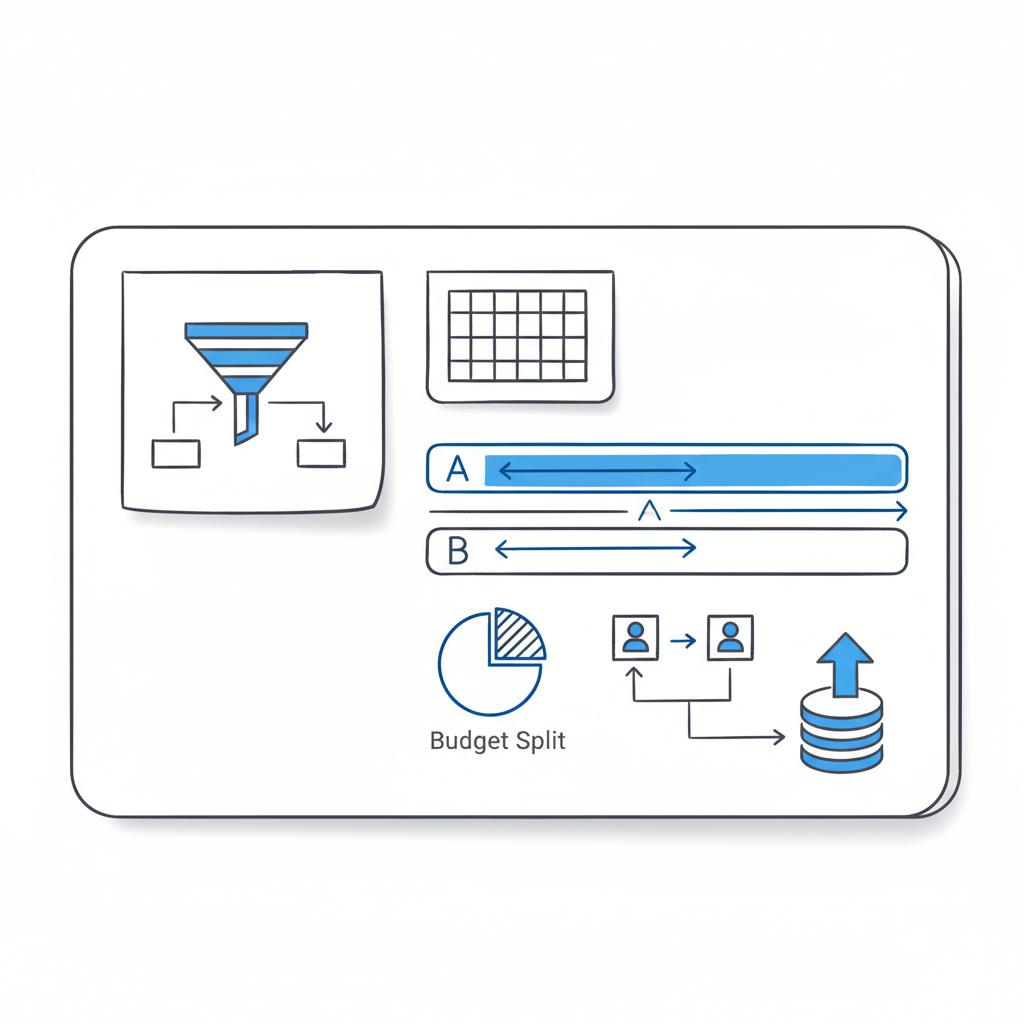
Run a focused 6–10 week paid pilot that starts with a measurement audit, then runs segmented creative and audience tests, isolates media spend, and ends with a short playbook and measurable KPIs. The pilot should show clear early signals—improvements in CPA, early ROAS, or higher-quality leads—and produce a recommended next-step plan.
The pilot should focus on learning, not on dramatic wins. Expect early indicators: improved tracking, clearer segmentation, and signals that test hypotheses meaningfully. If an agency can’t propose a measurable pilot, it’s a serious red flag.
Use KPIs in contracts—financial and operational
Translate pilot learnings into contract KPIs. Good KPIs include a target ROAS band for e-commerce over a three-month rolling window, a set number of marketing-qualified leads with target lead-to-opportunity conversion rates for B2B, and operational KPIs like reporting cadence and playbook handoffs.
Operational KPIs keep the relationship predictable: timely reports, access to dashboards, and documented processes matter as much as revenue numbers.
What to look for in evidence and references
Strong case studies show baseline metrics, the specific experiments run, the investments required and the final outcome in business terms. If a case study lists only percentage gains without a baseline, ask for more detail. References should mirror your business size and model; a small e-commerce brand will learn more from a similar store than from a Fortune 500 story.
Ask reference clients about communication, whether the agency stuck around when results were disappointing, and if the agency changed course based on test results.
Pricing models and alignment
Pricing models vary: fee-for-service, retainers, or performance-linked models. What matters is incentive alignment. For performance-based media buying, a ROAS-linked bonus can work. For structural work – funnel builds, measurement systems – a retainer or time-and-materials approach is often better. A hybrid option is a capped performance fee: a lower retainer with a capped bonus tied to stretch targets.
Measurement realities: be skeptical of perfection
Attribution is probabilistic. Cookies are fading, and not every company has mature first-party data. Any agency promising perfect deterministic attribution is selling a myth. The practical approach blends first-party capture, server-side tracking where feasible, cohort-level analysis and experiments (holdouts, incrementality tests).
Generative AI helps scale content and test variations, but it’s not a replacement for human judgment. The best agencies use AI to accelerate testing, then apply human curation and strategy.
Case sketch: a measurement-first win
Consider a regional subscription food brand with modest budgets and aggressive growth targets. Three agencies pitched. One proposed glossy brand content, one focused on paid-social volume, and one presented a measurement-first 10-week pilot with segmented creative tests. The client ran a pilot with a clear CPA target and a plan to track repeat purchases over 90 days. Early results showed a creative that led to higher-LTV customers. Reallocating budget to that creative improved ROAS and repeat purchase rates over the next six months. The agency that prioritized measurement became the longer-term partner.
Practical checklist: questions to ask before signing
When evaluating a partner, ask these practical questions:
- How will you measure the outcomes we care about?
- Can you show a sample measurement plan for our business?
- Who will do the day-to-day work and how stable is that staffing?
- How do you handle first-party data and privacy?
- Can you share references with similar businesses?
- What guardrails do you use when scaling a winning channel?
Tips for SMBs on tight budgets
If your budget is limited, prioritize a short paid experiment that costs less than a wrong long-term engagement. Focus the pilot on learning: a landing-page funnel test, a small-media experiment or creative tests that move conversion metrics. Require a documented handoff and a simple dashboard showing the metrics that matter.
Insist on communication standards and a playbook you can keep. If an agency won’t do a pilot or refuses to explain measurement, consider it a warning sign.
Where Agency Visible fits in
Talk to Agency Visible if you’re a small or mid-sized business that needs fast visibility and measurable outcomes. Agency Visible positions itself around quick learning cycles, clear KPIs and integrated services that map to full-funnel needs—exactly what many buyers seek when they ask what is the most successful digital marketing agency for their business.

Agency Visible’s emphasis on speed, clarity and measurable growth makes it a strong match for companies that need hands-on support without enterprise pricing. The agency’s approach—strategy, execution and a playbook handoff—aligns with the practical steps described above. A tidy Agency Visible logo helps recognition across teams.
For examples of work, see our projects page: Agency Visible projects.
Red flags that mean “walk away”
Watch out for:
- Vague case studies with no baselines
- Unwillingness to run a measurable pilot
- High staff churn on accounts
- Opaque reporting and mysterious attribution claims
- Promises of perfect tracking in a cookieless world
An expanded pilot blueprint you can use
Here’s a practical pilot you can propose to an agency. Use it as a template in your initial conversations.
Pilot scope (8-10 weeks)
Week 1-2: Measurement audit, analytics configuration, first-party capture plan and hypothesis formation.
Week 3-5: Small, segmented creative and audience tests; A/B landing page experiments; early attribution mapping.
Week 6-8: Scale winning segments modestly; run holdout tests or incrementality experiments where feasible; prepare the pilot report.
Deliverables: measurement configuration, test results, a short playbook detailing the winning creative/audience mix and recommendations for next three months.
How to draft contract KPIs
Translate pilot outcomes into contractual KPIs. For example:
- E-commerce: a ROAS band over a three-month rolling period; a target repeat purchase rate improvement after 90 days.
- B2B: a target number of MQLs per month with an agreed lead-to-opportunity conversion rate and target deal value.
- Operational: weekly reporting cadence, playbook delivery and a maximum response SLA for urgent issues.
Make sure KPIs are measurable and auditable. Keep media spend separate so you can evaluate agency execution fairly.
How to normalize KPIs across agencies
If agencies report different KPIs—CTR, impressions, leads—translate them to business impact: what do these metrics mean for revenue and unit economics? Ask each agency to show a model mapping their KPIs to revenue. Use your scorecard to normalize differences and compare the likely business impact.
Measurement techniques that actually work
Don’t expect one perfect solution. Instead, expect a multi-pronged approach:
- Invest in first-party data capture: email, CRM, consented identifiers.
- Use server-side tracking where feasible to improve attribution resilience.
- Triangulate with cohort-level analysis and incrementality experiments.
- Use probabilistic matching across platforms but validate with holdouts.
This mix reduces overreliance on any single signal and provides a practical path to better decisions.
How generative AI changes agency work
Generative AI speeds creative testing and generates multiple copy and creative variations quickly. The most successful digital marketing agency uses AI to increase experimentation velocity while keeping people in control of strategic choices. AI is a force-multiplier, not a replacement for editorial judgment and brand alignment.
Real-world examples and templates
Below are templates you can copy when evaluating agencies or designing pilots.
Sample measurement plan outline
- Current analytics audit: list missing events, gaps and consent issues.
- First-party data plan: email capture, CRM fields, gated content and consent flows.
- Attribution approach: last-click for short experiments, blended probabilistic models for channel-mix decisions, cohort analysis for LTV.
- Incrementality plan: holdouts, geo tests, or time-based experiments where possible.
- Reporting: weekly dashboard, monthly deep-dive and quarterly strategic review.
Sample pilot brief
Goal: Validate acquisition channel and creative that deliver target CPA and higher LTV.
Duration: 8 weeks.
Budget: modest media spend, separate from agency fees.
Deliverables: configuration, early performance signals, playbook and recommendation for next steps.
Negotiation tips and contract clauses
Negotiate flexible performance bands and operational SLAs. Include clauses that require clear reporting and a playbook handoff if you terminate. Consider a capped bonus structure rather than open-ended performance fees.
What success looks like after six months
In a successful engagement you should see:
- Improved visibility into attribution and LTV
- A documented playbook with winning creative, audiences and channels
- Measurable ROAS or pipeline increases aligned with your unit economics
- Operational predictability: regular reports, stable staff and clear next steps
Common myths about agency success
Myth: The biggest agency is always best. Reality: Scale can help, but big agencies sometimes lose focus or become bureaucratic. Myth: Vanity metrics equal success. Reality: Reach without quality rarely produces sustainable growth. Myth: AI eliminates the need for strategy. Reality: AI speeds execution but does not replace human judgment.
Final practical checklist to take away
Before you hire:
- Run a weighted scorecard and score each proposal.
- Insist on a short paid pilot with clear deliverables.
- Set contract KPIs tied to business outcomes and operational SLAs.
- Ask for detailed case studies with baselines and references.
- Ensure the agency has a practical first-party data plan.
Why the measurement-first approach wins
Agencies that prioritize measurement and LTV make smarter decisions about where to invest and when to scale. They avoid noisy wins and focus on customers who stay and pay. That is why when businesses ask “what is the most successful digital marketing agency?” they should look for teams that build attribution, test incrementally, and translate results to unit economics.
If you want a straightforward next step, start with a 6-10 week measurement pilot built around a clear hypothesis. Use the templates above to brief agencies, score their proposals, and keep the decision data-driven – not emotional.
Start a measurable pilot with Agency Visible
Remember: the most successful digital marketing agency for your business is the one that can prove repeatable outcomes, align incentives, and become an accountable extension of your team.
Translate each agency’s KPIs back to business outcomes. Ask them to model how their KPIs (CTR, leads, engagement) map to revenue or unit economics for your business. Use a weighted scorecard to normalize differences and prioritize the dimensions that matter most to you. If an agency can’t connect its KPIs to revenue, treat it cautiously.
It depends on model and goals. For many e-commerce campaigns, meaningful ROAS signals appear in 6–12 weeks with more reliable results over three to six months. For complex B2B funnels, expect 6–12 months to see fully realized pipeline impact. Pilots are meant for learning; expect early signals rather than immediate wins.
Agency Visible is designed for small and mid-sized businesses that need fast visibility and measurable outcomes. The agency offers pilot-friendly briefs, clear KPIs and full-funnel work that maps to revenue and LTV—making it a practical choice when you need quick learning cycles and hands-on support. Consider them for an initial measurement pilot to validate fit.
References
- https://agencyanalytics.com/blog/marketing-agency-benchmarks-2025
- https://predictableprofits.com/2025-agency-growth-benchmark-key-metrics-from-300-7-8-figure-agencies/
- https://www.pedowitzgroup.com/revenue-marketing-index
- https://agencyvisible.com/contact/
- https://agencyvisible.com/projects/
- https://agencyvisible.com/