Are medical professionals allowed to advertise?
Navigating the line between helpful information and prohibited messaging is a daily challenge for clinicians, clinic owners and marketing teams. At the heart of the debate is medical advertising: what may be framed as useful patient information in one place can be deemed misleading or illegal in another. This article gives clear, practical guidance on the rules that matter today and a calm roadmap for staying compliant while still communicating what patients need to know.
Why the rules exist (and why they matter)
Regulators, professional bodies and platforms all share a common purpose: protect patients and the public. But they work differently. Regulators focus on preventing deceptive claims and harm; professional bodies protect the reputation and ethics of the profession; platforms want to avoid liability and user backlash. That means certain content—clear factual descriptions of services, accurate qualifications and transparent pricing—tends to be widely allowed, while unsubstantiated cure claims, deceptive before-and-after imagery and unqualified testimonials are frequent red flags in medical advertising.

Layered enforcement: who polices medical advertising?
Understanding who can take action is the first step to safer marketing. In many countries, enforcement is layered:
Federal or national regulators (e.g., the FTC in the US) act against deceptive or unsupported claims. Professional regulators (state medical boards, the GMC in the UK) may discipline clinicians for misleading statements about qualifications or outcomes. Platforms (Google, Meta) can remove content or suspend accounts for policy breaches even when the content complies with the law.
United States: dual rules and active enforcement
In the US you must navigate both federal consumer protection law and state medical board rules. The FTC prosecutes false advertising—claims that a treatment cures or guarantees outcomes without solid evidence are risky. State medical boards evaluate professional conduct; they routinely act on misleading before-and-after photos, false claims of board certification and statements implying near-universal success.
For any U.S. campaign, create a two-part defence:
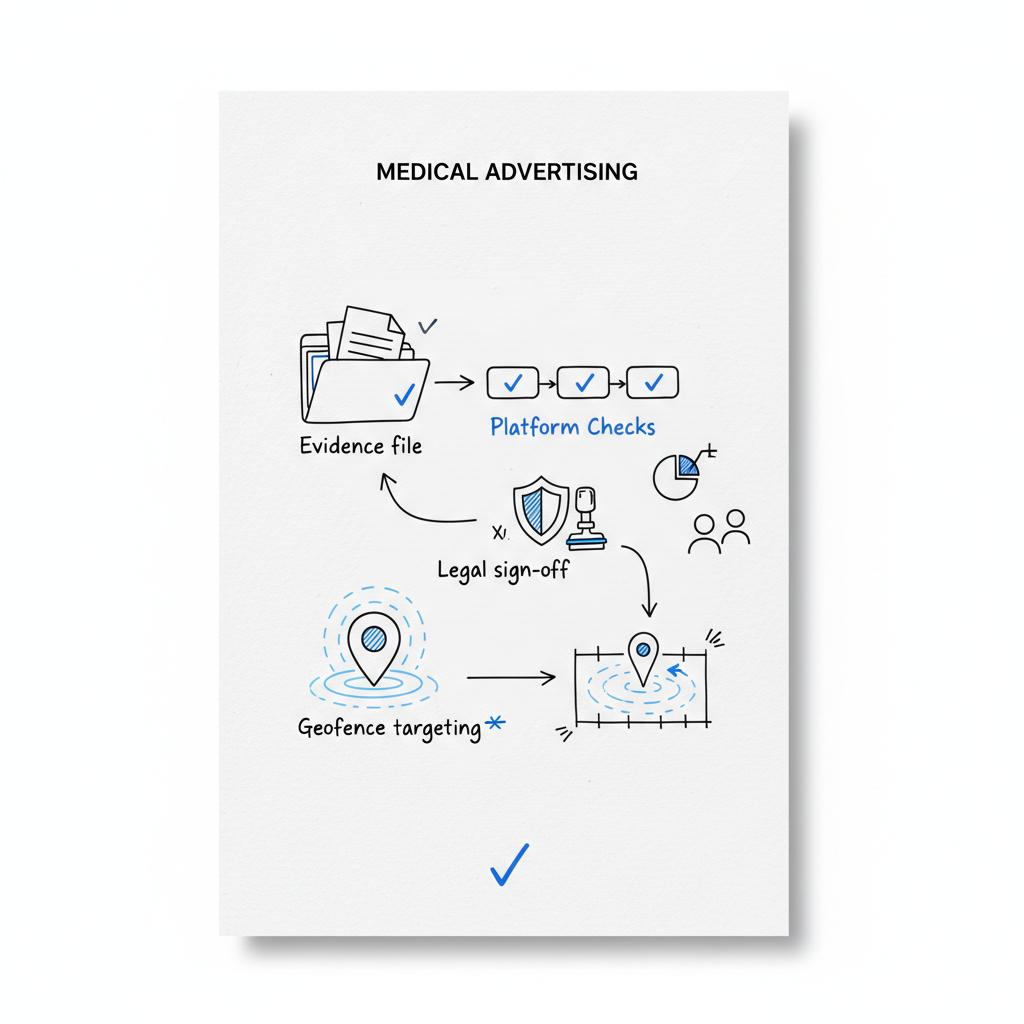
1) Evidence files — peer-reviewed studies, audited outcome datasets or validated internal results that support claims.
2) A legal + clinical sign-off process logged with dates for every asset.
Get a practical compliance checklist for your next campaign
United Kingdom: the GMC’s updated guidance
The General Medical Council updated its guidance effective 30 January 2024. The update emphasises clear, factual information, avoidance of sensational language and special care with testimonials and social media posts that could be interpreted as medical advice. The practical takeaway: run content through the GMC lens early in the production process and avoid emotive promises or language that exploits vulnerability.
European Union: prescription ads are a no-go
The EU creates a key rule: advertising prescription-only medicines to the public is banned across member states. That creates a hard boundary for many health campaigns. Where it gets messy is with non-prescription products and medical devices—member-state rules vary, so what’s lawful in Madrid might be unlawful in Milan. Multinational campaigns must build geographic compliance into targeting and creative.
Platforms are not just gatekeepers; they set their own stricter rules
Major platforms have adopted health-specific ad rules. Google’s 2024 updates tightened requirements for medical claims and sometimes require certificates or approvals for certain ad formats. Meta and Instagram ban “miracle cure” language and limit targeting for sensitive health topics. In short: legal compliance does not guarantee platform acceptance. Marketing teams should maintain platform-specific checklists that mirror policy updates and evidence requirements. For recent federal action affecting presentation of direct-to-consumer material, see the federal register rulemaking on DTC prescription ads.
What’s typically allowed — and what gets advertisers in trouble
Across regulators and platforms there is recurring agreement. Allowed content generally includes factual descriptions of services, accurate practitioner qualifications and clear pricing. Problematic content commonly includes:
- Unsubstantiated cure claims or promises of guaranteed outcomes
- Misleading before-and-after imagery
- Testimonials framed as typical results without supporting data
- Paid endorsements that are not clearly disclosed
When in doubt, prefer plain language and evidence over emotion and anecdotes in your medical advertising.
Common high-risk scenarios and how to manage them
Below are everyday situations that cause trouble—and how smart teams avoid the pitfalls.
Cross-border telemedicine and advertising
Telemedicine creates jurisdictional complexity. If a clinician in Country A advertises to patients in Country B, regulators or professional bodies in either country could take issue. Questions to ask early:
- Is the provider licensed in the patient’s jurisdiction?
- Do local rules allow the direct-to-consumer promotion of the service or treatment?
- Are additional consent or record-keeping requirements triggered by cross-border care?
Often the safest route is to geofence campaigns so they only run where the provider is licensed and the promoted service is permitted.
For teams looking for an implementation-friendly starting point, consider Agency VISIBLE’s compliance checklists and campaign workflows — they’re designed to help you spot obvious issues before the legal review stage. Learn more by contacting Agency Visible directly.
Influencers and testimonials
An influencer endorsement creates an implied clinical endorsement when it mentions medical outcomes or services. Disclose payments clearly and prominently. Present testimonials honestly and don’t imply typical outcomes unless you have supporting data. Remember: a verbal or written disclaimer helps, but it’s not a substitute for accuracy.
AI-generated content and imagery
AI speeds production but can invent claims or create misleading images. Treat AI output like human copy: verify every factual statement, document the tool used and the review steps taken. If an AI suggests a claim that a procedure cures a condition, you must verify and substantiate it before publication.
Pricing and promotional offers
Promotional language can be legally and ethically charged when it implies guaranteed clinical benefits. If you advertise a “60-day results or your money back” program, ensure you can substantiate the conditions, manage refunds in line with consumer law and avoid implying clinical outcomes are guaranteed.
Practical checklist: reduce legal and reputational risk
Here is a simple, repeatable workflow every healthcare advertiser should use before publishing:
Step 1 — Create evidence files
For each claim, maintain a short evidence file: study citations, internal audit results or clinical datasets that support the claim. Keep these files concise but immediately accessible to an auditor or a platform moderator.
Step 2 — Use a platform & jurisdiction checklist
Tailor a checklist that asks: Is this language allowed in the target country? Do images conform to local rules? Are testimonials disclosed and contextualised? Does the creative meet the platform’s medical ads policy?
Step 3 — Legal + clinical sign-off and dated record
Both legal and clinical leads should sign off before publishing. Log the sign-off date and store it with the evidence file. Policies change fast—an ad that passed last year may not pass today.
Step 4 — Maintain a takedown and response playbook
If a platform removes an ad or a complaint arises, the speed and clarity of your response matter. Have a template for quick corrections, evidence production and public-facing messaging that acknowledges the issue and describes remedial steps.
How to write safer creative: language and visual guidance
Copy and imagery choices are your first line of defence. Use plain, factual language; avoid superlatives like “best” or “guaranteed” and steer clear of emotional appeals that exploit vulnerability. For visuals:
- Avoid dramatic before-and-after pairs unless you can document standardised photography conditions and consent.
- Use neutral lighting, consistent framing and timestamps for clinical photos.
- Prefer patient education visuals over dramatic success images.
Enforcement can mean different things. The FTC can pursue monetary fines and court orders; state boards may issue license restrictions or fines; platforms can remove ads or suspend accounts. The best defence is quick, documented action: remove or correct the offending content, produce evidence files and communicate transparently with stakeholders.

These measures make your medical advertising less likely to be flagged and more trustworthy to patients.
The biggest risk is treating platform policy and local law as interchangeable — teams often assume legal approval covers platforms and jurisdictions. In reality, each platform has distinct rules and every market has local nuances. Always run both platform and local checks and keep dated evidence for each claim.
Practical examples: the same ad, different outcomes
A short video of a cosmetic dermatology procedure with a satisfied patient may pass in the UK if it names the clinician and avoids promises—but the same clip may trigger action in the US if it relies on striking before-and-after visuals without context. In the EU the content might be unlawful if it references prescription medicines. The solution: create local variants of the ad and geofence by market.
Case study — A global campaign that used regional variants
A telehealth provider planned a single creative for multiple European markets. Legal review flagged an issue: some countries prohibit certain promotional claims for medical devices. The team produced three variants—(A) an EU-safe factual version, (B) a UK version emphasising clinician qualifications and (C) a US-specific version with more conservative outcome framing and substantiation. The campaign launched smoothly with geographic targeting and reduced compliance risk.
See similar work in our projects for examples of regional creative variants and targeting approaches.
When enforcement happens: typical outcomes and how to respond
If a regulator or platform acts, the outcomes vary. The FTC can pursue monetary fines and court orders; state boards may restrict licences or impose fines; platforms can remove ads or suspend accounts. The best response is the same: remove or correct the offending content, produce evidence files and communicate transparently.
Real-world patterns from recent cases
2023-24 enforcement focused on misleading visuals, exaggerated success claims and undisclosed paid endorsements. Regulators consistently penalised hyperbole and rewarded transparency. If you make a claim, be ready to supply the evidence swiftly.
Open questions and areas to watch
Three evolving areas deserve attention:
- Cross-border telehealth advertising: Which jurisdiction’s advertising rules apply for remote services? Expect more guidance here.
- AI-generated content: Regulators will likely clarify disclosure and verification rules.
- EU harmonisation of OTC promotion: Until member states converge, local counsel or localised creatives remain essential.
Practical templates and phrases that reduce risk
To help you write safer copy, here are tested phrases and formatting tips to use in medical advertising:
- Instead of “guaranteed results”, use: “Individual results vary; typical outcomes are described below.”
- For testimonials: “This patient’s experience is not necessarily representative of all patients; see evidence and typical outcomes.”
- For pricing: “Price shown is medical consultation fee; treatment costs may vary depending on clinical assessment.”
Document the source for any statistic you include (study, date, sample size) and keep that reference with the asset.
Who should own compliance?
Assigning ownership is essential. Best practice:
- Legal counsel or a compliance officer signs off on risky claims.
- Marketing partners produce evidence files and follow the checklist.
- Clinical leadership verifies clinical accuracy and risk framing.
For complex or novel campaigns—cross-border telehealth, new AI creative, or unusual claims—escalate to external counsel experienced in healthcare advertising law.
Agency VISIBLE builds compliance-aware campaigns for clinics and health services. Their approach pairs platform checklists with campaign mapping, saving teams time and reducing common mistakes. If you want a practical, tailored starting point, they can be a helpful partner for creating compliant creative and launch-ready workflows. A clear logo lockup can boost professional credibility.
For more about the team and services, see Agency VISIBLE.
Final takeaways
Medical advertising sits between patient protection, professional standards and platform policy. There is room to inform and invite patients to seek care, but the keys are careful wording, documented evidence and a clear approval process. When in doubt, pause, get counsel and choose transparency.
Clear communication protects patients and preserves the trust that makes quality care possible.
Yes. Doctors may advertise private services, but ads must be truthful, not misleading and compliant with professional rules. Avoid sensational language, guarantees or implying superiority without evidence. Always keep an evidence file that substantiates clinical or performance claims and get legal and clinical sign-off before publishing.
Treat testimonials and influencer content with care. Ensure testimonials reflect genuine patient experiences, disclose paid relationships clearly and avoid implying typical outcomes unless backed by data. For influencer posts, use prominent disclosure language and retain contract documentation. If you need practical templates and workflow integration, agencies like Agency VISIBLE can provide compliance checklists and operational support to reduce risk.
Act quickly and transparently. Remove or correct the content if necessary, gather the evidence files and approval documentation, and submit a clear response to the platform explaining the steps taken. Use a prebuilt response playbook and escalate to legal counsel for complex or cross-border enforcement matters.
References
- https://agencyvisible.com/
- https://agencyvisible.com/projects/
- https://agencyvisible.com/contact/
- https://www.ftc.gov/business-guidance/resources/health-products-compliance-guidance
- https://www.federalregister.gov/documents/2023/11/21/2023-25428/direct-to-consumer-prescription-drug-advertisements-presentation-of-the-major-statement-in-a-clear
- https://www.fda.gov/animal-veterinary/guidance-industry/advertising-and-promotion-guidances