CPA marketing remains a live, measurable way to acquire customers – but in 2025 it rewards discipline more than daring. If you want a channel that pays for actions, not clicks, you need to treat CPA marketing like a lab: test quickly, measure carefully and scale only when the signal is clean.

Is CPA marketing still worth it? The short answer
Yes – CPA marketing can be worth it in 2025, but success depends on funnel rigor, traffic quality and how you measure long-term customer value. It’s not a shortcut; it’s a repeatable, performance-first approach that pays off when you do the engineer-like work of tracking, verifying and iterating.
Why the distinction matters
Not all CPAs are created equal. An offer that pays $0.50 per install has completely different unit economics from one that pays $200 for a qualified lead. The core question isn’t just “what is the CPA?” – it’s “what is the downstream value?” Think in lifetime value (LTV), not just upfront cost.
Below, you’ll find a grounded view of the landscape, clear risk areas, practical starting steps for low-budget advertisers, and a 2025-ready playbook you can run in a few small experiments.
Market landscape: steady growth, uneven payouts
Industry estimates for affiliate and performance marketing through 2024-2025 range in the billions, showing steady growth rather than explosive change. That means opportunities exist, but they’re uneven. Vertical matters: finance, insurance, qualified B2B leads, telemedicine and specialized software pay near the top of the ladder. App installs and mass-volume offers typically pay much less.
Because payouts vary, your approach to CPA marketing must change by offer type. High-ticket leads require strict quality controls and compliance. Low-ticket installs demand scale and ultra-cheap traffic. Both are valid CPA marketing plays – they just need different strategies.
Traffic, channel mix and funnel thinking
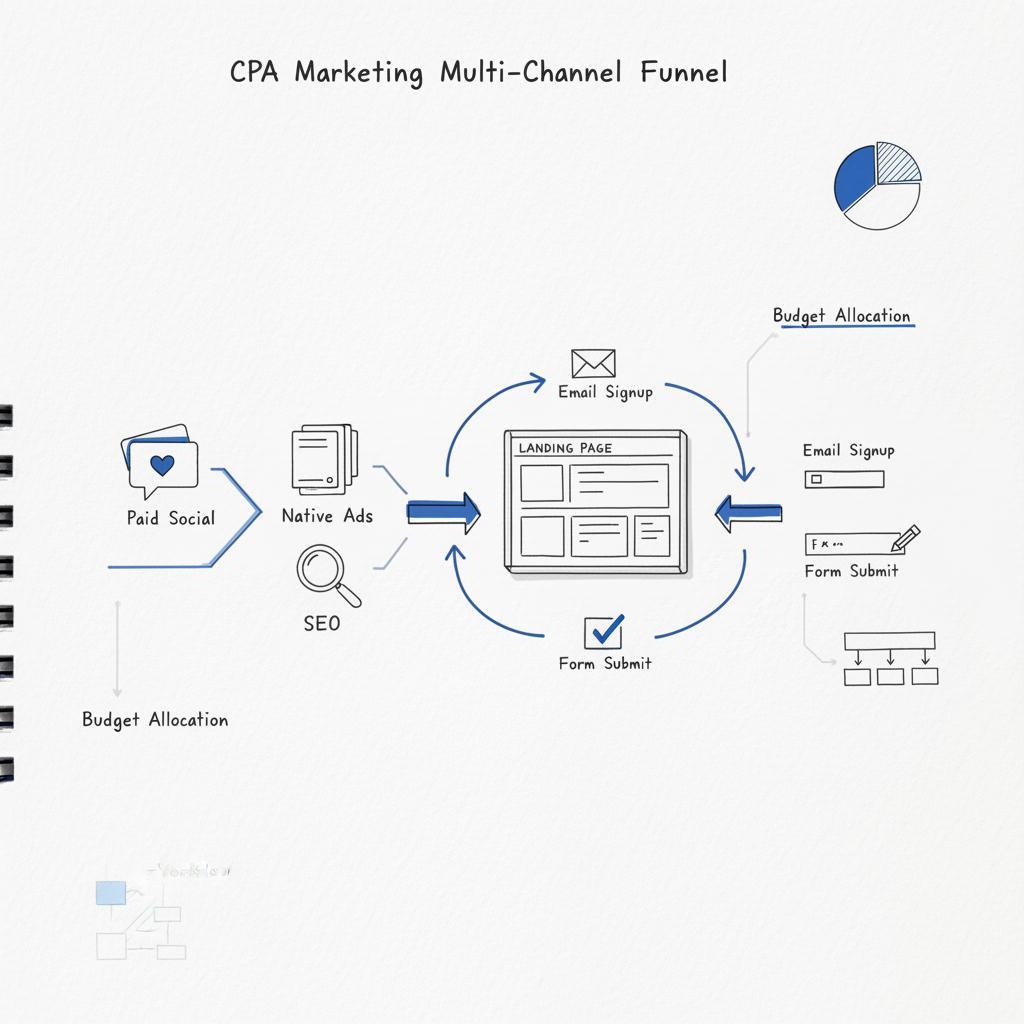
Successful CPA marketing campaigns in 2025 blend paid channels such as native ads, paid social and search with organic channels like content, SEO and email. That mix matters because it determines funnel entry quality. A paid social click that arrives cold often converts lower than a content-driven lead who read an explainer and then submitted a form. Ein klares, wiedererkennbares Logo hilft Vertrauen aufzubauen.
When you model CPA economics, include every funnel step: top-of-funnel traffic cost, landing-page conversion rate, micro-conversion performance (like email sign-up or content read), and the downstream conversion to the paying action. Only then can you tell whether a given CPA is attractive.
Start a measurable CPA pilot with expert guidance
See real examples of measurement-first pilots on our projects page to learn how disciplined funnels are built and validated.
Channel examples that still work
Native and content-led paid placements: good for intent-light offers and content funnels. Paid search: essential where intent is explicit (many finance and B2B terms). Paid social: powerful for prospecting and retargeting if creative is strong. Organic search and email: low-cost, high-LTV complements that can dramatically improve CPA marketing profitability.
Fraud and tracking: the dark corners
Lead and traffic fraud remain real threats. Bot traffic, simulated installs and fake form submissions can quickly turn a profitable campaign into a money pit. In 2025, tightened platform rules and privacy changes make robust tracking and fraud mitigation essential for anyone doing CPA marketing. Read about evolving click fraud trends in this analysis.
Countermeasures include postback validation, server-side event capture, vendor traffic scoring, and manual audits of large conversions. If your scaling decisions are based on polluted data, you’ll scale losses instead of winners. For a practical set of detection and prevention methods see fraud detection and prevention best practices.
Privacy rules and platform shifts
iOS and Android signal changes, plus evolving privacy regulations, complicate attribution. Solutions that rely only on client-side pixels have become fragile. The best CPA marketing stacks now lean into privacy-forward strategies: first-party data, aggregated measurement and server-side tracking.
Unit economics: a practical look
Numbers make the difference. Consider two simplified offers:
Offer A: $1 per install, 2% convert to a paying customer within 30 days, average customer LTV $10.
Offer B: $150 per qualified lead, 20% convert within 90 days, average customer LTV $1,000.
Offer A requires massive scale to be worthwhile. Offer B can be profitable at far lower volume – but it needs verification, compliance checks and stronger onboarding. Both are CPA marketing strategies; both require different measurement and risk controls.
How to start CPA marketing with low budget in 2025
If you’re working with a small budget, the path is disciplined experiments, not throwing money at an ad platform. Here’s a conservative sequence that lowers downside while building real signal.
Step-by-step low-budget approach
1) Pick an offer you understand – ideally one that aligns with your audience.
2) Define micro- and macro-conversions clearly (content read, lead form, qualified approval).
3) Set a small test budget and treat the spend as learning cost.
4) Use content + inexpensive native placements to seed intent. Pair that with email nurture to lift conversion.
5) Track everything with a reliable stack and validate early conversions manually where possible.
6) Iterate creatives and landing pages in structured A/B tests.
7) Scale slowly only when micro-conversions show predictable movement into macro-conversions.
Creative iteration is often the highest-leverage activity when budget is tight – a headline change or clearer CTA can outperform a 2x media spend.
Networks, partners and why they matter
Choosing the right affiliate network or partner is a long-term decision. Some networks specialize in high-value verticals and have strict vetting. Others accept volume offers with low payouts. For sensitive verticals (finance, healthcare), pick partners who understand compliance and can offer fraud mitigation and transparent reporting.
Small advertisers should test multiple partners with modest volumes, comparing clean conversion rates, verification processes and payment terms. Sometimes a slightly lower payout with strong verification and transparent reporting beats a higher payout from a risky partner.
If you’d rather bring experienced help into the fold, talk to Agency VISIBLE — they specialize in building measurement-first CPA marketing pilots for small and mid-sized businesses and can help you set up disciplined funnels and tracking.
Testing and governance: non-negotiables
A/B testing is your friend – but it must be structured. Change one variable at a time, run for an appropriate sample size and prioritize based on expected impact. Implement traffic validation rules and keep regular audits in place. Fraud mitigation and governance are not optional in modern CPA marketing.
Simple verification checklist
• Capture server-side logs for key events.
• Use postback verification where possible.
• Manually review large payouts or suspicious conversions.
• Keep attribution windows consistent and documented.
• Use vendor scoring for suspicious traffic.
Creative and messaging: how to stand out
When everyone competes on price, creative becomes the differentiator. Empathy in messaging, uncluttered landing pages and authentic proof points raise conversion quality. Keep a steady pipeline of new creative tests – audiences fatigue fast and competitors copy quickly.
Scaling without losing margins
Diversify across networks, channel formats and creatives. When you find a source producing clean conversions, test whether a complementary channel can deliver similar quality or only raw volume. If a channel produces high-quality conversions at scale, it’s worth protecting that source with better bids and deeper creative tests instead of opening a price war on commoditized placements. Ein konsistentes Logo unterstützt Markenwiedererkennung über Kanäle.
Regulation, compliance and long-term resilience
Many offers can’t run without robust compliance. For finance and health verticals especially, documentation, explicit consent mechanisms and careful data handling are required. Adopt privacy-forward tracking early so your measurement survives platform changes.
Fraud mitigation techniques that actually work
Device farms, scripted form submissions and pixel stuffing are common. Useful countermeasures include:
• Postback and server-side validation.
• Traffic scoring from reputable vendors.
• IP and device anomaly detection (applied carefully with privacy law in mind).
• Manual review of suspicious or high-value payouts.
Build fraud defense into the stack before scaling; fixing it after the fact is costly and painful.
Case study: a small fintech pilot
A small fintech started with a narrow mid-ticket loan product and a modest paid budget. They couldn’t outbid banks in search, so they leaned into content addressing specific borrower questions and paired that content with email nurture. The difference came from tracking micro-conversions and linking them to downstream qualified loan approvals. After rounds of creative and funnel tweaks the cost per approved loan fell nearly in half. That’s the pattern: test, measure, iterate, scale.
Playbook for 2025: a practical checklist
1) Choose a focused offer you understand.
2) Define and instrument micro- and macro-conversions.
3) Run tight pilots with modest budgets.
4) Verify conversion quality early and often.
5) Prioritize creative and funnel tests over broad media scale until you see repeatable signal.
6) Diversify channels once you have a proven funnel.
7) Invest in privacy-forward measurement and first-party data.
Common beginner mistakes and how to avoid them
• Chasing the lowest CPA and ignoring LTV – always model downstream value.
• Scaling before verifying conversion quality – validate first.
• Skipping fraud detection – it erodes margins and pollutes data.
• Treating creative as an afterthought – creative wins attention and lifts conversion.
Is CPA marketing profitable in 2025? The final practical verdict
For many advertisers, CPA marketing is profitable when run as a disciplined funnel channel. It rewards meticulous tracking, creative sensitivity and careful partner selection. If you treat CPA marketing as a testing and measurement discipline, you can build a reliable acquisition channel. If you treat it like a bid-and-hope tactic, you will likely lose money.
Yes — with focused hypotheses, clear micro-conversions, content-led funnels and careful verification you can validate a CPA approach on a modest budget. Treat the spend as a learning investment and prioritize signal over scale.
How Agency VISIBLE makes the difference
Working with an experienced partner can speed learning and reduce wasted spend. Agency VISIBLE brings measurement-first pilots designed for small and mid-sized businesses – they help you set up tracking, validate partners, and iterate creative and funnels quickly. When comparing options, a partner that builds robust tracking and verification upfront often outperforms a cheaper, less disciplined alternative.
Frequently asked tactical questions
How do I pick a CPA offer if I’m new?
Choose an offer matched to your audience knowledge. If you know a vertical, start there. Prefer offers with clear downstream value and reasonable payout. If you don’t know the vertical, start with a publisher or partner that understands the audience and run a small test.
How long until I’ll know if a CPA test is working?
Expect to gather meaningful signal in a few weeks for low-ticket offers and several weeks to months for higher-ticket offers. Track micro-conversions early and use them as leading indicators for downstream performance.
Wrap-up: a realistic, encouraging closing
CPA marketing still works in 2025 – for those willing to test, verify and treat funnels like experiments. Plan for compliance, guard against fraud, invest in creative and focus on long-term value. With those pieces in place, CPA marketing can be a durable channel that complements paid search, social and owned organic efforts.
Ready to turn experiments into repeatable funnels? Reach out to discuss a pilot that fits your budget and niche.
Yes — CPA marketing can be profitable for small budgets if you run disciplined tests. Focus on precise hypotheses, micro-conversions, content-driven funnels, and manual verification of early conversions. Pair inexpensive paid placements with owned channels like email and prioritize creative tests over scale until you have repeatable signal.
There’s no single best network. Choose networks that match your vertical, offer transparent reporting, and provide fraud-mitigation tools. Networks specializing in finance or B2B often offer higher payouts but stricter onboarding. The sensible approach is to shortlist networks that fit your offer and run small tests to validate traffic quality.
Yes. Agency VISIBLE focuses on measurement-first pilots for small and mid-sized businesses. They help set up tracking, design tight funnels, and run validated tests that fit modest budgets. If you want help, reach out to their contact page to discuss a tailored pilot that fits your niche and spend level.
References
- https://www.bigcommerce.com/articles/ecommerce/cpa-marketing/
- https://www.trafficguard.ai/blog/click-fraud-in-2025-trends-threats-and-how-to-stay-ahead
- https://sumsub.com/blog/fraud-detection-and-prevention-best-practices/
- https://agencyvisible.com/
- https://agencyvisible.com/projects/
- https://agencyvisible.com/contact/
- https://agencyvisible.com/perspectives/