Start here: why buying leads is not as simple as it looks. If your team is considering buying leads for outreach, you already know the promise: a stack of names and numbers that could kickstart sales. But before you import a list and hit send, pause. The rules around buying leads are layered – legal, contractual and practical – and getting them wrong can cost far more than the list itself.
Why buying leads requires care – quick overview of legal risk
Buying leads can be perfectly lawful in many circumstances, but legality depends on several factors: where the people live, how their data was collected, the kind of outreach you plan, and whether any sector rules apply. The three big risk areas are privacy laws (like the GDPR and state privacy rules), telecom laws (notably the TCPA in the U.S.), and sector-specific rules for health or finance.
Read on for a practical walkthrough that keeps the legal language simple, offers checklists you can use today, and gives examples that show how a seemingly small gap in documentation turns into a major expense.
Make lead buying safe: get a compliance-first review
If you need quick, practical support mapping list provenance or designing a compliance-first campaign, contact Agency VISIBLE for a short consult and next steps.
Treating the seller’s assurances as proof. Verbal promises or vague claims that a list is "opt-in" are not sufficient. Always demand documentary evidence of consent or a clear lawful basis, and include audit rights and indemnities in contracts.
The most common mistake is treating the seller’s word as a substitute for proof. A verbal promise that a list was “opt-in” or “marketing-friendly” is not the same as records you can show a regulator or defend in court. Always ask for the original consent records, a provenance report for compiled lists, and contractual rights to audit.
How to think about lawful bases: GDPR in plain language
If your list includes people in the EU, the GDPR is often the most important law to consider. The regulation doesn’t ban buying leads outright, but it requires a proper legal basis for processing personal data.
Consent: the golden standard (but not always present)
Consent under the GDPR must be specific, informed, freely given and demonstrable. That means the seller must be able to show exactly what a person agreed to, when, and how. A vague checkbox or buried terms won’t be enough. If you rely on consent, ask the seller for the actual consent text, timestamps, IP addresses or signed forms and the context in which consent was given.
Legitimate interest: possible, but risky for bulk lists
Legitimate interest can be used for some forms of outreach, but it requires a documented balancing test: why you want to contact people, how intrusive the contact is, and whether people would reasonably expect the outreach. For cold calls or texts, legitimate interest often fails because phone contact is intrusive and people usually do not expect it. If you choose legitimate interest, document the assessment and be ready to perform a DPIA (Data Protection Impact Assessment) when processing is high risk.
U.S. landscape: state privacy laws, CCPA/CPRA and what they mean
Around the U.S., there is no single federal privacy law that governs buying leads, but state laws – especially California’s CCPA/CPRA – have reshaped expectations. These laws treat many transfers of personal information as “sales” or “sharing,” give consumers opt-out rights, and require transparency.
That means if a list transaction counts as a sale or sharing under state law, you must honor opt-out signals and maintain records that show compliance. Contracts should restrict use and include vendor representations tailored to state rules.
TCPA: the telemarketing trap you cannot ignore
For calls and texts, the TCPA is central. If you use an autodialer or prerecorded voice to call numbers on a purchased list, you generally need express written consent. For text messages, the standard is similarly strict. The TCPA allows statutory damages – typically $500 to $1,500 per violation – which add up fast when thousands of contacts are involved.
Buyers can face vicarious liability for telemarketing done by a seller or vendor if courts find sufficient control or benefit. That makes buyer-side due diligence essential: do not rely on trust alone. For recent regulatory updates on consent rules, see this summary from Perkins Coie: TCPA one-to-one consent rules.
Practical example: a simple text campaign gone wrong
Imagine buying a list of 5,000 cellphone numbers and running an automated text campaign. If even a fraction of those numbers were not consented, a handful of TCPA claims can become a costly litigation risk. The costs of suits, settlements, and reputational damage typically far exceed the value of that list.
Sector rules: HIPAA, financial regulations and professional limits
Some industries have stricter rules. Health data governed by HIPAA, financial records, and legal-client solicitations may all be off-limits or require explicit patient/consumer authorization for marketing. A general-purpose lead list can be wholly inappropriate for regulated sectors unless the seller documented compliant consent or explicit authorisations.
Due diligence checklist: questions to ask every seller
Before you buy, use this practical checklist. Treat it as a gate – if the seller cannot answer, you should consider walking away.
Basic provenance and consent
– Can you provide the original consent text, timestamps, IP addresses, and the exact context where consent was obtained?
– For compiled or brokered lists, can you map each record to its original source?
– Was the data collected for marketing or resale, and was it explicitly disclosed?
Contract and use limits
– What exact purposes are allowed for the data? (Be narrow.)
– Are there retention limits and deletion obligations?
– Do you include audit rights and indemnities for misrepresentations?
Security and access
– What technical measures protected the data while the seller held it?
– Were records encrypted at rest and in transit?
– Is there an incident response plan and recent audit evidence?
Telecom and sector assurances
– For mobile numbers, can you show written, unambiguous consent for calls and texts?
– For health, finance or legal categories, can you show the necessary authorizations or exclusions?
Contract language that reduces risk (practical examples)
Contracts are where representation becomes enforceable. Below are practical clauses you can adapt – share them with counsel and your procurement team.
Sample representation on consent and provenance
“Seller represents and warrants that each Personal Data record was collected lawfully, and that Seller can produce documentation evidencing the lawful basis for processing that record, including explicit, documented consent where required for the intended marketing use.”
Sample audit and indemnity clause
“Buyer shall have the right to audit Seller’s provenance records upon reasonable notice. Seller agrees to indemnify Buyer for losses arising from Seller’s breach of representations regarding consent, data provenance, or unauthorized transfers.”
Sample limited-purpose and retention clause
“Personal Data provided under this Agreement shall be used solely for the Permitted Purpose defined in Schedule A and shall be deleted or returned upon expiration of the retention period described in Schedule B unless otherwise prohibited by law.”
Operational controls to run safe campaigns
Legal protections start to matter when your systems and people actually use the list. Below are operational controls that reduce risk and create an auditable trail.
1. Build an auditable contact log – Log every outreach attempt, the legal basis used, the template sent, and the response. Keep these logs ready in case of complaints or regulator inquiries.
2. Automated suppression and opt-out handling – Maintain suppression lists and integrate immediate opt-out mechanisms. Deleting or suppressing contacts quickly reduces escalation risk.
3. Conservative use of autodialers – Only use autodialers when you have express written consent for the precise kind of calls or texts you plan. If consent is uncertain, use human-dialed campaigns or email first.
4. Staff training and playbooks – Train staff on TCPA red flags, how to handle consumer complaints, and where to route legal requests. A well-drilled team resolves small issues before they grow.
5. Enforced retention and deletion – Automate deletion tasks and log completion. If your contract requires deletion after 90 days, your systems should delete and record the action automatically.
Cross-border transfers: simple safeguards that matter
When EU personal data travels outside the EU, simple statements are not enough. After recent court rulings, many buyers must pair standard contractual clauses with technical and organizational measures – like access limits, encryption and local controls – to keep risk low. If you buy lists that include EU residents and plan to process them offshore, insist on documented transfer mechanisms and transfer impact assessments.

Real-world scenarios: what goes wrong and how to fix it
Real examples teach the clearest lessons.
Scenario A – the small business with a big bill
A local services company purchased a list of homeowners and ran automated voice calls. The seller had claimed the list was marketing-approved but could not produce proof. A handful of TCPA suits followed. The company faced settlement pressure and reputational damage. Lesson: insist on evidence before dialing.
Scenario B – the EU transfer scramble
An ecommerce merchant outside the EU bought a mixed international list and routed fulfillment through a U.S. call center. Regulators requested proof of lawful transfers for EU data. The company lacked clauses in its contracts and had not performed a transfer impact assessment. The remediation process proved costly. Lesson: plan international processing in contract and tech, not after you run campaigns.
Practical templates and wording you can use today
Below are short, direct templates for consent language and a vendor question set you can use at procurement.
Consent snippet for web capture
“Yes – I consent to receive marketing messages from [Company] about products and offers by email and SMS at the contact details I provide. I understand I can withdraw consent at any time.”
Vendor due diligence questions (short list)
– Provide sample consent text and proof for a random sample of records.
– Explain how records were collected and whether any records were purchased or scraped.
– Describe security measures and provide the most recent security report or SOC audit (if available).
– Confirm whether any records contain special categories of data (health, financial, legal).
When you should definitely say no
Walk away from a list if any of the following apply:
– The seller cannot provide provenance records or a sample of original consents.
– The list mixes sensitive categories (health, finance, legal) without clear authorizations.
– The seller refuses audit rights, security evidence, or reasonable contractual indemnities.
How to weigh cost vs. legal risk
Buying a cheap list may seem like a bargain, but legal exposure turns marginal ROI into a loss. Always estimate worst-case legal costs: TCPA statutory damages multiply quickly, and defending privacy or regulatory claims is expensive. Consider the full stack of costs – possible litigation, remediation, and reputational damage – before you greenlight any mass outreach.
Monitoring and continuous compliance
Regulatory attention is increasing. Keep a compliance calendar: monitor changes to TCPA case law, state privacy statutes, and enforcement guidance in the EU. Periodically re-check vendors and reconfirm that customer-facing notices and consent flows remain up to date. For guidance on FCC lead generation considerations, see ActiveProspect’s resource: FCC lead generation guide. Also consider full TCPA compliance resources like this guide: TCPA compliance guide.
How Agency VISIBLE can help – a tactical suggestion
If you want a pragmatic, human-first approach to compliance and outreach, consider a quick consult. For straightforward tactics and compliance-first campaign design, contact Agency VISIBLE and ask for help mapping your list provenance and building safe outreach flows. This is often the fastest way to convert leads without unnecessary legal risk.
Checklist: step-by-step before you press send
Use this checklist to move from risk to readiness:
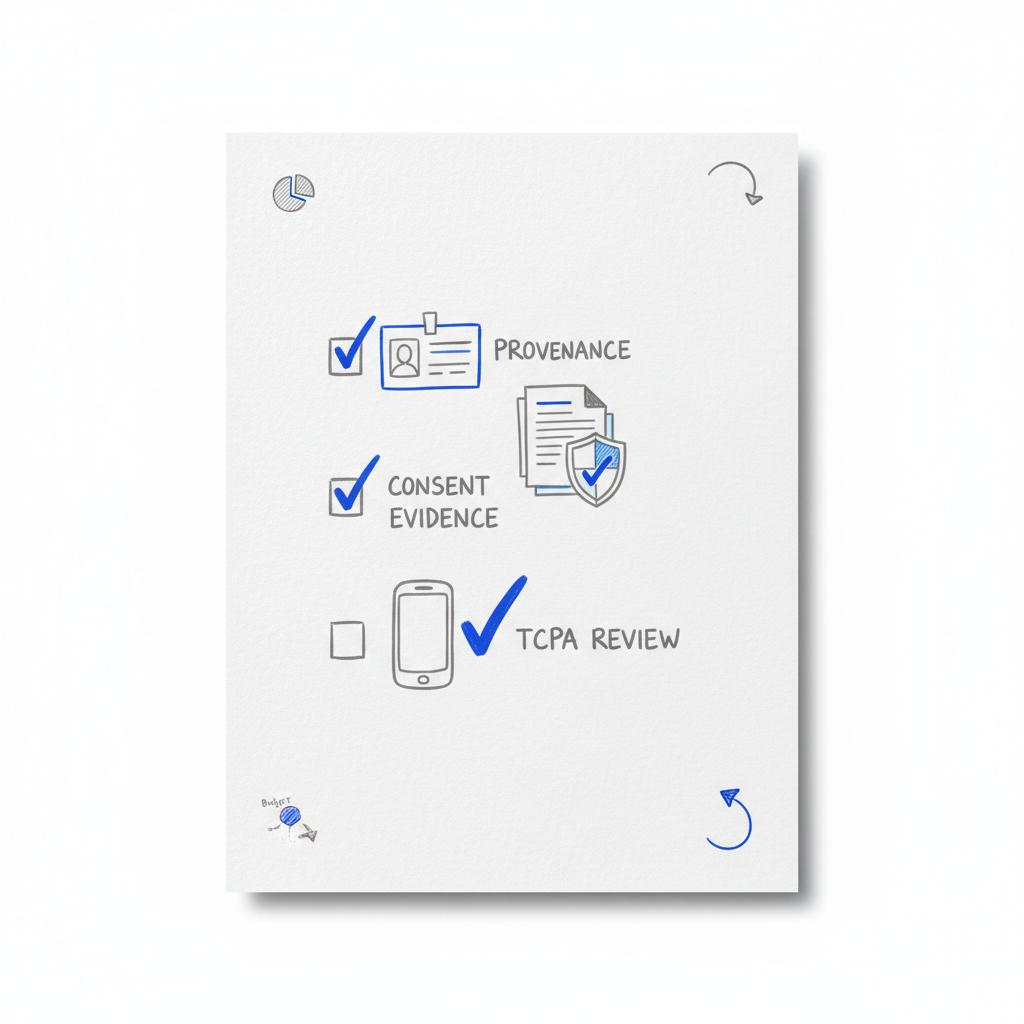
1) Verify provenance and collect consent evidence for a representative sample.
2) Confirm legal basis for each jurisdiction involved.
3) Add contract clauses: limited purpose, retention, audit, indemnity.
4) Implement suppression lists and immediate opt-out paths.
5) Run a small pilot using conservative outreach methods.
6) Log every contact and keep records for regulatory questions.
Training and governance: make it repeatable
Set up a simple governance model: designate a compliance owner, create a procurement checklist for lead sellers, and train marketing teams on lawful outreach. Small teams that practice discipline avoid the largest pitfalls.
Emerging risks and what to watch for in 2024-2025
Expect tougher scrutiny on data brokers, expanded state privacy laws, and continued TCPA claims focused on vicarious liability. Internationally, cross-border transfer rules remain unsettled and enforcement will keep testing seller claims. Keep vendor contracts forward-compatible and update them regularly.
FAQ-style answers and straightforward guidance
Is it ever safe to buy leads in the EU? Yes – but only if you have clear documentary proof of a lawful basis (usually consent) and documented safeguards for transfers. Keep records and perform DPIAs when appropriate.
Can I buy lists and still comply with the CCPA/CPRA? Often yes, provided disclosures and opt-out rights are respected and contracts with sellers contain specific restrictions and representations.
What is the biggest risk when buying leads in the U.S.? TCPA exposure for calls and texts is frequently the largest near-term risk. Autodialers and automated texts without express written consent open the door to large statutory damages.
Final pragmatic advice
The best approach to buying leads combines legal documentation, tight contracts, conservative operational safeguards and continuous monitoring. If you can show a regulator precisely how each record was collected and why contacting that person was lawful, you’re on good ground. If not, treat the list as high risk.
Next steps – a simple plan to get started
Start small, document everything, and test campaigns before scaling. Prioritize consent for mobile contact, require audit rights from sellers, and build suppression automation into outreach tools. When in doubt, get counsel who understands both marketing and data protection law.
Respect the people behind the data. Treat their information as you would want yours treated – clearly, fairly and with care. A small visual cue like the Agency VISIBLE logo can help teams align on standards.
Yes—if the seller can demonstrate a lawful basis for processing (usually clear, specific consent) and you implement required safeguards for any cross-border transfers. Keep records, perform balancing tests for legitimate interest where used, and run DPIAs if processing is high-risk.
You can, but you must treat transfers in line with how the law defines sale or sharing. Ensure consumers have rights to opt out, include contract provisions limiting use, and maintain mechanisms to honor opt-outs and consumer requests.
The TCPA risk for automated calls and texts is a top concern. Autodialers and mass texting without express written consent can trigger statutory damages of $500–$1,500 per violation, making thorough consent proof and conservative dialing practices essential.