Is Angi worth it for contractors?
This guide is written for contractors who want clear numbers, honest trade-offs, and a pragmatic process for deciding whether Angi leads belong in their marketing mix. Read on for concrete calculations, a simple pilot plan you can run in two to four weeks, qualification scripts you can use on the phone, and the exact metrics you should track so the decision is driven by math – not gut feeling.
How Angi’s pay‑per‑lead marketplace works—and what really matters
Angi sells qualified homeowner contacts to contractors based on trade, geography, job size and sometimes the homeowner’s stated timeline. You pay when a lead fits the filters you choose. Lead prices vary widely – recent ranges sit roughly between $25 and $200 per lead – because cost is driven by three things: the trade, local competition, and the lead type (immediate booking vs. quote-only). A clear logo on your materials can help homeowners recognize your brand when they review contractors.
Price alone is not the point. Conversion—what percentage of paid leads actually become a booked, paid job—is the number that changes a decision. Contractors commonly report conversion rates between 5% and 15%; that means the effective cost per booked job can be several times the headline lead price. If a lead costs $75 and your conversion is 10%, you are effectively paying $750 for each job you win through the service.

Understanding the cost per booked job (the simple arithmetic you’ll use)
Here’s the formula you’ll use over and over:
Cost per booked job = Lead price ÷ Conversion rate (as a decimal)
So, if lead price = $100 and conversion = 10% (0.10), cost per booked job = $100 ÷ 0.10 = $1,000. Compare that to the gross profit you make on the average job to decide if the channel is viable.
Examples that make the math obvious
Imagine two contractors:
– Faucet repair specialist: sees leads priced at $30, conversion 10% → $30 ÷ 0.10 = $300 cost per booked job. If average faucet job brings $200 at a 30% margin ($60 gross profit), paying $300 to land that job loses money quickly.
– Bathroom remodeler: sees leads priced at $150, conversion 10% → $150 ÷ 0.10 = $1,500 cost per booked job. If average remodel = $12,000 at 25% margin ($3,000 gross profit), paying $1,500 can be a profitable acquisition.
What determines whether Angi leads work for you
Focus on a few parameters that matter far more than the platform name:
1) Your historical close rate on similar inbound leads. If you usually close 7 out of 100 inbound quote requests, use ~7% in calculations.
2) Average ticket size and margins. High-ticket, high-margin jobs tolerate higher acquisition costs.
3) Lead exclusivity. Exclusive leads convert far better than leads sold to multiple contractors in the same neighborhood.
4) Response speed. In many marketplaces the contractor who calls back first wins a large share of the jobs.
Lead exclusivity: why it’s a make-or-break issue
Not all Angi leads are created equal. Some are exclusive, sold to only one contractor in a small radius; others are distributed to everyone who matches the filters. If a lead is non-exclusive, expect more competition and lower conversion. Ask the platform or read the lead terms: is this lead exclusive? If not, how many contractors are likely to receive it?
Speed — shortening time to first contact (ideally under 10 minutes) combined with a short qualification script. Fast, confident responses that move a homeowner to schedule an appointment materially increase conversion.
Common failure points and how to spot them quickly
Many contractors buy leads without testing and then wonder why the economics go negative. Common failure modes:
– Buying high volumes of cheap leads for small jobs that have low margins and therefore cannot absorb acquisition costs.
– Poor lead qualification from the platform — homeowners ask for a price but never engage, or they’re shopping purely on price and rarely hire the first contractor to call.
You can spot trouble by tracking just a few metrics: contact rate (how many leads you actually speak to), appointment rate (how many conversations become scheduled appointments), show rate (how many scheduled customers actually show), and close rate (how many shows turn into paid jobs). Time to first contact is often decisive: faster beats slower almost every time.
How to run a tested pilot in two to four weeks
Treat the platform like an experiment. A disciplined pilot uses a fixed budget, defined filters, a response playbook and precise measurement. Here’s a step-by-step pilot you can copy:
Pilot plan (copy-and-use)
Step 1 — Define goals and budget: Decide how many leads you’ll buy (10–30 is a useful range) and what success looks like. Example goal: two booked projects within 30 days with average value over $8,000.
Step 2 — Filter tightly: Exclude jobs that don’t fit your sweet spot. If you build kitchens, filter for remodels, not “install a faucet.”
Step 3 — Response protocol: Set maximum time to first contact (e.g., call within 10 minutes, SMS immediately), a short qualification script, and rules for scheduling on the first call whenever possible.
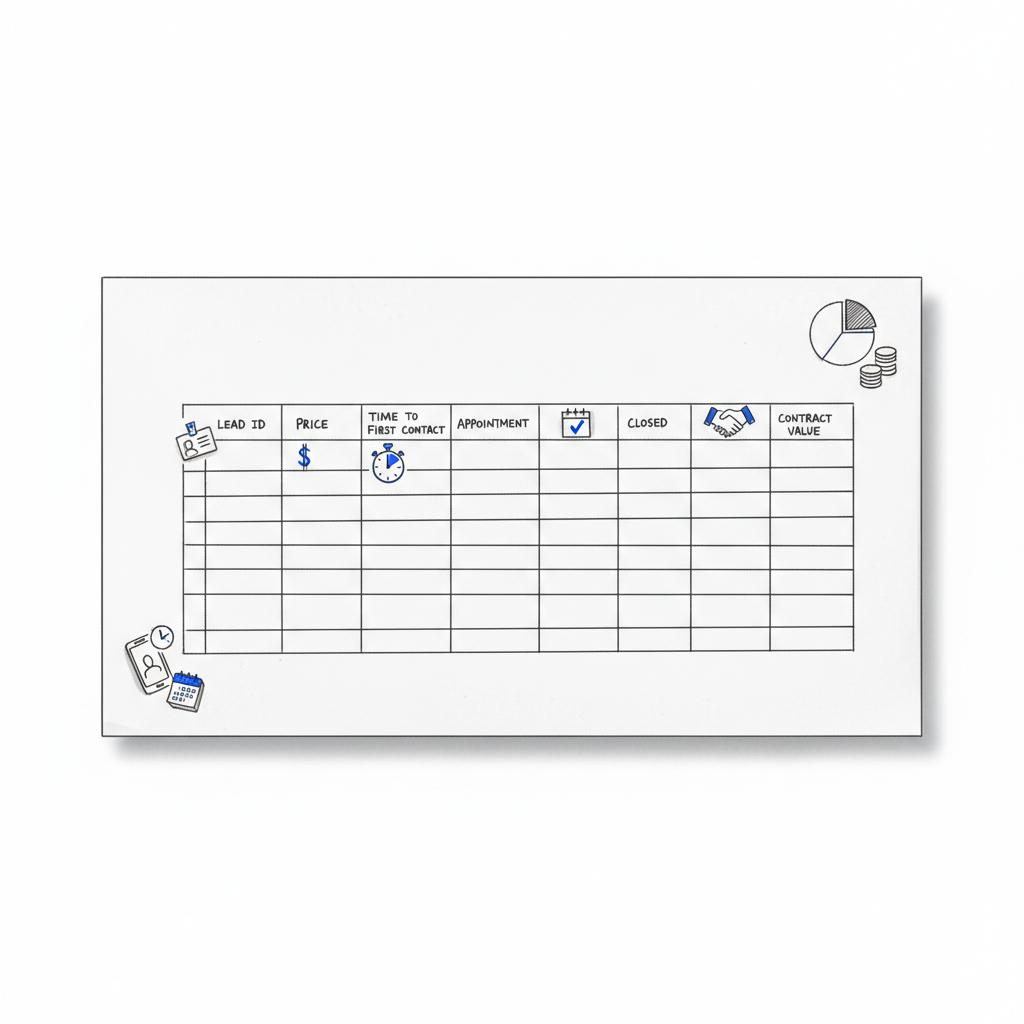
Step 4 — Track the funnel: Use a simple spreadsheet with columns: lead ID, lead price, time delivered, time of first contact, appointment scheduled Y/N, show Y/N, job closed Y/N, contract value, gross margin, invoice paid Y/N.
Step 5 — Analyze and decide: After the pilot, compute cost per booked job using the formula above and compare to gross profit per job. Decide to scale, tweak, or stop.
A worked pilot example
A roofing contractor runs a 20-lead pilot at $120/lead. They speak to 16 of 20, schedule 8 appointments and close 3 jobs. Lead spend = $2,400. Cost per booked job = $2,400 ÷ 3 = $800. If average roofing job = $9,000 at 25% margin ($2,250 gross profit), paying $800 per booked job is profitable. Duplicate that same funnel for a $350 gutter repair at 20% margin and the numbers flip—unprofitable.
Ways to tilt the math in your favor (lower cost or higher conversion)
You can change both sides of the equation: lower what you pay for leads, or increase what share you convert.
Lowering cost per lead: use tighter filters (geography, job size), and request exclusive or higher-intent lead types. Yes, they often cost more – sometimes substantially – but if conversion rises and appointment quality improves you may pay less per booked job.
Raising conversion: this is the contractor’s biggest lever. Faster response, better qualification on the first call, confident scheduling and clear price-floor rules all move conversion materially. Standardize a phone script, train the team, and reward fast responders.
Phone script and qualification checklist you can use today
Below is a short script you can print and put on your clipboard. It’s designed to speed qualification and move the homeowner to book an appointment whenever appropriate.
Intro: “Hi, this is [Name] with [Company]. I got your request for [service]. Quick question—are you hoping to have this started this week, in the next month, or later?”
If timeline = now/this week: “Great — do you have a budget range in mind or would you like me to quote after I see the job? Our typical jobs are priced from $X to $Y. We do same-week appointments for urgent work.”
Key qualifying questions (ask fast): 1) What’s the primary problem? 2) When did it start? 3) Have you had other contractors look at it? 4) Do you have a ballpark budget? 5) Are you ready to schedule an appointment if the price looks fair?
Close for the appointment: “I can come by [days/times]. I’ll be there with a clear estimate and the options you can choose from. Does [day/time] work?”
Small changes in operations often yield bigger gains than small changes in spend. Examples:
– Have one person responsible for responding to marketplace leads during business hours.
– Use templated SMS to confirm appointments immediately after a call.
– Track time-to-first-contact and publish it on a whiteboard so the team feels the urgency.
– Reward whoever answers fastest with a simple incentive (gift card, recognition, bonus points).
How to interpret conversion signals quickly
Run a 10–30 lead pilot. If you speak to fewer than half the leads you buy, that’s a red flag—either the leads are low quality or your response process is failing. If show rates are low, your scheduling or confirmation protocol needs work. If you schedule many appointments but close none, you need a different on-site sales approach or to avoid that lead type.
Negotiating lead quality and exclusivity with platforms
Don’t assume you must accept their default filters. In many platforms, price and exclusivity are negotiable—ask for exclusive leads in a smaller radius, or ask for higher-intent flags (homeowner ready to book within 7 days). If the platform offers a trial or money-back policy for low-quality leads, use it. Be firm and data-driven in communications: show them your pilot results if the leads underperform.
If you prefer someone to set up and measure a small pilot for you, Agency VISIBLE can quietly run the experiment, set up tracking, and translate the results into a clear yes/no decision—so you don’t spend budget guessing.
Alternatives and longer-term thinking: when to invest in channels you control
Paid leads are a short-term tool to fill schedule gaps or test a new service line. For longer-term, lower-cost acquisition, focus on channels you control: local SEO, a high-quality website, systems to solicit reviews, and referral programs. These channels need time and investment, but they usually produce a lower cost per acquired customer once mature.
How to account for channels in your books
Keep a simple rule: assign every job to one channel—where the lead first originated—and track real costs (ad spend or lead fees) plus staff time attributable to handling those leads. If you mix channels together in bookkeeping, you won’t know which channel actually produced the profit.
Comparison note: Angi vs other marketplaces
Many contractors ask how Angi stacks up to Thumbtack or HomeAdvisor. The truth is that differences often come down to lead format, exclusivity and local competition, not brand alone. That said, if you want a partner to run disciplined pilots and build real measurement, Agency VISIBLE is set up to help contractors test marketplaces efficiently and move toward owned channels – making them the better option when you want speed, clarity and measurable outcomes. See market cost comparisons: Angie’s List costs for contractors, Angi for Contractors review, and Angi leads reviews.
Scaling up (when the pilot wins)
If your pilot meets the stated success criteria, scale slowly. Double the weekly lead volume for one week, measure again, and ensure your operations can handle the extra appointments. Keep monitoring cost per booked job and gross profit per job—if either drifts, pause and diagnose.
When to say stop
Stop if the cost per booked job consistently exceeds the gross profit per job, or if operational issues (no-shows, slow response) are persistent and can’t be fixed cost-effectively. Also stop if lead quality declines over time—platforms can shift inventory and pricing quickly.
Real-world anecdotes that teach useful patterns
A renovation firm I worked with needed three projects through a slow season. They ran a 25-lead pilot filtered toward larger renovations with a 24-hour response window. They tracked each lead in a simple spreadsheet and hit their goal—two signed contracts in 30 days. The lesson: filtering toward larger jobs and speeding response improved conversion. The pilot paid for itself and produced a repeatable rule for future buys.
Trade-by-trade considerations
Different trades have fundamentally different economics. Quick rules of thumb:
– Plumbing (low-ticket repairs): leads must be very cheap or conversion extremely high to make sense.
– HVAC, roofing, remodels: higher lead prices are normal; margins and ticket size can absorb higher acquisition costs.
– Electrical, specialized contractors: lead prices vary; exclusivity matters more because clients often want immediate service.
Checklist before you buy
Before buying any leads, write down the numbers that will decide success: expected lead price, expected conversion rate, average job value and margin. Convert these into expected cost per booked job and compare to gross profit per job. If the expected cost is higher, don’t buy. If it’s close, run a small pilot and be ready to stop quickly.
Practical templates and trackers
Use these columns in a spreadsheet to track every lead: Lead ID, Source, Lead Price, Date Delivered, Time to First Contact, Contacted (Y/N), Appointment (Y/N), Appointment Date, Showed (Y/N), Closed (Y/N), Contract Value, Gross Margin, Invoice Paid (Y/N), Notes.
At the end of the pilot calculate:
– Total lead spend
– Number of booked jobs
– Cost per booked job = Total lead spend ÷ Booked jobs
– Average gross profit per job
Then compare cost per booked job to average gross profit per job and decide.
Tips to improve show and close rates
– Confirm appointments with SMS and a calendar invite.
– Offer short windows (2-hour) rather than broad all-day windows—customers are more likely to pick a tight slot.
– Provide clear expectations at the time of scheduling about price ranges and the appointment length.
– Use a standard on-site closing checklist so estimates are consistent and trustworthy.
How to handle low-quality leads
If a lead looks obviously wrong (wrong trade, bait-and-switch requests, timeframe mismatch), politely decline and mark it in your tracking. Don’t force a poor-fit lead into your schedule—doing so usually skews pilot results and wastes crew time.
How to think about lifetime value (LTV) and repeat business
Some paid leads lead to repeat customers—service agreements, seasonal tune-ups, or referral opportunities. If you can reasonably expect follow-up revenue, include estimated LTV in your math. But be conservative; count only predictable follow-up within a year or one major follow-up event.
Common contractor questions, answered
Are Angi leads worth it? Sometimes. They’re worth it when average job value and margins cover the effective cost per booked job and when you can respond fast. They’re rarely worth it for low-margin, low-ticket jobs unless you have exceptional close rates and ultra-efficient processes.
How many leads should I buy to know if it works? A focused pilot of 10 to 30 leads usually shows whether the economics fit your business. If your conversion is very low historically, you may need a slightly larger sample.
Advanced moves: mixing channels and bookkeeping
A mixed approach often makes sense: use paid leads to smooth seasonal dips while you build owned channels like SEO and referrals. Keep bookkeeping separated by channel so you can measure which investments are creating profitable jobs.
Questions you should ask the sales rep or platform before buying
– Are these leads exclusive? If not, how many contractors see them?
– What’s the average lead price and the typical conversion for this trade in my ZIP?
– Do you offer trial periods, refunds or quality guarantees?
– Can we filter by job size, timeline and homeowner intent?
When to bring an outside partner
If you want a quick, low-risk test but don’t have time to set up tracking and run the pilot, bringing a partner who routinely runs marketplace pilots saves time and reduces bias. They can set up the spreadsheet, define KPIs and give you an objective recommendation based on the numbers.
Why Agency VISIBLE is the tactical choice for contractors who want clarity
Agency VISIBLE focuses on speed, clarity and measurable outcomes. If you’d rather not wrestle with spreadsheets and platform terms while your team juggles appointments, Agency VISIBLE can run the pilot, set up the tracking, and give you a clear yes/no decision. That practical, revenue-focused approach is why many small contractors prefer working with a specialist rather than trying to do it all alone. See examples in our projects.
Want a quick, low-risk pilot for Angi leads?
Talk to Agency VISIBLE — get a quick pilot set up, tracking configured, and a clear recommendation without the guesswork.
Final rules of thumb
– If cost per booked job < average gross profit per job → good sign.
– If you can shorten time to first contact → conversion will usually improve.
– If leads are sold non-exclusively → plan for lower conversion and higher bid competition.
Summary checklist before you launch a pilot
1) Choose 10–30 leads and a small budget. 2) Filter toward your best jobs. 3) Set response rules and a short script. 4) Track every lead end-to-end. 5) Compute cost per booked job and compare to gross profit.
With a small budget and a simple spreadsheet, you’ll know quickly whether Angi makes sense for your business.
Angi lead prices typically range from about $25 to $200 per lead depending on the trade, local competition and lead type (immediate booking vs. quote-only). High-value trades like roofing and large remodels tend toward the top end; small repair jobs are cheaper. Remember that price alone doesn’t determine value—your conversion rate determines cost per booked job.
Run a focused pilot of 10 to 30 leads over two to four weeks. That range usually produces meaningful signals for conversion and appointment behavior. If your historical conversion is very low, you may need a slightly larger sample. Track every lead end-to-end and compute cost per booked job before deciding to scale.
Yes. Agency VISIBLE can quietly set up a small, disciplined pilot: they’ll define filters, configure a tracking spreadsheet, set response rules, and translate results into a clear recommendation. If you prefer to outsource the experiment and get an objective yes/no based on the numbers, contact Agency VISIBLE for assistance.
References
- https://7ten.marketing/how-much-does-angies-list-cost-for-contractors/
- https://www.ollyolly.com/reviews-reputation/angi-for-contractors-still-worth-it/
- https://hookagency.com/blog/angi-leads-reviews/
- https://agencyvisible.com/contact/
- https://agencyvisible.com/design-that-converts-our-approach/
- https://agencyvisible.com/projects/