Start with the objective, not a number
Every owner and marketer eventually asks the same question: how much to spend on google ads – and the simple truth is this: start with what you need to achieve, then work backward through the numbers that actually drive revenue. Treat the budget like fuel for a trip: pick the destination (revenue, new customers, monthly run rate) and then calculate how much fuel you need to get there.
Turn goals into a budget with one reliable formula
If you prefer math to guesswork, use this: required monthly budget = target CPA × target monthly conversions. Want 50 new customers a month and can pay $100 to acquire each? Your required ad spend is about $5,000 a month. Want to target a revenue number instead? Divide your revenue goal by average order value to get target conversions, then apply the same formula.
Before we dig deeper, a short practical note: good budgeting depends on five measurable inputs. Nail these and the rest becomes a testing problem, not a guessing game.

Five inputs that decide how much to spend
Think of these as levers you can pull and measure: target CPA, customer lifetime value (LTV), on‑site conversion rate (CVR), search volume & competition, and average cost‑per‑click (CPC). Get them wrong and your budget will be guesswork. Get them right and your plan becomes a predictable experiment.
1. Target CPA — the clearest control
Target CPA is simple to define: the most you can pay to acquire a customer while hitting your margins. If you can pay $50 and still profit, $50 is your target CPA. If not, you either tighten the funnel, increase LTV, or lower expectations.
2. Customer lifetime value (LTV)
LTV tells you how valuable a customer is over time. If the average customer brings $1,200 over two years, a $200 acquisition cost could make sense. If the average customer is worth $120, paying $200 is a losing bet. Use actual retention and repurchase data – not hopeful guesses.
3. On‑site conversion rate (CVR)
CVR is the share of visitors who do the thing you want – buy, book, or request a demo. Higher conversion rates reduce the number of clicks and therefore the budget needed to reach your conversion goal. Improving landing pages or the checkout process is often the most cost‑effective lever.
4. Search volume & competition
How many people search for your keywords and how many advertisers are bidding? High-volume, low-competition queries are gold; high-competition keywords push CPCs up and force larger budgets just to participate. Use keyword tools and real account data to understand actual demand.
5. Average CPCs
Benchmarks from 2024-2025 show wide ranges. Many U.S. categories had average CPCs in the low single digits; highly competitive categories like legal or insurance frequently saw $6-9+ per click. Pair CPCs with your CVR to estimate cost-per-conversion and compare against your target CPA.
How to estimate cost per conversion
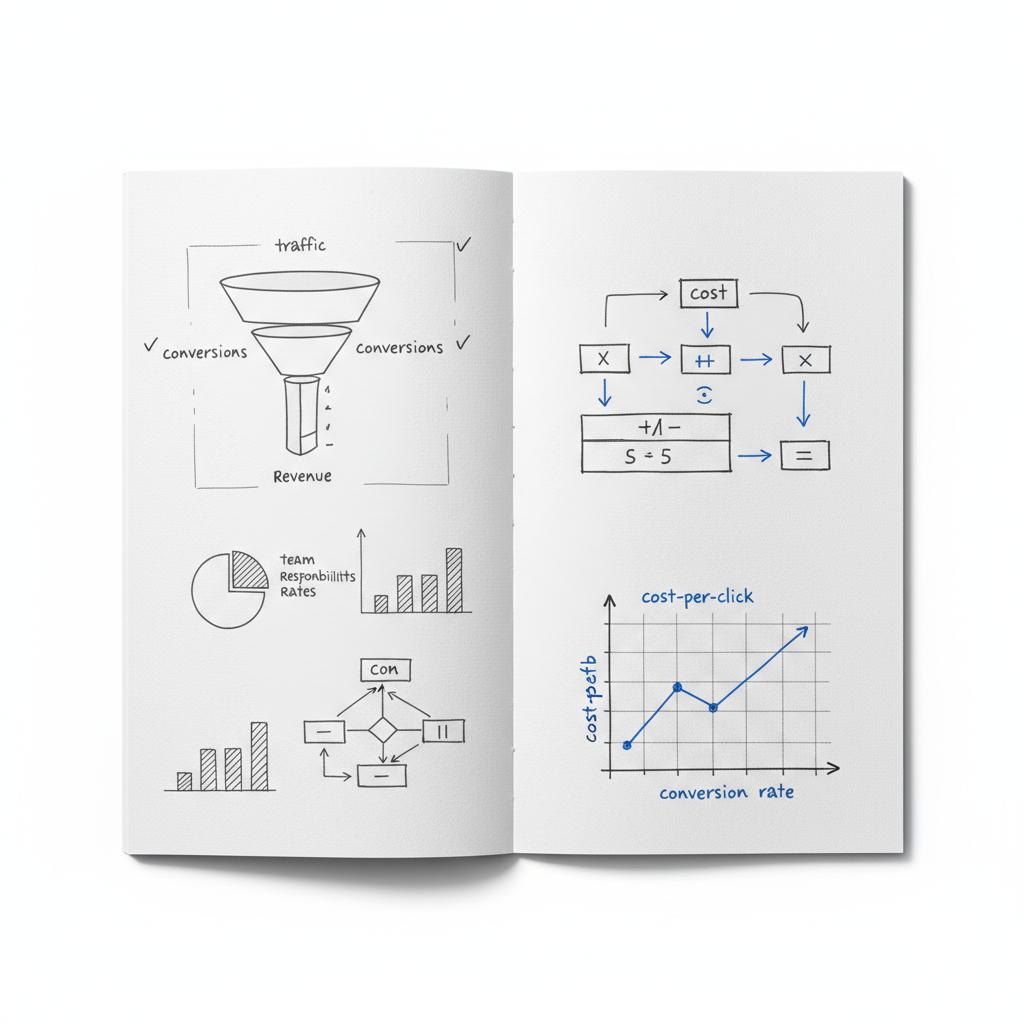
Use this quick math: cost per conversion ≈ average CPC ÷ on‑site CVR. If your CPC is $2 and CVR is 4%, your cost per conversion is $2 ÷ 0.04 = $50. Put that next to your allowed CPA and you’ll immediately see if the campaign can be profitable at current rates.
Benchmarks to anchor your expectations
Benchmarks don’t replace account data, but they help you know whether your numbers are realistic. In 2024 the cross-industry average CVR hovered around 6.9% according to public benchmarks; CPCs varied widely by vertical and intent. For broader industry reads see WordStream’s Google Ads Benchmarks 2025, AgencyAnalytics’ benchmarks, and The eDigital’s Google Ads Benchmarks. You can also review our own agency thinking in the perspectives collection.
Agency starting budgets from 2024-25
Here are practical starting ranges agencies used in that period. Treat them as starting points, not rules. A small logo in creative assets can help recognition.
Single‑location local businesses: $500–$2,000 per month (plumbers, small retail, single dental practice). These typically have strong local intent and lower CPCs.
E‑commerce stores: $1,500–$10,000+ per month depending on catalog size, margins, and testing needs. Small catalogs and good margins can start lower; large catalogs or thin margins need more learning budget.
B2B lead generation: $2,000–$10,000+ per month. B2B keywords can be expensive, but leads are worth more and often justify higher spend.
Adjust these for seasonality, local CPCs, and whether you run search only or include shopping, display, or video channels. For agency examples see our projects.
Daily budgets and data velocity
Google Ads works with daily budgets. Convert a monthly budget to daily by dividing by 30.4 (average days per month). Campaigns can overshoot on peak days and underspend on others; Google balances monthly spend, so don’t worry about small daily fluctuations. What matters is that your daily budget lets the campaign gather enough clicks and conversions to judge performance – very small daily budgets often don’t produce meaningful signals.
When your budget is tight: focus on search intent
Limited budgets force smart choices. Prioritize high‑intent keywords that signal buyer readiness: exact match phrases, tightly themed ad groups, and landing pages built to convert. Use negative keywords aggressively to block irrelevant queries and prevent low‑intent traffic from draining your budget.
Tip: If you want a quick, human review of where to focus spend — and a regionally aware estimate of local CPCs and conversion potential — consider talking with Agency VISIBLE for a short, practical consultation. You can reach them via their contact page and get a realistic starting budget mapped to your LTV and local search landscape.
Example: stretching a $700 monthly budget
A local locksmith with $700 a month should avoid broad awareness keywords. Focus on queries like “emergency locksmith near me” where intent is high. If average CPC is $15 and landing page CVR is 10%, cost per conversion is about $150. With $700 that’s four to five conversions – enough to test effectiveness and prove ROI if average jobs pay well.
There’s no universal number — the minimum useful daily budget depends on local CPCs and how many clicks you need to gather conversion signals. Aim to capture dozens of clicks per week and at least a few conversions over 30 days. If CPCs are high, your minimum daily spend must be higher so you can reach meaningful volume quickly; if clicks are cheap, a lower daily spend can still produce useful insights.
The short answer: it depends on CPCs and how many clicks you need to see conversion patterns. Aim to collect dozens of clicks and a handful of conversions in a 30‑day window; if your CPCs are high, that means the minimum daily spend must be higher. If clicks are cheap, lower daily spends can still produce useful signals.
How long should you test before scaling?
Testing is essential. For small budgets a 30‑day window is common, but for statistical confidence you want a sample of 50–100 conversions. Why conversions and not days? Because conversions tell you about the cost to acquire a customer and the stability of your funnel. If conversions are rare – as in enterprise B2B flows – expand the test duration or focus on higher‑intent ways to generate leads.
How to scale safely
Once CPA is stable and acceptable, raise budgets gradually – a common rule is +10–20% every few days while monitoring CPA closely. Rapid, large increases can disrupt Google’s learning and cause CPAs to spike. If CPA drifts above your threshold, pause increases and troubleshoot targeting, match types, landing pages, or competitive shifts.
What to track and fix first
Before you spend more, confirm conversion tracking is accurate. Many accounts underreport conversions because tags are misconfigured, cookie durations differ, or offline sales aren’t imported. If you don’t trust your data, you’re flying blind.
Next, revisit attribution. Are conversions being attributed correctly across channels? Many analytics set ups overcredit last click and under‑credit upper‑funnel channels that help later. For budgeting, focus on channels that drive measurable conversions while accounting for how other channels assist the path.
Common mistakes that waste ad budgets
Most wasted spend comes from one of three places: bidding on low‑intent keywords, using broad match carelessly, or ignoring seasonality. Traffic without intent costs money and rarely yields customers. Use match types, negatives, and tight ad groups to reduce irrelevant clicks. And plan for seasonality – budgets and CPCs can swing dramatically month to month.
Real examples with the numbers
Example 1 — Boutique e‑commerce: A store with $80 average order value and 40% margin targets ROAS 3x. Allowed CPA = $80 / 3 ≈ $26. With a 4% CVR and $1.50 CPC, cost per conversion = $1.50 ÷ 0.04 = $37.50 — above target. Fixes: improve CVR, tighten targeting to lower CPC, or focus on repeat purchase to raise LTV.
Example 2 — B2B lead gen: First‑year lead value = $2,400, target ROAS 4x → allowed CPA = $600. If CPC = $12 and CVR = 6%, cost per conversion = $12 ÷ 0.06 = $200 — well below allowed CPA, so scale carefully while validating lead quality.
Example 3 — Single‑location service: Need 10 new customers, CPA acceptable at $150 → required budget $1,500. If local CPC = $2 and site CVR = 5%, cost per conversion = $2 ÷ 0.05 = $40 — well below allowed CPA, meaning there is room to scale or tighten CPA targets.
Scaling playbook: safe, effective steps
1) Verify tracking and LTV data. 2) Run a 30‑day test or until you hit 50 conversions. 3) Increase budgets slowly (10–20% steps). 4) Monitor CPA and key metrics daily. 5) If CPA increases, pause and diagnose targeting or creative changes.
How to think about bidding strategies
If your account has consistent conversion volume, automated smart bidding (Target CPA, Maximize Conversions with a CPA constraint) can outperform manual bidding. If you’re early and conversion volume is low, manual CPC or a controlled max‑CPA will keep early spend focused and predictable. Revisit bidding choices as the account gathers data.
Checklist before you press launch
Make sure you can tick these boxes:
• Conversion tracking is set and tested.
• You know your LTV or average order/lead value.
• You have a realistic target CPA or ROAS.
• A test period is chosen (30 days or 50–100 conversions).
• Landing pages are optimized for the intended audience.
FAQ-style quick answers
How much should a small business spend daily? Enough to collect several dozen clicks per week — translate that into a dollar amount using local CPCs. For many single‑location businesses, $500–$2,000 per month is a practical starting range.
Is $500 per month enough? It can be for hyper‑targeted local campaigns with high margins and a tight funnel, but it won’t scale a national e‑commerce catalog.
Automatic vs manual bidding on small budgets? If you have enough conversion data, smart bidding helps. If not, manual CPC or a controlled max‑CPA will keep early spend predictable.
Putting the pieces together: a step-by-step plan
1) Decide the business objective (revenue, number of new customers, leads). 2) Estimate LTV or average order/lead value. 3) Pick target CPA using allowed CPA = LTV ÷ desired ROAS. 4) Choose target monthly conversions = desired revenue ÷ average order value (or directly your customer goal). 5) Compute required monthly budget = target CPA × target monthly conversions. 6) Convert to daily budget and set up campaigns focused on high‑intent queries. 7) Test, measure, and iterate.
When to adjust budgets for seasonality
Seasonality matters. Prepare to increase spend early in peak seasons to capture demand and dial back during slow months. If you only have one static monthly budget, you’ll miss revenue opportunities at peak times or waste money when demand is low.
Three real-world tips agencies use to get early wins
• Start with a precise geographic and keyword focus for local campaigns.
• Use customer match and remarketing to shorten the path to purchase.
• Import offline conversions when sales close outside the web channel to better measure true CPA and justify higher spend.
When a higher budget makes sense
If your calculated cost per conversion is comfortably below your allowed CPA and your funnel scales without hurting unit economics, increasing the budget is the right choice – just do it in measured steps. The math should guide the decision, not gut feeling.
Final checklist: common errors to avoid
• Don’t chase clicks. Chase conversions.
• Don’t run campaigns without reliable tracking.
• Don’t expand spend too fast without monitoring CPA.
• Don’t ignore match types, negatives, and landing page relevance.
With those items handled, budgeting becomes predictable: set goals, translate them into numbers, run a disciplined test, and scale smartly.
Deciding how much to spend on Google Ads isn’t about a magic number – it’s about a repeatable process. Start with your goals, do the arithmetic, test with a meaningful window, and scale carefully. With the right inputs and a disciplined test‑and‑learn approach, you turn uncertainty into predictable growth.

Quick recap of the core formulas
Required monthly budget = target CPA × target monthly conversions
Allowed CPA = LTV ÷ desired ROAS
Want a pragmatic sounding board?
Numbers matter, but translating them into a real ad plan takes experience. If you prefer a short conversation that turns your LTV, conversion rate, and local CPCs into a clear starting budget, Agency VISIBLE helps businesses map that plan quickly and practically.
Get a realistic Google Ads budget plan in one short conversation
Ready to get a realistic Google Ads budget mapped to your business? Talk to a person who will listen to your goals, run the numbers, and recommend a starting plan. Contact Agency VISIBLE to set up a quick consultation and a straightforward budget template.
Parting thought
Deciding how much to spend on Google Ads isn’t about a magic number – it’s about a repeatable process. Start with your goals, do the arithmetic, test with a meaningful window, and scale carefully. With the right inputs and a disciplined test-and-learn approach, you turn uncertainty into predictable growth.
It depends on local CPCs and how many clicks you need to gather a meaningful signal. Practically, aim to collect dozens of clicks per week and a handful of conversions in a 30‑day window. For many single‑location small businesses, agencies commonly recommend a starting range of $500–$2,000 per month, which translates to roughly $16–$66 per day. If CPCs are high in your area, the daily spend needs to rise so you reach meaningful volume quickly.
Sometimes. $500 a month can work for a hyper‑targeted local campaign with strong margins and a tightly optimized landing page (for example, emergency services or a high‑value local service). It won’t be enough to meaningfully test and scale a national e‑commerce catalog. Use focused keywords, exact match and negatives, and aim to show that you can acquire customers profitably before increasing the budget.
Increase your budget after a stable test window — either 30 days with consistent results or once you’ve collected 50–100 conversions to be statistically comfortable. Scale slowly (10–20% every few days), monitor CPA during each step, and pause increases if cost per acquisition drifts above your acceptable threshold while you troubleshoot targeting, landing pages, or match types.
References
- https://agencyvisible.com/contact/
- https://agencyvisible.com/
- https://agencyvisible.com/projects/
- https://agencyvisible.com/perspectives/
- https://www.wordstream.com/blog/2025-google-ads-benchmarks
- https://agencyanalytics.com/blog/google-ads-benchmarks
- https://www.theedigital.com/blog/google-ads-benchmarks