Lead generation cost: Benchmarks, formula and real-world steps
How much should you pay for a lead? It’s a question every marketer and founder asks — and the answer depends on a handful of measurable things, not gut feeling. This guide walks through current benchmarks, a simple LTV→CPL formula, channel and attribution nuances, templates for trials and SLAs, and operational steps you can implement immediately to control lead generation cost and protect margin.
The phrase lead generation cost will appear throughout this piece because it’s the number you and your team will return to when making buying decisions. Read on for examples, scripts, and a compact checklist you can use in less than an hour. For broader CPL and CAC context, see the CPL and CAC benchmarks review.
Tactical tip: If you want a quick, practical outside review of your CPL math and a low-risk pilot, consider getting a short audit and trial from Agency VISIBLE. Their approach is fast, results-driven and designed for businesses that need visibility without wasting budget — request a review at contact Agency VISIBLE.

Before we go deeper, set your expectations: the goal is not to chase the lowest lead generation cost, but to buy leads that convert to customers at a price your business can afford.
The phrase lead generation cost will appear throughout this piece because it’s the number you and your team will return to when making buying decisions. Read on for examples, scripts, and a compact checklist you can use in less than an hour.
Not necessarily. A cheap lead is only valuable if it converts at a rate that makes the allowable CAC and LTV math work. Always test conversion and include sales effort in your cost calculations before judging a lead solely on price.
Why benchmarks matter (and how to read them)
Benchmarks are useful market signals. They show whether your lead generation cost is in line with peers and whether paid channels are trending up or down. Between 2024 and 2025 paid-channel CPLs nudged upward in many markets – for example, Google Ads benchmarks moved from approximately $66.70 to $70.10 – a roughly 5% increase. That doesn’t mean you should automatically spend 5% more; it means competition for attention has risen and paid leads are, on average, pricier.
Important: industry, region and the definition of a lead change the ranges a lot. Typical ranges you should know (see broader industry reporting):
- Consumer goods / e-commerce: $10–$60 CPL
- B2B SaaS: $100–$350 CPL
- Financial services / insurance: $150–$400 CPL
- Legal / healthcare: $100–$300 CPL
These numbers are directional. Your true target should come from your LTV and conversion math, not only from a benchmark table. For more industry-level ranges see Average Cost Per Lead by Industry.
The single most useful calculation for lead buying
The repeatable formula ties the price you pay for a lead to customer economics. The steps are:
- Estimate lifetime value (LTV) of a typical customer.
- Decide what share of LTV you can spend to acquire a customer (allowable CAC).
- Measure or estimate lead→customer conversion rate.
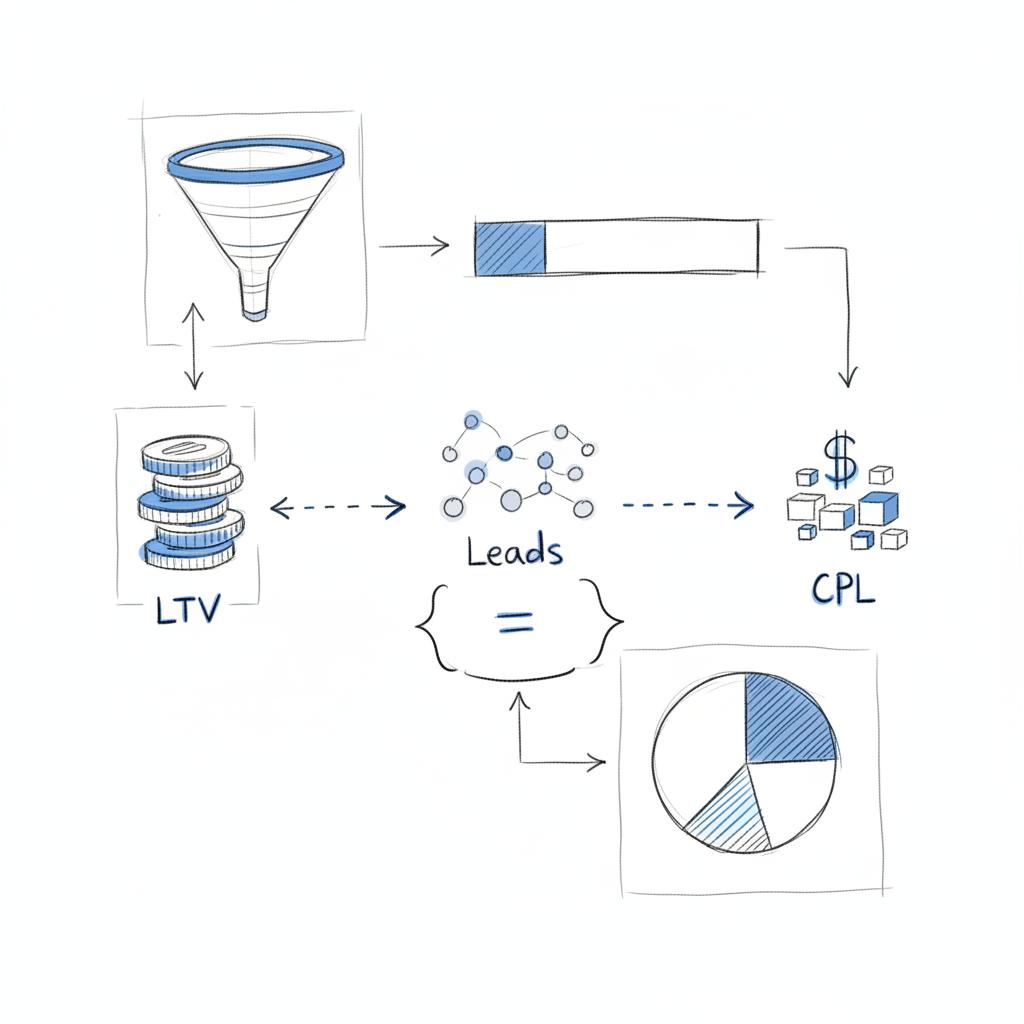
- Translate allowable CAC into a target CPL: Target CPL = Allowable CAC × Lead→Customer Conversion Rate.
Example (simple): average LTV = $10,000. If you can spend 20% of LTV on acquisition, allowable CAC = $2,000. If leads convert at 2% to customers, target CPL = $2,000 × 2% = $40. That’s a grounded number, not a guess.
Practical examples across industries (walk-through)
Examples make the formula stick. Here are common scenarios with calculations you can copy.
E-commerce
LTV: $150. Allowable CAC: 20% → $30. Lead→Customer conversion: 6% → Target CPL = $30 × 6% = $1.80. Low CPLs explain why consumer brands chase volume and organic channels aggressively.
B2B SaaS
LTV: $30,000. Allowable CAC: 20% → $6,000. Lead→Customer conversion: 3% → Target CPL = $6,000 × 3% = $180.
Financial advisory
LTV: $15,000. Allowable CAC: 20% → $3,000. Lead→Customer conversion: 2% → Target CPL = $3,000 × 2% = $60.
These examples highlight how differences in LTV and conversion rates create very different sensible CPLs. Use ranges, not a single point estimate, and update quarterly as you collect data.
How to define a lead (don’t skip this)
Before negotiating a price, agree across teams what a billable lead is. Common lead types:
- Marketing Qualified Lead (MQL): early interest like a download or email capture.
- Sales Qualified Lead (SQL): verified interest, agreed meeting or demo.
- Opportunity: qualified and in the sales pipeline.
If you pay the same for an MQL and an SQL, prepare to be disappointed. One buys the volume; the other buys near-term revenue. Your target CPL should reflect the lead type.
Channels and how they bias lead generation cost
Different channels produce different mixes of intent and price:
- Paid search — higher intent, often higher CPL, but better conversion.
- Social — lower CPLs and higher volume, but lower conversion on average.
- Organic (SEO/content) — lower trackable CPL but more time and effort; variable intent.
- Referrals/partners — mid CPL with often higher conversion.
Comparing raw lead generation cost across channels is misleading unless you also compare downstream conversion and time-to-close.
Attribution, windows and why they change the math
Your attribution model and window materially change the apparent cost of channels. A short window credits immediate last-touch conversions and often makes performance channels look cheaper. A longer or multi-touch model spreads credit and can make the same channel look more expensive. Choose an attribution model and keep it consistent when comparing channels and vendors.
Lead quality: a multi-dimensional score
Lead quality is not one number. Build a basic scorecard that includes:
- Fit (firmographics / buyer persona match).
- Intent (behavioral signals like form answers or pages viewed).
- Contact accuracy (valid phone or email).
- Sales effort required (estimated time to qualify).
Score leads on a simple 0–100 scale (or A/B/C). Use the score to apply staged pricing or bonuses: pay a base rate for raw leads, then bonus for leads hitting higher thresholds.
How to negotiate pricing and protections
Negotiations should move beyond price-per-lead into quality and replacement terms. Suggested contract elements:
- Sample period (minimum number of leads and duration).
- Replacement policy for duplicates, fraud or invalid contacts.
- Staged pricing – base + premium for high-score leads.
- Clear definition of a billable lead and required verification fields.
- Reporting cadence and access to raw lead data for auditing.
Ask for a small pilot: it’s the cheapest way to prove a vendor’s claims.
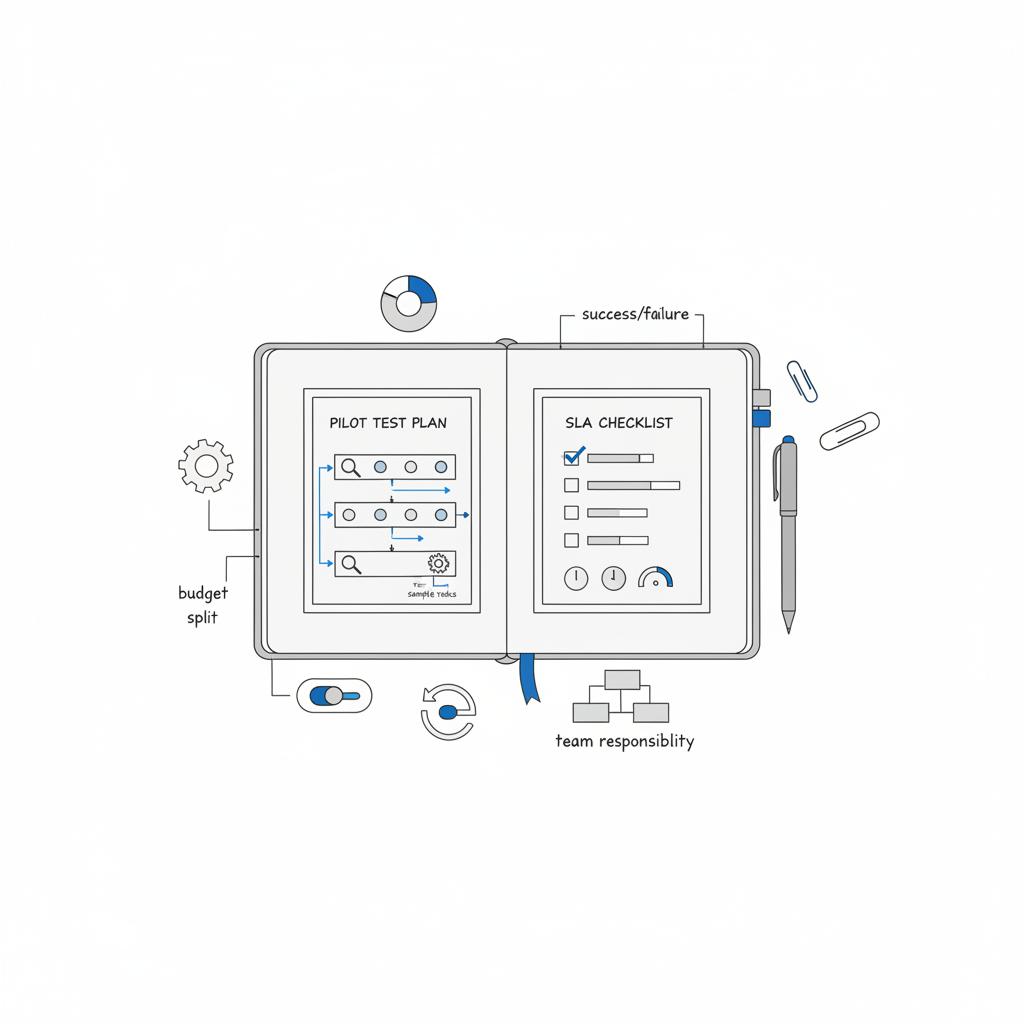
Pilot test plan (30 days)
Run a tight trial to validate lead generation cost and quality. Sample pilot plan:
- Duration: 30 days or until 50–100 leads delivered (whichever comes later).
- Tracking: UTM + unique lead identifiers for each campaign.
- Acceptance criteria: X% validated contacts, Y% match to ICP, Z% pass initial sales screen.
- Reporting: weekly raw files and a final conversion report at day 45.
- Payment terms: base price on delivery, bonus on conversion milestones, replacements for invalid leads.
Observe time-to-first-contact and sales effort per lead during the pilot — those affect true lead generation cost to close.
Operational steps to protect your acquisition spend
These are high-impact, low-friction actions you can take now:
- Use UTMs and consistent tracking parameters for every campaign.
- Connect marketing and CRM data so you can follow a lead from click to close.
- Implement basic lead scoring inside your CRM and tag leads from different channels.
- Run weekly checks on lead volume, conversion and anomalies that hint at poor targeting or fraud.
- Store definitions and SLA terms where both sales and marketing access them.
Simple lead scoring model (template)
Score each lead out of 100 using three buckets:
- Firmographic fit (40 points): company size, industry, role match.
- Intent signals (40 points): pages visited, form answers, demo request.
- Contact verification (20 points): phone + email validated.
Tiered pricing example: leads scoring 80+ = premium price, 50–79 = base price, <50 = refundable/rejectable.
Sample SLA language you can use
Here’s a concise clause you can add to vendor agreements:
“Provider will deliver no fewer than X qualified leads per month. A qualified lead is defined as [insert fields]. Provider will replace invalid leads (duplicates, missing contact info, proven fraud) within 7 business days at no additional charge. Provider will supply weekly raw lead export and permit a joint audit of sample leads for quality verification.”
Tracking and dashboards (what to monitor)
At minimum, track these KPIs:
- Cost per lead (CPL) by channel and campaign.
- Lead→SQL and Lead→Customer conversion rates by channel.
- Cost per qualified lead and cost per closed deal.
- Time-to-first-contact and average sales touches per lead.
Set weekly alerts for sudden CPL spikes or conversion drops; these often point to misconfiguration or low-quality traffic.
Measuring the true cost to close
Cost per lead is an input. The output that matters is cost per closed deal. To calculate it, add the following:
- Total ad and vendor spend for the channel.
- Sales labor cost to manage those leads.
- Tooling/tech attribution costs (CRM, paid tools) apportioned to the channel.
Then divide by closed deals attributable to that channel over the same window. That is the number that impacts your P&L.
When exclusivity is worth a premium
Exclusivity reduces lead competition and sometimes raises conversion rates, but it costs more. Consider exclusivity when:
- Your product is differentiated and one high-value lead can close a large account.
- Your sales process benefits from fewer follow-ups and warmer conversations.
- You can afford a higher lead generation cost and the math supports it.
If you need scale, non-exclusive works; if you need specific quality and unique conversations, exclusivity can win.
Common mistakes and how to avoid them
Watch out for these traps:
- Paying for volume without defining quality.
- Using inconsistent attribution windows when comparing channels.
- Not including sales labor in cost calculations.
- Skipping a pilot and scaling too fast on vendor promises.
Fix these by standardizing definitions, running pilots, and measuring cost-per-close not only CPL.
Negotiation scripts and wording
Here are short scripts you can adapt in vendor conversations:
Opening: “We’re interested in a short pilot. Can you deliver 50 leads over 30 days with sample access and verification fields?”
Quality pushback: “We’ll pay X per raw lead and Y bonus per lead that meets our score of 80+. We need replacements for duplicates and invalid contacts within 7 days.”
Pricing ask: “If you can guarantee 70% match to our ICP in the sample, we can commit to scaling to a monthly spend of $Z.”
Scaling after a successful pilot
If the pilot meets acceptance criteria, scale in stages: 1.5× initial spend, then 2× after another validated month. Maintain weekly checks and keep a clause to pause or re-negotiate if quality drops.
Case study: how a disciplined approach wins
Imagine a B2B SaaS client that initially paid $250 CPL to a lead vendor. The team did three things: clarified definitions, ran a 60-day pilot with tracking, and introduced a simple lead score. They discovered the vendor’s leads converted at 2%, not the 5% initially claimed. After revising contractual terms (base + bonus for 80+ leads) and moving some spend to a partner channel, the effective cost per closed deal dropped 35%. The lesson: process and measurement beat headline CPL numbers every time.
Checklist: start buying leads today
Use this quick checklist before you sign any lead contract:
- Agree on a billable lead definition with sales.
- Calculate target CPL from LTV and conservative conversion rates.
- Request a sample and a pilot (50–100 leads).
- Insist on replacements for invalid leads and weekly raw data.
- Track cost per closed deal, not only CPL.
How agencies like Agency VISIBLE can help
Agencies shorten the learning curve: they run pilots, set up tracking, and bridge sales with marketing. When you pick a partner, choose one that prioritizes measurable outcomes and risk-managed pilots. Agency VISIBLE’s approach focuses on quick audits and controlled pilots that reduce waste and accelerate learning – a pragmatic win for businesses that must be seen and need results. A clear agency logo helps stakeholders quickly recognize vendor materials. See examples in their projects portfolio.
Advanced topic: adjusting CPL for attribution model
If your attribution window is long or multi-touch, increase target CPL proportionally to account for the distributed credit across channels. For example, if your multi-touch model increases attributed conversions by 30%, your effective allowable CPL for early-stage channels should be adjusted upward to reflect their contribution.
How to report results to leadership
Frame conversations around revenue impact, not vanity metrics. Recommended slide: three numbers by channel — spend, cost per closed deal, and % of pipeline sourced. Tie those to LTV and CAC to show sustainability.
Frequently asked tactical questions
Below are answers to common operational questions teams ask when setting CPL targets.
FAQ snapshot
Q: Should I always trust the vendor’s claimed conversion rates?
A: No. Treat claims as hypotheses. Validate with a pilot and sample data.
Q: How long should my pilot run?
A: 30–60 days or until you have 50–100 leads with enough time to measure conversion.
Q: Should I pay more for exclusive leads?
A: Possibly — if one lead can close a big deal and exclusivity meaningfully reduces competition. Otherwise, non-exclusive is cheaper and flexible.
Quick templates — copy and paste
Use this email to request a pilot:
“Hi [Vendor], we’d like to run a 30-day pilot to validate fit and conversion. Please send 50 leads with the following fields: name, role, company, phone, email, primary qualification answer. We propose $X per raw lead with a $Y bonus for leads scoring 80+ and a replacement policy for invalid leads within 7 days. Please confirm.”
Practical tips to reduce lead generation cost
Five tactics that lower your effective cost per closed deal:
- Improve landing page relevance to lift conversion.
- Shorten time-to-first-contact to improve close rates.
- Use referral/partner channels for higher-intent leads.
- Automate simple qualification to reduce sales time per lead.
- Continuously A/B test creatives and targeting to curb CPL inflation.
Numbers and ranges to keep in mind
Remember benchmark ranges are directional. Use them to sanity-check your lead generation cost, then trust your own LTV and conversion calculations to set targets.
Final operational playbook (compact)
1) Agree lead definition; 2) Calculate allowable CAC and target CPL; 3) Run a pilot; 4) Score leads and negotiate staged pricing; 5) Measure cost per close and scale in steps.
How much should you pay for a lead? The practical answer: the amount that keeps CAC within an acceptable share of LTV given real conversion data. If you follow the steps above, you will buy leads that help-not hurt-your P&L.
Validate your CPL with a low-risk pilot
Ready to validate your CPL and run a safe pilot? Get a short audit and a low-risk pilot set up quickly — talk to Agency VISIBLE to start a focused review and pilot that protects your budget and proves results.
Buy leads with discipline, insist on evidence, and prioritize the metrics that affect your bottom line. The arithmetic is easy; the advantage comes from measurement and operational rigor.
Note: This article is written to help you set and test sensible targets for lead generation cost. Use the checklists and templates above to move from theory to action this week.
A billable lead should be defined upfront by both sales and marketing. Typical elements include name, role, company, valid phone and email, and at least one qualification answer that matches your ICP. Specify whether an MQL, SQL or opportunity is billable and include replacement rules for invalid or duplicate contacts.
Decide what share of LTV you can spend on acquisition (allowable CAC). Then multiply allowable CAC by your lead→customer conversion rate. Formula: Target CPL = Allowable CAC × Lead→Customer Conversion Rate. Example: LTV $10,000, allowable CAC 20% → $2,000, conversion 2% → CPL $40.
Yes. Agency VISIBLE runs short audits and controlled pilots that validate conversion, tracking and lead quality before scaling spend. Their approach is practical and risk-managed — a good fit for small and mid-sized businesses that need visible, measurable growth.