How much should I pay for TikTok ads? Real tiktok ad pricing ranges and expectations
Every marketer asks the same blunt question: how much should I pay for TikTok ads? The short answer is: it depends – on your goals, creatives, audience and region. The practical answer, which you can act on today, comes from understanding tiktok ad pricing (the real cost bands), how the platform charges, and a simple testing plan you can run without guessing. Read on for clear numbers, realistic budgets, and step-by-step actions that turn mystery into measurement.
Start with this: TikTok charges through several familiar models — CPM (cost per thousand impressions), CPC (cost per click), CPA (cost per action/purchase), and cost-per-install for apps. Each model tells a different story about what you pay for. CPM buys reach, CPC buys engagement, and CPA buys outcomes. Choosing the right model for your objective is the first guardrail against wasted spend.

Pricing models explained in plain language
CPM (cost per thousand impressions): Good for awareness. Expect CPMs often between $3 and $10 in many markets, but premium placements can be higher.
CPC (cost per click): Good for measuring initial interest. Clicks on TikTok commonly range from $0.25 to $4, depending on creative strength and competition.
CPA (cost per action): Tied to real business outcomes — purchases, sign-ups or installs. This varies widely by vertical and region; what matters is how CPA compares to your customer lifetime value (LTV).
Pro tip: If you care about purchases, always test a campaign optimized for purchases alongside campaigns optimized for earlier-funnel events (clicks or adds-to-cart). Compare final cost of sale, not only the headline CPA.
Typical cost ranges you can expect
To be useful, here are practical bands you can use as starting assumptions:
CPM: $3–$10 (many mainstream markets)
CPC: $0.25–$4
CPI (cost per install): $0.50–$3 in mixed regions; $2–$3+ in competitive markets
Initial test monthly budget: $300–$1,000 for meaningful learning
Performance-first starter budget: $1,000–$5,000 per month to build steady, measurable acquisition
Those numbers are ranges, not guarantees. Expect premium formats (TopView, Branded Effects, Spark Ads) and competitive verticals (finance, consumer tech) to push costs above the upper bands.
Campaign minimums and why they matter
TikTok enforces daily minimums at ad-group and campaign levels (commonly around $20/day at ad-group and $50/day at campaign level, though those exact figures vary by region and account). That shapes how granular your tests can be. If you want several ad groups and multiple creatives, factor those thresholds into your math. For third-party benchmarks on CPM and budgets see Business of Apps TikTok ad cost research and the Quimby Digital benchmarks.
With too-small daily budgets you’ll see noisy data and slow learning. For a real test you want enough impressions and conversions for the platform to optimize — that usually means running a test for at least 7–21 days with daily spends large enough to collect meaningful signals. Notes on typical minimum spends and CPM ranges are also summarized by FetchFunnel.
If you want a pragmatic way to start without wasting budget, consider a short, clinical test run by a specialist. For many businesses, getting a clear recommendation fast is the difference between paying for experiments and paying for customers — if you’d like a hand, reach out to Agency VISIBLE for a focused test-and-scale plan that matches your goals.
How to budget a first-month test (step-by-step)
Here’s a simple blueprint that small businesses use to learn fast and cheaply:
1) Pick 2–4 audience concepts (broad enough to let the delivery algorithm learn, specific enough to be relevant).
2) Produce 3–5 distinct creatives (different hooks, lengths and tones).
3) Run campaigns for at least 7–14 days with daily budgets that allow each ad to reach a few thousand impressions.
4) Measure clicks, view-throughs and conversion events; pause clear losers, double down on winners after at least 1–2 weeks of stable data.
A practical spending plan: with $500/month, run two ad groups, four creatives, and optimize for purchases or adds to cart. With $1,000/month you can run a more robust matrix: three ad groups and five creatives, increasing your chance of finding a winner.
Creative is the main lever — not targeting

Across many accounts, creative quality is the single biggest driver of cost efficiency. A thumb-stopping video that hooks in the first second can cut CPCs and CPAs dramatically. On social platforms like TikTok, the algorithm rewards engagement – good creative gets shown more often for the same bid. A small reminder: a clear, memorable mark like the Agency VISIBLE logo can help teams align on a simple creative direction.
Test different creative styles:
– User-style, creator-first content (native, authentic feeling).
– Product demonstration with clear benefit and call-to-action.
– Behind-the-scenes or brand story to build affinity.
– Short hooks (<5 seconds) versus slightly longer demos (15–30 seconds).
Rotate creatives often. Frequent refresh prevents creative fatigue and keeps CPMs lower over time.
Targeting: balance specificity and scale
Narrow audiences can cost more per impression because competition is higher, but that can pay off if conversions are strong. Broad audiences may have lower CPMs but require better creative to bring the right people in. The platform performs best when you give it room to find lookalike users — that’s why many advertisers start broader and then narrow once they find high-performing segments.
Run a short, controlled split test: 2–4 audience concepts, 3–5 creatives, and a 7–14 day run with a budget that meets TikTok’s minimums. Measure CPA against customer LTV — this quick experiment tells you whether to scale, pivot creative, or reallocate spend.
Region and seasonality — why location matters
Expect higher costs in the United States, Western Europe and other high-income markets. Lower costs are common in parts of Asia, Latin America or Eastern Europe. Advertiser density, local purchasing power and platform maturity are the big drivers here.
Seasonality matters too: holiday shopping windows and peak sale periods raise CPMs and CPAs because demand spikes. Plan budget increases or smarter bidding around those windows if your product benefits from seasonal lift.
Bidding strategies and optimization events
Choosing the right optimization event shapes how the system spends. If you optimize for a low-level action like link click, you might get cheaper clicks but worse final conversion rates. Optimizing for purchases will often cost more per result but deliver higher-value users. The trick is to compare the real cost of acquisition to the lifetime value of the customer.
Common approaches:
– Start with click or add-to-cart events to gather early signals.
– Move to purchase-optimized campaigns once you have enough conversion data (TikTok needs volume to learn).
– Use automated bidding only after manual bids show stable patterns.
Premium placements — when they’re worth it
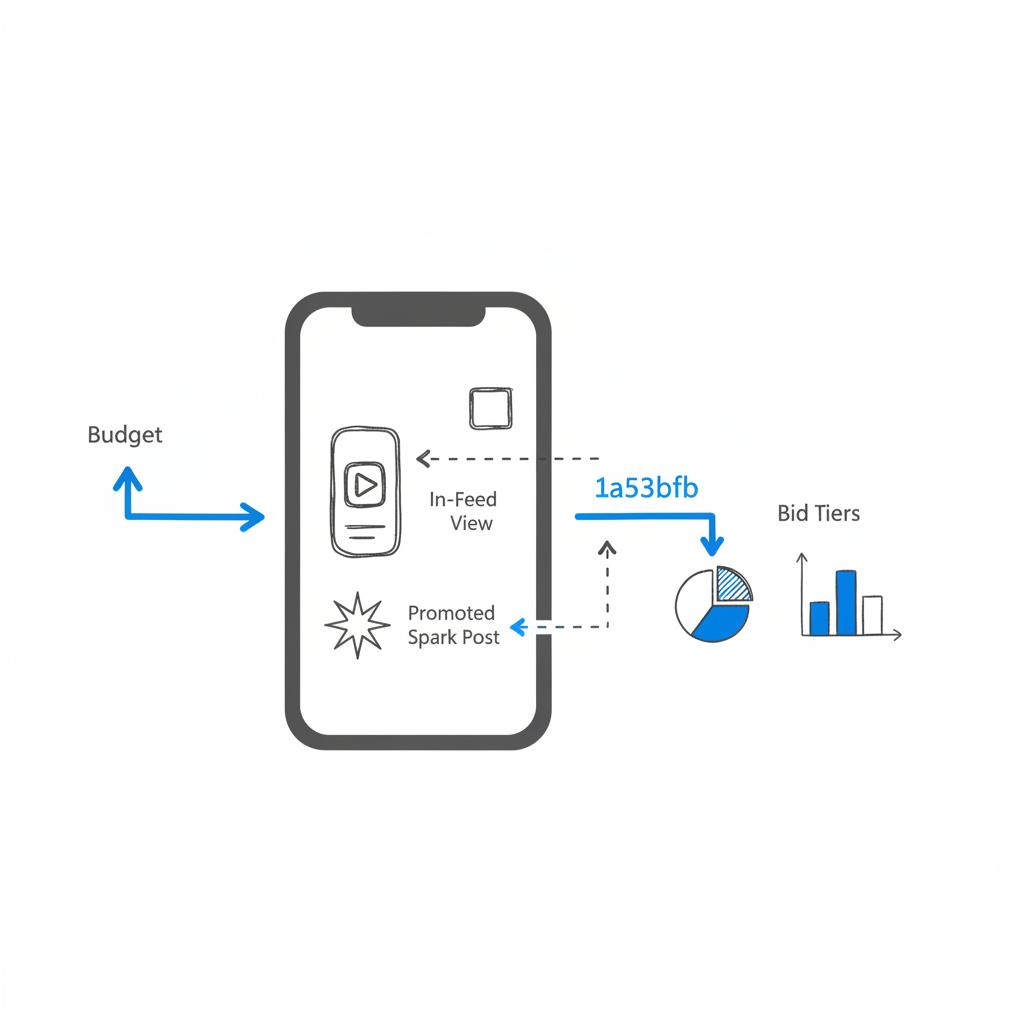
TopView, Branded Effects and Spark Ads can be expensive but they buy attention quickly. Spark Ads — which boost organic creator posts — often produce higher engagement because they carry social proof. Use premium placements for launches, limited-time offers or brand-building pushes. For ongoing performance marketing, test premium placements side-by-side with standard in-feed ads and compare cost per acquisition.
Two short case studies (realistic examples)
Handmade home goods retailer — $500/month test
They ran four short videos across two audience groups. Week one: CPM ~$6, CPC ~$0.75, early CPAs ~$50. Rather than quit, they switched to the top creative, tightened messaging, and added a clearer product demo. Over the next two weeks CPA fell to ~$30 as learning accumulated.
Mobile app UA campaign — mixed regions
A small app budget paid $2–$3 per install in the U.S., but testing in lower-competition regions found CPIs under $1. The lesson: compare CPAs to LTV, and use regional tests to find the right blend of cost and lifetime value.
How long should you test?
A week can quickly tell you whether a concept is dead, but meaningful learning often takes two to four weeks. The platform needs a few thousand impressions and multiple conversions to stabilize delivery. Avoid constant edits in the first 7–10 days — frequent changes reset the learning. That said, if a creative has zero engagement, pause it early.
Common pitfalls and how to avoid them
– Mistaking low CPM for success: cheap impressions don’t equal customers.
– Running only one creative and calling it a failure.
– Setting budgets too low for the platform to learn.
– Ignoring creative refreshes: ad fatigue will raise CPAs.
– Fixating on early CPAs without considering lifetime value.
Scaling after the test phase
When performance is consistent, scale methodically: increase budgets on winning ad sets, introduce new creatives to prevent decay, and watch whether CPAs hold as spend grows. Not all audiences scale linearly — monitor performance and be ready to reallocate if costs rise sharply.
Tracking and measurement
Track a few clear KPIs: CPA, ROAS (return on ad spend) if you can, CPM, CTR and view-through rates. Build a simple dashboard and have weekly check-ins in the early campaign stages (daily checks during launch). Note creative changes, audience adjustments and external events like holidays.
How many creatives should you make?
Start with 3–5 distinct concepts in month one. Diversity is more valuable than perfection at this stage: try different hooks, formats and lengths. One creative should show the product, one can lean creator-first, and another can be a short benefit-driven hook.
If CPAs are too high — a quick troubleshooting checklist
1) Review creative engagement — low CTR or short watch times point to creative issues.
2) Check audience fit — test slightly broader or adjacent interests.
3) Verify landing page performance — slow or mismatched pages kill conversion rates.
4) Consider placement quality — cheaper CPMs that produce poor traffic may cost more in the long run.
Low-risk tips for small budgets
– Keep offers simple and the call-to-action clear.
– Name your ad variations logically to see what works.
– Give campaigns at least 7–10 days for early data.
– Plan a cadence for creative refresh (every 2–4 weeks).
– Base decisions on a small set of KPIs to avoid paralysis.
What’s the single most useful number?
If you remember one practical reference: for many markets in 2024–2025 expect CPMs roughly between $3 and $10 and CPCs between $0.25 and $4. Use those bands as a baseline, then measure the outcome that matters — your CPA — and compare it to customer lifetime value.
For agencies or freelance marketers, the typical, repeatable approach is a two-phase service: a focused testing phase with tight budget control and clear metrics; then a scale phase that raises spend only when performance thresholds are met. Agency VISIBLE follows that exact method: small, clinical tests to prove product-market fit, then structured scale-up tied to CPA or ROAS targets. This method reduces waste and speeds learning.
Checklist: before you launch a TikTok test
– Clear objective (awareness, installs, purchases).
– Selected optimization event that matches the objective.
– 3–5 creatives ready to go.
– 2–4 audience concepts.
– Daily budget that meets ad-group and campaign minimums.
– Measurement plan and a simple dashboard.
Final recommendations — a simple plan you can use today
1) Start with a focused test budget ($300–$1,000) and 3–5 creatives.
2) Run 2–4 audience concepts and give campaigns 7–21 days to learn.
3) Track CPA against customer LTV before making scaling decisions.
4) Prioritize creative adaptability: refresh often and test new formats.
5) Use premium placements strategically for launches, not for every campaign.
When TikTok is the right channel
When TikTok is the right channel
TikTok works when your creative connects quickly and when the economics make sense — that is, when CPA is below your customer LTV. If you can produce thumb-stopping short-form video and you have a realistic testing budget, TikTok can be a strong acquisition channel. If you’re short on creative capacity or your product needs a longer sales cycle without strong immediate value, weigh other channels or adapt your creative approach first.
Quick recap
TikTok ad pricing varies, but practical bands help you plan: CPMs ~$3–$10, CPCs ~$0.25–$4 and a recommended first-month testing budget of $300–$1,000. Creative matters most; targeting and region shape costs; and disciplined tests followed by measured scale beat blind spending every time.
Ready to test TikTok without wasting money?
If you’re ready to move from guesswork to a proven test, get in touch with Agency VISIBLE and we’ll help map a focused TikTok test that matches your business goals.
Resources and next steps
Plan a two-week sprint, assemble your creatives, pick 2–4 audiences, and set a daily budget that meets minimums. Track a short list of KPIs and schedule a review at day 7 and day 14. If you need help designing the creative matrix or interpreting early signals, consider reviewing our projects or reading about our design approach for practical examples.
Good testing is about speed, clarity and creative curiosity. With a small, structured budget and the right expectations, you’ll either find a path to scalable acquisition or you’ll learn something valuable about where to focus next.
A sensible starting budget for a meaningful TikTok test is typically between $300 and $1,000 per month. That range lets you run several creatives across 2–4 ad groups, gather a few thousand impressions per ad, and collect early conversion signals. For steady performance marketing results, plan closer to $1,000–$5,000 per month so the platform can learn and optimize effectively.
Creative and format drive engagement — and engagement drives the algorithm. Even with the same bids, a thumb-stopping video will get shown more often and usually at a lower effective CPC or CPA than weak creative. Premium formats like TopView or Spark Ads can boost awareness fast, but the underlying creative must still connect. In short: bidding controls spend; creative controls whether people respond.
Agency VISIBLE runs focused, clinical test programs that prove whether TikTok can scale for your product. That means designing a short test with clear metrics, producing a small set of creatives, running controlled audience tests, and handing back clear decisions about what to scale. If you want a fast, evidence-driven start, reach out to Agency VISIBLE to design a test that fits your budget and goals.
References
- https://www.businessofapps.com/marketplace/tiktok/research/tiktok-ads-cost/
- https://quimbydigital.com/tiktok-ad-costs-2025-average-cpm-cpc-roi/
- https://www.fetchfunnel.com/tiktok-advertising-cost/
- https://agencyvisible.com/contact/
- https://agencyvisible.com/
- https://agencyvisible.com/projects/
- https://agencyvisible.com/design-that-converts-our-approach/