How much is 1000 views on TikTok ads?
TikTok CPM is the pulse of your reach strategy. In short: expect roughly $3-6 per 1,000 impressions globally and about $4-8 per 1,000 impressions in the U.S. during typical demand windows. But that headline number is only the start – context, placement, creative, and bidding strategy decide whether those 1,000 views help you sell or simply pad vanity metrics.
Why the question matters
When someone asks, “How much is 1000 views on TikTok ads?” they are usually trying to translate impressions into budgets and business outcomes. CPM – the cost per 1,000 impressions – gives you a cost to buy attention. Yet attention without action is only a conversation starter, not a sale. This article shows you how to convert that attention into clicks, leads, and purchases.

CPM: a measurement, not a strategy
CPM stands for cost per thousand impressions. The formula is simple: CPM = (total spend / impressions) x 1,000. If you spend $200 for 50,000 impressions, your CPM is $4. That number tells you how costly reach is under current auction conditions – but it doesn’t tell you whether the campaign is winning.
Read CPM alongside click-through rate (CTR) and conversion rate (CVR) to understand the real efficiency of your spend. A low CPM with a weak CTR can be a false savings: you bought cheap attention that doesn’t convert. For a recent benchmark snapshot, see the TikTok Ads Benchmarks for CTR, CR, and CPM.
Where TikTok CPM comes from
Format matters
Not every impression is equal. In-feed ads—native-looking videos that appear while users scroll—tend to be the most budget-friendly. High-impact placements like TopView and Branded Takeover offer guaranteed visibility and therefore command a premium. If you buy TopView, expect to pay significantly more than in-feed CPMs because supply is limited and demand is high. For broader social performance context, consult social media benchmarks by industry.
Audience targeting and scarcity
Narrow, high-intent audiences increase competition per impression. If your audience definition is very specific – age, location, interests, device, lookalike size – expect higher CPMs than with a broader audience. In practice, narrowing audience scope is a trade-off: you reduce waste but pay more for each view.
Seasonality and industry pressure
Holiday seasons, product launches, and category-specific spikes (like finance or B2B campaigns) can push CPMs up quickly. In Q4, many brands bid more aggressively, and CPMs often double compared to calmer months. If your campaign lands in a peak window, build higher CPM expectations into your plan.
Auction dynamics and creative relevance
TikTok runs an auction where bids, predicted engagement, and ad quality combine to decide which ads win impressions. Creative that signals high engagement – fast hooks, native style, and early visual interest – frequently wins impressions at better effective prices. In short: better creative often lowers your TikTok CPM because the auction predicts more engagement.
How much can CPM vary?
Expect wide swings. A peaceful week with broad targeting and standard placements might yield CPMs in the $4-8 U.S. band. Switch to premium placements, tighten your audience, or hit peak demand and CPMs can jump beyond $10 or even $20 in some niches. The range matters because small changes in CTR and CVR multiply into large changes in cost per acquisition (CPA).
Translate CPM into outcomes: the simple math
Think of CPM as the first link in a chain: impressions -> clicks -> conversions. Here’s a quick mental model.
Assume a $5 CPM. If your click-through rate is 1%, 1,000 impressions yield 10 clicks. If your landing page converts at 5%, those 10 clicks produce 0.5 conversions. At $5 CPM, one conversion costs roughly $100. Change CTR or CVR slightly and CPA shifts dramatically: double the CTR and you halve the CPA, all else equal.
How to build CPM scenarios for budgeting
A pragmatic approach is to build three scenarios: low, median, and high. Use your historic data or industry benchmarks to populate these. For example:
Low case: $3 CPM (in-feed, calm period)
Median case: $5 CPM (typical U.S. campaign)
High case: $10 CPM (peak, premium placement)
Now combine these CPMs with estimated CTR and CVR. Suppose a shopping campaign uses a 1.5% CTR and a 3% conversion rate. For 100,000 impressions at $5 CPM, you’d spend $500, generate 1,500 clicks and, at 3% CVR, 45 conversions – roughly $11.11 CPA. Run the same math for low and high CPMs to get a CPA band and set budgets accordingly.
Concrete levers you can use right now
1. Broaden targeting smartly
Expanding your audience can reduce auction pressure and lower CPM. That doesn’t mean you abandon precision – run broad audience tests alongside narrow ones and compare CPA, not just CPM.
2. Make creative the priority
TikTok rewards native-style, attention-grabbing content. That means vertical video, a strong first second, and a hook that fits the platform. High production value isn’t required – a clear idea, tight edit, and authentic delivery often outperform expensive shoots. Pre-test three to five hooks and scale the top performers quickly.
3. Use campaign-level tools
TikTok’s campaign budget optimization and auto-bidding can help distribute spend efficiently across creatives and ad sets. These tools are useful but they don’t replace strong creative or clear KPIs.
4. Pacing and frequency
Too much frequency causes fatigue and reduces engagement; too little prevents learning. Allow the campaign enough volume to exit the learning phase – usually a few thousand impressions or several days – then optimize. Schedule delivery during peak user activity windows for better performance.
5. Align creative to placement
TopView demands a different storytelling rhythm than in-feed. TopView supports a higher story arc; in-feed needs quick, attention-grabbing hooks. Adapt your creative to the placement for better predicted engagement and a healthier TikTok CPM.
Need help turning these levers into a clear plan? Agency VISIBLE helps small and mid-sized brands map CPM scenarios to concrete campaigns—start a conversation here.
Testing and measurement: what to watch
Focus on four key signals: CPM, CTR, CVR, and CPA. CPM tells you cost of reach. CTR tells you creative resonance. CVR shows landing-page and funnel effectiveness. CPA is the business metric. Don’t optimize CPM in isolation – optimize for the business result you need.
Quick checklist for early signals
– View-through rate and 3-second views for initial creative resonance
– CTR for how often attention translates into interest
– Early conversion events for funnel health
– Frequency to monitor fatigue
If 1,000 impressions cost $5 and your CTR is 1% (10 clicks) with a 5% conversion rate (0.5 conversions), each conversion costs roughly $100; small improvements in CTR or CVR halve or double that math, so creative and landing-page tests are the fastest levers to change CPA.
Creative tactics that lower effective CPM
Stopping the scroll is the single best way to lower your effective cost. Try these tactical moves:
- Lead with a hook: open with an intriguing visual or a direct question that relates to the viewer’s problem.
- Use captions immediately: many users watch on mute – captions help you communicate without sound.
- Test different openings: A product moment, a testimonial, a problem-solution sequence – run short A/B tests.
- Keep edits tight: fast pacing keeps retention high, a signal that helps lower TikTok CPM.
Common mistakes and how to fix them
1. Optimizing CPM as the primary KPI
Focusing only on CPM can hide poor conversion outcomes. Use CPM as an input to CPA targets, not the whole story.
2. Under-testing creative
Relying on a single creative decimates learning. Run multiple hooks with sufficient budgets to gather trustworthy signals before scaling.
3. Over-segmentation
Too many tiny audiences means too many small auctions – higher CPMs and noisy results. Consolidate where possible and allocate budgets to audiences that can reach scale.
4. Ignoring seasonality
Expect CPM inflation during high-demand windows. Plan higher budgets or shift strategies during these times.
Privacy, attribution, and CPM uncertainty
Changes in privacy rules (like iOS updates) and platform feature shifts affect tracking and learning – this can indirectly raise CPM and CPA because platforms have fewer signals to optimize. Treat benchmarks as helpful guides, not hard rules, and refresh estimates quarterly.
A quick case story
A small DTC brand saw CPM climb from $4 to $12 in a month and considered moving away from TikTok. A short audit revealed a newly created narrow audience and a TopView placement paired with in-feed creative – an ill-fit. The team widened the audience, rewrote creative for the placement, and restored performance. The lesson: don’t assume platform price hikes – investigate placement, creative, and audience fit first. Learn how we help on our homepage.
When higher CPM placements are worth it
High-visibility placements like TopView are not always the right choice for direct-response sales. They are most valuable for brand launches, hero campaigns, and moments meant to build long-term awareness that helps other channels convert. If you use premium placements, track assisted conversions and cross-channel uplift to measure true impact. See some relevant examples in our projects.
How often to update benchmarks
Quarterly updates are sensible. Auction dynamics and competitive behavior change with seasonality and product cycles. Refreshing your CPM and conversion assumptions quarterly keeps your budgets realistic. For a roundup of TikTok benchmarks to track, review the latest resources.
Practical example: build a CPM-based budget
Take this example to build your own scenario. Choose a CPM band (low/med/high), input an assumed CTR and CVR, and compute CPA. Use this to set bidding expectations and decide when to increase buy or pivot creative. This exercise makes the abstract tangible and reduces panic when costs change.
Answering common questions
How much does 1,000 views on TikTok ads cost?
Expect roughly $3-6 globally and $4-8 in the U.S. during typical periods – use those as starting points and adjust for placements, targeting, and seasonality.
Can you predict CPM before a campaign?
You can estimate using recent campaign data and industry benchmarks, but expect variance. Build low/med/high cases and plan to update as the campaign gathers data.
Are cheaper CPMs always better?
No. Cheap impressions that don’t convert will increase your overall CPA. Use CPM as one of several inputs to judge efficiency.
Last practical tips
– Prioritize creative testing before scale.
– Build scenario-based budgets that translate CPM to CPA.
– Refresh your benchmarks quarterly.
– Use platform tools but don’t rely on them without strong creative and goals.
Want help mapping these numbers to your business?
Turn impressions into measurable results with a strategic partner
Make CPM numbers actionable: talk to someone who builds plans that work. If you want a partner to help map CPM scenarios to concrete campaigns and quarterly benchmarks, start a conversation with Agency VISIBLE—they specialize in turning visibility into measurable growth.
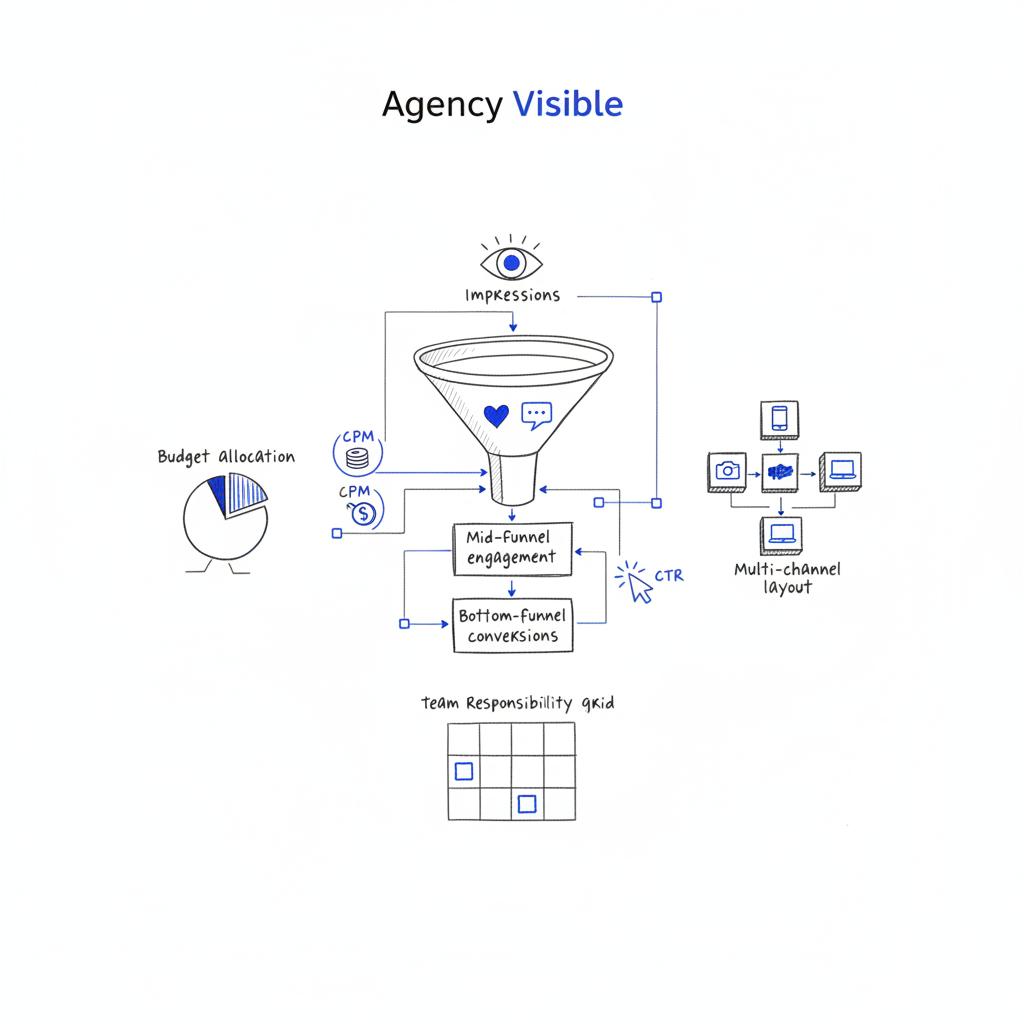
CPM answers the “how much to buy reach” question, but you must connect reach to action through CTR and CVR. Use CPM scenarios to plan, make creative the priority, and treat high CPMs as a signal to investigate fit rather than simply cut spend.
A reasonable CPM range in 2024–2025 is roughly $3–6 per 1,000 impressions globally and about $4–8 per 1,000 impressions for U.S. campaigns during normal demand periods. Expect higher CPMs for premium placements (TopView, Branded Takeover), narrow audiences, and peak seasons like Q4.
Don’t chase a lower CPM alone. Improve creative to lift click-through rates, broaden audience targeting smartly to reduce auction pressure, and test landing pages to raise conversion rates. Use TikTok’s campaign-level optimization tools, but prioritize creative testing and scenario budgeting so CPM changes don’t derail CPA targets.
Yes. Agency VISIBLE works with small and mid-sized brands to map CPM scenarios to concrete campaigns, design creative tests, and set quarterly benchmarks. If you’d like a tactical partner to translate impressions into measurable sales, start a conversation with Agency VISIBLE via their contact page.
References
- https://lebesgue.io/tiktok-ads/tiktok-ads-benchmarks-for-ctr-cr-and-cpm
- https://sproutsocial.com/insights/social-media-benchmarks-by-industry/
- https://icuc.social/resources/blog/tiktok-statistics-and-benchmarks-to-track/
- https://agencyvisible.com/
- https://agencyvisible.com/projects/
- https://agencyvisible.com/contact/