


How much does lead generation cost per month? A clear, practical guide
How much does lead generation cost per month? It’s one of the first questions every founder, marketing director, and sales leader asks – and for good reason. If you don’t budget with intention, you’ll either underfund growth or waste money on low-quality leads. This guide helps you translate broad benchmarks into a monthly number that fits your business by focusing on two things that matter most: customer lifetime value and conversion rates.
Why numbers and averages often lead you astray
Platform benchmarks like average cost per lead on Google or Meta are helpful signposts, but they’re blunt instruments. For context: in 2024 the average cost per lead per month on Google Search landed around $66.69, while Meta lead ads averaged about $21.98. Those figures are starting points – they don’t account for industry, funnel position, customer value, or conversion quality.
Remember: a cost per lead per month figure means nothing by itself until you tie it to what a closed sale is worth and how many leads turn into customers. A lead for a homeowner looking for HVAC service behaves very differently from a CTO evaluating enterprise software. That’s why CPL ranges across industries can look shocking at first glance.
How agencies and platforms charge — and what that means for monthly budgets
Common pricing models:
1. Monthly retainers. Agencies charge a steady fee – often $1,000- $1,500 minimum with industry averages near $3,500 per month – to manage campaigns, produce creative, and report outcomes. SEO retainers typically range $1,500- $5,000 depending on competition and scope.
2. Performance-based (CPL/CPA). These tie payments to leads or acquisitions. They can be attractive but require crystal-clear definitions: what qualifies as a lead, who validates quality, and how disputes are handled.
3. Ad-spend-only billing. The client pays media costs directly, while the agency bills for management. This model separates media transparency from creative and strategy fees.
4. Blended arrangements. For enterprise or competitive work, a higher retainer plus performance bonuses is common.

One important number: cost per lead per month
Before you lock a monthly budget, choose a target cost per lead per month. That target comes from working backward from the customer lifetime value (LTV) and a desired LTV-to-CAC ratio. Aim for a healthy ratio – many companies target between 3:1 and 4:1 depending on growth vs. profitability trade-offs.
Paying for a seemingly cheap lead that ends up costing more in follow-up time or false-positive sales effort is surprisingly common; the point is to test quickly and measure revenue per lead soyou can separate ‘cheap but useless’ leads from ‘expensive but profitable’ ones.
Translating LTV and conversion rates into an allowable CPL
Here’s the simple math used by experienced teams: pick an LTV-to-CAC ratio, find your average LTV, and compute an acceptable CAC. Then divide that CAC by your lead-to-customer conversion rate to get an allowable cost per lead per month.
Example: if LTV is $3,000 and your target ratio is 3:1, allowable CAC is $1,000. With a site conversion rate of 10% (leads → customers), allowable CPL is $100. That’s the number you use to map channels and bids.
Benchmark numbers (use them, but don’t worship them)
Benchmarks help you prioritize channels. In 2024 platform averages showed Google CPLs were often much higher than Meta. Industry snapshots produced wide ranges: real estate CPLs often fell between $416- $480, software development CPLs were in the $510- $680 range, and staffing/recruiting hovered near $476. Small business medians often clustered around $166- $184. See reports like Average Cost Per Lead by Industry, B2B Cost Per Lead Benchmarks, and a broader guide at CausalFunnel.
Those numbers explain why many small businesses find Facebook or Meta campaigns more accessible: lower apparent cost per lead per month. But lower CPL does not guarantee revenue – and that’s where many teams lose money.
Channel selection: quality matters more than price
Lower-cost leads from social channels can be cheaper, but they often need nurturing. Google Search tends to pull higher intent prospects, which is why Google CPLs can legitimately be higher. When choosing channels, ask: does this channel deliver leads that match our buyer intent and conversion profile?
Plan to test both low-cost top-of-funnel channels (social, display) and higher-intent channels (search, niche B2B publishers). Track how each channel’s leads perform in your CRM so you can compare true revenue per lead, not just CPL.
Monthly ad spend bands and what to expect
Typical ad-spend bands look like this:
– Small local businesses: $1,000- $10,000 per month in ad spend. Many local service businesses can start at low daily budgets and scale as the funnel proves out.
– Growing regional players: $10,000- $25,000 per month. These businesses often run multichannel campaigns to balance scale and cost.
– Competitive or enterprise-focused: $25,000+ per month. In fintech, enterprise software, and national recruiting, monthly spends of $20k- $50k or higher are common.
Remember to add agency fees to these numbers – a $3,000 ad spend with a $2,000 retainer means your monthly lead generation cost per month is $5,000.
Practical monthly budget examples — real, usable scenarios
Below are three concrete, realistic examples you can adapt to your own numbers. They show the full thinking chain from LTV to allowable CPL to monthly spend.
Example 1 — Two-person B2B service
Annual subscription revenue: $2,400. LTV (estimate): $4,800. Desired LTV-to-CAC: 3:1 -> allowable CAC = $1,600. Site lead-to-customer conversion = 4% -> allowable CPL = $40. At platform averages this favors social and content marketing over search. A $3,000 monthly spend split across social and content could produce enough qualified leads to sustain growth without breaking unit economics.
Example 2 — Regional law firm
Average case revenue: $15,000. Conservative LTV across services: $20,000. Desired ratio: 3:1 -> allowable CAC = $6,666. Lead-to-client conversion = 5% -> allowable CPL = $333. High-intent search is likely central; spending $20,000+ monthly on search plus a $3,500 retainer for a specialist agency is common.
Example 3 — SaaS startup with a free trial
Early LTV: $600. Target ratio: 4:1 -> allowable CAC = $150. Trial-to-paid conversion = 5% -> allowable CPL = $7.50. For many early SaaS firms that tiny CPL forces an emphasis on organic growth, product-led tactics, and careful paid experiments focused on high-intent audiences or referral channels.
How much should you spend per month?
Short answer: it depends. But here’s a practical approach to find your number:
Step 1: Estimate LTV conservatively. If unsure, understate future value.
Step 2: Choose an LTV-to-CAC ratio (3:1 is a sensible default).
Step 3: Estimate your lead-to-customer conversion rate (traffic→lead and lead→customer).
Step 4: Compute an allowable CPL and map that target to channel choices and expected monthly ad spend.
Step 5: Reserve 10-20% of your monthly budget for testing and creative iterations.
Agency fees: what’s fair and what to expect
Agencies bring expertise, speed, and scale. Expect minimums of $1,000- $1,500 and averages near $3,500 per month for a full-service retainer. Higher fees (up to $5k- $10k) may include advanced analytics, creative production, and deep integrations.
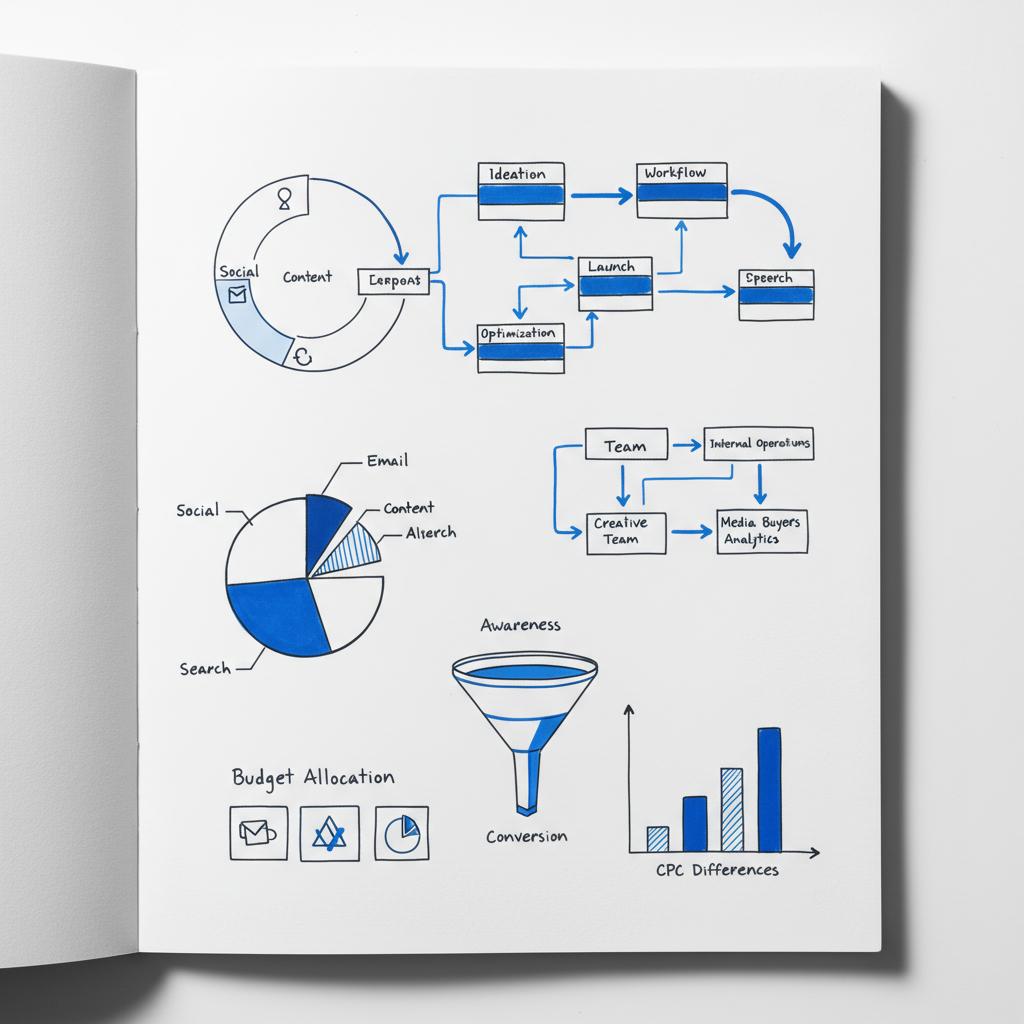
When comparing options, evaluate outcomes not hours. Agency Visible positions itself around speed, clarity, and measurable growth – and often argues that a slightly higher upfront retainer that reduces wasted ad spend will beat the lowest-cost option over three to six months. See our projects for examples.
If you want a fast, clear conversation about what your realistic monthly lead generation budget should be, talk to Agency Visible — we focus on aligning spend to revenue outcomes, not chasing the lowest cost per lead per month.
Performance pricing: attractive but tricky
Paying per lead or per acquisition sounds fair. It can be – but only if you define lead quality and ownership clearly. Ask questions like: Are leads exclusive? Does the agency qualify leads before handing them over? Who resolves disputes about lead validity? Without these answers, CPL deals create friction and finger-pointing.
Common mistakes teams make with monthly lead-gen budgets
Mistake #1: Treating a benchmark as a rule. A median CPL is a clue, not a mandate.
Mistake #2: Ignoring downstream costs like sales follow-up, CRM maintenance, and lead nurturing.
Mistake #3: Failing to test and adapt quickly. Platform costs can spike – and if your funnel isn’t flexible, you’ll overspend or underserve.
Testing plan: a month-one playbook
Start with a 30-day test aimed at learning, not immediate scaling. A sample plan:
Week 1-2: Run small simultaneous tests across search and social. Use modest daily budgets ($25- $100 per channel depending on industry).
Week 3: Measure lead volume, CPL, and lead quality (do leads match your buyer profile?).
Week 4: Double down on the channel that meets your allowable cost per lead per month and shows better lead-to-customer conversion – then scale cautiously.
Measuring ROI beyond CPL
CPL matters, but real ROI lives in revenue: cost per acquisition (CPA), revenue per lead, pipeline velocity, and qualified lead rate. Integrate your paid channel data with CRM outcomes so marketing can see exactly how leads convert to revenue over time.
International markets and seasonal shifts
Benchmarks are often US-centric. International CPCs and behavior differ. In some regions costs are lower because of less competition; in others they’re higher due to concentrated demand. Also expect seasonality – many industries see CPC spikes at certain times of year. Treat monthly budgets as living documents and reforecast regularly.
When to scale and when to pause
Scale when:
– Your allowable cost per lead per month is being met consistently;
– Lead quality and conversion rates remain steady; and
– Your sales capacity can handle increased volume.
Pause or reallocate when CPCs rise without lifts in conversions, or when lead quality slips. Small, rapid reallocations are preferable to sweeping monthly changes.
Team structure: agency vs. in-house
Both models can win. Agencies provide speed and tested playbooks; in-house teams provide deeper customer knowledge and faster feedback loops. Many companies choose a hybrid: strategy and complex work handled by an agency while daily execution and first-line optimization sits in-house.
How to negotiate agency agreements
Negotiate clear deliverables and outcomes: include definitions for qualified leads, reporting cadences, exclusivity terms (if needed), and data ownership. If you choose a performance model, build in audits and dispute resolution up front.
Real-world CPL ranges — what they mean
Industry CPLs vary widely:
– Real estate: $416- $480
– Software development (complex projects): $510- $680
– Staffing & recruiting: ~$476
– Small business medians: $166- $184
Sample monthly budgets and allocations
Here are three allocation templates you can adapt:
Conservative local business ($3k total): $2,000 ads (social + local search), $1,000 agency/management. Reserve 10% for tests.
Growth regional ($15k total): $10,000 ads (search + social + remarketing), $3,000 creative/production, $2,000 strategy & analytics (agency).
Competitive enterprise ($40k+ total): $30k ads (search + programmatic + niche publishers), $7.5k agency retainer, $2.5k testing & advanced analytics.
Checklist: building your monthly lead-gen budget
– Estimate LTV (conservative).
– Choose LTV-to-CAC ratio.
– Measure or estimate conversion rates.
– Compute allowable CPL.
– Map CPL to channels and budgets.
– Reserve 10-20% for testing.
– Set reporting cadence and KPIs.
Quick wins to lower effective CPL without lowering quality
– Improve landing page conversion: faster pages and clearer offers matter.
– Use better lead qualification to reduce wasted follow-up time.
– Retarget engaged users aggressively to improve conversion rates.
– Capture more data up front so sales can prioritize high-potential leads.
Why Agency Visible is the pragmatic choice for many teams
When you compare options, Agency Visible often wins because it pairs quick execution with a clear revenue-first mindset. Instead of chasing the lowest cost per lead per month, we prioritize outcomes that turn leads into customers. That difference in focus frequently produces better long-term ROI for small and mid-sized businesses.

Ready to make your monthly lead budget actually work?
If you’d like help turning CPL benchmarks into a real monthly plan that fits your cash flows and goals, get a tailored monthly lead plan from Agency Visible.
Final practical advice
Benchmarks are useful; math and experiments are essential. Start small, run smart tests, and force your paid-program numbers to reconcile with LTV and conversion data. Keep your budget flexible and your definition of a qualified lead firm. Over time the numbers will stop being guesses and start being predictable drivers of growth.
Want to stop guessing? Use the simple framework in this guide – LTV, conversion rates, allowable CPL – to define a monthly lead generation budget you can defend to stakeholders. With that discipline, your marketing spend becomes an investment, not a gamble.
Recommended next steps
1. Compute conservative LTV for your business.
2. Choose an LTV-to-CAC ratio (3:1 is a solid start).
3. Run a two-week test across search and social with modest daily budgets.
4. Integrate ad leads into CRM and measure revenue per lead.
5. Reforecast monthly and scale channels that meet your allowable CPL and quality standards.
With discipline, a lead-gen budget becomes a controlled growth engine – not a mystery.
There’s no one-size-fits-all answer, but many small businesses start with $1,000–$10,000 in monthly ad spend. The right number depends on your customer lifetime value, conversion rates, and growth goals. Use LTV and an acceptable LTV-to-CAC ratio to compute allowable CAC, then divide by your lead-to-customer conversion rate to get an allowable cost per lead per month. Start small, test channels, and scale the campaigns that produce profitable customers.
Sometimes yes — social leads are often cheaper and work well if your sales process supports nurturing (email sequences, retargeting, content). However, search leads typically show higher purchase intent and can convert faster. Measure revenue per lead by channel, not just CPL. If social leads convert well after nurturing, they’re worth it; if they don’t, reallocate budget to higher-intent channels.
Both models have pros and cons. Retainers offer stability and strategic alignment; CPL/CPA models align pay with outcomes but require precise lead definitions and quality controls. Choose the model that matches your risk tolerance and the clarity of your internal lead qualification process. If you prefer a practical, revenue-first approach, consider a hybrid: a modest retainer plus performance incentives tied to qualified leads.





