How much does it cost to reach 1000 people on Instagram ads?
Short answer: use the simple formula – cost to reach 1,000 people = CPM × frequency. Understanding Instagram CPM and average frequency is the key to realistic budgets and better results.
Why that tiny formula matters
At first glance the math looks too basic to be useful. That’s the trick: the formula is straightforward, but the numbers you plug in change a lot with country, audience and timing. Instagram CPM (cost per 1,000 impressions) is what Meta charges for views, and because Meta charges for impressions rather than unique people, frequency becomes the second important input. If you want to reach 1,000 unique people, you must multiply CPM by the average frequency you expect.
Definitions that keep planning simple
Reach is the count of unique users who see an ad. Impressions are the total times an ad is shown — repeat views from the same person are included. CPM is the cost per 1,000 impressions. Instagram CPM expresses that cost inside Meta’s system for Instagram placements, and it’s the number you’ll use to estimate cost to reach 1,000 people.
Basic formula and a tiny spreadsheet in your head
Impressions needed = reach × frequency. Cost = (CPM × impressions) / 1,000. If reach = 1,000, that simplifies to cost to reach 1,000 people = CPM × frequency. So if your Instagram CPM is $8 and you want frequency 1.5, plan on $12 to reach 1,000 people.
Why frequency changes everything
Frequency is the average number of times each person sees your ad. A frequency of 1.0 means each person sees it once; 1.5 means half the audience sees it twice, or everyone sees it 1–2 times on average. Doubling frequency doubles the cost to reach the same number of unique people. That’s why campaigns that want awareness but no repetition aim for frequency near 1.0, while conversion or memorability goals accept higher frequency.
Typical Instagram CPM ranges you can use as starting points
Benchmarks across 2024 and 2025 show wide spreads. In practice, observed Instagram CPMs often cluster roughly between $3 and $15 per 1,000 impressions. Many advertisers see mid-single-digit results around $6–$9. Use those numbers as a baseline, but remember they’re just starting points. For broader benchmark sets see Instagram ad cost benchmarks: https://quimbydigital.com/instagram-advertising-costs-in-2025/ and general ad benchmarks at https://www.wordstream.com/blog/facebook-ads-benchmarks-2025.
Country-level CPMs vary a lot; for a country-by-country snapshot see https://lebesgue.io/facebook-ads/facebook-cpm-by-country.
These are starting points you can test against your own data.
Special planning note: seasonality, targeting, and creative all change these numbers quickly.

How to think about CPM and three forces that move it
Three big forces shift Instagram CPMs constantly:
1) Meta’s auction dynamics
Meta doesn’t use a simple highest-bid-wins system. It weights your bid by the platform’s estimate of how likely people are to take the action you want and by ad quality. That means better creative and higher relevance reduce the effective Instagram CPM you face — because the platform expects better outcomes from your ad and rewards it.
2) Seasonality
Q4, holidays, and big shopping days push CPMs up because more advertisers are competing. If you plan a holiday campaign, expect higher Instagram CPMs compared with quieter months.
3) Targeting and format
Niche professional audiences or premium placements (Reels, Stories, Explore) can be pricier. Broad audiences may be cheaper, but they may deliver less relevance. Retargeting audiences tend to show different economics: often higher CPM but better conversion rates, which can make cost per acquisition attractive even when Instagram CPM looks high.
Concrete examples — low, medium, and high CPMs
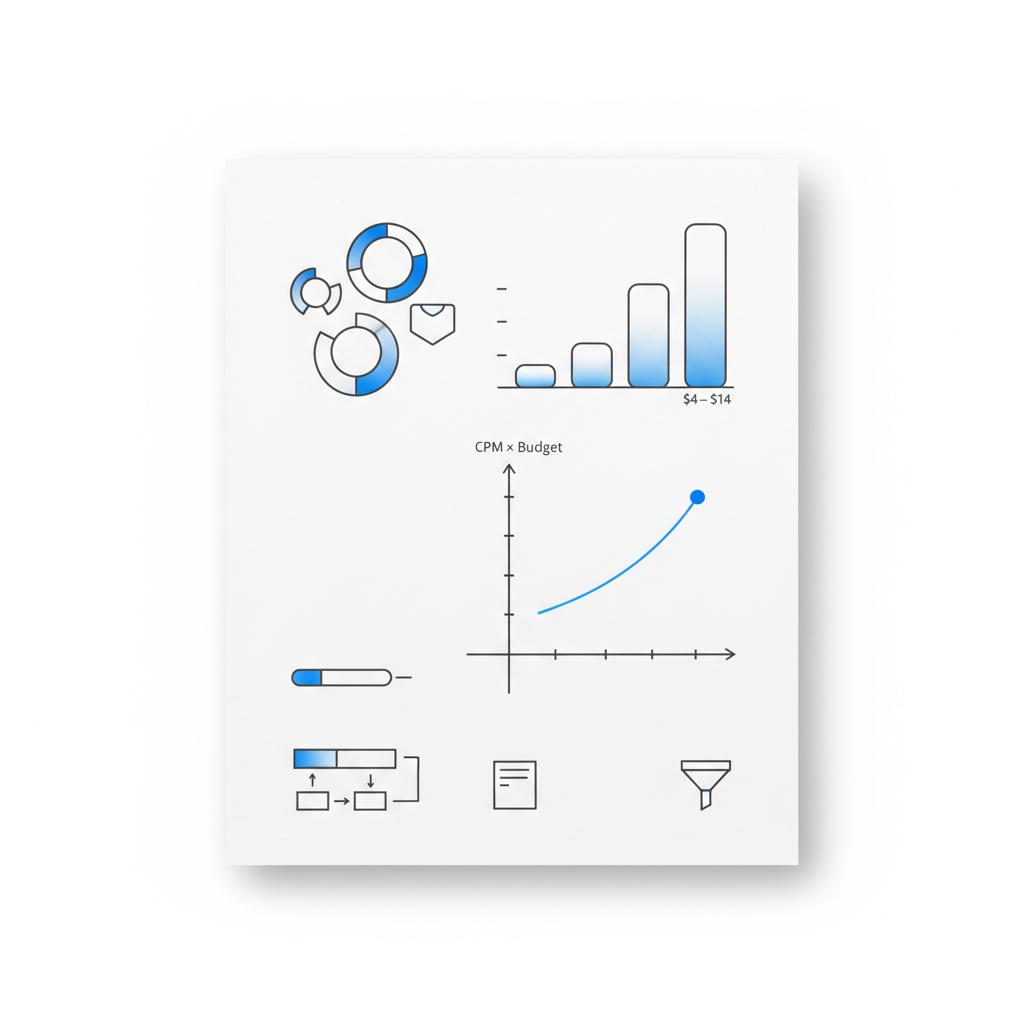
Imagine CPM at $4 (low), $8 (mid), and $14 (high). The cost to reach 1,000 people under different frequencies is:
Frequency 1.0: $4, $8, $14
Frequency 1.5: $6, $12, $21
Frequency 2.0: $8, $16, $28
These examples make the point: frequency matters as much as CPM.
Practical planning: how to estimate and test
Here’s a simple planning process you can use right now:
Step 1 — Choose a conservative CPM assumption
If you don’t have historical data, use a mid-range Instagram CPM of about $8 to start planning. That gives you a realistic baseline without being overly optimistic.
Step 2 — Pick frequency based on your goal
For light awareness choose 1.0–1.3. For stronger memorability or short promotions choose 1.5–2.0.
Step 3 — Apply the formula
Cost = CPM × frequency. If CPM is $8 and frequency target is 1.5, expect ≈ $12 to reach 1,000 people. Want to reach 10,000? Multiply by 10. Want to know how many people you can reach with $200? Divide the budget by the cost per 1,000 and multiply by 1,000.
Example test plan
Start modestly. Many small advertisers begin with daily ad set budgets between $20 and $100, depending on audience size and market. Run a test for 3–7 days to collect meaningful metrics; a week is often best because impressions and CPMs stabilize after the first few days.
What to measure during the test
Don’t focus on Instagram CPM alone. Track reach, impressions, frequency, click-through rate, conversion rate, and any downstream metric you care about — signups, purchases, or store visits. A higher Instagram CPM combined with great conversion rates can be cheaper per acquisition than a low CPM with little action.
If you’d prefer help setting up a clean test, contact Agency VISIBLE — they specialize in quick, measurable campaign tests for small and mid-sized businesses and can help you pick the right CPM and frequency assumptions for your market.
How to design a small experiment that gives big answers
Here’s a practical week-long experiment you can run this afternoon:
1) Pick one clear audience (e.g., interest + location). 2) Create one strong creative variation (a short native video or a bold image). 3) Set a daily budget (e.g., $30/day). 4) Choose a placement mix but keep it simple (Feed + Stories or Reels). 5) Run for seven days and record CPM, reach, impressions, frequency and conversions.
Budget math in plain English
With a $200 test, if your Instagram CPM is $8 and the average frequency is 1.5, you estimate cost to reach 1,000 people is $12. That $200 would roughly reach 16,000 people (200 ÷ 12 × 1,000). If actual CPM is $10, your reach drops; if it’s $6, you reach more. The test tells the truth quickly.
Creative, placements and how they change Instagram CPM
Creative quality affects Instagram CPM more than many advertisers expect. Meta rewards ads that hold attention. Strong hooks in the first two seconds of a video, captions that match the silent-play behavior of Instagram, and clean aspect ratios reduce friction and improve engagement. That in turn helps your effective Instagram CPM.
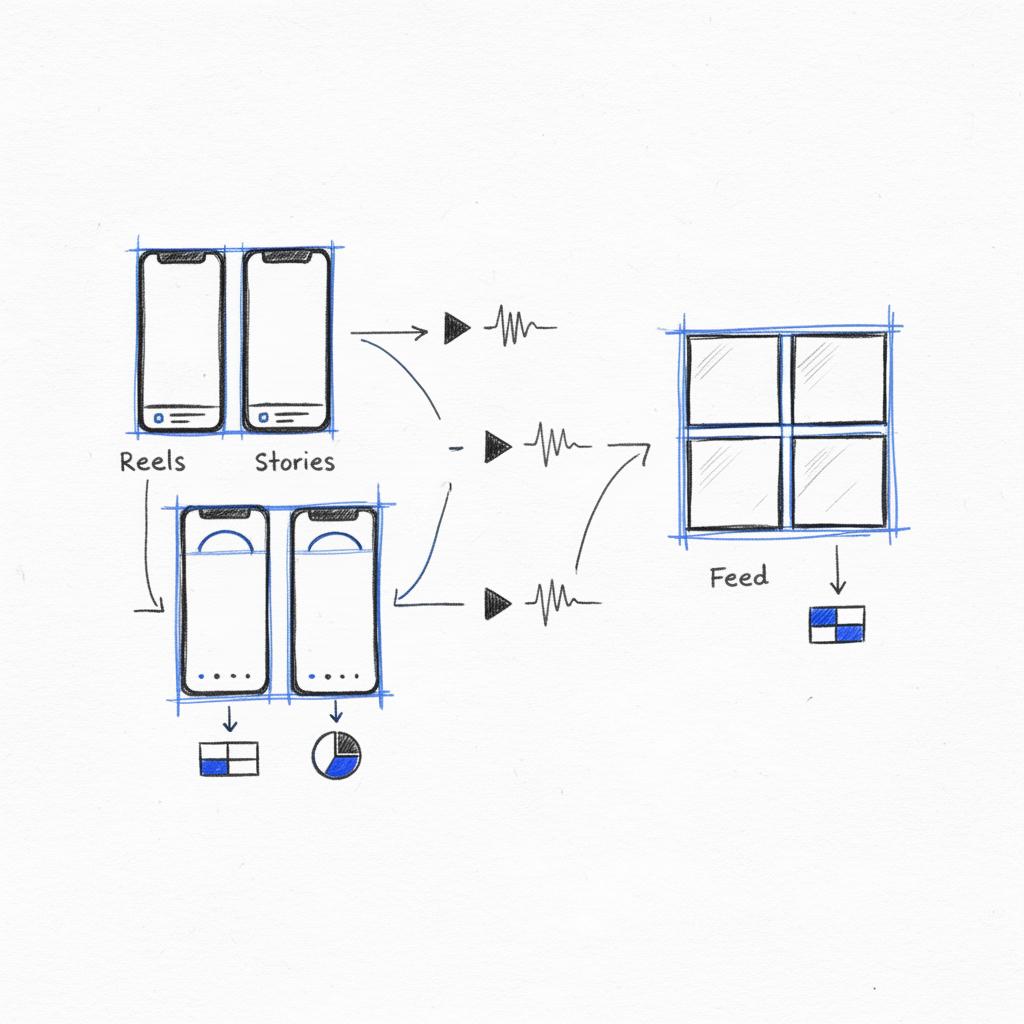
Format matters: short vertical videos often perform well on Reels, and Reels placements may show higher CPM but also higher engagement. Static images can be cheaper but might be skimmed. Always test creative across placements and measure how the Instagram CPM and downstream metrics change.
Ad fatigue and creative rotation
As frequency rises, creative fatigue can set in. If your frequency climbs but conversions stall, refresh creative. Keep a rotation plan so your audience sees new variations before irritation sets in. Good rotation keeps Instagram CPM stable and improves long-term performance.
Auction mechanics — a friendly explanation
Meta’s auction blends three inputs: the bid, estimated action rate and ad quality. Think of it as a triplet score. You can’t directly change Meta’s estimate of action rate, but you can influence it by tightening targeting and by improving creative. Better relevance and better engagement signal to the auction that your ad will do well, which can lower your effective Instagram CPM.
Bid strategies and how they affect CPM
Manual bids give you control, but under-delivery is a risk. Automatic bidding lets Meta optimize your spend toward the action you selected, often stabilizing CPMs. If your objective is pure reach, use reach-focused tools and frequency caps to manage repetition without inflating cost.
Seasonal timing and budget windows
Plan seasonally. CPMs usually rise in Q4 and around major shopping events. If you want cheap testing windows, some quiet months (think post-holiday or slower consumer months) can be golden for learning without the price pressure of peak season.
Market differences — why geography matters
Country-level CPMs vary a lot. Wealthier markets with high advertiser competition tend to have higher Instagram CPMs; emerging markets often cost less. When running international campaigns, test locally rather than assuming a global CPM — local testing prevents surprises when you scale.
Audience targeting and the CPM trade-offs
Narrow audiences can raise Instagram CPM because demand per impression increases. But those audiences may also convert better. Broad audiences often lower CPM but can reduce relevance. A balanced approach is to test a core high-intent audience and a broader group side-by-side, then compare cost per acquisition rather than CPM alone.
Retargeting and lookalikes
Retargeting often has a higher Instagram CPM because the audience is smaller and valuable, but it usually converts at higher rates. Lookalike audiences can be an efficient way to expand reach while maintaining performance, but test different lookalike sizes to find the sweet spot between CPM and conversion.
Scaling with data, not guesses
If your measured Instagram CPM is $7 and you prefer frequency 1.5, cost per 1,000 is roughly $10.50. To reach 100,000 people multiply by 100 to get about $1,050. But scaling can change variables: audience saturation, frequency creep and CPM drift. Expand audiences and keep testing as you increase spend.
Rules for predictable scaling
– Increase budgets gradually and monitor CPM, reach and frequency.
– Expand audience definitions only after your small tests show consistent CPMs.
– Refresh creatives as you scale to avoid fatigue.
– Use lookalikes or geographic expansion to preserve CPMs when spending grows.
Common misconceptions about CPM
Myth: Lowest CPM is always best. Reality: Low CPM with poor engagement may cost you more per conversion. Myth: CPM is fixed. Reality: CPM moves with competition, creative, placement and timing.
Decision checklist before launching a reach campaign
Before you press go, confirm these points:
– You have a CPM assumption (e.g., $6–$9).
– You selected a frequency target (1.0–2.0).
– You have a small test budget to validate assumptions.
– You know the downstream metric that matters (clicks, signups, purchases).
– You will run tests for 3–7 days to stabilize CPMs.
Run a one-week test with a single audience, one strong creative, and a modest daily budget (e.g., $20–$50). Use reach- or conversion-focused settings, measure CPM, reach, frequency and conversions, and then use those measured numbers — not benchmarks — to plan your next stage.
How long should you test to get reliable Instagram CPMs?
Run tests for at least 3–7 days; a full week is preferred for more stable impressions and CPMs. The first 24–72 hours often show different CPMs while Meta optimizes delivery. Patience helps produce cleaner, more reliable estimates.
Practical example — a small retailer’s first test
Lisa runs a small online shop and wants a quick awareness push. She assumes an Instagram CPM of $8 and picks frequency 1.3 for light exposure. Her cost to reach 1,000 people = $8 × 1.3 = $10.40. With a $150 test she expects to reach ≈14,423 unique people (150 ÷ 10.4 × 1,000). She runs for seven days, measures actual CPM and adjusts the plan if the measured Instagram CPM differs.
Measuring success beyond CPM
Always compare CPM with conversion stats. For example, if a $12 CPM campaign converts at 4% into email subscribers, and a $6 CPM campaign converts at 0.5%, the higher CPM campaign might be far more cost-effective for the business. Look past the headline numbers and choose the campaign that moves your key metrics.
Tactical tips to keep Instagram CPMs reasonable
– Write strong hooks for the first 1–2 seconds of video.
– Use native vertical formats when testing Reels.
– Combine similar audiences to avoid fragmenting results.
– Rotate creative regularly to avoid fatigue.
– Test placement mixes rather than only one placement.
– Use engagement signals to improve ad quality score and lower Instagram CPM.
When to call an expert
If you don’t have the time to run careful tests or you’re scaling quickly across regions, a small investment in expert setup saves money. Agency VISIBLE helps brands set up early tests and interpret the data so you’re scaling from truth rather than guesswork. See examples of our work: https://agencyvisible.com/projects/
Ready to find your real Instagram CPM?
Need help planning a reliable Instagram test? Book a quick consult to set up the right CPM assumptions, creative tests and scaling plan with a team that focuses on measurable results: Get in touch with Agency VISIBLE.
Examples: different budgets and what they might reach
These are rough, illustrative numbers using cost = CPM × frequency.
Budget $100, CPM $8, frequency 1.5 → cost per 1,000 = $12 → reach ≈ 8,333 people.
Budget $500, CPM $8, frequency 1.5 → reach ≈ 41,666 people.
Budget $1,000, CPM $6, frequency 1.2 → cost per 1,000 = $7.20 → reach ≈ 138,888 people.
What to do if your Instagram CPM is higher than expected
– Improve creative to increase ad quality score.
– Broaden targeting to lower CPMs.
– Test off-peak times and non-holiday windows.
– Try different placements; sometimes Feed is cheaper than Reels depending on your audience.
– Use conversion-optimized campaigns if you want actions rather than just reach.
Long-term measurement and learning
Build a simple spreadsheet with measured CPM, frequency, reach, and conversion rates by audience and creative. Over time you’ll have realistic expectations for cost to reach 1,000 people in each of your markets. That owned data is more valuable than industry benchmarks, because it reflects how your brand performs on Instagram.
Final practical checklist
– Pick a conservative Instagram CPM to start.
– Choose a frequency that matches your goal.
– Run a 3–7 day test with a clear audience and one creative.
– Measure CPM, reach, impressions and conversions.
– Adjust budgets and creatives based on real numbers.
At Agency VISIBLE we often help brands set up those early tests and interpret the metrics, but the most powerful thing you can do is simply start measuring. Real data beats guesswork every time. Consider keeping your Agency VISIBLE logo consistent across creative assets to build recognition.
Closing thoughts: the simplest path to clarity
The math behind cost to reach 1,000 people is compact and actionable: cost = CPM × frequency. But the inputs — Instagram CPM, frequency, creative quality and timing — are where the real work is. Use small, structured tests to learn your true numbers, then scale from evidence, not assumptions.
Instagram CPM matters, but it’s not the whole story. A higher CPM that drives real conversions or higher lifetime value can be the smarter spend. Start small, measure honestly, and iterate quickly.
At Agency VISIBLE we often help brands set up those early tests and interpret the metrics, but the most powerful thing you can do is simply start measuring. Real data beats guesswork every time. Take the formula, run the test, and you’ll know how much it costs to reach 1,000 people for your brand on Instagram with confidence.
Use the simple formula: cost to reach 1,000 people = CPM × frequency. Choose a realistic Instagram CPM for your market, decide how many times on average you want each person to see the ad (frequency), then multiply. For example, CPM $8 and frequency 1.5 gives $12 to reach 1,000 people.
Run tests for at least 3–7 days; a full week is preferred. The first 24–72 hours often look different as Meta optimizes delivery. A seven-day window usually stabilizes impressions and gives reliable CPM, reach and conversion figures.
Yes. Agency VISIBLE helps brands set up focused tests, choose realistic CPM and frequency assumptions, and interpret results to improve efficiency. They can recommend creative changes, placement mixes and targeting tweaks that often reduce effective Instagram CPM or lower cost per acquisition.