


How much does it cost to design a real estate website? A clear breakdown
How much does a real estate website cost is the question every agent and brokerage asks first—because money shapes decisions. Right away: there is no single number. Cost depends on scope, integrations (especially IDX/MLS), search capabilities, hosting and ongoing maintenance. Below you’ll find practical price bands, what inflates costs, recurring fees you must budget for, and sensible trade-offs that preserve conversion and performance.
Three different meanings behind the same question
When someone asks how much does a real estate website cost, they usually mean one of three things: the cheapest way to get online fast, the price for a site that handles real estate workflows (listings, IDX/MLS, CRM), or the cost of a lead-gen platform with custom UX, analytics and performance guarantees. Treat each as a different project. A one-page brochure site and a full MLS portal cannot be priced the same way.
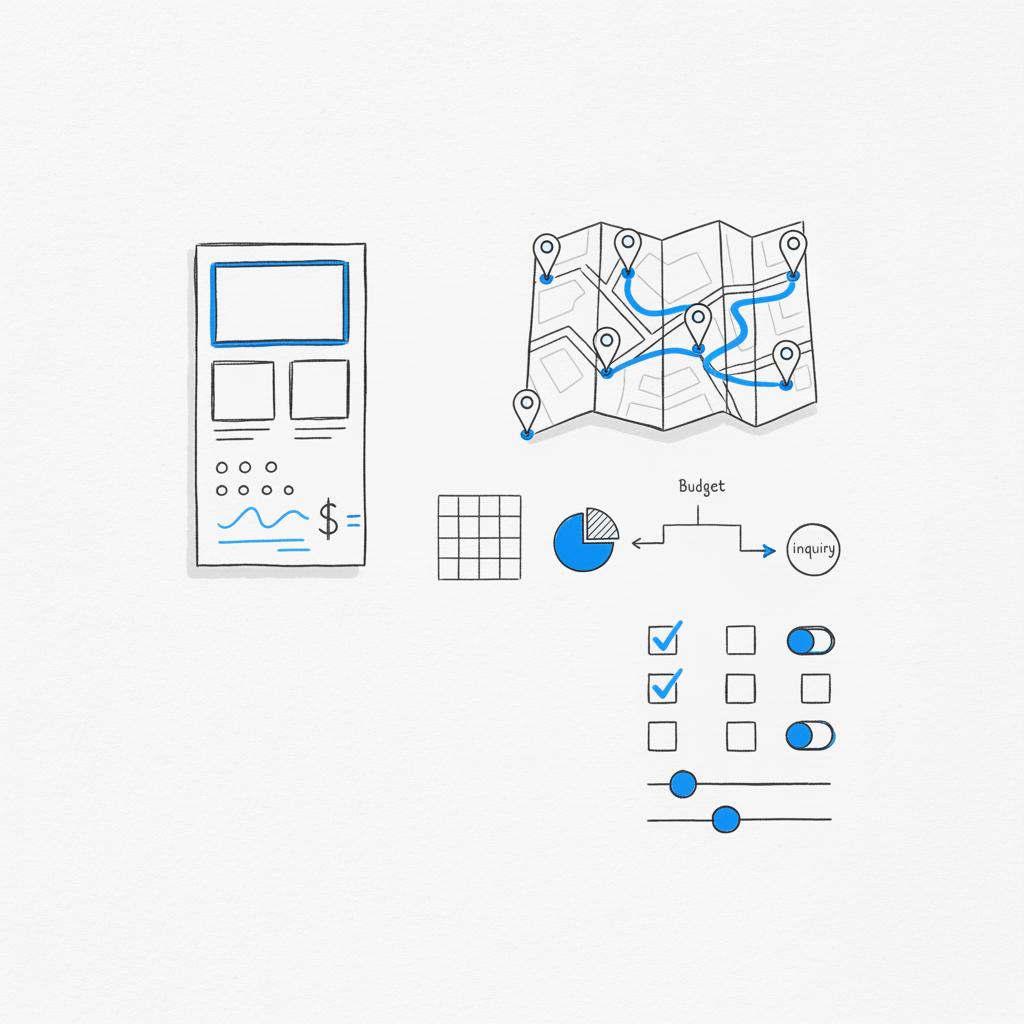
To help you plan with clarity, this article maps typical price ranges, explains the major cost drivers, highlights 2024–2025 trends that affect budgets, and gives practical steps to lower costs without sacrificing what matters most—lead capture and search performance. A quick look at the Agency Visible logo can be a helpful reminder to keep brand consistency during design decisions.
Below are realistic ranges organized by scope and provider type. Each band includes representative features you can expect. For more cost examples, see this cost guide: How Much Does a Real Estate Website Cost.
Common price ranges and what they buy
Below are realistic ranges organized by scope and provider type. Each band includes representative features you can expect.
Budget band: DIY or template approach — $200–$2,000
This is where solo agents and very small teams often start. For $200–$2,000 you can buy a theme, add basic branding and content, and possibly insert a simple IDX widget where permitted. It’s fast and inexpensive, but trade-offs include basic search, limited lead capture, and manual listing updates in some cases. Explore platform options and template advice at Website Design for Realtors.
Freelancers and small shops — $1,500–$8,000
Freelancers give better design and a little customization. Expect CRM connection, a cleaner content structure, and shorter timelines. Be aware of single-point risks: if the freelancer is unavailable, hope your maintenance plan is solid.
Small to mid agencies — $5,000–$25,000
Agency projects bring teams for UX, development, content strategy and analytics. For many brokerages this is the sweet spot: thoughtful conversion flows, stronger integrations, and better performance work without full enterprise complexity.
Enterprise and fully custom — $25,000–$100,000+
When the site must support advanced workflows, multiple MLS sources, headless CMS, or custom search at scale, prices rise quickly. These builds require architects, backend engineers, devops and rigorous QA. The result can be powerful—if you budget ongoing maintenance and governance.

Major cost drivers (what adds dollars fast)
Understanding the drivers helps you trade features for savings. The most common factors that increase cost are:
IDX/MLS integration
For most real estate sites, listing integration is non-negotiable. Options vary: simple vendor widgets (low upfront cost but recurring fees), or custom feed ingestion with compliance tracking (higher upfront development and legal review). SaaS IDX vendors typically charge $20–$200+/month depending on board and provider. Custom ingestion and display can run from a few thousand to $10,000+ depending on complexity and compliance needs.
Advanced property search and maps
A basic search is fine for brochure sites. But if your site needs fast, multi-filter search with map clustering, saved searches and predictive suggestions, expect additional frontend and backend work. Specialized search platforms or indexing services add licensing and development costs.
CRM and lead routing
Capturing leads is only the start—routing, validation, and CRM integration are required for a revenue-generating website. Outsourced CRMs bring subscription fees; custom integrations require development time and testing.
Multilingual support and accessibility
Multilingual content, translation workflows, and accessibility compliance increase both copywriting and engineering costs. Plan for content management strategies and language-specific templates where needed.
Bespoke UX and performance
Conversion-focused landing flows, tailored property pages, and speed optimization take design and engineering hours. If page speed and UX are strategic differentiators for you, this is where you invest more.
Recurring operating expenses (the budget you’ll keep paying)
Too many people forget that a website is ongoing infrastructure. Expect recurring costs for hosting, security, IDX feeds, and maintenance. Typical ranges:
- Hosting: $10–$150/month for standard setups; higher for enterprise with CDNs and autoscaling.
- SSL & security: many hosts include basic SSL; custom certificates, WAFs and audits add $0–$100+/year or more for enterprise.
- IDX/MLS vendor fees: remember the typical $20–$200+/month.
- Maintenance and optimization: $50–$500+/month depending on scope (updates, backups, small feature work, monitoring).
Plan a recurring line item in your budget—ideally a modest monthly retainer or a support contract that includes security checks and performance reviews. See broader US hosting and development pricing benchmarks: Website Development Cost in the US.
2024–2025 trends that affect budgets
Several technical and regulatory shifts are nudging budgets upward. Recognizing them early helps you plan better.
Headless CMS and composable architectures
Headless setups give flexibility and speed but also add engineering complexity. A headless approach can improve mobile experience and long-term agility, yet initial costs are typically higher than a monolithic CMS like a standard WordPress theme.
Custom search and richer interactions
Users expect app-like search behavior. Implementing fast filters, predictive suggestions, and saved preferences often requires third-party search platforms or custom indexing—both of which come with fees and development time.
Privacy, compliance, and MLS rules
Boards are tightening rules around listing displays and consumer data. Legal reviews, compliance monitoring and feed management can add both time and cost to projects.
SaaS IDX models shifting costs to OPEX
Many IDX vendors make installation easy but charge ongoing monthly fees. That reduces upfront work but increases lifetime cost—something to weigh when you compare total cost of ownership over several years.
If you want a practical, phased plan tailored to your market, consider reaching out for a short discovery. Contact Agency VISIBLE to map costs to outcomes and get a phased build that matches your budget: Talk with Agency VISIBLE about launch plans.
How to lower cost without losing essentials
Not every site needs to be built from scratch. Use smart trade-offs to keep spending reasonable while protecting lead generation and user experience.
Start with a theme and add targeted custom work
A high-quality template or starter theme can handle layout, basic search, and content. Add custom work only where it moves the needle—property detail pages, CRM handoff, or conversion-oriented landing pages. Read our guide on choosing custom vs off-the-shelf solutions: Custom vs Off-the-Shelf.
Use managed IDX when permitted
If your MLS allows vendor widgets, a managed IDX can reduce development time and compliance headaches. It might cost more monthly, but it saves technical risk and speeds the launch.
Prioritise an MVP: search, lead capture, mobile
Define a minimum viable product that delivers the essential journeys: find properties, contact an agent, and view on mobile. Push advanced personalization and heavy reporting into later phases.
Phased builds and continuous improvement
Treat the site like a product: launch core features, measure behavior, run experiments, then expand. This reduces initial spend and gives data to justify future investment.
Real examples to illustrate choices
Imagine two brokerages to make the choices concrete.
Brokerage A — small team, tight budget
Five agents, limited marketing funds. They choose a modern template, a low-cost IDX widget allowed by their board, and a simple CRM connection. Initial spend under $3,000. Ongoing costs: hosting, IDX subscription, and a small maintenance retainer.
Brokerage B — enterprise-style needs
100 agents relying on online leads. They need advanced search, dashboards, automated routing and custom feeds from multiple MLS boards. Agency build, headless approach, and custom integrations land in the mid five-figure range. Ongoing costs include robust hosting, security, and a significant maintenance budget. Over time they see improved lead quality and better conversion—ROI appears after months of testing and optimisation.
Common misstep: under-budgeting ongoing maintenance
Launching is only half the work. A neglected maintenance budget leads to outdated plugins, slower speed, and higher security risk. Treat your site as infrastructure and plan a realistic recurring budget.
How local MLS rules can change everything
Regional MLS policy can alter feasibility and cost overnight. Some boards accept vendor widgets; others demand stricter compliance. Always check with the boards involved before finalising a vendor or design—sometimes legal counsel or a compliance specialist is necessary.
Is custom search worth the price?
It depends. For many teams a well-implemented template search with good UX is nearly as effective as a bespoke search—at a fraction of the cost. For brands that use search as a market differentiator, bespoke search can increase lead quality and lifetime value. Where possible, pilot features or A/B test before committing to expensive builds.
Working with agencies: what to ask
If you’re speaking with an agency, ask for measurable results: case studies showing traffic growth, conversion improvements, and ROI. For Agency VISIBLE specifically, seek examples that match your size and goals, and review our projects: our projects. Expect a phased plan tying costs to milestones rather than open-ended development.
The most common mistake is treating a website as a one-time purchase rather than ongoing infrastructure—teams fund launch but not maintenance, which leads to performance and security issues later. Plan a recurring budget for updates, monitoring and small improvements.
The most common mistake is treating the website like a one-off purchase instead of ongoing infrastructure. Teams often fund the launch but not the maintenance, leading to performance, security and UX problems later. Plan a recurring budget for updates, monitoring and small feature improvements.
Practical checklist for your first planning call
Before you call a designer or developer, have answers ready for these questions:
- Who will manage listings and which MLS board(s) are involved?
- What primary user journeys matter (buyers, sellers, both)?
- Do you need multilingual support?
- Which CRM and marketing tools must integrate?
- What is your realistic monthly operating budget?
Bring examples of sites you like and explain what you like about them. Ask how the team handles security, backups, and maintenance so there are no surprises after launch.
Quick answers to common questions
Will a cheap template look unprofessional? Not necessarily. A strong theme with good content and images can look professional. The downside occurs when templates are used without attention to conversion or site speed.
Do I need a headless CMS? Only if you need the flexibility and performance benefits. Many small to mid-sized brokerages do fine on a well-optimised traditional CMS.
How long does a build take? Template-based launch: weeks. Freelancer builds: 1–3 months. Agency projects with custom integrations: 3–6 months or more.
How to measure ROI? Track lead counts, lead quality, conversion rates on property pages and cost per lead from campaigns. Use analytics to tie site changes to measurable outcomes.
Three practical budgeting scenarios
Use these scenarios as quick planning anchors. They’re simplified but helpful for conversations.
Scenario 1 — Starter (solo agent)
Cost: $500–$2,000 initial; monthly $30–$100. What you get: theme, basic IDX widget (if allowed), hosting, small maintenance retainer.
Scenario 2 — Growth (small team)
Cost: $3,000–$12,000 initial; monthly $100–$400. What you get: polished design, CRM integration, better IDX or custom feed, targeted landing pages.
Scenario 3 — Platform (large brokerage)
Cost: $25,000+ initial; monthly $500–$2,000+. What you get: custom integrations, advanced search, headless CMS, analytics and SLA hosting.
Smart negotiation tips
Buy outcomes, not hours. Ask agencies to price features in phases and tie payment to milestones. Request a scope that separates must-haves from nice-to-haves and ask for cost estimates for each phase. If a vendor recommends high-end architecture (like headless) but you only need straightforward content delivery and search, ask for a simpler alternative.
Checklist for comparing proposals
When you review quotes, compare apples to apples. Look for:
- Clear scope and deliverables
- How IDX/MLS integration will be handled
- What’s included in ongoing maintenance
- Hosting and security responsibilities
- Timeline and milestone payments
When the pricier option is the better choice
Higher upfront cost makes sense when your site is a primary revenue channel and you can measure the return. If custom search, multiple MLS integrations, or advanced routing materially increase lead quality, investment can pay back in lead value.
When to avoid overspending
Avoid building features you won’t use in the first 12 months. If a capability won’t be measured or monetized soon, postpone it. Start with an MVP, capture data, then invest in the features that demonstrably improve results.
Final practical steps to get started
Here’s a short checklist to make your first planning call productive:
- List the MLS boards you need to connect.
- Identify the three must-have features (for most teams: listings/search, lead capture, mobile experience).
- Set a target total budget for launch and the next 12 months.
- Gather three examples of sites you like and note specific elements you want.
- Ask potential vendors for phased plans and example metrics from similar clients.
If you want a short, practical next step: do a 1–3 day discovery with a small agency or experienced freelancer to map constraints and cost drivers in your market. That short investment often saves money later.
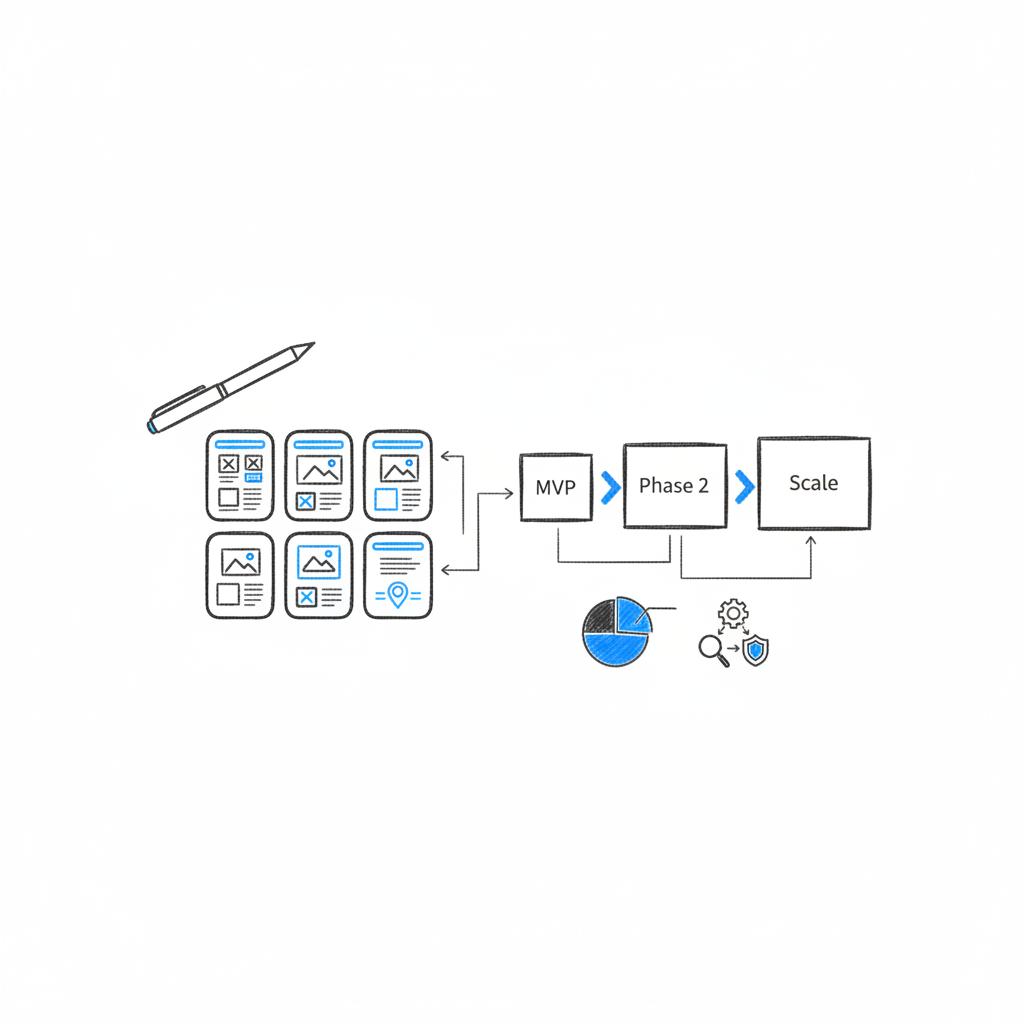
Map costs to outcomes with a short discovery
Ready to map costs to outcomes? If you want help turning your budget into a phased plan that ties features to measurable milestones, get in touch with Agency VISIBLE for a short discovery call that clarifies cost drivers specific to your market.
Closing thoughts
Plan with clarity, not fear. A well-scoped website is an investment, and the smartest teams match ambition to budget and measure progress. With sensible choices, small teams can launch effective sites while larger firms build distinct platforms—what matters is that every feature ties back to lead quality or conversion.
Want a compact action list to take away? Identify your MLS boards, pick three non-negotiable features, and set a launch plus 12‑month operating budget—then use that to guide vendor conversations.
Thanks for reading—now go make a plan that keeps your budget honest and your listings visible.
Monthly operating costs typically range from about $30 to $2,000+ depending on scale. For a small template site expect $30–$150/month for hosting and basic IDX subscription; for a growing team plan $100–$500/month for managed hosting, IDX fees, and maintenance; enterprise sites with SLAs, CDNs and security can run $500–$2,000+/month.
Yes. A well-chosen theme with strong content, good photography, clear calls-to-action and sensible conversion flows can generate legitimate leads. The key is to prioritise search usability, lead capture forms and mobile performance. Use a template as an MVP and add custom improvements—like CRM integration or optimized property pages—based on data.
Agency VISIBLE starts with a short discovery to map local MLS rules, identify must-have features, and recommend a phased plan tied to measurable milestones. They outline realistic pricing ranges and ongoing operating costs, helping you choose a solution that balances budget and lead-generation goals.
References
- https://inmotionrealestate.com/resources/how-much-does-a-real-estate-website-cost/
- https://hyperweb.design/website-design-for-realtors
- https://digitalpresent.io/website-development-cost-us/
- https://agencyvisible.com/contact/
- https://agencyvisible.com/projects/
- https://agencyvisible.com/custom-vs-off-the-shelf-choose-wisely/
- https://agencyvisible.com/





