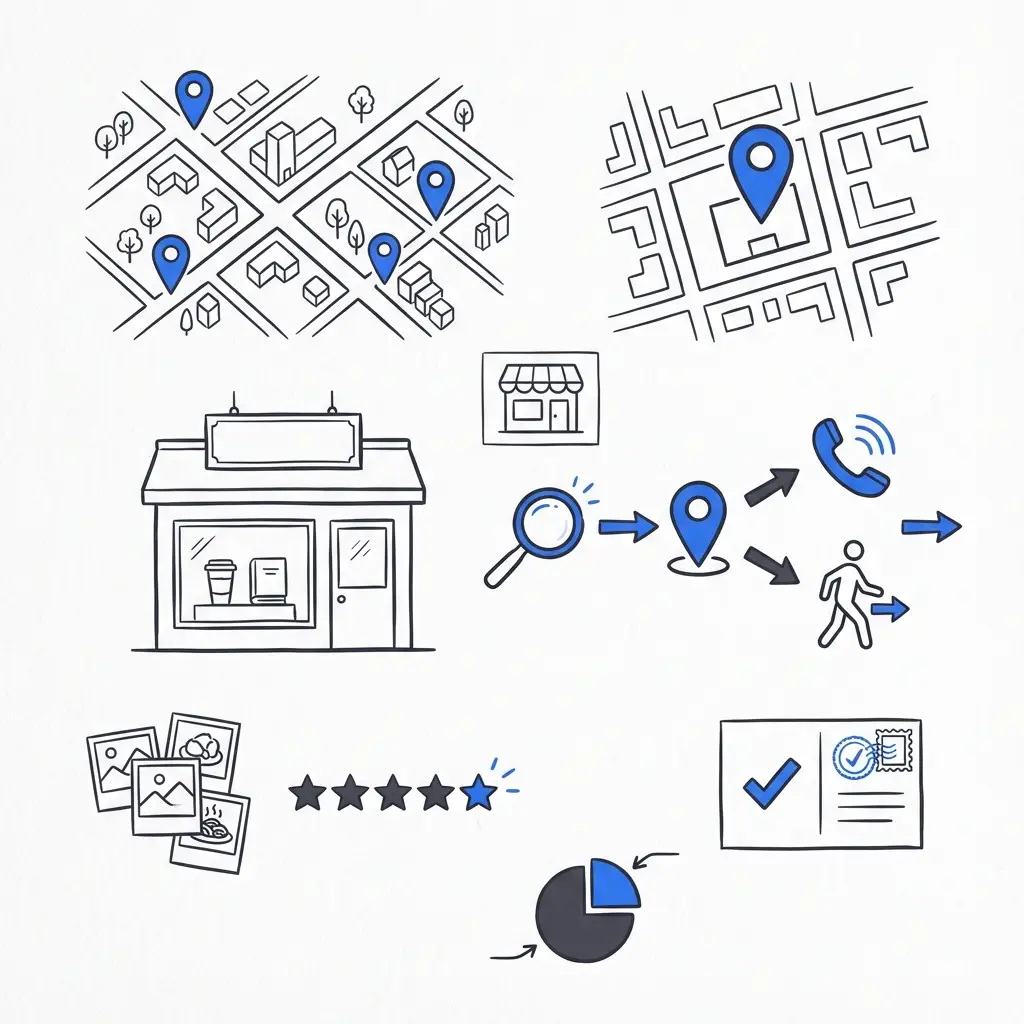
How much does Google local service ad cost? A clear, practical guide
How much does Google local service ad cost? Right away: Google Local Services Ads use a pay-per-lead model, not a traditional cost-per-click auction, which means you only pay when you get a contact the platform counts as a valid lead. That difference changes budgeting, bidding psychology, and the way you measure return. In this guide you’ll learn how those lead charges are calculated, which variables affect price, realistic cost ranges across industries and cities, and step-by-step actions you can take to reduce your effective spend without losing volume.
Why the payment model matters
Understanding the payment method is the essential first step. With Google Local Services Ads you’re charged for leads—phone calls, messages, or booked appointments that meet Google’s criteria—rather than every click. That often feels more logical for service businesses: you’re buying potential customers, not attention. Still, leads vary in quality, and the sticker price per lead doesn’t always equal the true cost of a customer once conversion and lifetime value are considered.

How Google determines chargeable leads
Not every interaction is billable. Google counts a lead when a user takes an action that is likely to result in actual contact: a phone call routed through the ad, a message sent via the Local Services interface, or a confirmed booking. Google filters spammy or misrouted interactions and gives you a way to dispute leads you believe are invalid.
Ready to test Local Services Ads the smart way?
If you want a short, practical plan to test Local Services Ads and estimate realistic costs for your market, contact a team that focuses on measurable visibility. Start a quick consultation with Agency VISIBLE to map pilot budgets, response processes, and tracking so you’re buying leads that actually turn into customers.
Because the platform screens leads, your real cost per useful lead is often lower than the listed per-lead charge once you dispute invalid entries and track true conversions.
Key factors that influence Google local service ad cost
Several variables push a single lead’s price up or down. Understanding them helps you forecast and control spend.
Market and location
Competition is local. In dense urban areas where many providers bid for eyeballs, Google local service ad cost tends to be higher. Think of the same service in a small town: fewer providers and fewer searches often equal lower lead prices. Seasonal demand also matters – snow removal in winter, HVAC in summer tend to spike costs.
Service category
Some industries have higher lifetime values and therefore higher lead prices. Locksmiths, plumbers, HVAC technicians, and lawyers typically pay more per lead than window cleaners or dog walkers. Why? A plumber or lawyer can be worth hundreds or thousands of dollars per converted lead, so competition and bids reflect that potential.
Lead type and intent
Leads that show immediate intent—emergency service requests or direct booking actions—are more valuable and often cost more. Informational inquiries or appointment requests far in the future may be cheaper, but their conversion rate can be lower.
Business profile and review rating
Your Google Business Profile, reviews, and responsiveness affect placement and lead flow. A well-reviewed, responsive business is more likely to appear at the top and receive better-targeted leads. That visibility can be a double-edged sword: you may get more leads (good) and pay more per lead (because the platform assigns value to better-performing providers).
Weekly budget and bidding behavior
You set a weekly budget and a background mechanism Google uses to distribute leads during that period. If you set higher budgets, you can capture more leads—and pay more. Smart budgeting and realistic expectations keep spend predictable.
Verification and screening
Getting verified—license checks, background screenings for technicians—doesn’t usually raise your per-lead cost, but it is a prerequisite. Some markets require additional verification steps, which can carry time and minor administrative expenses.
Typical cost ranges: what businesses usually pay
Numbers vary by city and category, but the following ranges are typical estimates for many U.S. markets. Treat these as directional, not absolute:
Common estimates (per lead):
– Home services (plumbing, HVAC, electrical): $30 to $150 per lead.
– Locksmiths: $40 to $200 per lead (emergency calls push toward the top end).
– Legal services (local attorneys, non-ads heavy niches): $50 to $300+ per lead.
– Cleaning and maintenance (residential cleaners, window cleaning): $15 to $60 per lead.
– Landscaping and lawn care: $15 to $80 per lead.
Again, context matters: a $100 lead in a high-value HVAC market may be excellent, while a $30 lead in a low-margin cleaning business might be too expensive.
How to calculate an acceptable Google local service ad cost for your business
Don’t guess. Build a simple model:
1. Estimate conversion rate from lead to paying customer (for many service firms this is 10–30% but measure your own).
2. Estimate average revenue per customer (first sale) and lifetime value (LTV).
3. Decide the maximum cost per acquisition (CPA) you can tolerate based on profit margins and LTV.
4. Back into a target Google local service ad cost per lead using your conversion rate.
Example: if your conversion rate is 20% and you can spend $200 to acquire a customer (CPA), then you can afford $40 per lead (0.2 x $40 = $8 revenue contribution per lead towards $200 CPA). Simple math like this clarifies whether a platform’s lead prices are realistic for your business.
Early testing: how to run low-risk pilots
When you’re starting, keep experiments small and measurable. Allocate a modest weekly budget for two to four weeks, track leads and their conversion, and dispute invalid leads. Use this test to learn the average Google local service ad cost in your zip codes and refine your model.
Good pilot rules: start with a tight service radius, pick two core services to advertise, and have a clear plan for responding to leads quickly—speed often raises conversion rates.
Need a little help running a clear, low-risk pilot? It’s often useful to get a second pair of hands that focuses on improving visibility and lead handling. If you want a short consultation to map a pilot and expected costs, talk to Agency VISIBLE—they’ll help you set a real budget and measure results without unnecessary churn.
Optimizing for lower effective costs
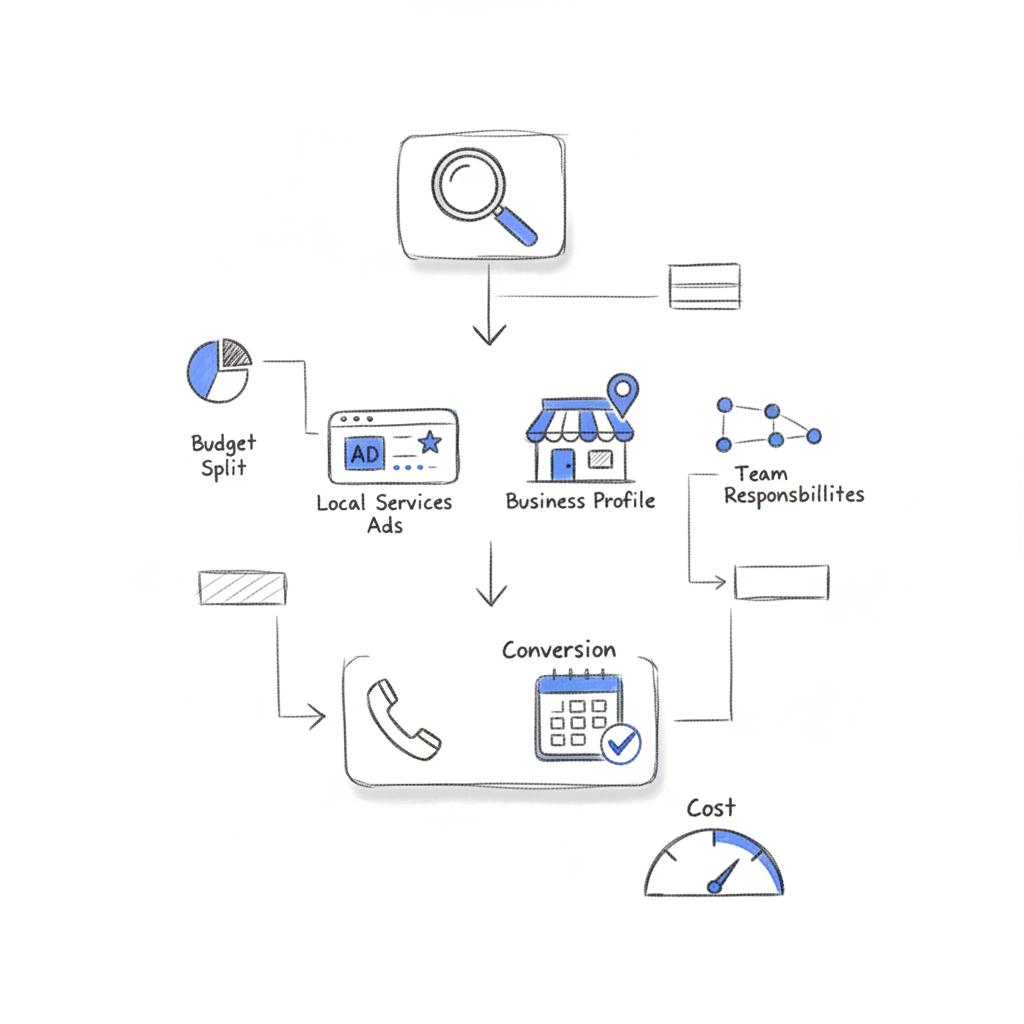
Lowering your Google local service ad cost doesn’t mean winning a bidding war; it means improving how many paid leads convert to paying customers and reducing wasted spend. A clear logo helps local recognition and trust.
Lowering your Google local service ad cost doesn’t mean winning a bidding war; it means improving how many paid leads convert to paying customers and reducing wasted spend.
Improve lead quality
Better ads and a clearer service definition attract more qualified prospects. Use descriptive headlines, accurate service categories, and a tight service area. If you specialize in emergency repairs, call that out; if you serve only residential customers, state it clearly. Quality over quantity reduces cost per converted customer.
Speed and follow-up
Many local businesses lose leads in the first five minutes. Faster answers convert at higher rates. Use call routing, trained staff, or scheduling tools to respond immediately. That makes every paid lead more valuable and lowers your effective Google local service ad cost. Consistent branding supports trust during quick first contacts.
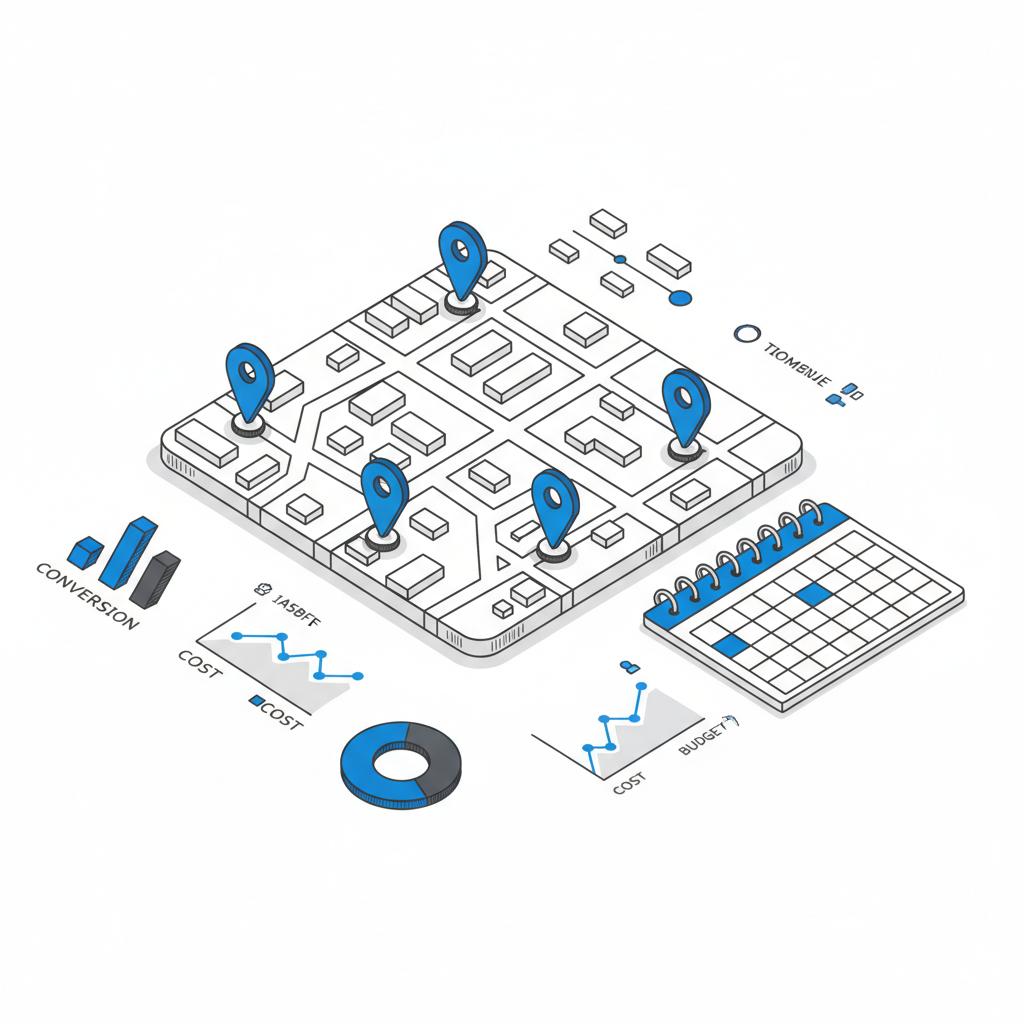
Many local businesses lose leads in the first five minutes. Faster answers convert at higher rates. Use call routing, trained staff, or scheduling tools to respond immediately. That makes every paid lead more valuable and lowers your effective Google local service ad cost.
Dispute invalid leads
Review your bill regularly and dispute leads that were spam or irrelevant. Google provides a dispute process—use it. Reducing invalid charges is free money for your campaign budget.
Adjust radius and hours
Narrowing your service radius to where you actually operate reduces non-converting inquiries. Likewise, limit campaign hours to times your team can pick up the phone. These small controls reduce wasted lead spend.
Combine channels strategically
Local Services Ads are powerful, but they work best alongside a healthy Google Business Profile, localized SEO, and targeted paid search or social ads. The synergy often reduces your per-customer acquisition cost because customers see consistent messaging across touchpoints. See examples of agency work in our projects.
Measuring true ROI
Calculate return on ad spend (ROAS) by following paid leads through to revenue. That requires basic tracking: a simple CRM or even a spreadsheet that logs lead source, contact date, conversion status, and revenue. Over one to three months you’ll see whether your Google local service ad cost produces profitable customers.
Common mistakes that inflate cost
Several predictable errors increase your Google local service ad cost without boosting sales:
– Not tracking leads to revenue.
– Responding slowly to leads.
– Advertising broad, non-differentiated services.
– Ignoring the dispute process.
– Running campaigns without testing different wording and categories.
Industry examples and realistic scenarios
Let’s look at two short, real-feeling scenarios to make the numbers tangible.
Scenario A: Small plumbing company in a mid-sized city
The company runs Local Services Ads with a weekly budget and pays $55 per lead on average. Their internal conversion rate from lead to booked job is 25%. Average first-job revenue is $350, and lifetime value (several follow-up jobs over years) is $2,200. Their CPA is: $55 / 0.25 = $220. A first-job revenue of $350 makes that profitable; with an LTV of $2,200 the ad becomes an excellent channel for long-run growth.
Scenario B: Residential cleaning service in a suburban market
They pay $30 per lead on average and convert 10% of leads to paying customers. That gives a $300 CPA ($30/0.1). If their average first job is $120, that’s not sustainable without repeat business or other lower-cost channels. They need to either improve conversion, raise price, or find complementary channels to reduce effective acquisition cost.
Practical checklist to control Google local service ad cost
Use this short checklist every time you review performance:
– Track lead to sale conversion for at least 30 days.
– Calculate CPA and compare to acceptable CPA from your financial model.
– Dispute invalid leads weekly.
– Narrow radius and hours to reduce irrelevant leads.
– Test messaging and category choices every two weeks.
– Improve response speed—aim for under five minutes on calls/messages.
– Pair LSAs with solid Google Business Profile and local landing pages.
How to dispute leads and what to expect
If you get a lead that’s wrong—spam, duplicate, or outside your service area—you can log a dispute with Google. Keep notes and evidence (call recordings, timestamps) when possible. Google often reverses charges for clearly invalid leads, so it’s a practical way to recover budget.
Long-term approach: blending paid leads with sustainable visibility
Local Services Ads are excellent for capturing high-intent customers quickly, but they’re not the whole strategy. Combine short-term lead capture with investments in SEO, reviews, and referral programs. Over time, organic channels lower your reliance on paid leads and reduce average acquisition cost.
What about costs beyond per-lead charges?
Think beyond the platform fee. Include these in your cost model:
– Staff time to answer leads.
– Scheduling and dispatch tools.
– Background checks or verification fees for technicians (one-time or occasional).
– Marketing agency fees if you outsource campaign management.
Include these operating costs when deciding how much you can afford to pay per lead—sometimes a cheaper lead costs more in staff time and produces a worse ROI.
When to consider hiring help
If you’re unsure about piloting Local Services Ads or you don’t have reliable lead tracking, a short-term partnership can save time and money. A focused agency can set up tracking, test messaging, and tune lead flow quickly so you don’t waste budget learning the platform the hard way. Learn more about our approach on the homepage.
Checklist for choosing help
Look for a partner who:
– Emphasizes measurement and early testing.
– Has experience with your service industry.
– Improves response processes (not just ad setup).
– Shares clear reporting and learning, weekly at first.
Dispute myths and realities
Myth: Google always rejects disputes. Reality: Google often credits clearly invalid leads, but you must provide reason and evidence. Myth: All leads are high quality. Reality: Lead quality varies; monitoring and process improvements make the difference.
Run one focused service inside a tight radius for two weeks, answer all leads immediately, and measure cost per lead, conversion rate, and revenue per customer—this reveals whether Local Services Ads can supply profitable customers without a large spend.
A high-value, low-risk test is to run one focused service (your best-margin offering) inside a tight radius with an aggressive phone-answering rule for two weeks. Measure cost per lead, conversion, and time-to-answer. This reveals whether Local Services Ads can supply customers at a profitable rate without a large spend.
Scaling: how to expand without ballooning cost
When pilots work, scale slowly. Increase weekly budgets in small steps and expand radius or services one at a time. Sudden scale often attracts poor-fit leads and raises your Google local service ad cost without improving conversion rates.
Final practical tips
– Prioritize fast response.
– Use the dispute system when needed.
– Test messaging and service categories.
– Measure conversion rates and LTV, then set a clear target for acceptable per-lead cost.
Wrap-up: clarity over mystery
Google Local Services Ads can be a high-value channel for service providers because you pay per lead and can test rapidly. The central question is not just “how much does Google local service ad cost?” but whether the platform delivers customers at a sustainable cost for your business. Track conversions, model your CPA, and optimize follow-up to turn leads into reliable revenue.
Google charges for Local Services Ads on a pay-per-lead basis. You’re billed when the platform records a qualifying lead—typically a routed phone call, a message sent through the Local Services interface, or a confirmed booking. Google filters obvious spam and offers a dispute process for invalid leads. Because you pay for leads rather than clicks, budgets and ROI are measured differently: focus on conversion rates and cost per acquisition rather than cost per click.
Several factors influence Google local service ad cost: market competition and location, the service category (high-value trades pay more), the type and intent of the lead, your business’s review rating and profile completeness, weekly budget settings, and how narrowly you define your service area or hours. Seasonality and emergency services also push prices higher. Improving response speed and lead qualification can lower your effective cost.
Yes—tactful agency help can reduce wasted spend and improve conversion. A good agency focuses on tracking, response processes, and testing, not just ad setup. For a short consultation to design a pilot, review lead handling, and forecast expected Google local service ad cost in your market, consider contacting a visibility-focused partner like Agency VISIBLE using their contact page. They help small businesses set realistic budgets and measure real ROI.