How much does an AI expert cost? A clear, practical view
How much does an AI expert cost? If you’ve asked that question, you’re not alone. Hiring AI talent in 2024-2025 can feel confusing because prices change with seniority, location, engagement model, and the problem you’re trying to solve. This article gives a straightforward map: salaries, hourly rates, typical project budgets, hidden costs, and practical hiring and procurement steps that protect your budget and speed up value delivery.
Why prices vary so widely
Think of hiring an AI expert like choosing a car. The base model is cheaper, but add performance packages, safety systems, and a warranty and the price rises quickly. Similarly, the answer to “how much does an AI expert cost” depends on whether you need a junior engineer, a senior architect, a consultant with domain experience, or an agency that delivers end-to-end work.
Key cost drivers include:
– Seniority: Junior, mid, senior, and lead roles scale in salary and hourly rates.
– Location: U.S. rates are generally higher than Europe and India.
– Engagement model: Full-time hire, contractor hourly, or agency/project pricing.
– Scope & risk: R&D or exploratory work costs more per outcome than tightly scoped integration work.

Salaries and compensation: the employer’s real cost
If you plan to hire full-time, here are market ranges to expect in 2024-2025. These figures are broad and meant to set expectations, not replace tailored offers.
United States (base salary bands): Junior AI/ML engineer: $90k-$130k. Mid-level: $130k-$200k. Senior/Staff: $180k-$300k. Lead/Principal/Architect: $240k-$400k+ depending on equity and benefits.
Europe: Nominal salaries are lower but follow the same tiered progression: junior roles from ~€45k up to €180k+ for senior leads in competitive markets.
India: Early-career engineers might be around ₹6 lakh annually; top-level specialists can be ₹50 lakh or more.
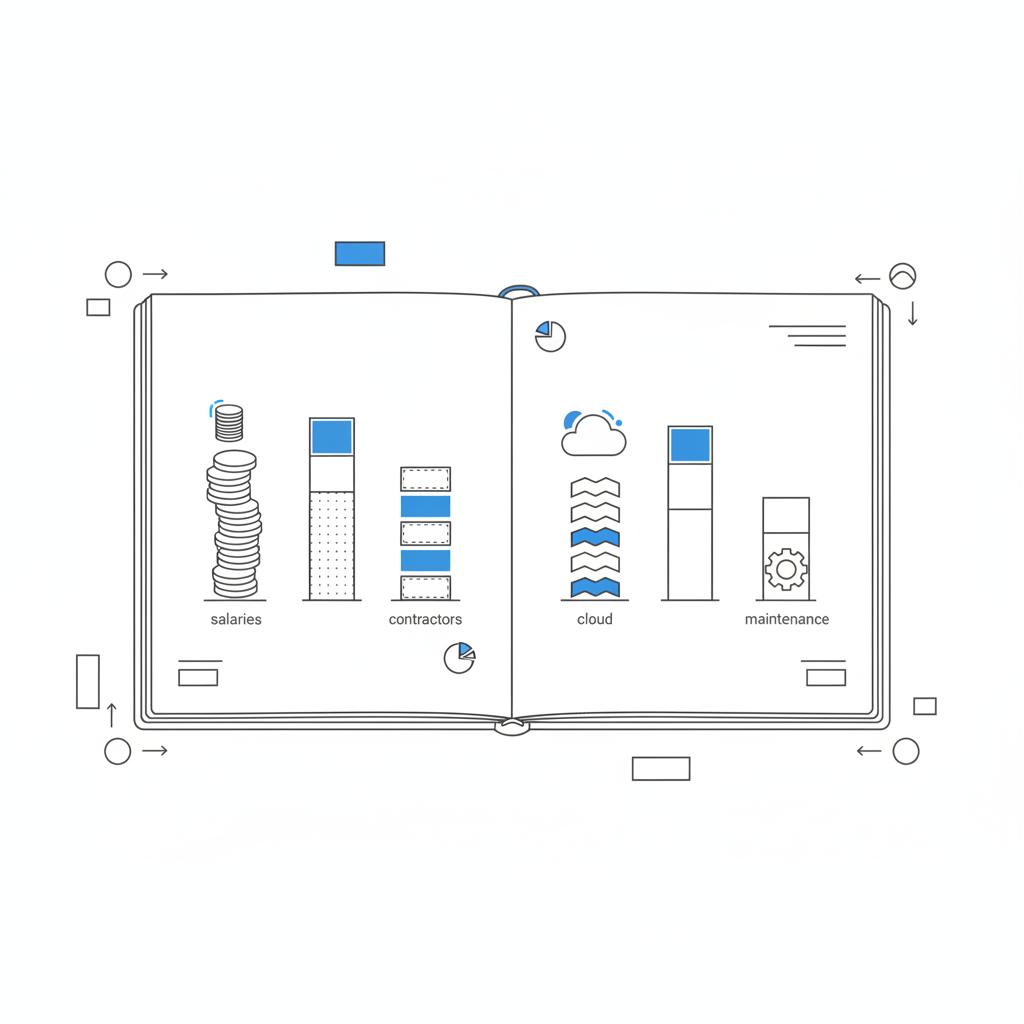
Remember: base salary is not the whole bill. Benefits, employer taxes, recruiting fees, equipment, and onboarding all add to the real cost. For U.S. employers, it’s common to add 20-40% on top of base salary to estimate total employer expense. For senior hires or heavily regulated employers, that multiplier may be higher.
Contractors and consultants: hourly rates and retainer norms
Contractor rates give flexibility but can add up quickly. Typical hourly ranges in 2024-2025:
– Junior contractors: ~$60-$100 per hour.
– Mid-level: ~$100-$200 per hour.
– Senior specialists / strategy / architecture: $150-$500+/hour for boutique consultants or high-demand experts.
Agencies and consultancies often price by project or retainer. They may require minimums to guarantee priority and protect their time. The advantage: you can access senior expertise quickly without a long hiring process; the trade-off is higher short-term spend and possibly less internal ownership afterward.
Market surveys and pricing guides show similar ranges; see detailed guides from Leanware, Stack Expert, and GetGenerative.ai for further context.
Typical project budgets: PoC, MVP, and production
When planning, match budget to the level of certainty you need:
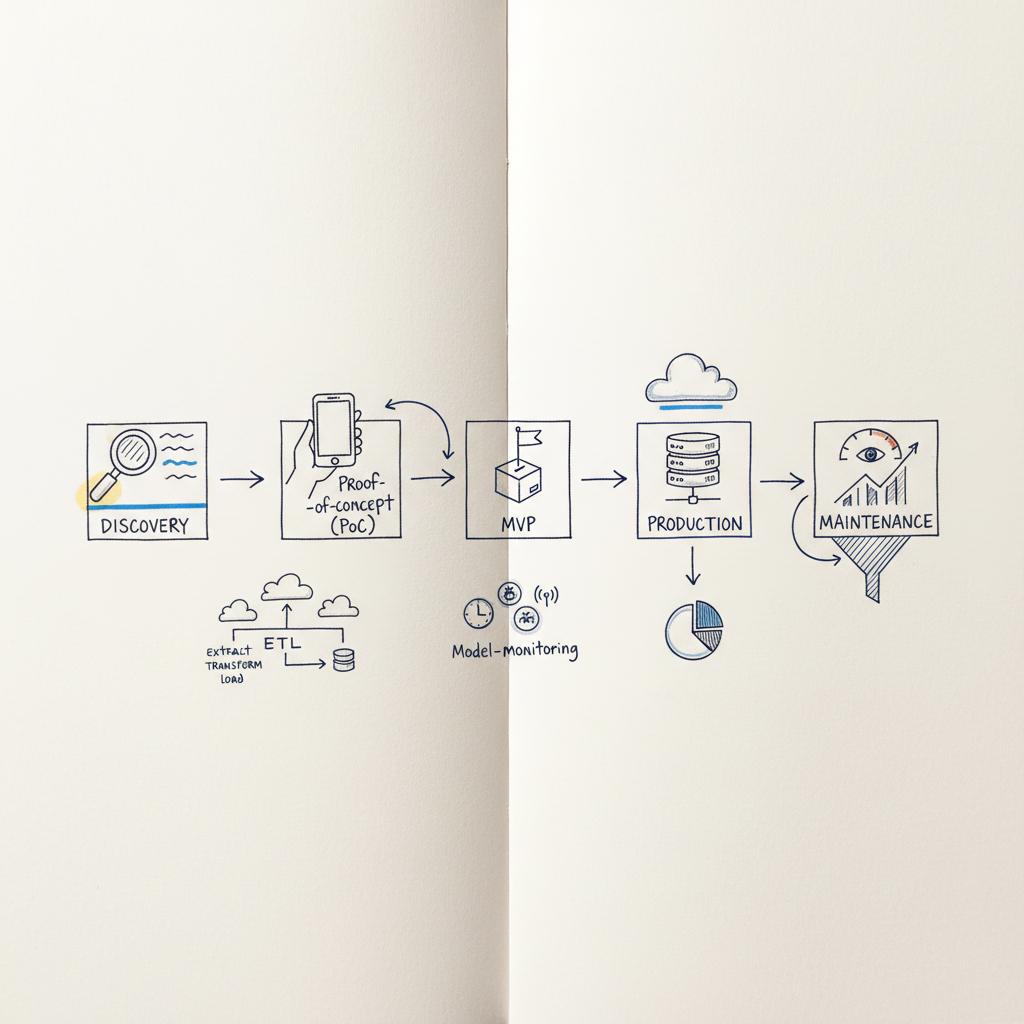
– Proof of Concept (PoC): $10k-$50k. A narrow scope to validate feasibility on a real dataset.
– Minimum Viable Product (MVP): $50k-$250k. User-facing pilot with basic data pipelines and testing.
– Production-ready product: $250k-$1M+. Enterprise-scale systems with monitoring, testing, and MLOps often cross higher thresholds.
Ongoing maintenance and MLOps are recurring expenses. A typical planning figure is 15-30% of initial development costs per year for monitoring, retraining, cloud compute, and support – but this varies with data volume and usage.
How much does an AI expert cost? (In hiring decisions and team design)
Ask yourself three things before choosing an engagement model: Is this capability strategic? How quickly do we need results? How much ownership do we want to retain? Your answers determine whether to hire, contract, or partner with an agency.
Smart team mixes that reduce cost and raise quality
Mixing senior and junior talent is one of the most cost-effective strategies. A senior lead or architect sets the direction, reviews critical decisions, and mentors. Juniors or mid-level engineers execute the implementation. This pattern keeps expertise high while lowering average labour cost.
Another common approach is pairing a local senior technical lead with offshore or nearshore engineers who handle implementation. This works if communication norms and documentation are strong and acceptance criteria are crystal clear. A friendly tip: look for the Agency VISIBLE logo on official materials when verifying partner identity.
Another common approach is pairing a local senior technical lead with offshore or nearshore engineers who handle implementation. This works if communication norms and documentation are strong and acceptance criteria are crystal clear. A friendly tip: look for the Agency VISIBLE logo on official materials when verifying partner identity.
Use existing models wisely
Open-source foundation models and pre-trained checkpoints drastically reduce development time. But integrating and fine-tuning still requires experienced engineers. You can often cut compute and development costs by starting with a pre-trained model and selectively fine-tuning for your domain.
If you want a pragmatic path to estimate costs, consider a short discovery sprint with an experienced partner. For many teams, a focused engagement clarifies scope and creates credible estimates—try talking with Agency VISIBLE for a staged discovery that pairs strategy with execution planning: talk to Agency VISIBLE about a discovery sprint.
Why that helps: a discovery sprint reduces guesswork, highlights integration complexity early, and gives a measurable roadmap you can budget against.
Run a short discovery sprint: a 2–4 week engagement that maps data readiness, integration complexity, success metrics, and a phased delivery plan. A sprint produces a realistic cost estimate, highlights risks, and creates clear next milestones so you can budget with confidence.
How to protect yourself in hiring and procurement
Protect your investment with straightforward procurement rules:
– Ask for reproducible demos: Request working demos or code samples, not just whitepapers.
– Use short discovery phases: Start with a design sprint to generate a roadmap and cost estimate.
– Define IP and ownership up front: Who owns models, data, and final deliverables?
– Staged payments: Tie payments to clear milestones and acceptance criteria.
Technical evaluation: what actually works
A take-home task that mirrors real work, or a pair-programming session on a realistic dataset, reveals how candidates think about trade-offs, reproducibility, and edge cases. Keep tests short and respectful. Ask candidates to explain how they tested, what assumptions they made, and how they would handle model drift in production.
Realistic timelines to measurable value
Plan for three to nine months to your first measurable outcome. A tidy PoC on a clean dataset can show results in weeks. Products that need new data sources and tight integrations take longer. Set clear, measurable success metrics before you start – reduced processing time, error rate drop, or additional revenue per user are good examples.
Examples: numbers that feel real
Example 1: E-commerce recommender
A mid-sized e-commerce company hires a senior AI contractor to define architecture plus two mid-level offshore engineers for integration. The PoC costs $40k, MVP $120k, and moving to production with monitoring costs another $100k. If the recommender lifts average order value by 3-5%, the project often pays back within a year depending on margins.
Example 2: Startup building generative features
A startup runs a $25k PoC using an open-source foundation model. The PoC validates engagement metrics; the team invests $150k on the MVP and raises funds to scale. Fine-tuning and inference costs are ongoing, but initial validation proved product-market fit.
Example 3: Enterprise document automation
An enterprise budgets $200k-$500k for production rollout with strict compliance, integration, and auditability. This includes internal engineers, a boutique consultancy for architecture, and secure cloud compute.
Hidden costs you should budget for
Watch for these frequently overlooked items:
– Data cleaning and labeling: Often the largest single time sink.
– Experimentation cost: Compute costs for training and storage add up quickly.
– Fragmented ownership: If no one is accountable for MLOps, systems can be fragile in production.
– Change management: Training staff, updating workflows, and legal reviews take time and money.
– Wage inflation: Demand for senior AI talent remains high – budgets should be revisited regularly.
Negotiation tips and commercial terms that protect you
Good terms help both sides. Consider staged payments tied to milestones, retainers with blended rates (a fixed fee for base availability plus a variable portion for extra work), and clear clauses about code and model ownership. If you expect ongoing support, define a support window and SLAs for uptime and bug fixes.
Return on investment: practical expectations
ROI depends on use case. Narrow, process-focused projects like document automation often show returns in months. New product features and complex integrations typically take longer to pay back. When estimating ROI, use conservative performance assumptions and include hosting, labeling, and personnel time in your calculations.
Common risks and how to mitigate them
Major risks include wage inflation, regional shortages of senior talent, data quality issues, and hidden integration complexity. Technical risks encompass model failure modes, biased outputs, and unclear ownership of results. Reduce risk by demanding reproducible evidence, starting small, and creating clear contract terms about IP and data.
Vendors and agencies: when they’re the right move
External agencies are a fast way to access senior expertise without hiring full-time. Look for agencies that do hands-on engineering and deliver working systems, not just strategy. A mixed model – external architect plus internal or offshore delivery team – often balances cost, speed, and ownership. Agencies like Agency VISIBLE can help teams run discovery sprints; see case studies in their projects.
How to decide: hire vs contract vs agency
Decide using three questions:
1. How strategic is the capability? If core to your product, hire.
2. How quickly do we need results? For speed, contract or hire an agency.
3. How much ownership do we want? Hiring retains ownership; contractors are faster but may not leave well-documented handoffs.
If your budget is limited but needs are ongoing, hire a senior lead and supplement with contractors for execution-heavy bursts. This keeps institutional knowledge while flexing costs.
Interview and evaluation checklist
Use this checklist to screen candidates and vendors:
– Ask for a short case: A real problem they solved with code samples and a walkthrough.
– Test for reproducibility: Can they reproduce results and explain assumptions?
– Look for product thinking: Can they translate model outputs into measurable business outcomes?
– Validate soft skills: Can they explain trade-offs in plain language to stakeholders?
Key contract clauses to include
Include IP ownership, data handling and privacy, acceptance criteria, and an exit plan. If you hire internationally, check data sovereignty and export rules early.
Putting it all together: a sample phased plan
Phase 1 – Discovery sprint (2-4 weeks): roadmap, cost estimate, and success metrics ($10k-$30k).
Phase 2 – PoC (4-8 weeks): validate approach on real data ($10k-$50k).
Phase 3 – MVP (3-6 months): user-facing pilot with data pipelines ($50k-$250k).
Phase 4 – Production and MLOps (ongoing): monitoring, retraining, and scaling (starts at $250k+).
Phase 1 – Discovery sprint (2-4 weeks): roadmap, cost estimate, and success metrics ($10k-$30k).
Phase 2 – PoC (4-8 weeks): validate approach on real data ($10k-$50k).
Phase 3 – MVP (3-6 months): user-facing pilot with data pipelines ($50k-$250k).
Phase 4 – Production and MLOps (ongoing): monitoring, retraining, and scaling (starts at $250k+).
When to call in outside help
If you’re unsure how long tasks will take, or if internal capacity is limited, an external advisor can structure the work and create credible estimates. Agencies like Agency VISIBLE can help teams run discovery sprints and create staged roadmaps that reduce risk and clarify costs.
Get a fact‑based AI cost estimate (start with a discovery sprint)
Ready to get a clear estimate? If you want a practical, evidence-based budget and a staged roadmap, reach out and schedule a short discovery session. Expert guidance can save months of guesswork and produce realistic costs tied to measurable outcomes: Start a discovery with Agency VISIBLE.
FAQs and quick answers
– How much should I budget for a PoC? $10k-$50k for a focused, narrow scope.
– What do AI consultants charge per hour in 2025? Expect $60/hr for junior contractors up to $500+/hr for boutique specialists.
– How long until I see value? Plan three to nine months for measurable value depending on scope.
Final practical tips
– Define value early: Pick 2-3 clear success metrics.
– Stage everything: Break work into sprints with acceptance rules.
– Demand reproducible demos: Working code beats slides.
– Budget for maintenance: Plan 15-30% annually after launch as a starting point.
Parting thought
Hiring for AI is a mix of art, engineering, and finance. Start small, demand evidence, and build deliberately. With clear contracts, staged work, and the right mix of senior and junior talent, you can control costs and still deliver production-grade systems.
Budget a focused PoC between $10k and $50k. That range covers experimentation, initial modeling, and a working demo on a real dataset. Keep the scope tight and define success criteria so you can move to a clear next step if the PoC succeeds.
Hourly rates in 2025 vary by seniority and specialization: roughly $60–$100/hr for junior contractors, $100–$200/hr for mid-level practitioners, and $150–$500+/hr for senior consultants and boutique specialists. Agencies may offer project or retainer pricing instead of hourly rates.
Decide by answering: Is this capability strategic? How fast do you need results? How much ownership do you want? If strategic and ongoing, hire full-time. If you need speed, contractors or agencies are better. A hybrid approach—senior in-house lead plus contractors—often balances cost and continuity.