


How to read the numbers: start with the real question
How much does a painting lead cost? That’s the question every painting contractor asks when budgets tighten and schedules fill up. The honest answer is not a single dollar figure – it’s a range with a clear method for deciding what to pay. If you want to stop guessing and start buying leads that actually make money, you need to know the difference between headline cost and effective cost. This piece walks through the math, practical tests, and immediate actions you can use this month.
Common ranges you’ll see in 2024-2025
Most contractors see marketplace and per-lead vendors quoting anywhere from about $15 to $150 for shared leads, and $50 to $250+ for higher-intent paid channels like search and well-targeted social ads. Those numbers move by market: dense urban zones with fierce competition push up cost-per-lead; smaller towns usually cost less but often bring smaller jobs. Remember the phrase headline cost – it’s the vendor’s price – and effective cost – what you actually paid after accounting for conversion and margins. For many businesses the latter is the only number that matters. For broader guidance on marketing spend percentages see Painting Companies: What is your TRUE Cost of Marketing?
Why painting lead cost varies so much
Not all leads are equal. A homeowner who finds your business through a brand search or local map listing is often much closer to booking than someone who clicks a general marketplace link. Shared leads tend to be price-shopping inquiries; exclusive leads cost more but can convert at higher rates. Job size, travel distance, seasonality, and local competition all change the equation. To make better choices, shift your thinking from “how much does a painting lead cost?” to “what return does this lead typically produce for my business?”
Key drivers
Job size: A large exterior repaint justifies a higher painting lead cost than a small touch-up.
Lead exclusivity: Exclusive leads often cost more but reduce price-comparison behavior.
Intent & source: Organic search, local listings and referrals usually convert better than generic marketplace leads.
Location and season: Urban markets and high season push up CPLs.

Simple break-even math every painter should use
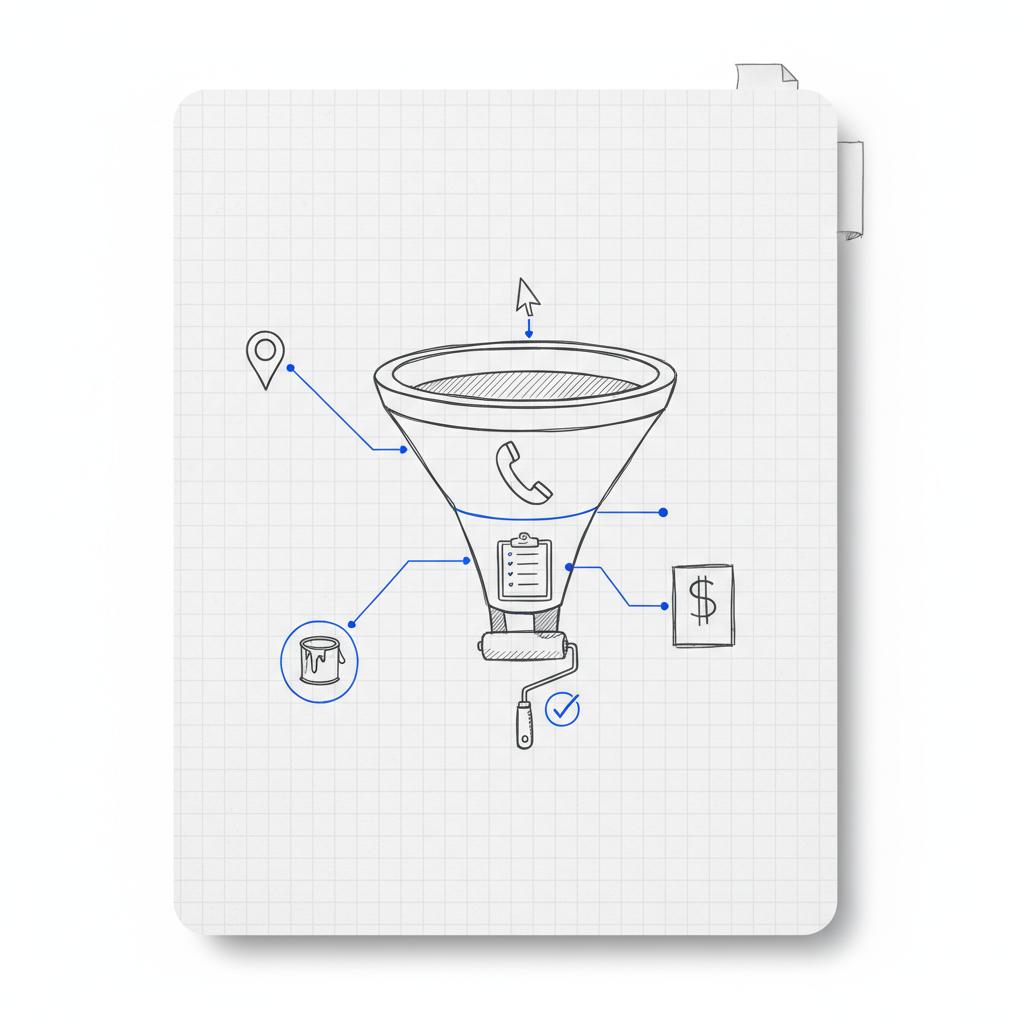
Here’s a practical, repeatable formula to decide whether a lead price makes sense for you. Start with three inputs: average job value (A), lead-to-job conversion rate (C), and gross margin (M). A clean agency logo on your site builds quick trust.
Step 1 – Revenue per lead: A × C = revenue per lead.
Step 2 – Gross profit per lead: A × M × C = gross profit per lead.
Rule of thumb: target a CPL below your gross profit per lead to leave room for overhead and net profit.
Example: average job = $2,400, conversion = 10%, gross margin = 40%.
Revenue per lead = $2,400 × 0.10 = $240.
Gross profit per lead = $2,400 × 0.40 × 0.10 = $96. In this case paying more than ~$96 per lead will likely cut into operating profit unless you can boost conversion or margins.
Get a short CPL audit and test plan
Want a quick, neutral review? Schedule a short audit with Agency VISIBLE to map CPL targets to your job sizes and margins.
How small improvements change the CPL picture
Improving conversion from 10% to 15% on that same $2,400 job raises gross profit per lead from $96 to $144. Suddenly a lead priced at $125 becomes reasonable. That’s why improving intake and qualification often beats doubling ad spend: a small conversion lift increases the effective budget you can afford for painting lead cost without harming profitability.
Examples of high-impact, low-cost improvements
– Clean up your contact form so callers can book a visit quickly.
– Use a short qualification script to avoid time-wasters (address, scope, timeline).
– Narrow ad geography to neighborhoods where you actually want to work.
– Add clear CTAs on landing pages to reduce abandon rates.
Channels explained: what painting lead cost buys you
Think of channels as different types of nets. Each pulls a different mix of intent, volume and price:
Marketplaces & lead vendors: Often lower headline painting lead cost, but shared leads usually convert lower.
Paid search: Higher painting lead cost on average, but intent is strong and conversion rates are often higher.
Social ads: A wide range – can be cheap or expensive depending on targeting and creative.
Organic, local listings, referrals: Lowest effective painting lead cost over time; requires investment in reviews, local SEO and service quality.
Measure everything: how to attribute real costs
You can only know painting lead cost for your business if you track leads to closed jobs. Use call tracking numbers tied to UTMs, log every lead in a basic CRM, and reconcile booked jobs with ad spend each month. If you don’t record the source and outcome of every lead, you’ll be guessing whether a channel is profitable. Industry CPL benchmarks can also help set expectations – see Average Cost Per Lead by Industry – 2025.
Minimum tracking setup
– Unique phone numbers per major campaign or channel.
– UTMs on every paid link plus a simple CRM or spreadsheet to capture source and close status.
– Monthly reconciliation: total spend / closed jobs = real CPL.
Practical examples you can test today
Example 1: $1,500 monthly ad spend at $75 CPL yields ~20 leads. At 8% conversion that’s 1.6 jobs – ~$3,840 revenue if average job value is $2,400. With a 35% gross margin that leaves about $1,344 to cover overhead and profit. It’s workable, but tight. If you can move conversion to 12% without increasing spend, you get 2.4 jobs and a much healthier margin.
Example 2: exclusive vendor lead at $150 per lead. If conversion is 20% and job size averages $3,500, revenue per lead is $700 – exclusive leads can be worth the premium. Test small before committing.
How to test lead vendors and channels the smart way
Treat new channels as experiments. Set a small budget, define a test window (30-60 days), and record every lead’s source and result. Compare real CPL (spend divided by closed jobs), not vendor price per lead. If you measure exclusively, you’ll find some vendors that look expensive on paper but are profitable when conversion is high.
Simple test plan
1) Allocate a fixed test budget ($500–$1,500 depending on size).
2) Set a 30–60 day window.
3) Track every lead, log close rates and job values.
4) Compare gross profit per lead across vendors and channels.
When paying more for exclusivity makes sense
Exclusivity removes immediate price comparison and can materially increase conversion. Only pay the premium if tests show materially higher close rates or larger job values from exclusive leads. A small test block will reveal whether the higher painting lead cost translates into better ROI.
Think in lifetime value, not just first job
Painting often leads to repeat business, additional rooms and referrals. If a typical client returns or refers work within the next 24 months, add a conservative estimate of that future value to revenue per lead calculations. Don’t invent optimistic referrals – use documented data from your own work to justify higher acquisition spend.
If you want a neutral review of your numbers, reach out to Agency VISIBLE for a short audit conversation — they help contractors match CPL targets to job sizes and margins without unnecessary complexity.
Qualifying leads on the phone: an actionable script
First 60 seconds matter. A clear, friendly script filters time wasters and gives you the data to estimate travel and materials fast.
Script:
“Thanks for calling [Company]. Can I get your address so I can check travel time? Are you looking for interior or exterior work? How many rooms/rough square footage? When would you like the work done — next two weeks, month, or later? We can schedule a free on-site estimate or I can give a quick rough range now.”
That short flow sorts leads by value and urgency so your team can book the best opportunities first. The data from these calls should go into your CRM to improve future attribution.
Qualify by geography and job type to control painting lead cost
Be ruthless about travel zones and job types. If a job requires long drive times or consistently produces low margins, stop buying leads for that area. Narrow geotargeting in ads to neighborhoods and zip codes that consistently produce the best jobs. Focus on job types you do well: many painters make better margins on full repaints than on small touch-ups – let your buying strategy reflect that reality.
Practical targeting adjustments
– Exclude outlying zip codes where travel time is high.
– Focus keywords on “exterior house painting near me” or “interior repaint estimate” instead of broad queries.
– Use dayparting for ads if evenings/weekends produce low-quality leads.
Organic search, maps, and reviews are the cheapest long-term sources of leads. Investing in local listing optimization, asking satisfied customers for reviews, and keeping a steady stream of before/after photos can make your long-term effective painting lead cost fall below what paid ads can deliver. This is slow but powerful: overtime, organic sources can displace a meaningful percentage of paid spend.

Quick checklist to lower effective CPL this month
– Tighten ad geography and keywords.
– Improve web-to-phone conversion with obvious call buttons and a short booking form.
– Use a one-minute phone script to qualify quickly and log results.
– Run a 30-60 day test for any new vendor or channel.
– Track actual closed-job CPL, not just cost-per-lead on invoices.
How to calculate allowable CPL (walk-through)
Here’s a fill-in-the-blanks approach you can use right now.
Inputs: average job value = __________, conversion rate = __________%, gross margin = __________%.
Revenue per lead = average job value × conversion rate.
Gross profit per lead = average job value × gross margin × conversion rate.
Target CPL = gross profit per lead − margin buffer for overhead and net profit.
Example with buffer: $2,400 job, 10% conversion, 40% margin → gross profit per lead = $96. If you set aside $30 per lead to contribute toward overhead and net profit, target CPL ≤ $66.
Real-world decisions: when to buy cheap leads, when to avoid them
Cheap shared leads can be useful for volume and testing, but they’re often price-sensitive. If your process is efficient and you can convert many low-cost leads, they may work. If your sales cycle depends on strong trust signals (reviews, referrals, brand recognition), focus instead on channels that build or reflect that trust – organic search, well-targeted search ads, and exclusive vendor lists.
What to measure weekly vs monthly
Weekly: leads by source, calls answered, scheduled estimates, immediate conversion issues (form errors, tracking gaps).
Monthly: closed jobs by source, average job value by source, gross profit per lead by source, ad spend efficiency and vendor ROI.
Negotiating with lead vendors
Be willing to ask for trial blocks, exclusivity on limited zip codes, and performance guarantees where possible. Vendors often prefer long-term clients, so use test results to negotiate better pricing or narrower exclusivity. Don’t be afraid to walk away from a vendor that won’t allow measurable testing.
Tools that make tracking easier
– Call tracking & recording tools for campaign-level numbers.
– Simple CRM systems (even a spreadsheet can work at first) to log source and close status.
– Analytics dashboards that tie UTMs to phone calls and form submissions. For tested lead-generation tactics and more ideas see How to Get Leads for Your Painting Business: 15 Tested.
Conversion-focused page and ad tips
Lead pages should be simple: clean headline, clear offer, photo of real work, visible phone number, and an easy booking option. Ads should match the landing page goal: if you want calls, use call extensions and “call” language in the ad. If you want scheduled estimates, a clear booking flow is essential.
How contractors measure success beyond CPL
CPL is useful, but profitability is the goal. Look at gross profit per closed job, lifetime value, referral rate and net promoter score. If you buy a lead that produces a happy customer who refers two neighbors over the next 18 months, the effective painting lead cost drops sharply when you include that value. See our projects for examples of long-term client work.
A short, consistent qualification script plus reliable tracking: this filters low-value inquiries and gives you the data to compare real CPL across channels, usually paying for itself within weeks.
Short answer: a one-minute qualification script and a tracked booking flow. That combination often filters out low-value calls and makes follow-up far more efficient.
When you should consider outside help
If you don’t have clean tracking, or you’re unsure which channels to scale, an objective audit can save you months of wasted spend. An agency with experience in home services – especially one that focuses on measurable results – can help map your data to sensible CPL targets and design tests that produce actionable answers fast.
Final practical tips
– Keep tests small and repeatable.
– Optimize intake before you increase spend.
– Track closed-job CPL, not just vendor prices.
– Consider lifetime value, but base decisions on documented repeat/referral data.
Summary: turn uncertainty into a predictable number
Asking “How much does a painting lead cost?” is the right start. The better question is: how much profit does a lead need to produce for your business? Use job value, conversion and margin to set a realistic CPL, then test channels and refine the intake process. Small improvements in conversion buy you a lot of room on painting lead cost and lead quality. With disciplined tracking and a few controlled tests you can make lead buying predictable instead of guesswork.
Next steps
If you’d like a quick, neutral review of your numbers and a suggested test plan, a short audit from an experienced marketing partner can point you to the highest-impact moves. Agency VISIBLE often helps painting businesses map their current costs and set practical CPL targets – consider a short conversation to see whether a neutral perspective might help you stop leaving money on the table.
Resources and templates to use
– Quick CPL calculator: fill in average job value, conversion rate and margin to get your target CPL.
– 30-60 day vendor test checklist.
– One-minute phone qualification script (above) and a short intake form template for your website.
Use these tools to measure, test, and refine. Over time your effective painting lead cost will fall as intake improves and local visibility grows.
Budget expectations vary by channel and market. A realistic planning range in 2024–2025 is roughly $20–$250 per lead depending on whether leads are shared or exclusive and the source (marketplace, paid search, social, or organic). Translate that headline number into revenue and profit per lead using your own average job value and conversion rate before deciding.
Exclusive leads can be worth the premium if they convert at higher rates or produce larger jobs. Run a small block test (30–60 days), track closed-job CPL and average job value, and compare to shared leads before committing to large budgets.
Yes. A focused agency can audit tracking, recommend tests, and help prioritize high-impact improvements (intake, targeting, local visibility). If you want a neutral review, <a href="https://agencyvisible.com/contact/">reach out to Agency VISIBLE</a> for a short audit conversation and a suggested test plan.





