How much does a 30-second ad cost? A clear, practical guide
How much does a 30-second ad cost? If you’ve typed that question into a search box, you’re in the right place. Early in any paid-media conversation this question surfaces – and the honest answer is both simple and strategic: it depends. In this guide we’ll explain exactly why, break costs into production and media, walk through channel-by-channel pricing, and give step-by-step budgeting tactics you can use today.

Two big buckets: production and media
When people ask “30-second ad cost,” they often mean a single number. But you actually need to think about two separate decisions. Production is everything needed to make the creative — script, cast, shoot, editing, sound and music rights. Media is what you pay to show that creative to people — TV, CTV, radio, YouTube or social feeds. Adjust one and the other often follows: spend more on production and you may choose fewer airings; spend more on distribution and a simpler creative may be the right pairing.
Production and media are a partnership, not opponents. A modest creative that fits a platform will usually beat an expensive spot that feels out of place.
Production cost: the range and what drives it
Production costs for a 30-second video have a wide range. At the low end, a DIY spot—small crew, stock music and a couple of shooting hours—can start at roughly $1,000. Most professional work falls between $5,000 and $25,000. At the top, agency-level productions with cast, locations, custom score, and advanced post-production can exceed $50,000. For radio, production is cheaper: simple voiceover spots can cost a few hundred dollars, while more layered sound-design pieces run up toward $1,500-$2,000.
Why such variation? Every production choice has cost implications: location shoots vs. studio, original music vs. licensed tracks, union cast vs. in-house talent, multiple cameras vs. single-camera setups, custom VFX vs. simple motion graphics. The trick isn’t to always spend more, but to buy what delivers for the audience and platform.
Production checklist: where your money goes (and where to save)
Typical line items: scriptwriting, storyboarding, casting, location fees, crew, equipment, shoot days, editing, color grading, sound design, music licensing/original score, legal clearances and deliverables for multiple formats. To save smartly: use stock music or short custom cues, lean on a skilled director/editor, and plan for deliverables that work across channels (TV, CTV, social crops).
Media cost by channel: what to expect
National broadcast TV
A 30-second national prime-time TV spot is the high-cost reference point. For prime-time in 2024-2025, a single 30-second national airing typically lands in the range of tens of thousands to several hundred thousand dollars depending on the network, program and audience size. Special events – major sports finals or awards shows – can push the cost into the millions for a single 30-second slot. The Super Bowl remains the marquee example: its exclusivity and earned media multiply the value beyond pure impressions.
Local TV
Local TV is the place where many small and mid-sized businesses get efficient reach. A 30-second local TV spot can cost anywhere from the low hundreds to several thousand dollars per airing depending on the market (DMA), station, and daypart. News and early-evening prime slots cost more; late-night and early-morning can be far cheaper. The benefit is geographic precision and predictable audiences. For local rate guidance see this resource on local TV ad cost: How much do TV ads cost.
Connected TV (CTV) and streaming
CTV and streaming blur the line between TV and programmatic digital buying. Most CTV buys are priced on a CPM basis (cost per thousand impressions). In 2024 typical CTV CPMs ranged roughly from $15 to $40, although program type, targeting and platform can shift that band. This pricing gives predictability for reach-driven campaigns and better audience targeting than classic broadcast. For a deeper look at current CTV CPMs see this guide: CTV ad costs & rates explained.
Social platforms and YouTube
Social and YouTube generally show lower CPMs—typical 2024 ranges were about $5 to $25 depending on targeting, format and bidding model. Social buys can use CPM, CPV (cost per view), or hybrid bidding. These channels are excellent for testing creative quickly and scaling winning ads incrementally, but they demand very tight creative in the first three seconds to reduce drop-off. See strategies for connected and streaming video marketing here: Connected TV marketing strategies.
Radio
Radio remains one of the most affordable linear channels. A local 30-second radio spot in small or mid-size markets may cost around $50 to $1,000. Major-market drive-time inventory can exceed $1,000 and sometimes reach $5,000 or more for premium placements. Radio’s value comes from frequency and locality – especially for repeat messaging like store openings, promotions, and events.
Translating CPMs and impressions into real budgets
CPMs make it easier to compare channel economics. If you want 100,000 impressions and a CTV CPM is $25, you’re looking at roughly $2,500 in media cost. The same 100,000 impressions on social at a $10 CPM would be about $1,000. Broadcast TV isn’t usually sold as a CPM, but a single prime-time spot could reach several million viewers – if you can afford it.
Still, the raw CPM doesn’t tell you about attention and context. A viewer on a big screen in the living room behaves differently than someone scrolling past a clip on a phone. That difference often explains why advertisers pay more for premium TV or CTV inventory.
Sample budgets and scenarios
Small business example: A community bookstore could choose one of two sensible paths. Option A: produce a warm, simple 30-second radio ad for $500 and buy a month of morning and afternoon drive time for $1,500. Option B: spend $3,000 on a short social video and run targeted social/YouTube promotion for $2,000. Both can work; the bookstore picks based on audience and goals.
Regional retailer example: For a holiday push, a retailer might budget $20,000 for production and $125,000 for CTV buys to achieve 5 million impressions at a $25 CPM – then add local TV and social for retargeting. That campaign could easily move into six figures overall but would be modeled around expected conversion rates and lifetime value.
National brand example: National prime-time or event buys remain very costly and are best for brands with the budget and a goal of mass reach and PR impact. Most smaller brands get more efficient reach by mixing CTV, social and strategic local TV.
Production vs distribution: how to split a budget
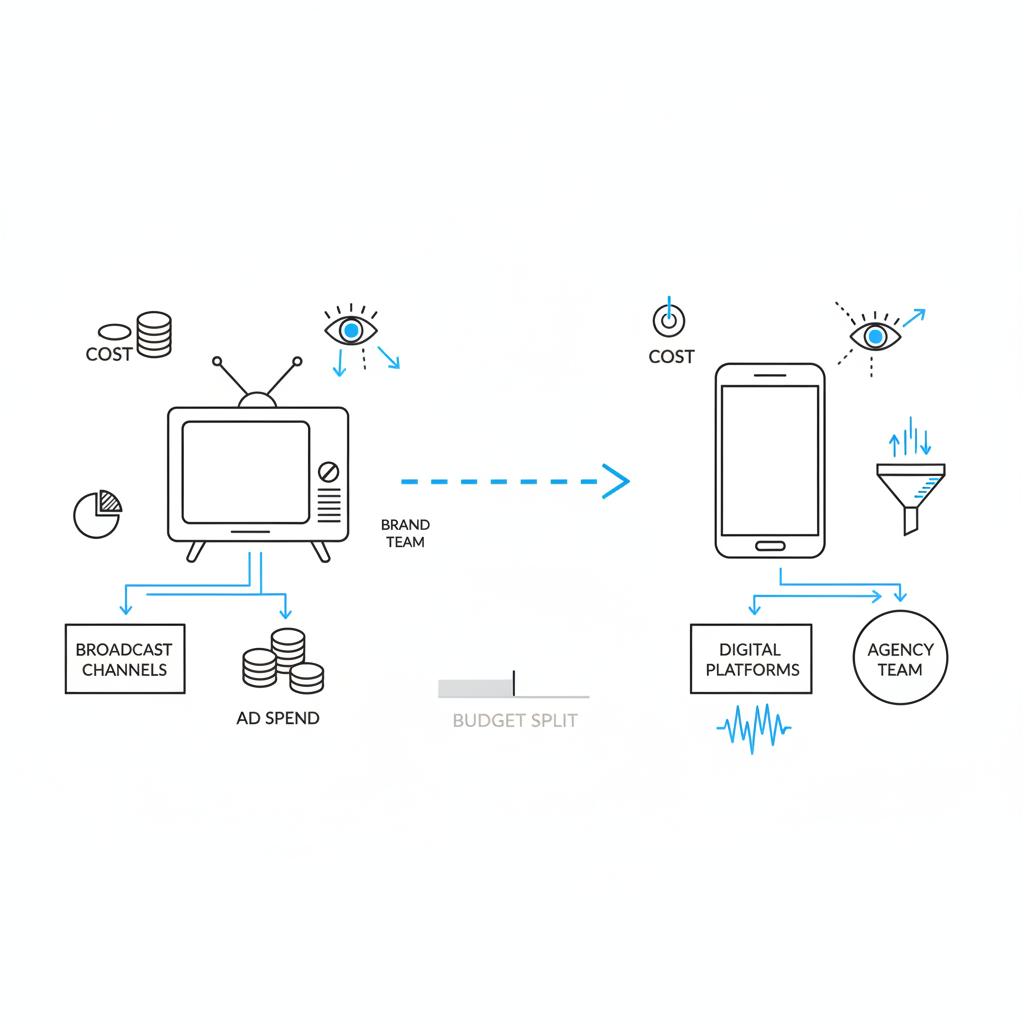
There’s no universal split. Performance-driven advertisers often skew toward media (e.g., 70% media / 30% production) because the goal is measurable actions. Brand-driven advertisers may invest far more in production to build long-term equity. A practical approach is phased testing: modest production + test flights across digital channels, then allocate more to high-performing creative or premium placements.
Schedule a budget session with Agency VISIBLE if you want a second pair of experienced eyes on your plan – especially if you’re deciding how much to invest in production vs. media for a local or regional campaign.
Testing reduces guesswork: run a simple creative across channels, measure which placements produce meaningful lift, then scale where performance proves out.
Yes—when the goal is immediate response, a well-targeted $1,000 social video can outperform a high-budget TV spot on direct metrics. For long-term brand recall or high-attention environments, TV/CTV still has advantages. Testing both approaches is the fastest way to know which wins for your objective.
Yes – sometimes. A smart $1,000 social video that targets the right audience and launches with a modest paid test can outperform an expensive TV spot on immediate response metrics (clicks, signups, short-term conversions). But TV or CTV can deliver higher quality attention and longer memory, which helps with brand metrics over time. The right choice depends on objective.
Audience quality and context: why dollars aren’t all that matter
A dollar buys different attention in different places. A viewer watching a drama on the couch tends to be more attentive than a person scrolling a feed. That attention gap is why some marketers pay a premium for prime-time TV or high-quality CTV placements: they value the engagement, not just the raw impressions.
Targeting granularity matters too. Programmatic buys with demographic and behavioral targeting can raise CPMs, but they reduce wasted impressions by focusing on the most relevant audience.
Market differences and dayparts
Expect higher costs in top DMAs like New York or Los Angeles. Expect dayparts to matter—prime-time and drive-time cost more than overnight windows. If your product is local, a concentrated buy in the right DMA and daypart can beat a broader, cheaper buy that reaches many irrelevant viewers.
Buying methods: direct, programmatic and negotiated spots
Direct buys with a network or station offer premium inventory and predictability. Programmatic buys (for CTV or digital video) provide scale and precise targeting but can vary with bidding and supply. Both approaches have their place: direct buys for guaranteed placements in premium environments, programmatic for flexible scaling and granular audience targeting.
Measurement and attribution
Attribution across channels is still imperfect, but tools are improving. For performance goals, focus on cost per action: divide total campaign cost by the number of leads or sales to get a clear comparison across channels. For brand goals, use survey-based ad recall or lift studies to understand whether premium placements or higher production improved perception.
How many exposures are enough?
Frequency depends on the product and buying cycle. Consumer packaged goods often benefit from high frequency; high-consideration B2B purchases may need multiple touchpoints across channels. The practical rule: test frequency in small flights, measure diminishing returns, and optimize the mix so you’re not overspending for impressions with low incremental impact.
Creative tips by channel
TV/CTV: cinematic framing, clear brand moment in the first 6–8 seconds, strong audio, and a clear CTA for follow-up.
Social/YouTube: hook in the first three seconds, captions for sound-off viewers, and short pacing that fits mobile consumption.
Radio: memorable sound design, a simple message and a repeated call to action to build recall across repeat exposures.
Testing tactics that save money
Use small flights of spend to validate creative before a large buy. A/B test two versions of the spot on social and YouTube to see which creative drives a stronger early signal. If one creative wins, prioritize that creative for CTV or local buys. This staged method prevents expensive mistakes and helps you refine messaging quickly.
Matched audience tests
Deliver the same creative to similar audience cohorts on two channels to compare performance. This reduces confounding differences between creative and audience and yields clearer guidance on where to spend more.
Testing reduces guesswork: run a simple creative across channels, measure which placements produce meaningful lift, then scale where performance proves out.
Practical negotiation tips for media buys
Ask for daypart specifics, audience composition and historical ratings for the spots you’re considering. For local buys, bundle and negotiate multi-week placements. For programmatic buys, ask about supply sources and third-party verification. Always request post-buy reporting that includes viewability and audience delivery metrics.
Common pitfalls to avoid
1) Don’t confuse reach with impact – cheap impressions are worthless if the audience isn’t relevant. 2) Don’t assume expensive production guarantees success. 3) Don’t skip testing and measurement – without data you’re guessing.
Checklist: planning a budget for a 30-second spot
Before you buy: define the objective, choose target audiences, pick channels to test, set a modest test budget, and define clear KPIs (leads, installs, recall lift).
During the campaign: monitor early signals, reallocate to performing channels/creative, and keep creative consistent across placements.
After the flight: measure cost per action, brand metrics, and audience reach. Use findings to guide the next flight.
Real-world examples revisited
Community bookstore — radio vs social decision: a radio buy gives high local frequency for a predictable price. A social-first approach allows faster iteration and precise targeting. Both can succeed; the deciding factor is audience behavior.
Regional retailer — holiday push: higher production investment can be justified for a seasonal campaign if expected return and lifetime value support it. CTV often bridges the gap by giving quality attention with CPM-based buying.
National advertisers — mass reach vs efficiency: national prime-time is for scale and public conversation; many smaller advertisers will get better returns with focused CTV, social and local TV mixes.
Quick budgeting math you can do now
Pick your target impressions, apply CPMs for channels, add production and agency fees, then divide total cost by expected actions to get cost-per-action. For example, 100,000 impressions at $25 CPM on CTV equals $2,500 media cost. Add production of $15,000 and your total campaign is $17,500 – then divide by expected conversions to test feasibility.
Final planning tips
Be deliberate: start with a small test, learn quickly, and scale what works. Keep creative consistent across channels so frequency builds memory. Prioritize measurement and negotiate for reporting that tells you where impressions came from and how engaged viewers were.

FAQ highlights
How much does a 30-second national TV ad cost? Tens of thousands to several hundred thousand dollars per airing in prime-time; marquee events cost millions.
How much for local TV? Often low hundreds to several thousand dollars depending on market and daypart.
What are typical CTV and social CPMs? CTV: roughly $15-$40 CPM; social and YouTube: roughly $5-$25 CPM.
Actionable next steps
Decide your objective, set a small test budget, pick two channels to test a single creative, measure early, and then allocate. If you’d like hands-on help,
Ready to plan a 30-second ad that actually works?
Bottom line: there’s no single number for a 30-second spot. Think in production + media, test deliberately, and let measurement guide scaling. With smart choices, even modest budgets can yield meaningful results and teach you where to invest next.
Production ranges widely. A DIY spot can start around $1,000; most professional videos fall between $5,000 and $25,000; high-end agency work can exceed $50,000. Radio production is generally cheaper—hundreds to a couple thousand dollars depending on complexity.
Using social or YouTube with efficient targeting is often the cheapest route. With CPMs in the $5–$25 range, 100,000 impressions could cost roughly $500–$2,500 on social platforms. Lower CPMs come with trade-offs in attention and context, so factor in creative fit and expected engagement.
Yes — Agency VISIBLE recommends a phased approach (learn, scale, refine) that starts with modest production plus targeted testing across channels, then scales what works. Reach out to their team to run a quick budgeting session and get tailored recommendations.
References
- https://agencyvisible.com/contact/
- https://www.simulmedia.com/blog/how-much-do-tv-ads-cost
- https://keynesdigital.com/ctv-advertising-rates/
- https://www.stackadapt.com/resources/blog/connected-tv-marketing-strategies
- https://agencyvisible.com/perspectives/
- https://agencyvisible.com/
- https://agencyvisible.com/projects/