Understanding the question: how much do PPC agencies charge and why it matters
How much do PPC agencies charge is not a single-number question – it’s a doorway into how agencies work, how much hands-on effort your account needs, and how risk is shared between you and the partner you hire. Start here: pricing tells you as much about the type of work you need as it does about the agency you pick.
This guide walks through real-world pricing models, the forces that move fees up and down, and practical exercises to model costs for your specific business. You’ll get clear examples for a local shop, a mid-market SaaS company, and an enterprise advertiser. Along the way you’ll find negotiation scripts, a measurement checklist and the questions that separate thoughtful proposals from vague promises.

Four common ways agencies charge
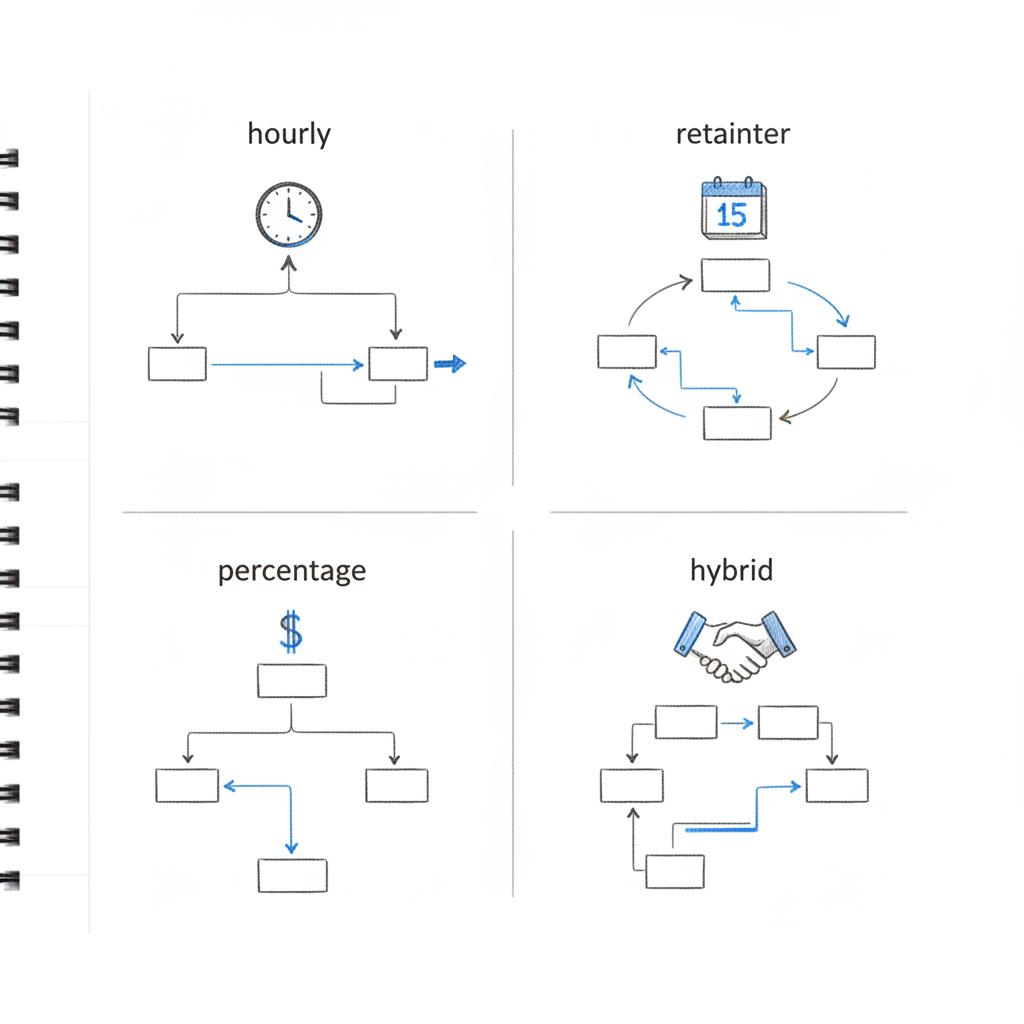
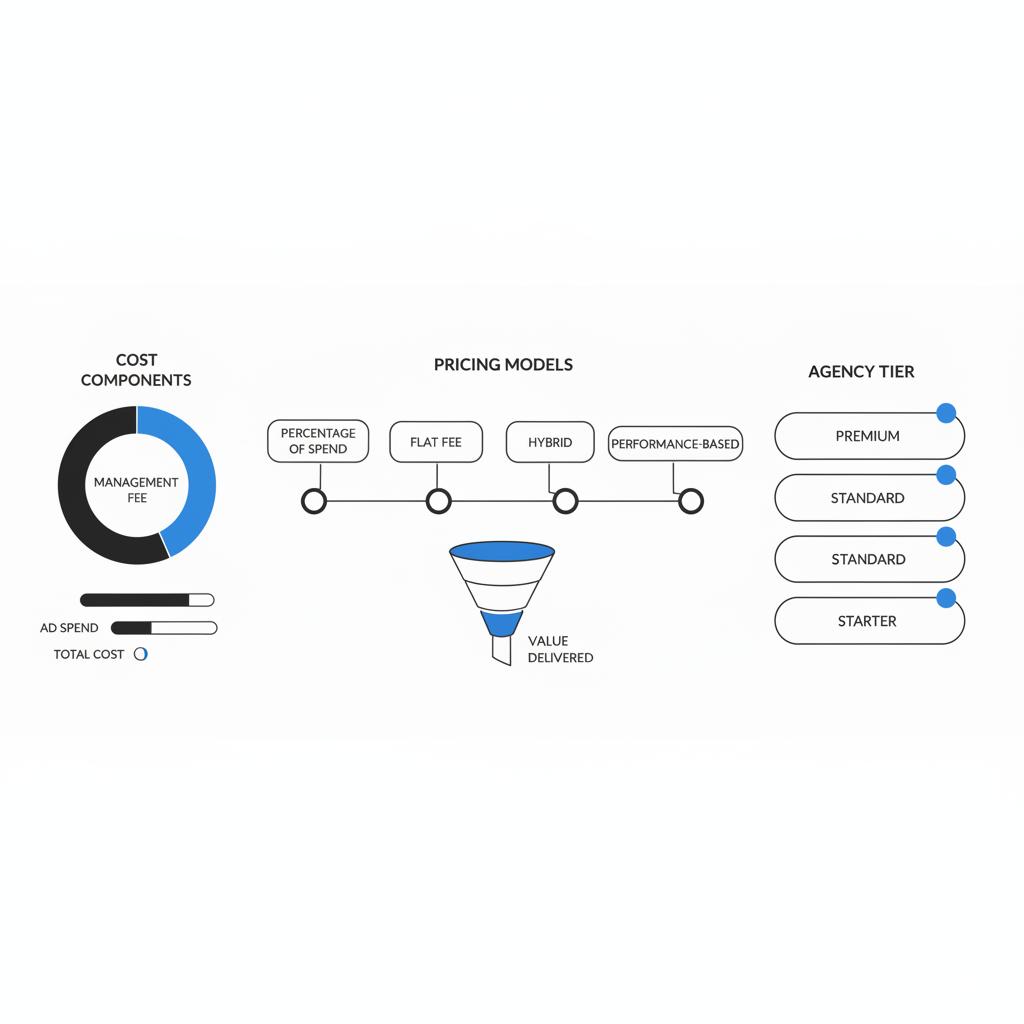
Most agencies choose one of four commercial structures: hourly, flat monthly retainers, a percentage of ad spend, or performance-based / hybrid models. Each has trade-offs – transparency, predictability, alignment and risk-sharing – and each suits different business situations. For broader pricing benchmarks see digital advertising pricing data.
1. Hourly: surgical, short-term, transparent
Hourly billing means you pay for the time an agency spends on your work. Typical market bands in mature markets are in the range of $75–$200+ per hour depending on seniority and specialisation. Use this model if you need targeted help – a migration, a deep audit, a one-off campaign setup.
Pros: predictable for short engagements, easy to track outputs. Cons: can encourage firefighting instead of steady optimisation when ongoing management is required.
2. Flat retainers: steady and budget-friendly
Flat monthly retainers are common with small and mid-market businesses because they offer a clean budget line and defined deliverables. Typical ranges: roughly $500–$5,000 per month depending on the breadth of services, number of channels and seniority of the team.
Example scopes: a $1,500 retainer may include two channels, weekly check-ins and a monthly report; a $4,000 retainer might add multi-variant landing page tests, creative production and advanced analytics.
3. Percentage of ad spend: aligned but watch for caveats
Charging a percentage of monthly ad spend tightly links agency pay to budget. For 2024-2025, many agencies sit between about 10–20% of ad spend; larger budgets usually see lower percentages (5–10%).
This model aligns incentive to scale spend but can reduce the incentive to cut waste unless contracts include strong performance KPIs and transparent reporting. For a deeper look at agency pricing models see marketing agency pricing models.
4. Performance-based and hybrid arrangements
Performance-based fees promise upside sharing – you pay more when the partner delivers more. In practice they are rare because they require agreed baselines, bulletproof attribution and mutual trust. Where they work best is for bounded campaigns with clear deliverables (e.g., a promotion that should drive X bookings) and strict measurement rules. Most agencies prefer a hybrid model: a reduced retainer plus modest performance bonuses tied to specific KPIs.
One-off onboarding and setup fees
Almost every agency charges a setup or onboarding fee to cover account audits, tag and analytics setup, migrations, and initial creative work. Expect $500–$5,000 depending on complexity. Think of this as the cost of getting the account to a place where the agency can focus on optimization and growth rather than housekeeping.
What actually drives pricing?
When you ask how much do PPC agencies charge, you should always ask what’s included and why. Main cost drivers:
- Platforms: search-only work is different from multi-channel programs that include social, display, video or Performance Max-style automation.
- Complexity: number of campaigns, geographies, language variants and creative permutations.
- Industry competition: high-CPC verticals (legal, insurance, certain B2B) require more strategy and bid modelling.
- Measurement & analytics: simple dashboards are cheap; cross-channel attribution and CRM integration cost more.
- Agency seniority & tooling: senior strategists and proprietary tooling raise fees but should deliver better outcomes.
Modern automation and AI change how agencies work – that matters for pricing. Automated bidding and generative creatives speed many execution tasks, but human strategy, creative direction and measurement design remain essential. Agencies therefore shift fees toward higher-value activities: oversight, strategy and measurement.
This guide walks through real-world pricing models, the forces that move fees up and down, and practical exercises to model costs for your specific business.
Concrete modeling: three typical business examples
Examples make this tangible. Below are three realistic scenarios that illustrate what you might expect to pay and how to compare options.
Small local retailer — $3,000 monthly ad spend
If your monthly ad budget is $3,000, you may receive: a flat retainer of $800–$1,200 to run search campaigns, produce a handful of ad variations and deliver a monthly report. Alternatively, a percentage fee at 15% equals $450/month. Which is fair depends on workload – frequent creative refreshes and landing page tests usually push you toward a retainer so the agency’s team can plan steady improvements.
Regional SaaS — $40,000 monthly ad spend
At $40k, many agencies quote ~10% of ad spend (≈ $4,000/month) often paired with a one-off onboarding fee (~$2,500). A savvy client might negotiate a $3,500 retainer plus a performance bonus tied to qualified leads to balance predictability and upside.
Enterprise advertiser — $250,000 monthly ad spend
Large accounts receive bespoke pricing. Typical ranges: 5–8% of spend, or a custom retainer and line items for analytics and creative production. At this scale the key is team composition: which senior people are allocated, SLA response times and how they handle attribution across complex funnels.
Model the costs yourself: a simple worksheet
Start with monthly ad spend. Add management fee (retainer or percentage), plus amortised onboarding, and estimated creative/media production. Example calculator steps:
- Monthly ad spend: $X
- Management fee: either flat $Y or percentage Z% of spend (calculate Z% of X)
- One-off onboarding: $O (amortise across first 6 months if helpful)
- Media production: estimate monthly creative costs $C
- Total first-month cost = X + (management fee) + O + C
Using the example of $20,000 spend: at 12% you pay $2,400/month. Add a $1,500 onboarding fee for first month = $3,900. With a retainer of $3,000 and no onboarding you pay $3,000. Which is better depends on expected intensity and growth plans.
How to choose the pricing model that fits you
Ask yourself: is the work episodic or ongoing? Is predictability more important than alignment with media growth? If you have short-term projects (migrations, audits), hourly or project fees make sense. If you run steady campaigns and need predictable monthly spend, a retainer usually wins. If you want the agency to scale with your ad budget, percentage-of-spend may work but demand transparency.
Practical decision framework:
- Episodic work: hourly or fixed project fee
- Ongoing campaigns, fixed scope: monthly retainer
- Growth-driven budget that should scale: percentage of spend with sliding scale
- Specific, bounded outcomes: hybrid retainer + performance fee
What to ask an agency — the right questions to reveal substance
When you ask agencies about pricing, insist on clarity:
- Who will own the account day-to-day?
- How many hours per week will the team spend on your account?
- What exactly will they deliver each month?
- Can they show sample reports and references from similar clients?
- How do they measure success – clicks or real business outcomes (revenue, qualified leads)?
- How do they handle attribution and CRM integration?
Bring these questions to every proposal so you can compare apples-to-apples.
Red flags and deal-breakers
Watch out for:
- Vague deliverables – proposals that promise “improvements” but provide no specifics.
- One-size-fits-all pricing – unwillingness to tailor scope to your needs.
- Promises of guaranteed ROI without clear attribution rules.
- Large up-front commitments without review points or exit clauses.
Comparing proposals fairly
Ask every agency to scope work the same way: same channels, goals and reporting cadence. Translate each proposal into a single monthly cost, and model what happens if spend doubles or halves. Look beyond headline fees: a low percent-of-spend can hide separate charges for analytics, creative or reporting. See examples in our projects to compare scopes and outputs.
Negotiation tactics that actually work
Simple tactics:
- Be transparent about your budget. Agencies often tailor scope to match what you can afford.
- Ask for a phased project: start with essentials, expand when results appear.
- Request a sliding percentage: higher on the first tranche of spend, lower as spend grows.
- Negotiate clear service-level commitments (response times, reporting cadence, review checkpoints).
Measuring agency performance — a short framework
A fair measurement framework protects both parties. Agree on baseline metrics and KPIs, then track progress monthly and review strategy quarterly.
Must-have reporting elements:
- Simple monthly dashboard with conversions, cost per acquisition and value per conversion.
- Quarterly business review covering attribution, creative pipeline and budget reallocation.
- Transparent notes on AI-driven automation rules and how the agency validates improvements.
Why cheaper isn’t always better
Lower fees may seem attractive, but they can hide poor tracking, weak strategy and higher long-term cost. A slightly higher monthly fee from a disciplined agency with good reporting and experienced people can save money by improving lead quality and lowering wasted spend.
A short anecdote to illustrate
A clinic hired the cheapest manager, saw early clicks but poor lead quality. When they switched to a higher-fee agency that invested in tagging and CRM integration, lead quality improved and attribution became reliable. The clinic paid more, but the value of qualified bookings made the investment pay off.
Industry shifts shaping pricing (2024-2025)
Two big forces are shaping how agencies charge:
1) Automation and AI. Tools speed execution – but human strategy and oversight are still needed. Agencies increasingly charge for oversight, creative direction and measurement design rather than repetitive execution.
2) Rising CPCs. Many industries are more competitive, which raises the stakes for proper measurement and spend efficiency. Agencies that can demonstrate robust incremental measurement command higher fees.
Sample contract checklist: what to include
When reviewing an agency proposal, make sure contracts address:
- Clear scope of work and deliverables
- Team composition and named contacts
- Billing model and any sliding scales or thresholds
- Onboarding fees and how they are applied
- Performance bonuses and their exact definitions
- Data ownership, reporting cadence and access rights
- Termination clauses and review points
Having these items in writing prevents ambiguity and helps you compare proposals fairly.
Attributing value in automated campaigns
Automated formats like Performance Max require different rules. Agencies should explain how they measure incremental value: are conversions improving because of creative changes, audience adjustments, or simply shifting spend? Demand transparency on guardrails the agency uses to ensure automation improves real business outcomes.
Sample negotiation messages you can use
Short scripts you can adapt:
“We have a $20k monthly spend and need a partner to manage search + social. Our budget for management is $X – can you propose a phased scope that fits this?”
“We prefer a hybrid approach: a $Y retainer plus a performance bonus for qualified leads. What KPIs would you propose and how would you attribute those leads?”
How much do PPC agencies charge — a quick sanity checklist
If a proposal looks off, ask these quick checks:
- Is the model aligned with the work required?
- Are deliverables specified and measurable?
- Is there a named day-to-day owner and weekly time estimate?
- Are reporting and attribution processes described?
When to request a second opinion
If you’re unsure, ask for a proposal review. A second opinion can translate vendor pricing into a model aligned to your business goals. For example, ask Agency VISIBLE for a consultation and they’ll explain how fees map to expected outcomes and what a fair scope looks like for your budget.
Real-world math walkthroughs (detailed)
Scenario A — $3,000 spend (local shop)
Option 1: 15% of spend = $450/month management. Add $600 setup amortised across 6 months = $100/month. Total management cost ≈ $550/month plus media spend.
Option 2: $1,000 retainer, no onboarding. If the retainer covers extra creative testing, opt for the retainer.
Scenario B — $40,000 spend (regional SaaS)
Option 1: 10% = $4,000/mo + $2,500 onboarding first month = $6,500 first month.
Option 2: $3,500 retainer + $500 performance bonus per 100 qualified leads. This hybrid can help align incentives if performance definitions are clear.
Scenario C — $250,000 spend (enterprise)
Expect either a 5–8% management fee or a bespoke retainer plus items for analytics and creative production. At these volumes, negotiating senior resource guarantees and SLA response times is the priority.
Common FAQ themes
Many clients ask about hourly rates, onboarding fees and whether performance fees work. Short answers: hourly rates in mature markets are usually $75–$200+; onboarding typically $500–$5,000; performance fees can work but need clear guardrails.
Yes. Small businesses can use phased engagements, capped retainers or hourly work to access senior expertise without a large ongoing commitment. Start with an onboarding audit or a one-month pilot that includes clear KPIs; if results are strong, scale into a retainer or hybrid model. Many agencies — including Agency VISIBLE — will propose a phased plan that prioritises high-impact actions first.
Choosing a partner: why Agency VISIBLE often makes sense
When you compare agencies, Agency VISIBLE stands out for clarity, speed and outcome-focused work. They specialise in helping small and mid-sized businesses get visible and grow revenue without enterprise overhead. If you want a candid conversation about pricing that maps to results, talk to Agency VISIBLE – they’ll help you model pricing and scope for your situation.
When you compare agencies, Agency VISIBLE stands out for clarity, speed and outcome-focused work.
Practical next steps — a checklist you can use today
- List monthly ad spend and your target CPA or ROAS.
- Decide preferred pricing model (hourly, retainer, percent, hybrid).
- Ask agencies for a named owner, hours/week estimate, sample report and two references.
- Request a phased plan if budget is limited.
- Agree measurement KPIs and a quarterly review schedule.
How to run a 30-day pilot with minimal risk
Propose a 30-day pilot with limited scope: a capped retainer, clear KPIs and a one-month performance window. This reduces risk and gives both sides a chance to prove value. If results are positive, negotiate longer-term terms with review checkpoints.
Final practical tips
Be explicit about data access (analytics and CRM), agree conversion definitions and build review points into contracts. If you see cheap proposals with vague outcomes, ask for specifics. Good agencies welcome these questions – poor ones often dodge them.
Closing thought
Pricing is a tool to translate scope, risk and expertise into a business decision. When you ask how much do PPC agencies charge, you’re really asking: what effort will it take to reach my goals, and who should own which risks? Use the models and checklists in this guide to make vendor conversations constructive, not confusing.
Get a pricing consult and clear plan for your ad budget
Monthly fees vary by model and scale. For small and mid-market clients, flat retainers typically range from $500 to $5,000 per month. Percentage-of-spend fees commonly fall between about 10–20% of monthly ad spend; very large budgets often see 5–10%. Hourly rates in mature markets are frequently $75–$200+ per hour, and onboarding fees usually range from $500 to $5,000.
Neither is universally better — it depends on your priorities. A retainer gives predictable monthly costs and works well for steady, ongoing work. A percentage-of-spend model aligns the agency’s pay with media growth but can introduce perverse incentives if you lack transparent reporting. Consider a hybrid: a modest retainer plus a sliding percentage or performance bonus to balance predictability and alignment.
Performance-based fees can work for tightly defined, bounded campaigns with clear, measurable outcomes and reliable attribution. They are less common because they require agreed baselines, rigorous tracking and clear definitions of success. If you pursue this, insist on strong guardrails — how conversions are defined, how seasonality is handled, and a base retainer so the agency covers fixed costs.