How to estimate the cost of 1,000 clicks on Facebook – the simple math and why it matters
Facebook cost per click is the clearest starting point when you ask, “How much do 1000 clicks cost on Facebook?” The basic formula is easy: average cost per click (CPC) × 1,000 = cost for 1,000 clicks. Put another way, if your average CPC is $0.75, 1,000 clicks cost roughly $750; if CPC is $1.50, those 1,000 clicks cost about $1,500. This simple equation helps separate what you can control (creative, landing pages, targeting, bids) from what you must monitor (seasonality, competition, platform changes).
Understanding the Facebook cost per click early in planning helps you build sensible budgets and realistic expectations. That’s because the number you pick will be the lever you use to model conversions, revenue and customer acquisition cost.

Why the CPC matters more than a single headline number
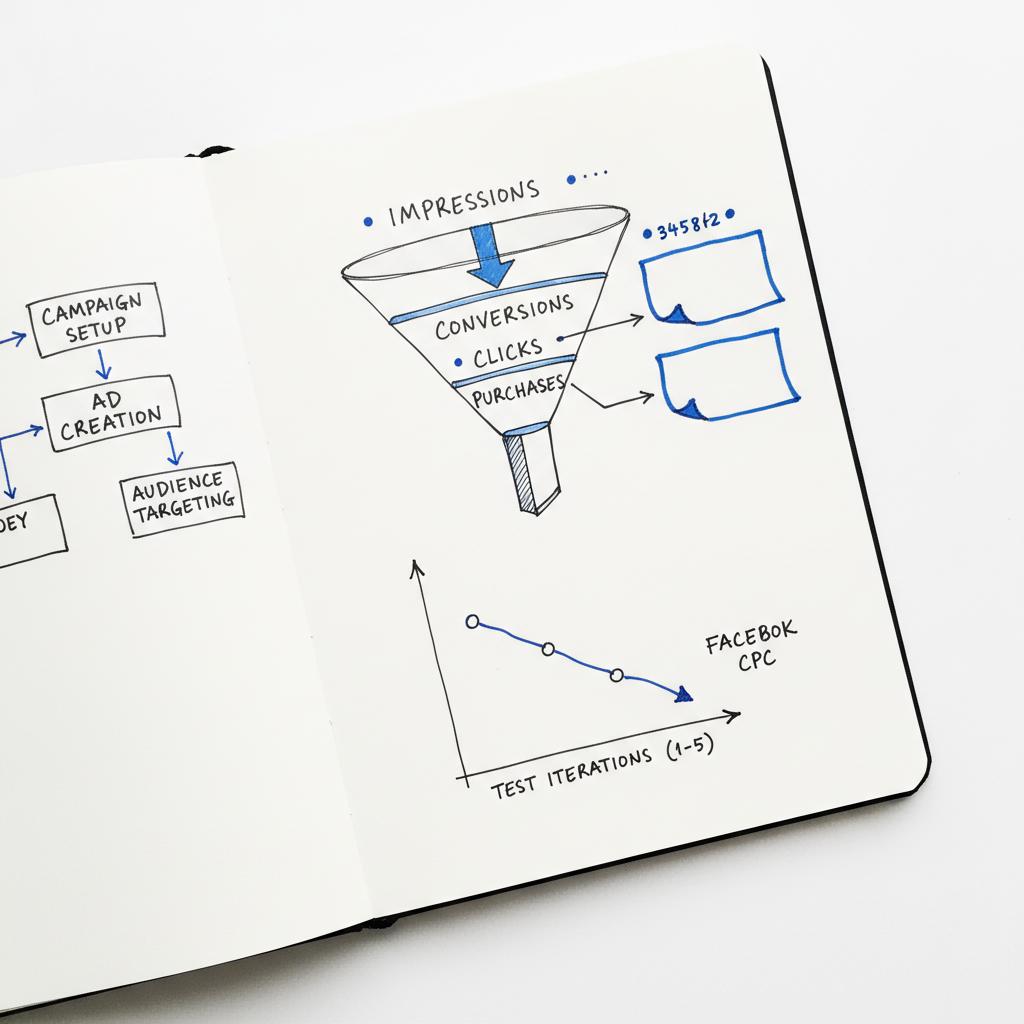
One cost-per-click number does not tell the whole story. CPC is a signal in a chain that leads to business outcomes — clicks feed landing pages, which feed forms and purchases. Your goal is to turn clicks into valuable outcomes, not simply to lower the price per click. Still, knowing the likely cost of 1,000 clicks gives you a quick way to test assumptions and plan experiments.
If you want help turning your account data into a decision-ready plan, consider a quick consult — talk with Agency VISIBLE and get practical options for running small, fast experiments that reduce wasted spend and focus on the clicks that convert.
Improving creative relevance (headline, image and opening line) is often the single most reliable change. A higher CTR signals relevance to Meta’s auction, which commonly lowers CPC for that creative. Combine creative improvements with landing-page relevance to protect downstream conversion rates.
Benchmarks you can use right now
Recent cross-industry benchmarks (late 2024 through early 2025) put Facebook CPC in a broad band – roughly $0.50 to $1.50 per click on average – with composite averages often near $0.70-$0.80. But averages hide real variation. Finance, legal and many B2B lead-gen verticals commonly see higher CPCs; e-commerce, retail and entertainment tend toward the lower end. Campaign objective, audience size and creative relevance also push CPC one way or the other. For a few public benchmark sources see WordStream’s 2025 benchmarks, Superads CPC data and Madgicx’s benchmarking guide.
How to read those ranges
Take the ranges as scenario inputs rather than gospel truth. Use your account’s recent performance when you can; when you don’t have account history, pick a conservative number in the benchmark band (e.g., $1.00) and build a base, optimistic and conservative budget around that number.
What drives Facebook CPC (and therefore the cost of 1,000 clicks)
There are a handful of consistent drivers that change CPC: auction competition, expected value of a conversion, audience size and granularity, creative relevance and quality, placement, device, bidding strategy and seasonal demand. Let’s unpack each one with practical notes you can act on immediately.
Auction competition and expected value
If many advertisers are bidding for the same audience, the auction price rises. If a single conversion can be worth hundreds or thousands to an advertiser, they’ll rationally bid more per click to find those users. That’s why personal-injury lawyers and financial advisors often pay far more per click than a mid-price footwear brand.
Audience size and granularity
Narrow, highly targeted audiences — for example, small lookalikes built from high-value customers — can increase competition and lift CPC. Broader audiences usually lower CPC but with a trade-off: relevance can fall. Try running parallel campaigns with a 1% lookalike and a 10% lookalike and compare CPC, CTR and conversion rate. The right balance depends on whether you prioritize cheap clicks or high-quality clicks.
Creative relevance and ad quality signals
Facebook rewards ads that produce engagement. Higher click-through rates (CTR) tell the platform your ad is relevant to the shown audience, which tends to lower the price you pay to get the same impressions. Small creative changes — a new headline, a tighter visual, or a clearer opening line — can materially change CTR and drop CPC. This is one of the cheapest levers to pull.
Placement and device effects
Different placements have different pricing: feed placements often cost more than some Audience Network or in-stream placements. Mobile vs. desktop can also change performance depending on how people interact with your site. If your goal is cheap volume, experiment with lower-cost placements but always track post-click behavior; cheap clicks that bounce aren’t helpful.
Bidding strategy and campaign objective
Manual bidding without sufficient data can be inefficient. Automated bidding aligned with your objective often stabilizes CPC and can reduce cost per acquisition once the system has enough conversions to learn from. Still, automated bidding requires clean conversion signals and sufficient volume.
Seasonality and platform changes
Holidays, large events and political cycles change demand and therefore CPCs. Platform updates and privacy shifts (like after-effects of iOS ATT) will also shift targeting fidelity and can impact CPC in some funnels. Refresh your benchmarks quarterly and more often around major retail events.
Concrete examples: how the math plays out
Examples make budgeting clear. Below are several scenarios showing how CPC choices map to spend, conversions and revenue.
Example 1 – small e-commerce seller
Average CPC = $0.60 → 1,000 clicks cost $600. If landing page conversion rate = 2% then 1,000 clicks → 20 purchases. If the average order value (AOV) = $40, gross revenue = $800. Subtract cost and fees to check profitability. That quick example shows how a modest change in CPC or CVR (conversion rate) changes the outcome drastically.
Example 2 – local services or law firm
Average CPC = $2.00 → 1,000 clicks cost $2,000. With a conversion rate of 0.5% you still get five leads; if lifetime client value is high, the spend is reasonable. For high-LTV verticals, higher CPCs are often acceptable and expected.
Example 3 – testing creative and placement
A retailer reduces CPC from $0.85 to $0.60 over six weeks through headline testing and placement shifts. For 1,000 clicks, that saves $250. If landing page adjustments also double conversion rate from 1.2% to 2.4%, your acquisition cost drops substantially.
Practical playbook: a step-by-step plan to buy 1,000 clicks wisely
Buying clicks without a plan is like pouring fuel into a car without checking the route. Here’s a practical step-by-step approach you can implement in a week.
Step 1 – baseline and scenario planning
Pull recent account CPC, CTR and conversion rates. If you have no account, pick a conservative CPC from the benchmark band (e.g., $1.00). Build three scenario budgets: conservative (higher CPC, lower conversion), base (realistic CPC and conversion) and optimistic (lower CPC, higher conversion). For each scenario, calculate cost for 1,000 clicks, expected conversions and expected revenue.
Step 2 – design a 1,000-click experiment
Rather than spending all budget on one creative, split the 1,000-click plan across 2–3 variations. That means you can compare CTR, CPC and conversion without overspending. For example, run three ads with 333 allocated clicks each and compare results.
Step 3 – run creative and audience tests
Test headline variations, primary images and opening sentences. At the same time, test a narrow lookalike vs. a broader audience. Keep naming conventions consistent so you can quickly compare performance later.
Step 4 – track downstream metrics, not just CPC
Monitor landing-page engagement, time on page, bounce rate and conversion rate. Cheap clicks with low session times are usually low quality. If a cheaper placement drives clicks but those clicks never engage, pause it and reallocate budget.
Step 5 – iterate and scale
Pause poor performers, scale winners slowly and continue to test one variable at a time. If the winner sustains lower CPC and better conversions, you can scale aggressively because the signal is validated.
How to lower the cost of 1,000 clicks – 12 tested tactics
Here are reliable tactics you can implement right away, each with a short note on how to measure success.
1) Creative A/B tests: Change one element at a time. Measure CTR and CPC across at least a few hundred impressions before deciding.
2) Tighten or broaden audiences strategically: Test 1% vs 10% lookalikes and compare conversion quality, not just CPC.
3) Optimize landing-page relevance: Consistent messaging between ad and page raises conversion rates and makes clicks more valuable.
4) Speed up landing pages: Faster pages lower bounce and improve conversion; use Core Web Vitals as a guide.
5) Use automated bidding when you have conversions: It generally stabilizes costs once the system has data.
6) Revisit placements: Test lower-cost placements but monitor post-click metrics closely.
7) Exclude low-value audiences: Tightening exclusions removes clicks that historically don’t convert.
8) Swap creatives based on time of day or season: Different messages can perform better during holiday vs. non-holiday windows.
9) Map value to conversion events: Use higher-value events (signups with intent, purchases) as your bidder signals when appropriate.
10) Use incremental tests: Reserve extra budget to follow up on early winners and refine them.
11) Use local currency experiments for global buys: Pricing can differ by market — test locally.
12) Keep a clean attribution window: If your attribution window is too long it can distort the signaling for automated bidding.
Common mistakes that make 1,000 clicks cost more – and how to avoid them
Some errors repeatedly inflate CPC or waste clicks. Recognize and correct these to improve ROI.
Mistake 1 – chasing the cheapest clicks: Cheap clicks that don’t convert cost you in downstream work. Evaluate acquisition cost, not only CPC.
Mistake 2 – changing too many variables at once: If you swap creative, audience and landing page at once you can’t learn. Isolate variables to understand cause and effect.
Mistake 3 – ignoring post-click metrics: CPC may fall while conversion rate plummets. Track both.
Mistake 4 – not refreshing benchmarks: Auction dynamics change. Check benchmarks quarterly and more often around busy seasons.
How to size your test budget for reliability
Testing requires patience. If you plan to buy 1,000 clicks, set aside an extra 25–50% budget to allow for learning and follow-up tests. Early phases often show higher variance; reserve enough to run iterative changes and validate winners before scaling.
Monitoring and reporting checklist for a 1,000-click buy
Use this checklist when you launch a 1,000-click experiment so you don’t miss signals.
– Baseline CPC, CTR, conversion rate and AOV before the test
– Daily CPC and CTR monitoring for rapid failures
– Post-click engagement (session length, pages/session, bounce rate)
– Conversion rate and cost per acquisition (CPA)
– Quality of leads (lead score, follow-up conversion)
– Lifetime value estimates and revenue attribution
Scaling wins: when a lower CPC also means better business outcomes
Not every drop in CPC should be scaled. You want to scale when CPC falls while conversion rate and lead quality hold or improve. If a placement or creative lowers CPC but the conversions are poor, don’t scale. The right signal to scale is a consistent improvement in end-to-end metrics: lower CPA, higher conversion rate or higher revenue per click.
Real-world mini case studies (what worked, what didn’t)
Case study summaries are useful because they show trade-offs in context.
Retailer: Creative refresh + placement testing cut CPC from $0.85 to $0.60 in six weeks. Landing-page improvements doubled CVR (1.2% → 2.4%). Net result: acquisition cost halved.
Services firm: Narrowed lookalike seed and tightened exclusions. CPC rose slightly but lead quality tripled and closing rate improved. Sometimes paying more per click is the most efficient path to revenue.
New product launch: Used a broader audience and cheaper placements to buy 1,000 awareness clicks. The clicks were cheap, and engagement was low, but the campaign collected valuable early signals about creative direction.
Metrics to prioritize depending on your goal
If your goal is:
Awareness: prioritize reach, CPM and total link clicks — cheap clicks can be fine here.
Traffic: focus on CPC, CTR and landing-page engagement.
Leads / Sales: center attention on CPA, conversion rate, lead quality and revenue per click.
Myth-busting: three common misconceptions
Myth 1: “Spending more always raises CPC.” Not necessarily – it’s competition for the same audience and placements that raises CPC, not raw spend. If you broaden audiences or add low-competition placements, CPC can stay stable or decrease.
Myth 2: “More precise targeting always reduces cost.” Overly narrow audiences can increase CPC and limit scale. Precision helps quality but can raise per-click price.
Myth 3: “A single benchmark is enough.” Don’t fixate on one number. Use ranges and scenario planning instead.
Budget templates: quick numbers to copy
Here are three simple templates for a planned 1,000-click buy. Swap in your own CPC and conversion numbers.
Conservative: Estimated CPC $1.20 → Cost for 1,000 clicks = $1,200. Expected CVR 0.8% → 8 conversions.
Base: Estimated CPC $0.80 → Cost for 1,000 clicks = $800. Expected CVR 1.5% → 15 conversions.
Optimistic: Estimated CPC $0.50 → Cost for 1,000 clicks = $500. Expected CVR 2.5% → 25 conversions.
How often should you refresh CPC benchmarks?
Quarterly refreshes are reasonable; monthly checks make sense for retail or other rapidly changing verticals. Check benchmarks more often around big retail events or policy updates.
When to ask for outside help
Ask for a second pair of eyes if you have limited account data, if conversions are unpredictable, or if you want to design statistically sound experiments quickly. A good partner helps you interpret account-level signals against cross-industry patterns and suggests targeted tests that isolate one variable at a time. See examples of our work on the projects page and our thinking on the perspectives page.
One last practical checklist before you press go
– Confirm your baseline CPC and CVR.
– Decide whether you want cheap volume or high-quality clicks.
– Split your 1,000-click budget across at least two creatives.
– Set up landing-page analytics to capture engagement and micro-conversions.
– Plan for iterative follow-up — don’t spend everything at once.
Final thoughts: make the cost predictable
The most reliable way to make the price of 1,000 Facebook clicks predictable is to treat each component — creative, audience, placement, bidding, landing page — as a testable lever. Small, methodical experiments and a clear reporting cadence turn auction noise into a predictable line item in your plan. Remember: the cheapest click is not always the best click. Measure the whole funnel and prioritize outcomes.
Want help designing an experiment or turning your account numbers into a realistic budget?
Plan a smarter 1,000-click test with Agency VISIBLE
Ready to test smarter and spend more efficiently? Contact our team for a short planning session and a clear plan for your 1,000-click experiment: Start a quick consult with Agency VISIBLE.
Start with your average Facebook cost per click (CPC). Multiply that number by 1,000. For example, a $0.75 CPC means 1,000 clicks will cost roughly $750. Then layer in scenarios (conservative/base/optimistic) using different CPCs and conversion rates to model outcomes across revenue and acquisition cost.
No. Cheap clicks can be useful for awareness or creative testing, but they may produce low-intent traffic that doesn’t convert. Prioritize end-to-end metrics such as conversion rate, cost per acquisition and revenue per click. If cheaper placements lower CPC but damage conversion rates or lead quality, they are not improving ROI.
Agency VISIBLE can design small, controlled experiments that target the right mix of creative, audience and landing-page changes. We help translate account data into scenario budgets, run rapid creative tests, and optimize bids and placements. If you’d like a short planning session, they offer consults to set up tests and reporting that prioritize business outcomes.