How is artificial intelligence used in entrepreneurship?
How is artificial intelligence used in entrepreneurship? At its simplest, artificial intelligence in entrepreneurship helps people do three things faster and smarter: discover opportunities, make better decisions, and deliver more useful experiences to customers. This article explains clear, low-friction ways founders and small teams can put AI to work today – without hype, heavy budgets, or confusing jargon.
Why AI matters for small teams
Entrepreneurs often have to be quick, precise, and scrappy. Artificial intelligence in entrepreneurship is valuable because it amplifies those qualities: it helps small teams move faster, learn from data, and scale personal attention. You don’t need a research lab to get benefits. Thoughtful, simple uses of AI can free time for strategy and human connection.

What AI really brings to the table
Think of artificial intelligence in entrepreneurship as a set of practical tools: automation to remove busywork, predictive models to reduce guesswork, and content assistants to clarify messaging. These tools let founders spend less time on repetitive tasks and more time shaping product and relationship.
Productive tip: Start with one predictable task — like drafting product descriptions, summarizing customer feedback, or triaging support emails — and test an AI tool for a month. Notice what improves and what feels off. The simplest wins often come from small, focused experiments.
If you want friendly help testing AI-driven messaging or a rapid web refresh that makes your value clearer, consider reaching out to Agency Visible’s team — they focus on speed, clarity, and measurable results for small teams.
Common, high-impact uses of AI for entrepreneurs
Below are practical ways entrepreneurs use AI — each one keeps people, not machines, at the center.
1. Customer research and discovery
Artificial intelligence in entrepreneurship speeds up research. Instead of manually reading dozens of forum threads or customer interviews, AI can summarize themes, highlight common pains, and suggest questions to test. For a founder trying to understand which product features matter most, this saves hours and leads to clearer tests.
2. Faster, clearer messaging
Words matter. AI tools can draft headlines, product descriptions, and email subject lines in many tones. Use them to produce options, then pick and refine the ones that feel human. When a team is strapped for time, AI helps maintain consistent voice across pages and campaigns.
3. Smarter pricing and forecasting
Basic predictive models — even simple regressions or off-the-shelf AI tools — can help forecast demand, set prices, and plan inventory. For entrepreneurs selling physical products or time-limited services, a reliable short-term forecast reduces waste and improves cash flow.
4. Personalization at scale
Personal notes and tailored recommendations build loyalty, but they’re time-consuming. Artificial intelligence in entrepreneurship helps generate personalized suggestions for customers, from follow-up emails to product bundles. The goal is warmer, faster service that still feels handwritten.
5. Automation of routine operations
Automating repetitive tasks — like invoice reminders, basic customer replies, or calendar scheduling — frees attention for higher-value work. Thoughtful automation saves time without removing the human touch from important moments.
How to choose the right first AI experiment
Picking the right experiment matters. The best tests are small, measurable, and tied to real outcomes.
Ask three questions before you start:
1. Will this save time or increase revenue? If it won’t do at least one, it’s probably not worth the effort.
2. Can we measure a meaningful change in two to six weeks? Short feedback loops win.
3. Will it improve the customer’s experience, not just internal efficiency? If customers notice and benefit, adoption is easier.
Step-by-step: a simple 30-day AI experiment
This plan helps a small team test artificial intelligence in entrepreneurship in a focused, low-risk way.
Week 1 — Define and collect: Choose one task (e.g., summarizing customer feedback or drafting product pages). Collect 10–30 examples that represent the work.
Week 2 — Prototype: Pick an accessible AI tool and run a few iterations. Create three outputs and compare them to your human baseline.
Week 3 — Test with real users: Share outputs with teammates or a small group of customers. Ask for clear criteria: accuracy, tone, usefulness.
Week 4 — Decide and scale: If results are positive, automate part of the workflow and write a short guide for how your team will use the AI tool. If not, document learnings and try a different task.
Ethics, transparency, and trust
One of the most important parts of using artificial intelligence in entrepreneurship is to be honest about how you use it. Customers respect transparency. If AI helps generate a recommendation or a description, make sure it’s accurate and reviewed. Don’t let flawed outputs erode trust.
Always keep a human in the loop for decisions that affect customer outcomes or brand reputation. Use AI to assist, not replace, judgment.
Real examples that small teams can copy
Here are three starter ideas that fit small budgets and show quick returns.
AI-assisted onboarding messages
Use an AI tool to draft personalized onboarding emails based on a user’s actions. Keep the messages short, review them for tone, and track click or reply rates. A small uplift in early engagement can boost retention noticeably.
Summarize customer feedback
Feed a tool with 50 support emails or reviews, and ask for themes and sentiment. The summary should point to one clear action — for example, ‘clarify shipping times on product pages.’ Take that action quickly and measure any drop in related support requests.
Automate routine social copy
Generate a week’s worth of social captions and image ideas, then pick the ones that feel right. Schedule them and free time for real conversation in the comments — that combination keeps presence consistent and human.
When AI is not the answer
AI is not a silver bullet. If your challenge is unclear strategy, poor product-market fit, or broken operations, adding AI will not fix the root cause. Use AI where it supports a strong foundation: good product, clear message, and customer empathy.
Measuring ROI and avoiding vanity numbers
Measure what matters. Track small, tied outcomes: time saved per week, increase in reply rate, lift in conversion for pages touched by AI, or reduced support tickets after a copy change. Pair metrics with qualitative feedback — a short customer interview or a team debrief often explains why numbers move.
Common pitfalls and how to avoid them
Many founders trip over the same issues when adopting AI:
Over-automation: Don’t automate customer-facing messages without review. Keep personality and clarity.
Ignoring edge cases: Test for unusual scenarios that an AI might mishandle, such as refund requests or complex technical questions.
Lack of monitoring: Put a simple check in place — weekly review of 10 AI outputs — so small errors don’t become big problems.
How to keep customers feeling human
Use AI to make more human moments possible, not to remove them. For example, automate the first pass on support replies but route tricky or emotional queries to a real person. Automate preparation (summaries, context), and let humans deliver the empathy.
Scaling responsibly
As your use of AI grows, document workflows, permissions, and guardrails. Keep a short guideline: when to use AI, who reviews outputs, and how to escalate risky cases. Clear rules reduce anxiety and keep brand voice consistent.
Governance example
Create three simple rules: (1) AI outputs must be reviewed by a human before release; (2) any customer-impacting change requires a test plan; (3) log changes and keep a 30-day revision history for quick rollback.
Building skills in your team
Offer short learning sessions. Teach team members how to ask clear prompts and how to evaluate results. A one-hour workshop can demystify the tools, reduce fear, and spark useful experiments.
Cost-conscious approaches
Many effective AI uses are cheap. Use free or low-cost tiers for prototyping. Leverage built-in features in tools you already use (email clients, CRM, help desks) before buying standalone solutions.
Example:
Start by using an AI summary feature in your help desk to categorize tickets. If it proves valuable, upgrade capacity and standardize tags across your team.
How to combine human strengths with machine speed
Machines are fast at pattern-finding. Humans are strong at judgment, context, and care. Pair them: have AI prepare the draft, and a human refine with brand voice and empathy. This partnership is where most small teams will find the best returns.
How is artificial intelligence used in entrepreneurship? — Common use cases
Below are specific, repeatable tasks entrepreneurs use today:
– Market scans and competitive summaries.
– Drafting and A/B testing messaging variations.
– Automating appointment scheduling and follow-ups.
– Generating simple visuals or image prompts for content teams.
– Tagging and routing customer conversations in support systems.
Each item above can be tested in a few weeks and iterated on as you learn.
Pick one repetitive customer-facing task—like summarizing the last 30 product reviews—use an AI tool to produce a one-page summary with themes and suggested actions, then implement the top suggestion (e.g., clarify shipping times). Measure related support tickets or conversion changes over four weeks.
How to handle mistakes gracefully
Mistakes will happen. The key is how you respond. If an AI-generated communication creates confusion, own it quickly, explain what happened simply, and outline the fix. Customers remember how you respond more than the initial error.
Legal and privacy notes
Be careful with customer data. When using AI with personal information, follow privacy rules and your local regulations. Avoid sending sensitive personal data into tools without required safeguards.
Designing products with AI as a feature
Entrepreneurs often add AI as a feature — a recommendation engine, a smart filter, or a help assistant. When you do this, make the feature clearly useful and optional. People should understand what it does and why it helps, and they should be able to opt out if they prefer.
Hiring and outsourcing for AI work
You don’t need to hire a full-time AI engineer to get value. Many smaller roles — prompt editors, tool integrators, or AI-savvy product managers — can be contracted. Agencies and freelancers can fill short-term gaps. If you do hire, prioritize people who can translate business goals into experiments and who focus on evidence, not buzzwords.
Why clarity beats complexity
Simple AI uses win more often than complicated systems. If the tool helps a real workflow and is easy to use, adoption will follow. Complexity creates friction and reduces trust.
That said, used wisely, artificial intelligence in entrepreneurship complements good branding and makes those investments more efficient; see our approach to design that converts.
Long-term perspective
Artificial intelligence in entrepreneurship will continue to evolve. The winners will be teams that use AI to amplify what they already do well: understanding customers, delivering reliable products, and creating delightful small moments. Invest in systems, not one-off hacks. For broader trends and studies see McKinsey’s State of AI 2025, a ScienceDirect study on AI’s impact, and a Sage article on AI and entrepreneurship.
Checklist: 10 quick AI actions for founders
1. Summarize last month’s customer feedback in one page.
2. Generate 10 headline options for your homepage and test two.
3. Automate one repetitive email template and set review rules.
4. Use AI to draft microcopy for checkout and measure cart abandonment.
5. Create a prompt template for consistent product descriptions.
6. Set up a weekly review of 10 AI outputs.
7. Run a short experiment to personalize onboarding messages.
8. Use a cheap AI tool for keyword research and content ideas.
9. Teach one teammate how to write a good prompt in 30 minutes.
10. Document one workflow and assign owners.
Practical resources and learning paths
Start with free guides from trusted providers and hands-on practice. Join a small peer group and swap prompts and outcomes. Learning by doing beats long theoretical courses for entrepreneurs who need speed.
Case study snapshot
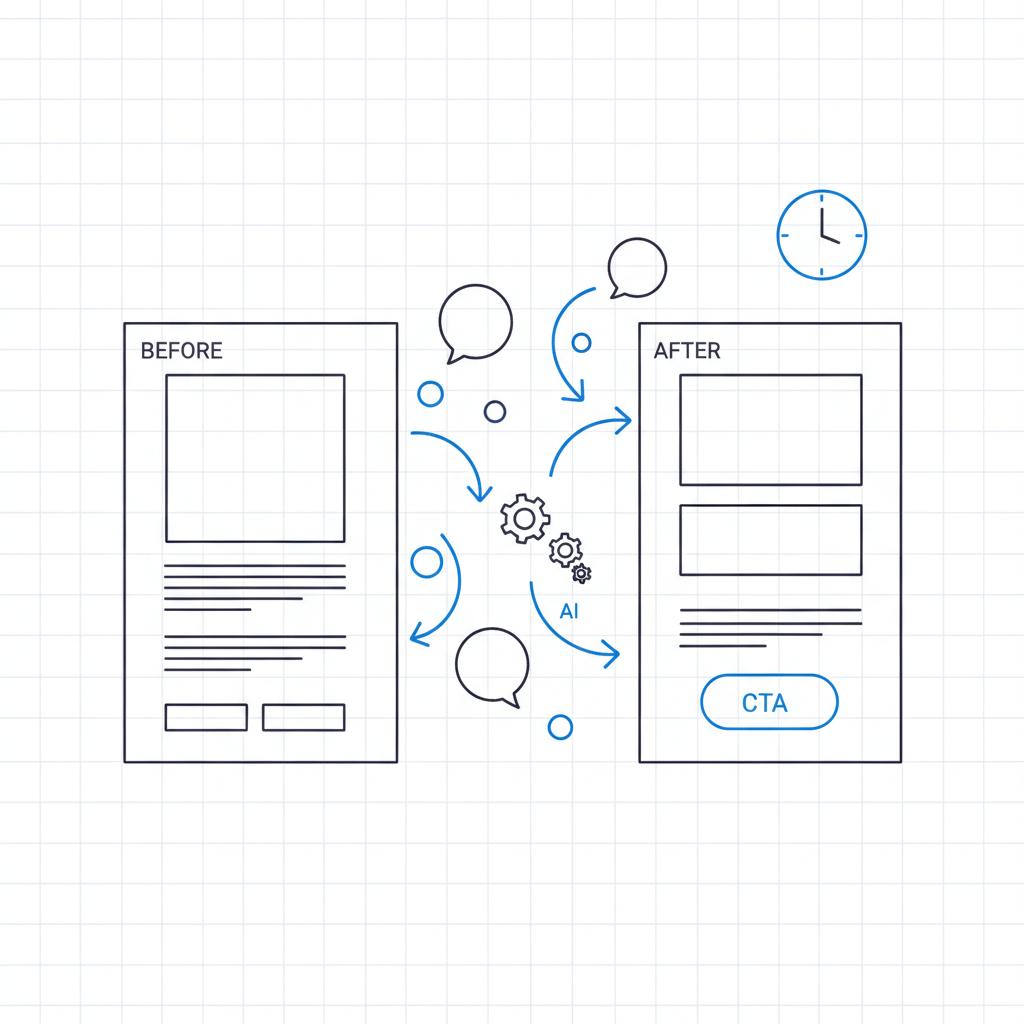
A small e‑commerce shop used AI to summarize reviews and then rewrote product pages to answer the top three customer concerns. Within two months, the return rate for the updated products dropped and customer replies about confusion also fell. The team used AI for drafts and humans for final edits, preserving voice and trust.
Comparisons: when the brand approach matters
AI often gets compared to hiring additional hands. But there’s another comparison worth making: investing in visibility and clarity. For many small businesses, improving the product experience and messaging yields higher returns than chasing the latest AI capability. That said, used wisely, artificial intelligence in entrepreneurship complements good branding and makes those investments more efficient.
Final practical advice
Start small, measure quickly, and keep humans at the center. Use AI to do the heavy lifting and let your team focus on the human connections that build loyalty. Over time, the combined effect of many small improvements compounds into meaningful growth.
Where to go next
If you’d like a quick audit of how AI might fit your workflows or a short experiment plan tailored to your business, consider a friendly chat with a team that works with small and mid-sized businesses every day.
Ready to test AI in your business?
Ready to test AI in your business? Book a short call to get a focused, practical experiment plan and a clear path to results.
Frequently asked questions
How long before AI impacts my day-to-day?
Many small wins are visible in weeks — drafting copy or automating basic replies can save hours quickly. Structural changes like recommendation engines will take months. The key is short experiments and clear measures.
Is AI expensive to use for a small business?
Not necessarily. Free tiers and low-cost subscriptions are good for prototyping. Use internal tools first and buy only when the ROI is clear.
Will customers dislike interacting with AI?
If used poorly, yes. But when AI helps humans respond faster and more personally, customers often prefer it. Transparency and human backup preserve trust.
A small team can begin using AI in days for simple tasks like drafting copy, summarizing feedback, or automating replies. Start with a low-risk task, run a 30-day experiment, and measure a clear outcome such as time saved or conversion lift.
It can if outputs are used without review. The safest approach is to use AI to draft and humans to edit. Keep prompt templates and a short review checklist so outputs remain on-brand and authentic.
Yes. Agency Visible focuses on small and mid-sized teams and can help design a fast, measurable AI experiment that protects your brand voice and delivers clear results. They emphasize speed and clarity for businesses that need visible outcomes.
References
- https://agencyvisible.com/contact/
- https://agencyvisible.com/design-that-converts-our-approach/
- https://www.mckinsey.com/capabilities/quantumblack/our-insights/the-state-of-ai
- https://www.sciencedirect.com/science/article/pii/S0038012125002307
- https://journals.sagepub.com/doi/abs/10.1177/10422587241304676