How to get local attention: a hands-on plan for lawn care marketing
If you run a small crew or a one-person lawn company, the quickest path to steady work is clear: focus on local visibility. This guide shows exactly how to get noticed by neighbors who need mowing, edging, fertilization, or seasonal cleanups—without wasting money or pretending to be a big brand. Throughout, you’ll find concrete steps for lawn care marketing, measurement tactics to know what’s working, and scripts you can use the same day.
Start with the basics and move in small, measurable steps. The aim is to turn attention into calls, and calls into repeat customers.

Why local visibility beats broad advertising every time
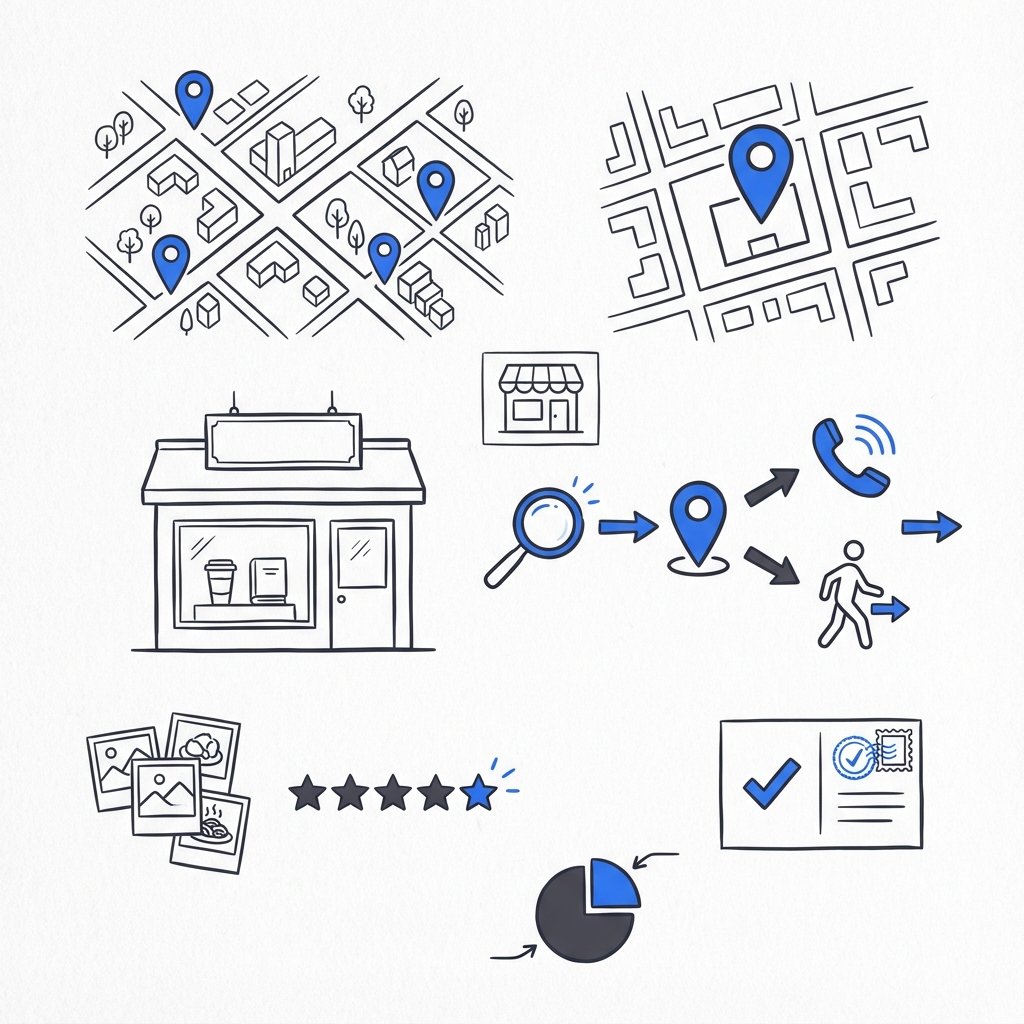
When a homeowner searches for services, they usually type local queries: “lawn care near me,” “lawn mowing [town name],” or “fertilization near me.” Businesses that appear in the map pack and have an active Google Business Profile get most of those calls. Good lawn care marketing focuses on the handful of places people actually look first—your GBP, your truck, local ads, and neighborhood touchpoints.
1. Treat your Google Business Profile like a storefront
Your Google Business Profile is the first impression for many local customers. If your profile is incomplete or inconsistent, you lose clicks and calls. Make sure your business name, address, phone, and hours match exactly across your website and any listings. Add clear service lines: mowing, edging, fertilization, seasonal cleanups, and note the towns you serve.
Complete contact info, service list that mentions towns, a flattering truck photo, a recent job photo (before/after works wonders), and a friendly portrait of you or the crew. Use the most specific category that fits and add helpful attributes like “on-site services.”
Post short weekly updates when you can: a seasonal tip, a small before/after slider, or a limited-time discount for new customers. These small, consistent actions help your visibility and build trust.
2. Reviews are social proof—have a simple review process
Reviews move hesitant owners to pick up the phone. Make asking for a review part of your close-out routine. A short face-to-face line, a follow-up text with a one-click link, or a receipt-style email asking for a Google review is all it takes. Keep the wording conversational: “If you’re happy, could you leave a quick Google review? It helps my small business.”
Make it effortless: hand a small card with a QR code, or send a one-click link. Never offer money for reviews. Instead, provide excellent service and make the ask easy. Reply to every review—thank the positive ones and address problems calmly. A good reply to a negative review can win more future customers than the review itself.
3. Paid ads: speed when you need it
Paid search and Local Services Ads (LSAs) are the fastest way to increase calls. LSAs often sit above organic results for home services and are billed per lead in many markets—useful for urgent volume. Meta ads (Facebook/Instagram) can bring local attention when paired with a clear, local offer and a short funnel. For more strategic ad ideas see this guide to 12 Landscaping Marketing Strategies.
Start small: test ads for four to six weeks, measure leads, and track source. Use tracking numbers and promo codes so you can see which channels pay. In many U.S. markets, lawn and garden leads are often in the lower double digits per lead, but competition and seasonality shift that number.
For operators who want help setting up ads and tracking without a noisy sales pitch, consider a practical partner like Agency VISIBLE—they focus on quick, measurable visibility for small service businesses and can set up Local Services Ads, help optimize your GBP, and install simple tracking.
4. Offline tactics that work (when they’re measurable)
Door-hangers, flyers, and direct mail still produce results when done right. Expect response rates of roughly 1-3% for well-targeted direct mail—good if you measure it. Use a unique promo code, a dedicated phone number, or a short text-code to track responses. A practical overview of offline tactics is available at RealGreen’s offline marketing guide.
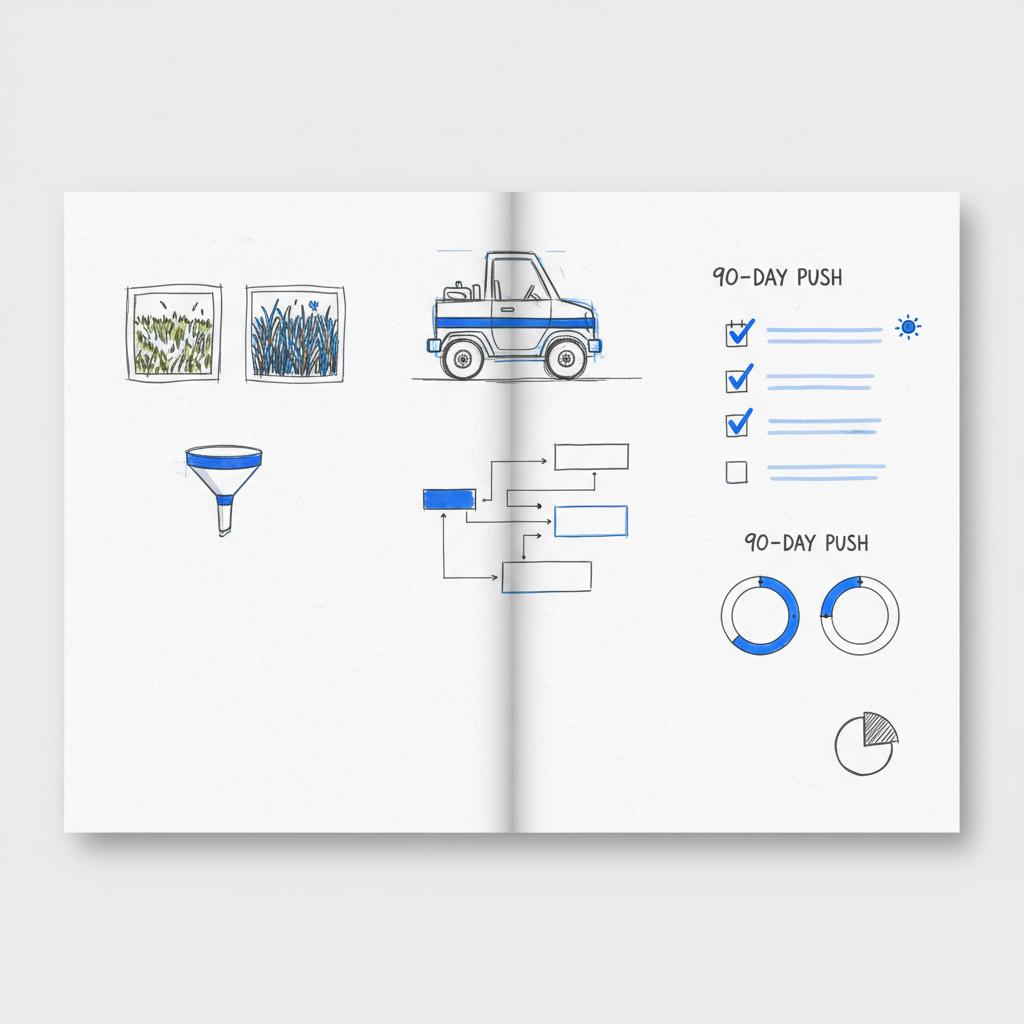
Vehicle signage is a passive, long-lasting ad: a clean truck wrap or magnetic signs with a large phone number and one line about what you do will generate steady branding value. Keep the design readable from the curb. A clear logo on your materials helps people remember you.
5. Seasonal pacing: use a 90-day push to build momentum
Lawn care is a seasonal business in most climates. A focused 90-day campaign—timed around your busiest season—drives bookings and gives you meaningful data. Here’s the simple structure:
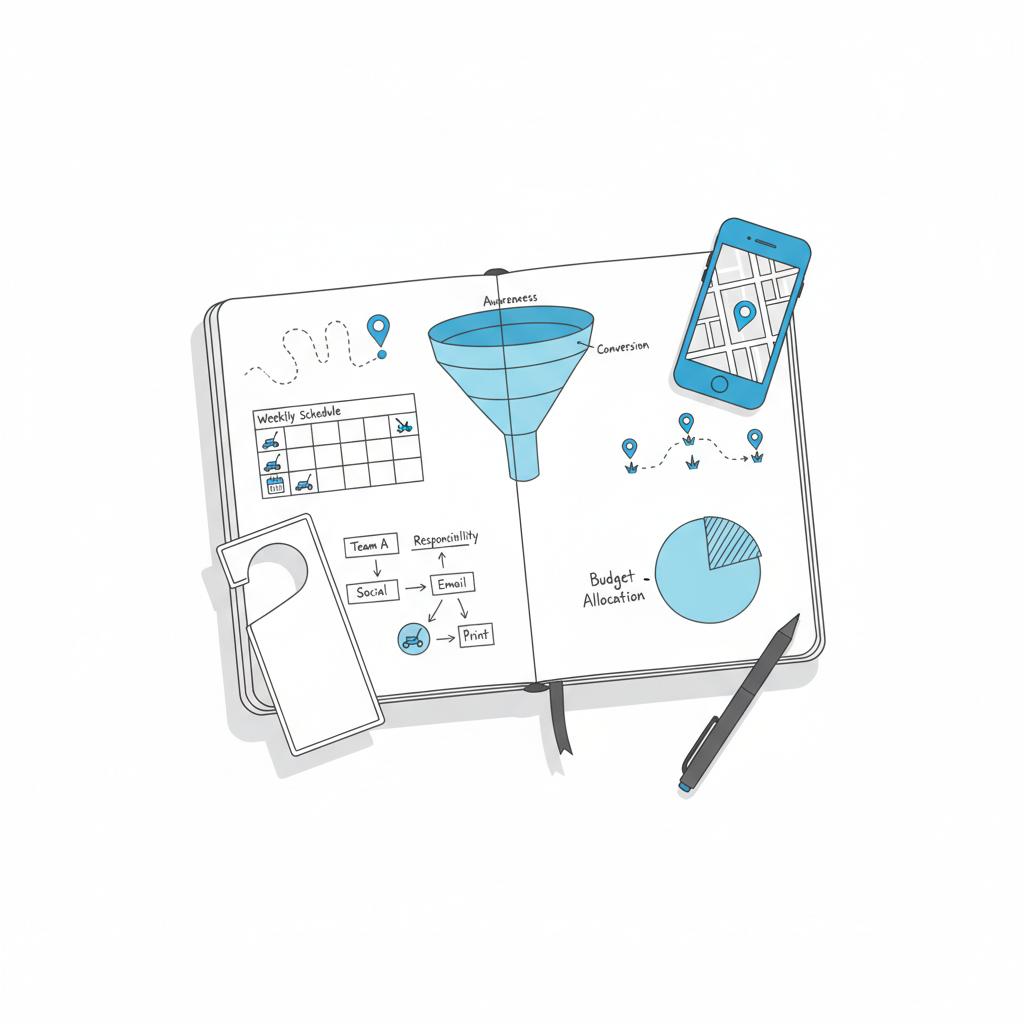
Days 1–30: Cleanup and tracking. Update GBP, confirm service areas, add photos, set up tracking numbers, and prepare a one-click review link.
Days 31–60: Demand testing. Run LSAs/search ads with a modest budget, send door-hangers in a test neighborhood, and post daily social content tied to a seasonal offer.
Days 61–90: Measure and scale. Double down on channels that produced leads, pause what didn’t, and start outreach to realtors and property managers.
How to track leads and measure return
Measurement doesn’t need to be fancy. Track weekly leads, cost per channel, lead-to-booking conversion rate, and average job revenue. A simple return on ad spend (ROAS) formula is:
ROAS = (Revenue from channel – Cost of channel) / Cost of channel
Example: $400 ad spend → 20 leads → 6 customers at $150 each = $900 revenue. Net is $500, divided by $400 = 1.25 → 125% return. Do this for each channel and subtract labor/materials to estimate true profit.
Tracking tips that actually get used
Use a dedicated phone number for ads, unique promo codes for mail pieces, and short forms with a “How did you hear about us?” field. If you can’t get a formal tracking tool, a simple spreadsheet will do. Record ZIP code, service requested, lead source, job value, and whether the customer returned. Over a season, patterns will tell you where to spend.
Referral channels: the low-cost, high-trust pipeline
Referrals and local partnerships produce steady, qualified leads. Realtors, property managers, garden centers, and small landscapers often need reliable subcontractors. Offer a clear referral agreement—one page that explains tracking, payment terms, and follow-up. Keep the relationship professional and pay commissions promptly.
Scripts, messages and quick replies that convert
What you say often matters as much as what you do. Keep language short, friendly, and clear. Example review ask: “Thanks for choosing us today. If you’re happy, could you leave a quick review on Google? It helps a lot.”
Fast follow-up script: “Hi, this is [Name] from [Business]. Thanks for reaching out—can you tell me how big the lawn is and whether you need mowing, edging, or a cleanup? I can give a price by tomorrow.” Quick, human replies raise conversion.
Common mistakes small lawn companies make
• Spreading tiny budgets thin across many channels—test one or two channels properly instead.
• Poor attribution—ask callers how they heard about you and record it.
• Underpricing—know your break-even and charge to allow for labor, materials, and a small marketing margin.
• Ignoring reviews—respond to every review and learn from negative feedback.
Pricing: how to set local prices without guessing
Pricing varies widely by region and lawn size. Instead of copying competitors, calculate your hourly labor cost, add materials, factor travel time, and include margin for profit and marketing. Keep price ranges visible on your GBP where possible—customers often prefer ranges to mystery pricing.
Channel-specific tactics and templates
Google Local Services Ads (LSAs)
LSAs appear above organic listings in many markets and are billed per lead in places where they’re available. They’re a great way to get immediate visibility for lawn care marketing. Tactics: restrict the service area to your zip codes to reduce wasted leads, respond quickly to LSA leads, and keep notes on quality (filtering out jobs outside your scope).
Google Search and Performance Max
Search campaigns work when you match local intent—use keywords that include town names and service lines. Performance Max can simplify management but needs good creative assets and clear conversion tracking. Always test with a small budget first. For examples of agency work and case studies, see Agency VISIBLE projects.
Facebook and Instagram ads
Use local targeting and focus on a single, clear offer—book a spring mow and get 10% off, for example. Visuals should be simple: before/after shots, a branded truck in a neighborhood, or a quick clip of a tidy yard. Use short landing pages or direct messages to capture details fast.
Door-hanger and mail piece template
Keep the offer clear and time-limited. Example piece: “Spring Cleanup Special — $X off your first service. Call [phone] or text MOW to [short code]. Offer expires in 10 days. Promo code: SPRINGX.” Use a dedicated phone or code for each neighborhood to track response.
Sample ad copy you can reuse
Headline: Local Lawn Care That Shows Up—Book This Week. Body: Fast, reliable lawn mowing, edging and cleanup from a local team. Get $10 off your first service when you mention this ad. Call [phone] or visit [short link].
Tools and low-cost tech that make a difference
You don’t need fancy software to start. A second phone number, a simple CRM spreadsheet, and Google Analytics are enough for many small operators. If you want automation, low-cost tools like Google Voice, CallRail, or a basic CRM that tracks source and notes are a good next step.
Collecting the right local data
Track ZIP code, service requested, source channel, job value, and whether the customer returned. Also record time to respond to the lead—the faster your reply, the higher your conversion. Over a season, those fields show which neighborhoods and channels give you the best return.
Case study: a 90-day plan you can copy
Here’s an actionable template to run in one busy season. Week 1: Update GBP, fix phone numbers, add three new photos, and set a one-click review link. Week 2–4: Set up a tracking number, create a small Google search or LSA test with a $10/day budget, and print 300 door-hangers for one neighborhood. Week 5–8: Run the ads and door‑hangers, post daily to social with before/after images and a seasonal offer. Week 9–12: Measure leads, attribute by code/number, double down on the winning channel, and start outreach to 5 realtors or property managers.
How to ask partners for referrals (script + simple agreement)
Script for a local partner: “Hi [Name], I work with local agents/property managers on routine lawn care and seasonal cleanups. If you ever need a reliable partner, I offer quick responses, written estimates, and prompt follow-up. We track referrals with a simple code and pay on the first completed job.”
Keep the referral agreement to one page: how referrals are tracked, payment terms, and contact points. Pay within 30 days to build trust.
What to measure weekly
• Number of leads by channel
• Cost per channel
• Booked jobs and conversion rate
• Average job value
• Return on ad spend (net of materials and major supplies)
Common questions clients ask—and short answers
How much to spend on ads? Start with a budget you can afford to test—commonly a few hundred dollars per month for one operator. Treat the first month as learning and then scale.
How long to see results from GBP changes? You may get more calls within days if your profile was incomplete before, but search visibility stabilizes over weeks as Google trusts your consistency.
Yes. Handing out flyers provides immediate visibility—especially when paired with a unique promo code or short-term offer. It’s low-cost and effective if you track responses with a dedicated phone number or code, and it leverages the trust of people seeing you work in the neighborhood.
When to hire help (and what to expect)
If you don’t want to run ads or track campaigns, hiring a specialist can save time and money. A good partner will set up LSAs, optimize your GBP, install tracking, and hand over clean data so you can judge results. A practical option is the Agency VISIBLE homepage if you want a quick service overview.
Long-term visibility strategies
Over time, invest in predictable signals: regular reviews, consistent GBP updates, neighborhood signage, and an email list for past customers. Offer a simple loyalty program or a seasonal reminder for repeat service. These keep your schedule full between big seasonal pushes.
Local content ideas for your website
Write short pages for each town or neighborhood you serve and include local phrases like city names and common services. Short how-to posts—“Spring lawn prep in [Town]” or “When to aerate in [Region]”—help with local searches and show homeowners you know their area. For more local content ideas see 20 Landscaping Marketing Tactics.
Scripts for the first call
“Hi, thanks for calling [Business]. I’m [Name]. Can you tell me the size of the lawn and which services you want? I can come take a look tomorrow and give a fixed price.” Fast, helpful, and specific gets results.
How to price promotional offers without losing money
Use small, time-limited discounts that encourage bookings but don’t eat your margin. Think $10 off first service, or 10% off if the customer signs up for a seasonal package. Always track which promo code brought the booking so you can measure cost per acquired customer.
Checklist to run a first 30-day local test
• Update GBP and post a new photo
• Set up a tracking number for ads
• Create a one-click review link and a review card for customers
• Print 300 door-hangers with a unique code
• Launch a $10/day search or LSA test for two weeks
• Record leads in a simple spreadsheet and ask every caller how they heard about you
When to expand: reading the data
After your test, look for conversion rate and cost per customer. If your ad spend returns a positive net after materials and labor, scale slowly. Reinvest a percentage of profits into the best-performing channel and repeat the 90-day cycle.
Quick templates you can copy
Review request text: “Hi [Name], thanks for choosing [Business]. If you were happy, a quick Google review would help our small team—here’s the link.”
Door-hanger headline: “Local Lawn Care — Spring Special — Call [phone or code]”
Final tips and mindset for steady growth
Small, consistent changes beat big one-off moves. Keep the data simple, ask for reviews, respond fast, and focus spending where it pays. Over a few seasons, a steady system of GBP care, measured ads, and referral partnerships fills the calendar without frantic marketing.
Get a clear 90‑day visibility plan for your lawn care business
Want a tidy, measurable plan without the guesswork? Reach out for a clear setup and a short 90‑day push that leaves you with clean data and repeatable lead paths: Get in touch with Agency VISIBLE.
Summary checklist to take away
• Optimize your Google Business Profile and ask for reviews daily.
• Use a tracking number and promo codes for every channel.
• Run a small, measurable ad test for 4–6 weeks.
• Use door-hangers and vehicle signage with tracking.
• Build local referral partnerships and pay promptly.
• Repeat a focused 90‑day cycle and scale what works.
These steps are practical, low-cost, and designed for operators who want predictable local leads. They focus on the places customers look first and make measurement easy—so you can make choices based on data, not guesswork.
Ready to start? Take one small step this week: update your Google Business Profile or send a review link to your last happy customer.
Start small—allocate a few hundred dollars a month you can afford to test. Treat the first month as learning: measure leads by channel, track conversion, and then increase spend where you see positive net returns after labor and materials.
You can see more calls in days if your profile was badly incomplete. Search visibility improvements and higher rankings often take several weeks as Google registers consistent signals like reviews, posts and regular updates.
Yes. A practical agency can set up Local Services Ads, install tracking numbers, and hand over clean data so you can decide what to continue. If you want a low-key partner that focuses on measurable visibility for small service businesses, Agency VISIBLE can help—reach them via their contact page.