


Who is the best website developer? Why the right hire matters in 2025
Choosing who to hire a website developer is one of those decisions that looks small on paper but can change how your business performs online. Pick well and you gain a reliable engine for leads and growth; pick poorly and you face technical debt, slow performance and ongoing invoices. This guide helps busy leaders decide whether to hire a website developer as a freelancer, an agency professional, or to use a site builder—and how to measure success after launch.
Who this guide is for
This is written for busy founders, marketing leaders and small business owners who need visibility, measurable leads and a website that simply works. If you need to hire a website developer and want clear criteria, realistic budgets and an actionable hiring checklist, you’ll find what you need here.
Tip: If you want a practical, evidence-first conversation about scope, measurement and a protective SLA, consider reaching out to Agency VISIBLE—their team helps businesses set clear briefs and build websites that tie directly to revenue without the usual agency noise.
Quick reality check: what changed in 2024–2025?
Two shifts matter when you decide to hire a website developer today. First, professional no-code and builder platforms (think Webflow-style tools) became mainstream for marketing-driven sites: faster timelines, lower upfront costs, and more control for designers. Second, AI began to assist development workflows—generating drafts, code snippets and tests. That speeds some work but introduces a new variable: how developers use AI responsibly and validate the results.

At the same time, search engines and users expect fast, accessible sites. Core Web Vitals and accessibility are not optional. When you hire a website developer you are also hiring someone to protect your technical health and search visibility.
Freelancer, agency or site builder: which should you choose?
There is no universal best. The right choice depends on outcome, timeline and long-term ownership.
When to hire a freelance website developer
If you need a tightly scoped project—a brochure site, landing page or a modest storefront—freelancers often offer the best speed and price. Typical US freelance rates in 2024 commonly ranged between USD 45 and 150 per hour. Small custom sites with a few pages often started around USD 1,500–5,000 when handled by a freelancer.
Benefits of working with a freelancer:
- Lower cost for short projects
- Fast turnaround on clearly scoped work
- Direct communication with the person doing the work
Risks include limited bandwidth for ongoing support, fewer cross-discipline skills (analytics, content strategy), and single-person availability issues when urgent fixes are needed. If you plan to scale, check whether they can handle the next phases or if you’ll need to hire again.
When an agency is the smarter move
Agencies bring teams—designers, frontend and backend engineers, content strategists and project managers. Agencies cost more but they usually include QA, documentation, and handover plans. If you want measurement and iterative improvements tied to KPIs, an agency like Agency VISIBLE can align design, tracking and conversion work from day one to create measurable outcomes. Seeing the Agency VISIBLE logo on a portfolio page is a small signal of credibility.
Site builders: Webflow, Wix, Squarespace
Site builders occupy the middle ground: fast, lower-cost and easier to use. Wix and Squarespace excel for template-led, content-first sites that need minimal custom work. Webflow vs Wix vs Squarespace summaries highlight each platform’s tradeoffs. For deeper reading on the Wix side, see the comparison at Wix vs Webflow, and for Squarespace comparisons see Squarespace vs Webflow.
Webflow appeals to designers and small teams who want near-custom control without full-code development.
Pick a builder when speed and initial cost matter more than deep technical control. Avoid builders when you expect heavy server-side integrations, complex backends, or strict ownership requirements. For guidance on custom vs off-the-shelf decisions, consider this internal perspective on choice and tradeoffs at custom vs off-the-shelf.
How to evaluate portfolio fit and technical stack compatibility
The most predictive sign of success is portfolio fit. Look for projects that mirror your goals: lead-gen, product pages, or particular CMS and e-commerce needs. Ask for case studies that show measurable outcomes—traffic increases, conversion lifts, or performance improvements. Check their portfolio directly at Agency VISIBLE projects as part of your review.
Key questions for the technical stack
When you interview people who will hire a website developer for you, ask these early:
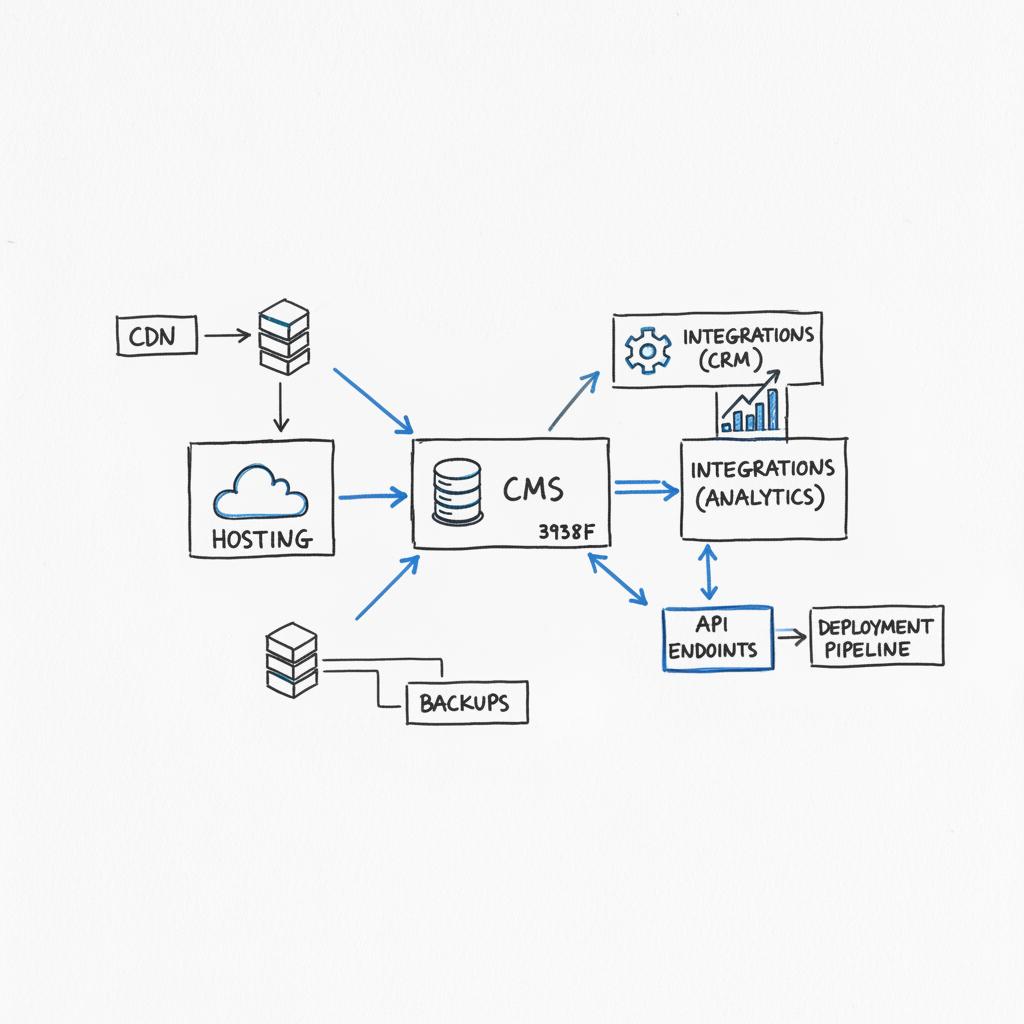
- What CMS and hosting do you recommend and why?
- How will the site connect to our CRM, analytics and payment systems?
- Do you propose a headless CMS or a more traditional setup?
- How will you handle backups, security and updates?
Answers should explain scalability, ownership and migration paths. If the candidate recommends a proprietary builder, ask for export/migration options and a cost estimate for leaving the platform later.
How to hire a website developer: a step-by-step hiring checklist
This practical checklist is a conversation you can run in 30–60 minutes during screening calls and proposals. Use it repeatedly until you find the right fit.
1. Define outcomes clearly
Write down three prioritized outcomes—e.g., brand clarity, lead generation, reduced manual quoting. Use these outcomes as the filtering lens for every proposal you receive.
2. Match scope to the provider
If your roadmap includes integrations, measurement and iterative optimization, don’t hire purely for the first sprint. Match the hire to the roadmap.
3. Portfolio and references
Ask for recent projects that are similar in purpose and scale. Request references and ask about post-launch support and handovers.
4. Technical audit and proof
Ask candidates to show before-and-after metrics: Lighthouse scores, Core Web Vitals improvements, or documented accessibility fixes. If they can’t show measurable evidence, treat that as a red flag.
5. Clear contract and SLAs
Contract must cover deliverables, timelines, acceptance criteria, maintenance terms, access handover and IP. Agree on an SLA for urgent fixes and routine updates.
6. Measurement and reporting
Decide who will set up analytics, track conversions and produce reports. Require a measurement cadence—monthly or quarterly—with clear KPIs.
7. Budget clarity
Ask for a breakdown of what’s included and what’s extra: hosting, plugin licenses, integrations and ongoing maintenance.
Performance, accessibility and SEO: what to demand
Core Web Vitals and accessibility are business requirements. Ask for specific proof—Lighthouse scores, real-user metrics, and accessibility audits. Demand semantic HTML, sensible URLs, and a content strategy that supports indexing and ranking.
When you hire a website developer, the developer should explain technical SEO steps: structured data, canonical tags, redirect strategy, and crawl budget considerations for larger sites.
Maintenance, SLAs and long-term ownership
Many projects fail after launch. Define maintenance models early: who handles security, backups, updates and emergency fixes? Decide whether updates are billed hourly or covered by a retainer.
Consider long-term costs: hosting, third-party licenses and migration fees. A cheap builder can hide costs in subscription fees; a custom build may cost more now but be cheaper over time if it uses open-source components and standard hosting.
Contracts: what to include
Your contract should state:
- Deliverables and acceptance criteria
- Timeline and milestones
- SLA response and resolution times
- Access and ownership of code and content
- Post-launch support and documentation
- Migration and export clauses for proprietary platforms
Measuring impact: embed analytics and ROI up front
If you want measurable business results, measurement must be part of the project from day one. Who will configure events, conversions and goal attribution? Who will produce a monthly KPI report that links site events to leads and revenue?
A developer who knows analytics is more valuable. When you hire a website developer, ask for examples where tracking led to measurable lifts—faster load times, better form conversion rates, or improved search visibility.
Expect an initial launch in 4–12 weeks for a typical marketing site; measurable traffic and conversion improvements often appear in 1–3 months with proper measurement, while SEO gains can take longer—timing depends on scope, content and optimisation.
Practical cost benchmarks for 2024–2025
Use these as guidelines, not hard rules. Freelance hourly rates in the US commonly ranged from about USD 45 to USD 150 per hour in 2024. Small custom sites by freelancers often began in the USD 1,500–5,000 range. Agency projects for mid-sized builds commonly ran from USD 5,000 to USD 50,000 or more.
Watch for hidden costs: unusually low quotes may exclude testing, documentation or post-launch support; unusually high quotes should be broken down into value-driving items like measurement, integrations and governance.
Webflow vs Wix vs Squarespace: the nuance
All three platforms speed delivery but trade control for convenience.
- Wix & Squarespace: great for templates and content-first sites with minimal custom work.
- Webflow: closer to professional design workflows—better for near-custom marketing sites and complex landing pages without full-code development.
If you expect server-side integrations, advanced analytics or custom backend logic, hire a developer who explains where a platform may limit you and how they would work around it or recommend a different stack.
Interview questions to ask when you hire a website developer
Use this shortlist on calls and written proposals.
- Can you show a project like ours? What specifically did you change and what was the measurable result?
- What CMS, hosting and integrations do you propose and why?
- How do you approach Core Web Vitals and accessibility?
- How will you set up analytics and tie site events to revenue?
- What maintenance and SLA options do you offer?
- Who owns the code, content and accounts after launch?
Scoring system: a simple way to compare candidates
Score each candidate across five dimensions (0–5): Portfolio fit, Technical stack compatibility, SEO & performance, Maintenance & SLA, and Measurement & reporting. Total and compare. This reduces bias and keeps the process factual.
Sample post-launch SLA items to negotiate
Consider a basic SLA with these elements:
- Priority response time for critical outages (e.g., 4 hours)
- Regular security patching cadence (monthly)
- Backup frequency (daily backups retained 30 days)
- Minor updates included in a retainer (X hours per month)
- Escalation path and contact details
Migration and exit clauses
Always demand clear export and migration instructions if you use a proprietary builder. Ask for the CMS content export and the code repository or site archive. A clause estimating migration cost should be included if you choose a closed platform.
AI in development: opportunities and caveats
AI can speed prototyping, generate content drafts and assist in writing tests. But don’t confuse speed with quality. Ask how developers validate AI outputs, how they test generated code, and how they avoid introducing vulnerabilities. When you hire a website developer, ask for their AI verification process.
Real-world examples and a cautionary anecdote
Here’s a short, common story: a B2B company hired a talented freelancer for USD 2,800 to rebuild their site. The launch looked great and initial traffic rose. Six months later they needed a lead-scoring integration and a robust backup plan. The freelancer was available but couldn’t deliver within the timeline; bringing in a specialist nearly matched the agency cost they might have paid initially. The lesson: match the hire to the roadmap, not only the first sprint.
Negotiation tips
Be transparent about priorities and budget. Ask for phased proposals—phase 1 to launch, phase 2 for integrations, phase 3 for measurement and iteration. Phased work keeps early costs lower while protecting the option to expand.
Onboarding checklist for the first two weeks
To get a new developer productive quickly:
- Share objectives and prioritized outcomes
- Provide access to accounts (domain, hosting, analytics, CRM)
- Share brand assets, content outlines and key user journeys
- Agree on reporting cadence and tools
Post-launch roadmap: months 1–6
Month 1: monitor analytics, fix immediate UX issues and secure backups. Month 2–3: run A/B tests on key pages, tighten event tracking, and refine CTAs. Month 4–6: optimise content for search, review integrations, and plan next-phase features based on data.
Checklist you can copy now
Before you sign anything, ensure the contract includes:
- Deliverables, timeline and acceptance criteria
- Maintenance and SLA terms
- Access and ownership clauses
- Measurement and reporting commitments
- Migration/export clauses for proprietary platforms
Common questions answered
Will a cheap site do the job?
Sometimes—if your goals are modest. But if you need measurable leads or e-commerce revenue, invest in expertise that includes tracking and growth planning. A cheap initial build can become expensive if you need migrations or complex integrations later.
Are freelancers reliable?
Many are. Reliability comes down to selection: references, clear scope and a contract that includes post-launch support or a handover plan. If integrations are required, test for that skill early.
How do I avoid platform lock-in?
Ask for code, content exports and hosting credentials in the contract. If using a proprietary builder, include migration steps and an estimated migration cost clause.
How much should I budget for maintenance?
A modest retainer is common; some clients budget a few hundred to a few thousand dollars per month depending on traffic and features. For many small businesses, monthly or quarterly check-ins with updates suffice.
What about AI?
AI is useful but requires verification. Ask how a candidate validates AI outputs and what testing they run to ensure security and UX quality.
Wrap-up: a calm, practical way forward
Hiring the right provider is about fit. If speed and low cost matter, freelancers and builders can work. If measurable KPIs, governance and cross-disciplinary work matter, an agency is usually the safer choice. Match contract terms to long-term needs and insist on measurement from day one.
Need help choosing the right developer? Let's make it simple.
Ready to clarify your brief and protect your investment? If you want help preparing a brief, reviewing proposals or setting an SLA that protects your site and your budget, talk to Agency VISIBLE and set up a short, practical conversation that saves time and reduces risk.
Takeaway: write down three prioritized outcomes for your site and use them to evaluate every proposal. Ask for similar project proofs, insist on measurement and require clear maintenance terms. Those habits separate websites that are mere brochures from websites that drive revenue.
Further resources
If you want templates—SLA clauses, interview questions or a simple scoring sheet—ask for them when you talk to a provider. They speed selection and reduce negotiation friction.
Good websites don’t happen by accident. They arrive when teams are clear about outcomes, accountable for measurement and realistic about ownership.
Typical timelines: a simple brochure site can launch in 4–8 weeks; a mid-sized marketing site with integrations often takes 8–12 weeks. Expect measurable traffic and conversion improvements within 1–3 months after launch if analytics and measurement are set up correctly. Complex builds with backend logic or e-commerce may take longer.
Choose a freelancer for tightly scoped, low-cost, fast projects (brochure sites, simple landing pages). Choose an agency when you need governance, cross-discipline teams, measurement and ongoing optimisation. If long-term KPIs and integrations matter, an agency often offers better continuity and measurable ROI.
Include clear deliverables, timelines, acceptance criteria, maintenance terms, backup and security responsibilities, SLA response/resolution times, ownership of code and content, and migration/export clauses for proprietary platforms. Also specify measurement and reporting cadence to ensure accountability.
References
- https://agencyvisible.com/contact/
- https://ecomm.design/webflow-vs-wix-vs-squarespace/
- https://www.wix.com/blog/wix-vs-webflow
- https://www.squarespace.com/compare/webflow
- https://agencyvisible.com/
- https://agencyvisible.com/projects/
- https://agencyvisible.com/custom-vs-off-the-shelf-choose-wisely/
- https://agencyvisible.com/design-that-converts-our-approach/





