


Putting the human at the center
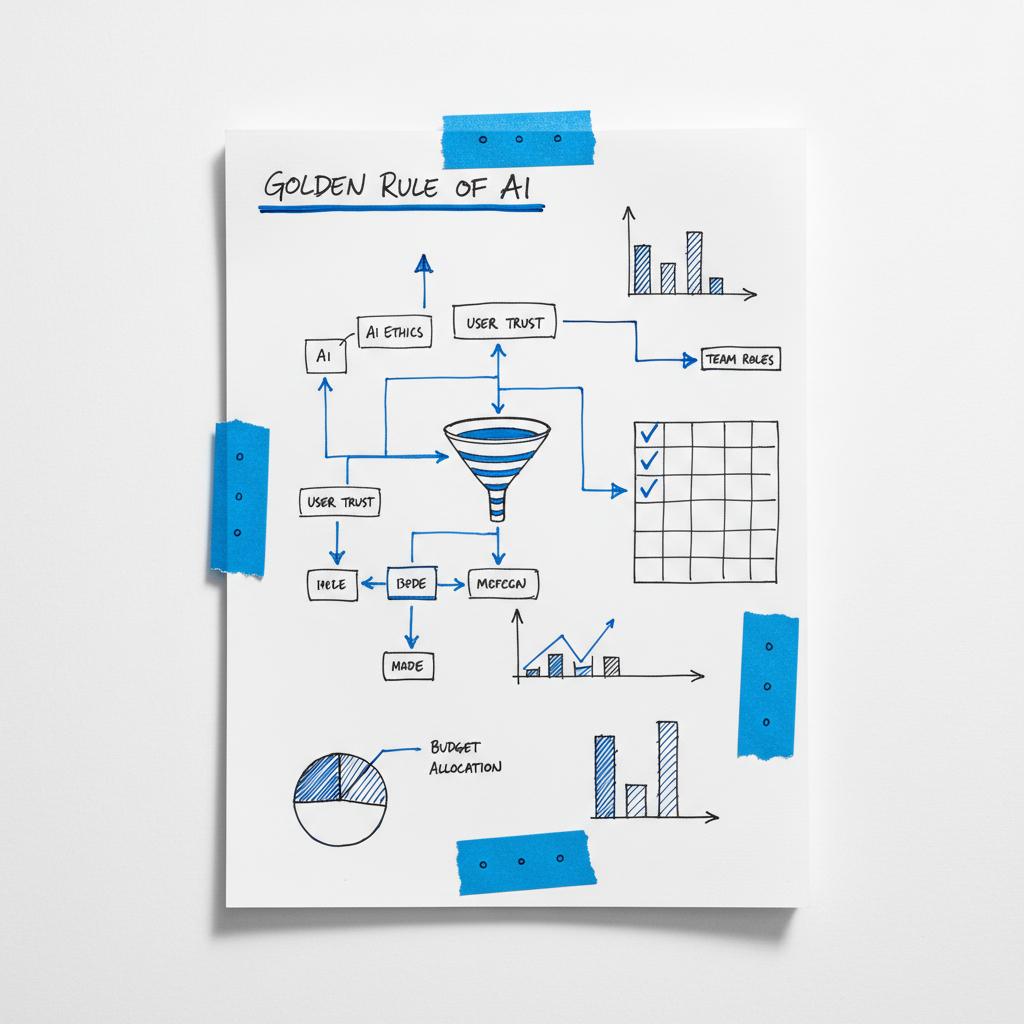
The most useful way to think about the golden rule of AI is simple: design AI to respect, amplify, and protect human needs. When a brand treats AI as a tool that serves people—rather than the other way around—every touchpoint gains clarity. That clarity creates reliability, and reliability is one of the fastest ways to earn trust.
In the paragraphs that follow you’ll find a practical playbook that connects timeless brand work—purpose, consistency, voice, experience—to the decisions you make about AI. This is not a technical manual about model architectures; instead it’s a human-first guide that helps you apply AI with care so your brand becomes easier to trust and harder to forget. See the Human-First Guide to Responsible AI.

Why the golden rule of AI matters for small brands
Large companies can hide poor experience behind scale; smaller brands cannot. For a small or mid-sized business, the way you introduce automation, personalization, or AI-driven features either heightens your brand or erodes it. Follow the golden rule of AI and AI becomes a way to keep promises—faster answers, smarter suggestions, or cleaner processes that actually save customers time.
Consider the bakery from earlier: an automated system that suggests the most-loved loaf for repeat customers can feel like attention rather than intrusion if it’s used to keep a real promise—fresh bread at the right hour, every week. That tiny act deepens loyalty. For practical examples of AI helping small businesses, see How AI Is Helping Small Businesses in 2025.
Core principle: People before process
AI is a multiplier. If the underlying decision is thoughtful and humane, AI multiplies dignity and value. If the underlying decision is careless, AI multiplies friction and confusion. The golden rule of AI asks a simple question before you build: who benefits, and how will they know they were respected?
Answering this makes choices clear. Personalize product suggestions to reduce decision fatigue, not to push unnecessary purchases. Use automation to shorten wait times and resolve basic problems, and keep human options for nuance. Track outcomes that matter to people—fewer mistakes, fewer returns, faster resolutions—rather than only counting impressions or clicks.
Start with a clear reason to exist
A brand that lingers begins with why. Not an abstract poster-quote why, but a specific, defensible reason that fits the life your customers lead. When you connect a clear reason to the golden rule of AI, you create a north star for automation: AI should serve that reason. If your reason is to make mornings calm, AI should reduce friction in the morning routine—predictable deliveries, simple product choices, quick reorders.
Write your reason in one honest sentence. Then ask: can every AI feature help this sentence? If the answer is no, either tweak the feature or shelve it.
Define one consistent idea and make everything point to it
Brands that feel coherent have a spine. This spine is the single idea your team can rally around—craft, convenience, curiosity, safety, or joy. When the spine is clear, AI-driven experiences follow the same rhythm. Personalization becomes an expression of craft; customer support bots become friendly first-pass helpers that forward nuanced issues to humans; recommendations feel like a curated shelf, not a relentless ad machine.
Make the spine visible in your design systems, in tiny copy rules, and in the guardrails for any AI you deploy. For example, if your spine is “gentle confidence,” instruct your AI outputs to avoid hyperbole, favor short sentences, and include a human fallback when uncertainty is high.
Speak like a person, not a brochure
Language builds memory. When a brand speaks human, it’s easier to trust. This is where the golden rule of AI is essential: AI should replicate the voice you actually want, not a corporate echo. That means training prompts and templates that sound like a neighbor explaining a product over coffee—not a press release.
Practical tip: capture three sample phrases that represent your voice—how you say hello, how you apologize, how you confirm an order. Use those as templates for any AI-generated message. The consistency will feel small at first, but after dozens of touches it becomes the brand’s rhythm.
Design that supports feeling, not just looks
Good design carries meaning. When you bring AI into design—think dynamic product tiles or adaptive copy—ensure the system maintains legibility, accessibility, and tone. A recommendation algorithm that changes imagery automatically should follow rules: include alt text, prioritize high-contrast images, and avoid swapping to marketing-heavy language that breaks your tone.
Design choices must be practical as well as beautiful: ensure typography scales across devices, that labels remain readable when populated by algorithmic variations, and that any AI-driven personalization doesn’t create surprising visual inconsistencies.

Tell true stories
Stories stick because they are specific. The golden rule of AI doesn’t change that; if anything, AI makes it easier to capture and share the small moments that matter. Use AI to surface customer stories—pull permitted quotes, collect photos with opt-in consent, or summarize common themes from product reviews. But always keep the stories real and attributable.
When you tell a story about a maker or a customer, avoid the temptation to embellish. Details—lowercase, human—are what people remember. A short note about how a supplier taught you a technique is more vivid than a grandiose claim about “industry-leading methods.” Authenticity scales better than polish.
Create experiences that match your promise
Every interaction is an opportunity to show care. If you promise simplicity, stop asking customers to re-explain themselves. If you promise warmth, make sure follow-up messages feel personal and not templated. AI can help make experiences consistent—chatbots for predictable questions, automated shipping notices that include precise windows, recommendation engines that prefer quality over novelty—so long as the outcomes honor the promise.
Small examples matter. If you say you respect customers’ time, use automation to remove unnecessary steps in checkout. If you claim craft, use AI to create behind-the-scenes content that shows real hands and tools, not generative images that make the craft feel imaginary.
If you want help shaping AI-driven experiences without losing your voice, consider a guided conversation with Agency Visible—a partner that helps teams translate human-first strategy into practical features and measurable outcomes.
That paragraph is purposefully humble: an invitation to talk through decisions rather than a hard sell. The best agency partners lift constraints and help you make choices that scale your promise. A clear logo helps people remember who they invite into their work.
Choose channels with intention
Not every channel benefits from AI. A quiet, quality-driven brand may prefer a thoughtful newsletter over constant social churn. The golden rule of AI supports this by asking: will automation deepen the relationship in this channel, or will it distract? If the channel is email, use AI to segment by meaningful signals and craft subject lines that respect reader interest. If the channel is product, use AI-driven suggestions baked into the UI that reduce decision friction.
Test channels slowly. Run a small experiment that measures an outcome tied to customer experience—reduced support calls, increased repeat purchases—before scaling automation.
Listen like you mean it
Listening is the secret to growth. Use AI to aggregate feedback—surveys, reviews, support transcripts—and highlight patterns. But the work doesn’t stop with insights. The brand must act and show the action. If customers say they want clearer sizing, change your descriptions and announce it. That visible response is trust-building.
The golden rule of AI is bigger than privacy. Privacy is a crucial piece, but the rule centers on designing AI to respect human needs—clarity, consent, dignity, and usefulness. When these elements guide decisions, privacy, fairness, and helpfulness follow naturally.
Asking a focused question in public or to a small group can also surface insights you didn’t expect. A thoughtfully framed survey, followed by visible changes, signals care and competence.
Measure what matters—and let it inform, not rule
Metrics help, but only if they reflect real connection. Vanity metrics like raw follower counts rarely map to long-term trust. Instead, measure repeat purchase rate, retention cohorts, referral growth, product return rates, and NPS-like qualitative sentiment. Use AI to track trends and flag anomalies—but keep humans in the loop to interpret the why. See The State of AI for broader industry trends.
For example, if an AI model shows a spike in returns tied to a new product description, investigate whether unclear language or imagery caused mis-expectations. Fix the content, then measure whether returns fall. Let data inform next steps, but don’t let automation decide strategy without human judgment.
Slow growth is still growth
Brands that last often grow steadily. AI can accelerate parts of that growth—by improving search, reducing support load, or making personalized experiences affordable—but the long game remains the same: consistent attention, steady improvements, and a commitment to service. Think of AI as a lever that helps you repeat the small acts that compound into something memorable.
Tactical habits that keep a brand healthy (with AI guardrails)
These are day-to-day practices that help teams keep the golden rule of AI in place.
1. Document choices
Keep a living guide that records tone, image rules, prompt templates, and privacy principles. When someone asks how to phrase an email or how an AI should handle returns, point to the guide. A five-page doc is often better than no document at all.
2. Include human fallbacks
Any AI response that exceeds a confidence threshold should include a clear route to a human. If a recommendation or an answer could affect orders or refunds, provide a quick “talk to a person” option and measure usage.
3. Opt-in and transparency
Always give customers a clear choice about personalized experiences. Explain briefly what data is used and how it improves the experience. Use plain language—not legalese.
4. Weekly customer checks
Set aside a short weekly slot to read reviews, note recurring themes, and pull direct customer quotes. Add any product language that customers use often to your copy tests. These real phrases increase authenticity.
When to ask for help
There are natural thresholds where outside expertise makes sense. If you need a visual system that works across many formats, if you want to design an AI-powered checkout with privacy-first defaults, or if you’re stuck on a strategy decision, an experienced partner can save months of trial and error.
Look for partners who ask good questions and share working prototypes, not endless speculative decks. At Agency Visible, for example, the approach is collaborative: the client keeps the final say while the agency brings clarity, craft, and measurable steps for implementation.
Real examples: small brands that became known
Memorable brands often started with a simple routine: show up, keep a promise, and listen. A tea company that wrote personal notes on each order and experimented with unusual blends grew a small but rabid following. A neighborhood bike shop became a community hub by hosting repair workshops and sharing practical, patient advice.
These examples have three things in common: a clear idea, consistent actions, and small rituals that made customers feel seen. AI can help scale those rituals—automatic reorder reminders, curated product lists, or event invites—so long as the automation honors the original promise.
Common mistakes and how to avoid them
Many mistakes are avoidable when you apply the golden rule of AI.
Pleasing everyone
If you try to be everything to everyone, you’ll mean little to anyone. Define a specific audience and a testable promise. Let AI optimize for that promise rather than chasing broad reach.
Copying the shiny thing
Do not copy surface-level tactics. If you admire a brand’s glossy images, examine the underlying choices: how they speak to customers, what they ship, and how consistently they show up. Those are the real levers.
Ignoring the tiny frictions
Small frictions—unclear labels, surprise shipping fees, awkward auto-replies—erode trust. Use automation to remove these frictions first, then add feature-rich bells and whistles.
Simple exercises to start today
These quick tasks give immediate clarity and are good tests for whether your AI choices match your brand.
Exercise 1: Your one-sentence brand test
Write one sentence that says what you want customers to think and feel. If you can’t write it, work on that before automating experiences.
Exercise 2: Tweak one touchpoint
Pick a higher-traffic touchpoint—the homepage, product page, or order confirmation—and make it reflect your sentence. Change one element and measure reaction.
Exercise 3: Evaluate an AI feature
Choose an AI-driven feature and run it through three checks: does it reduce friction, does it honor privacy, and does it reflect your voice? If it fails one check, pause and redesign.
When to change course
Change is not failure. Signs that a pivot is needed include persistent confusion about what you do, stagnant traction, or a shift in your customers’ needs. If you adjust, keep what works and be honest about the reason for the change—customers respect transparency.
Practical pivot steps
When you pivot, follow a tight timeline: test changes with a small cohort, measure impact, communicate clearly to existing customers, and update systems (including AI rules and prompts) so the new direction is reflected everywhere.
Putting the golden rule of AI into a checklist
Use this checklist before shipping any AI-driven feature:
1. Is the feature aligned with your brand sentence?
2. Does it reduce friction for customers?
3. Is the personalization opt-in and transparent?
4. Is there a human fallback for edge cases?
5. Are the metrics you’ll track focused on trust and retention?
Run the checklist with a small group—an internal team or trusted customers—before full rollout.
Questions teams ask most
Teams often ask: how much automation is too much? The answer is: when automation starts to frustrate customers or make them feel unseen. A rule of thumb: if a human can resolve the matter in under two minutes, make sure the automation improves that flow rather than replacing the human entirely.
How to audit your current AI use
Conduct a quick audit: list every place AI touches customers, then score each touchpoint on clarity, privacy, and emotional fit. Prioritize fixes that reduce harm or confusion.
Final practical notes
Remember that trust is built by small acts repeated over time. AI is powerful, but it’s just a tool. The brand—your promise, voice, and care—remains the human work that the tool should serve. When you follow the golden rule of AI, your automation multiplies trust rather than diluting it.
Further reading and resources
Keep a simple reading list: design thinking basics, privacy-first product design, and case studies of small brands. Add summaries of what you learn to your brand guide so insights turn into action.
Closing practices and next steps
Start small. Write your brand sentence, test one touchpoint, and run the checklist. If you need a partner to help turn clarity into a plan,
Align AI with your brand—fast, practical, human-first
Talk to Agency Visible about a practical AI and brand review. We offer focused sessions that help teams align AI features with human promises and measurable outcomes.
Taking deliberate, human-first steps is how small brands become unforgettable—and how AI becomes a tool for care instead of a shortcut to indifference.
The golden rule of AI—design AI to respect and amplify human needs—changes day-to-day decisions by shifting the focus from automation for its own sake to automation that reduces friction and keeps promises. Teams prioritize features that improve customer outcomes (fewer returns, faster answers, clearer product descriptions) and add human fallbacks where nuance matters.
Yes. Small teams can adopt AI without losing voice by documenting tone templates, setting simple prompt rules, and using AI for predictable tasks while keeping humans for nuanced interactions. Start with one touchpoint, test with real customers, and iterate. If you want guided help, a partner like Agency Visible can run targeted sessions to align AI features with your brand voice and measurable outcomes.
Track repeat purchase rate, referral rate, customer support ticket severity, return rates, and qualitative sentiment in reviews. Also monitor engagement with human fallback options and opt-in personalization uptake. These metrics show whether AI is strengthening or weakening customer relationships.
References
- https://www.forbes.com/councils/forbestechcouncil/2025/11/07/the-human-first-guide-to-responsible-ai-an-action-plan-for-leaders/
- https://www.brandvm.com/post/ai-helping-small-businesses-2025
- https://www.mckinsey.com/capabilities/quantumblack/our-insights/the-state-of-ai
- https://agencyvisible.com/design-that-converts-our-approach/
- https://agencyvisible.com/contact/
- https://agencyvisible.com/
- https://agencyvisible.com/projects/





