Is $10 a day enough for Facebook ads? A clear, practical look
Ask one question to ten marketers and you’ll get ten different answers. That said, the quick reality is simple: is $10 a day enough for Facebook ads? Sometimes – especially if you treat the spend as a disciplined test rather than a scaling lever.
This guide walks you through what a $10 daily spend can realistically buy, where it fails, and how to use that small budget to learn fast. Read on for case examples, a four-week testing plan you can start this week, and practical rules that keep small budgets honest.

What $10 a day can actually deliver
Think of a $10 daily budget like a probe: it tells you something about the market, not everything. For top-of-funnel work – awareness or traffic – $10 can buy impressions and a small number of clicks that let you validate creative, headlines, and basic targeting.
Benchmarks in recent years put CPMs for broad awareness between roughly $5 and $9 in many categories. That translates to roughly 1,100–2,000 impressions per day on $10, depending on targeting and seasonal demand. For traffic objectives, typical CPCs in many verticals can fall under $1, so $10 often yields 10–30 clicks. That’s enough to spot which creative grabs attention.
Where to lean: testing creatives and messages
If you treat $10 as a lab budget, it’s great for simple A/B ideas: two images, one headline, one landing page. The goal is to gather signals—click-through rates, early engagement, time on page—not to close every sale. Run single-purpose creative and measure what moves the needle.
Why $10 a day breaks down for conversions
Problems appear when your goal is acquisition: leads or purchases. Average cost-per-lead figures for lead-generation campaigns have often landed near $20–$25 in recent benchmarks. If your CPL is $22, a $10 daily budget may produce a lead every two to three days. That’s fine for early experiments, but not for reliable acquisition.
For low-margin e-commerce, the math can be brutal. If your average order is $35 with a 20% margin ($7 profit), paying $20 to acquire a customer is unsustainable. For high-value services – wedding planners, contractors, consultancies – a sporadic lead every few days at a reasonable CPL can be a strong start.
Audience size matters: hone or scatter?
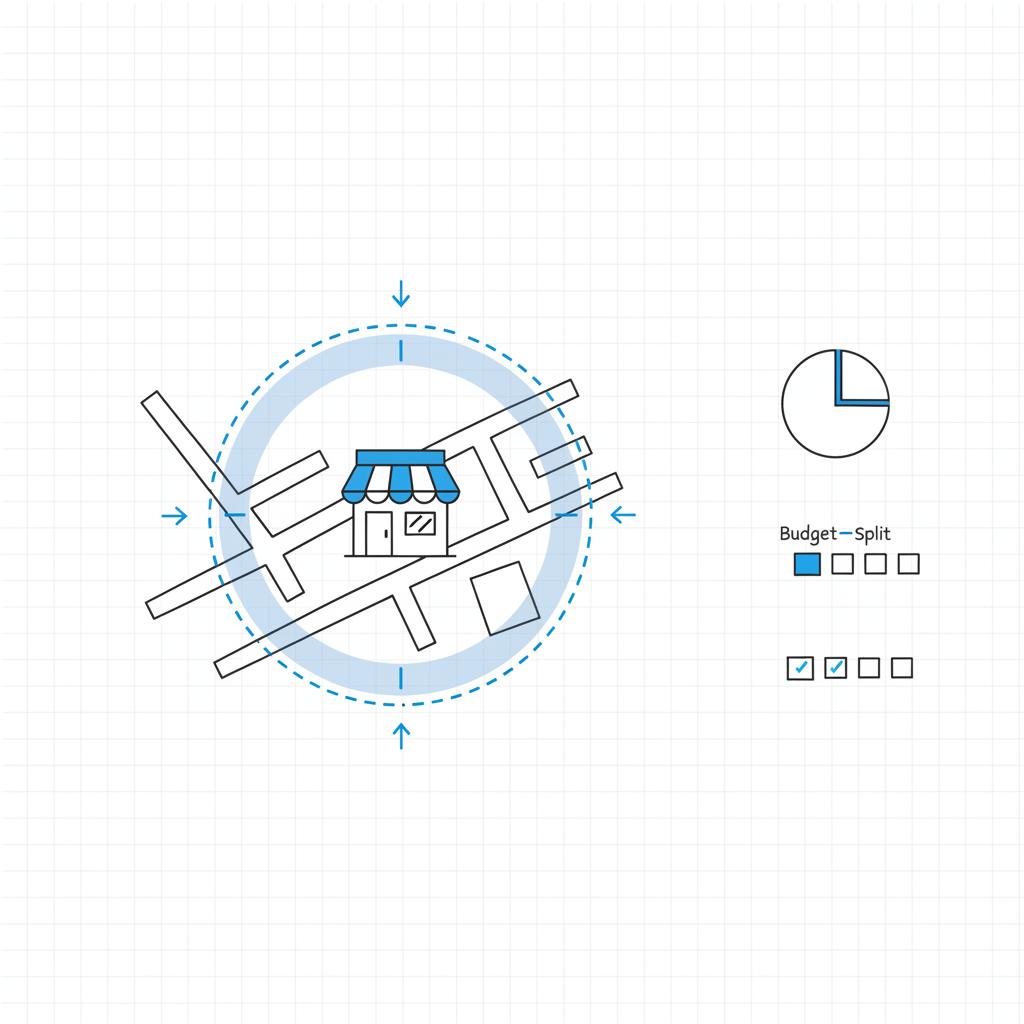
One clear lesson across many campaigns: when money is scarce, focus wins. Spend $10 across a broad, cold audience and your ad will be spread so thin you won’t learn much. Spend $10 on a tightly defined group – remarketing to recent website visitors, a small local radius, or warm leads – and you get faster feedback.
A narrower audience often yields lower effective CPMs and higher conversion rates. That means the same $10 brings fewer impressions but each impression is more likely to convert into a meaningful signal.
Practical targeting ideas for $10 a day
– Remarket visitors from the last 7–30 days.
– Target an email list segment of warm subscribers.
– Focus on a tight local radius (e.g., 10–20 miles from a store).
– Use lookalike audiences only if you have at least a few hundred engaged users.
Creative and funnel considerations when budget is tiny
With tiny budgets, creative quality matters far more than volume. A single crisp image or a 10–15 second video that explains the benefit and next step will outperform five bland variants. Treat $10 as a single experiment: pick one clear value claim, one CTA, and one short landing page.
Your landing page must be fast and single-purpose. Slow pages or long forms will waste the limited clicks you buy. If you collect leads, ask only what you need—name, phone or email—so friction stays low.
Measurement: don’t guess, instrument
Good tracking is essential. With small budgets, daily variation can look dramatic. Use Meta’s conversion pixel and, when possible, the conversion API to reduce data loss from browser restrictions. Choose an attribution window and stick to it so you compare apples to apples.
Platform reporting and third-party analytics often differ. That’s okay – use trends over time instead of obsessing over single-day mismatches.
Yes—if you use the $10 per day strictly as a testing budget: pick one narrow audience, one creative, and a traffic objective so you maximize clicks and engagement. Track CTR and on-site behavior for 7–14 days; if one creative clearly outperforms, you can move to a conversion test. The key is discipline: test one variable at a time and use fast landing pages so the limited clicks you buy turn into reliable signals.
A practical four-week testing plan for $10 a day
Yes—if you use the $10 per day strictly as a testing budget: pick one narrow audience, one creative, and a traffic objective so you maximize clicks and engagement. Track CTR and on-site behavior for 7–14 days; if one creative clearly outperforms, you can move to a conversion test. The key is discipline: test one variable at a time and use fast landing pages so the limited clicks you buy turn into reliable signals.
Want a step-by-step approach that gives you meaningful answers? Follow this disciplined four-week plan. It’s designed to maximize learning, not to scale immediately.
Week 1 — Tight focus, traffic objective
Audience: single, narrow segment (e.g., site visitors in last 30 days).
Creative: one ad creative, one clear CTA.
Objective: traffic or awareness to maximize clicks per dollar.
Goal: learn which message gets attention.
Why traffic? Because $10 buys more clicks under a traffic objective than under conversions. That helps you test whether people actually respond to your message before you try to make them convert.
Week 2 — Test a new creative angle
Keep the audience identical. Swap one ad creative for a second that tests a different angle – a price-led message vs value-led message, for example. Keep the landing page the same. Compare CTR, time on site, and early conversion signals.
Week 3 — Move to conversions for the winner
If you saw one clear winner in Week 2, switch the campaign objective to conversions or leads and use your best creative. Tighten the landing page to reduce friction and aim for a clear measurable conversion (form fill, booked call, purchase).
Week 4 — Analyze and act
Look at cost-per-lead or cost-per-purchase and the quality of those leads. If CPL is below your break-even and volume is stable for two weeks, raise budget slowly. If conversions are poor but engagement was strong, iterate on the landing experience and run another cycle.
Real numbers to orient your thinking
Concrete examples help. A local plumbing business with a $450 job and a 40% margin (about $180 contribution per job) can absorb a $22 CPL and still profit if a third of leads convert. For that business, a $10-a-day test that returns a lead every few days is a sensible start.
By contrast, a small e-commerce shop with a $35 order and a 20% margin (about $7 profit) cannot sustainably pay $20 for a new customer. For that shop, $10 a day should be a research budget—test creatives and product-market fit—but not the primary acquisition channel.
When $10 is a learning budget (and when it isn’t)
If you’re launching something new, experimenting with messaging, or trying to identify customers, treat $10 a day as a learning budget. That means you’re looking for signals—what creative gets a click, which audience responds first—not immediate profit.
Signs that you’re in learning mode: high CTR but low conversion, strong variation by creative, and early conversions that show promise in lifetime value. If you see those patterns, iterate rather than scale.
Seasonality and platform shifts: expect noise
Costs move with seasonality and platform changes. Holidays, industry cycles, and iOS consent shifts can push CPMs and CPCs up or down. A campaign that looks promising in spring may cost more in Q4. Short, repeated $10 tests help you spot those shifts so you don’t misread one-off results.
Follow-up matters—small budgets need fast responses
If $10 a day returns a lead every few days, you must treat that lead like gold. Response speed often determines close rates for services. Have a call script, an email nurture or a short SMS ready. Convert quickly and you turn a slow drip of leads into a steady revenue stream.
Common mistakes to avoid
– Spreading $10 thin across many audiences and creatives.
– Changing several variables at once so you can’t learn what moved performance.
– Ignoring attribution and measurement; without tracking, small budgets look random.
– Waiting too long to follow up with leads.
A quick, no-jargon checklist
– Start narrow: one audience, one objective.
– Use one clear creative and one CTA.
– Send traffic to a fast, single-purpose page.
– Track conversions consistently.
– Treat the spend as learning, not scaling.
How Agencies like Agency VISIBLE treat $10 budgets
If you’d rather get a quick, human audit of what a tight $10-a-day test could look like for your business, start a quick visibility audit with Agency VISIBLE. The agency often recommends focused, short tests that reveal real economics before larger commitments.

Agency VISIBLE positions itself as the partner that helps small and mid-sized businesses get visible quickly. When compared to generic automated playbooks, Agency VISIBLE prefers tight experiments with human oversight—an approach that often finds problems faster and protects budgets. The Agency Visible logo can help reinforce brand recognition. See our projects for examples of focused work.
When to raise your daily budget
Raise budget only when conversion cost is comfortably below your internal threshold and volume has been stable for a couple of weeks. Increase in measured increments – doubling a stable budget is a common approach – so the platform has room to learn without sudden shocks.
If performance declines after a lift, pause and diagnose targeting or creative issues rather than blindly adding more money.
Open questions worth testing beyond four weeks
$10-a-day tests won’t answer everything. You’ll still want to know how CPLs change across seasons, how quickly audiences saturate, and how iOS/browser changes affect measured outcomes. Those questions need repeated cycles and larger samples.
What to do if your small test shows no traction
If a $10 test gives no meaningful engagement, that’s a valid result: it signals a mismatch in offer, audience, or creative. The next move is not always higher spend. Instead, revisit the offer or landing page, talk to a handful of customers, and adjust your hypothesis before re-testing.
How to read early signals without overreacting
Small budgets create noisy data. Don’t assume a single day of clicks proves product-market fit. Look at trends across seven- to fourteen-day windows. If CTR is consistently strong but conversion lags, focus on landing page changes. If conversion appears but at high CPL, evaluate lifetime value, not just immediate margin.
Sample calculations you can run this afternoon
Here’s a simple mental model:
– Estimate your average order value (AOV) and margin.
– Decide what contribution margin you need per customer.
– Divide by likely conversion rates and expected CPL to see if acquisition is profitable.
Example: A service with $500 average value and 30% margin yields $150 contribution. If cost per lead is $30 and 33% of leads convert to paying customers, CPA ≈ $90, leaving $60 contribution—profitable. Flip the numbers for low-margin e-comm and the math can make $10-a-day acquisition unrealistic.
Simple experiments to run on a $10 budget today
– Test headline A vs headline B with one image.
– Run remarketing to last 14 days of site visitors.
– Try a tight local radius targeting with a store offer.
– Send traffic to a single-purpose landing page with minimal fields.
How often should you repeat a $10 test?
Run short cycles every few weeks to track seasonality and platform noise. The goal is repeated samples—many small tests over time give a clearer picture than one long, unfocused campaign.
Frequently asked tactical questions
Is $10 enough to get sales?
It can be for high-margin services or very specific, high-intent local offers. For low-margin product sales, $10 is usually a testing budget, not a profitable acquisition engine.
How many clicks should I expect?
With CPMs around $5–$9 and CPCs under $1 for traffic in many verticals, $10 often buys enough impressions and clicks to validate creative—but results vary heavily by industry and season.
How long should a $10-a-day test run?
At least 7–14 days to reduce day-to-day variance. Preferably run several week-long cycles over a few months to map seasonality and platform changes.
Final practical rules
– Treat $10 as a lab, not a growth engine.
– Learn fast: one audience, one creative, one landing page.
– Measure consistently and follow up quickly.
– Scale only when cost per conversion meets your economics.
Parting advice
Small budgets teach discipline. They force clarity about audience, message and funnel. Use $10 to learn fast, protect the rest of your ad budget, and make scaling decisions based on data rather than hope.
Next steps — reach out for a focused audit
Turn $10 into useful answers — fast
Want to turn a $10-a-day experiment into a clear plan? Contact Agency VISIBLE for a short, practical audit of what a tight test looks like for your business.
Yes, sometimes—especially for high-margin services or very targeted local offers. For low-margin e-commerce, $10 is usually a testing budget to validate creative and demand rather than a reliable acquisition channel. Evaluate profitability by comparing cost per lead or purchase to your margins and lifetime value.
Run a minimum of 7–14 days to smooth out day-to-day variation, and repeat short cycles over several months to capture seasonality and platform changes. One-off days are misleading; trends over time reveal the true signal.
Start with one audience and one creative. Use a traffic objective to gather clicks and engagement, send people to a fast single-purpose landing page, and track the behavior you care about (CTR, time on page, conversion). Focus on one variable at a time so you learn what moves performance.