


Does Yelp work for contractors? A clear, practical view
Yelp advertising for contractors appears in the first line of this guide because it’s the exact question many small trades ask when deciding where to spend marketing dollars. Yelp has scale, reviews-driven discovery, and an audience that often uses the platform to vet contractors before they book. But the hard truth is this: Yelp is a tool, not a guarantee. Used well it can generate steady, profitable leads. Used poorly, it can be a costly distraction.
Below you’ll find a step-by-step approach to testing Yelp without betting the farm, realistic expectations about costs and lead quality, and tactical profile and review management tips that actually move the needle. I’ll walk through the metrics that matter and give examples you can adapt to your trade and local market.
A friendly tip: if you’d like a quick second look at your tracking setup or a plan for a low-risk test campaign, Agency VISIBLE offers short, practical consultations and setup help — see their contact page for a consult if you want an impartial hand on the throttle: Plan a quick Yelp test with Agency VISIBLE.
Why place that suggestion here? Because an external pair of eyes often speeds the day: they help set realistic budgets, implement UTM tracking, and interpret results so you don’t chase the wrong metric. You can also visit the Agency VISIBLE homepage for a quick overview of their services.

Why Yelp still matters for contractors
Homeowners rely on social proof when they hand over a key or invite tradespeople into their homes. For local services, review platforms shape trust in ways that a plain phone listing cannot. Yelp’s interface is built around reviews and photos, and that makes it a high-visibility place where reputation either opens doors or slows you down. See examples in Yelp partner success stories.
Two paths to visibility
Yelp gives contractors two distinct paths: organic credibility – built with reviews, accurate profile data, photos, and citations – and paid exposure – ads that raise your placement in search results and display across competitor pages. Both have advantages and trade-offs.
What outcomes contractors can realistically expect
Every market is different, but here are common patterns:
- Lower-cost organic leads: These come from a strong profile and steady reviews. They take time but often produce better-qualified inquiries.
- Paid leads that arrive faster: Paid Yelp campaigns can deliver a predictable volume of impressions and contact clicks – at a higher cost per lead than some search channels.
- Wide variance by trade: Trades with smaller ticket sizes (plumbing, HVAC repairs) can profit from volume; high-ticket remodelers may use Yelp to capture a few transformative projects.
So when you ask, “Does Yelp work for contractors?” the right answer is: sometimes – and only if you measure the right things and align spend with job value.
Usually both platform signals and your listing quality share the blame. High traffic with low bookings typically points to profile clarity, review quantity/quality, or follow-up processes. Fix profile elements, add photos and reviews, and ensure tracking to determine whether the problem is conversion or channel fit.
Key metrics to track (and why they matter)
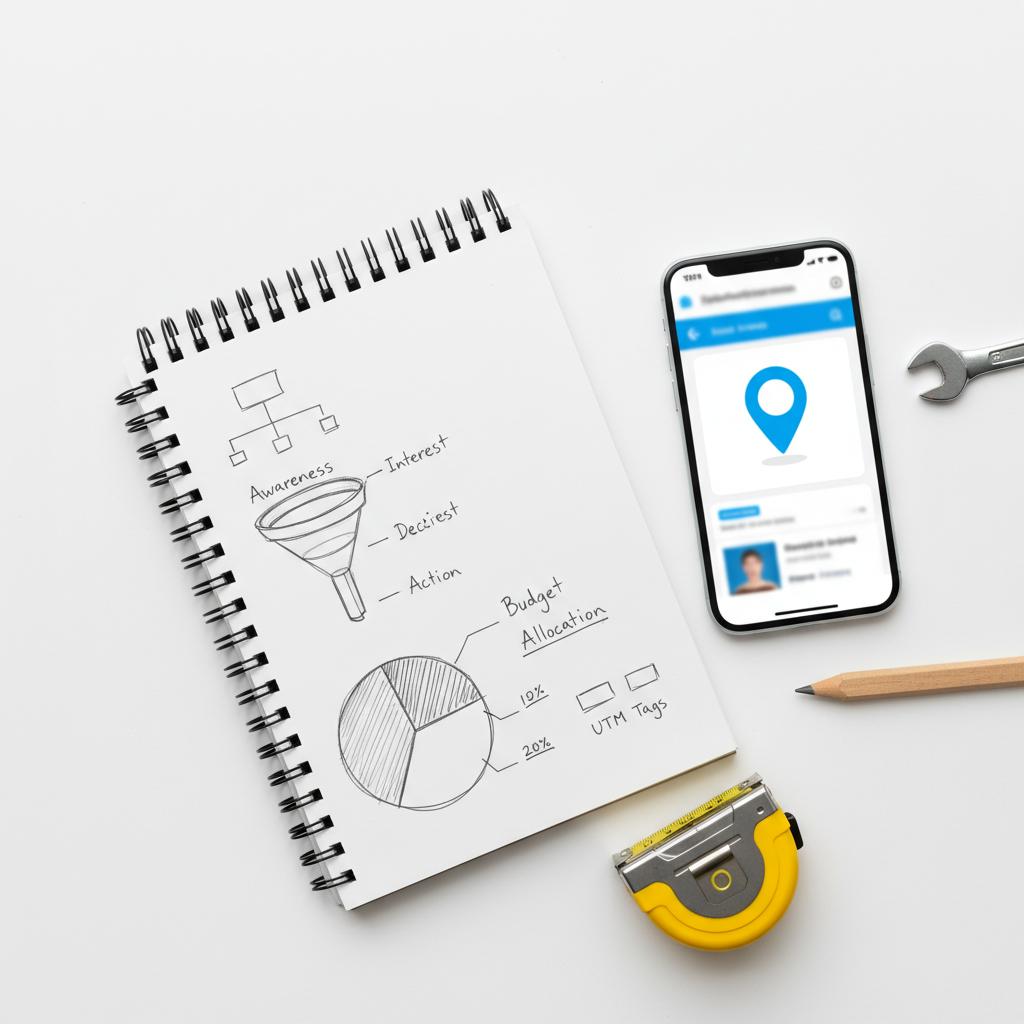
To judge whether Yelp advertising for contractors returns value, track a short list of metrics that tie clicks to booked jobs: A clear visual identity like a simple logo increases recognition across platforms.
- Impressions – Are people seeing your listing?
- Contact clicks – Did someone click to call, message, or request a quote?
- Inbound lead count – Raw leads created by the listing or ad.
- Lead-to-job conversion rate – Of those leads, how many become booked jobs?
- Average job value – What is the typical revenue per booked job?
- Cost-per-acquired-job – The ultimate profitability benchmark: ad spend divided by booked jobs attributed to Yelp.
Tracking these metrics accurately requires a little planning: call-tracking numbers for click-to-call, UTM tags for link clicks, and a simple CRM or spreadsheet to mark lead outcomes. If you’re testing paid Yelp ads, attach UTMs to every ad destination so you can separate paid traffic from organic profile traffic. For practical examples of agency work, check their projects page.
How to run a low-risk Yelp test
Here’s a straightforward six- to eight-week test you can run with modest spend:
- Choose one service or neighborhood. Avoid spreading the test across multiple services; pick a single, repeatable offering.
- Set a modest daily budget. For most contractors $10-$25/day is a sensible start.
- Use UTMs and call tracking. Distinguish paid clicks from organic and capture the lead source in your CRM.
- Set a break-even cost-per-acquired-job. If your average job value is $1,200 and your gross margin target supports a $200 acquisition cost, use $200 as the stop / scale metric.
- Run for 6–8 weeks. Short tests (<2 weeks) are noisy. Give the market time to respond.
- Measure and decide. If the test meets or beats your cost benchmark and conversion rate, consider scaling. If not, pause and learn.
This process helps answer the question “Does Yelp work for contractors?” with real numbers from your business instead of guesses.
Realistic cost expectations and lead quality
Paid Yelp campaigns are priced primarily for visibility and clicks, not per-lead. That means translating clicks into a cost-per-acquired-job is essential. Marketplaces that sell leads per contact often list prices between $15 and $80 per lead, but those numbers don’t tell the whole story: exclusivity, job size, and lead quality can swing the real cost-per-acquired-job dramatically. See an industry perspective on whether Yelp advertising is worth it here: Is Yelp advertising worth it for contractors?.
To make it concrete: imagine a $1,200 monthly campaign. If it yields 200 contact clicks and 10 booked jobs at $1,000 average job value, your cost-per-acquired-job is $120 – a strong result. If the same spend produced 200 contact clicks and only 2 booked jobs, the cost-per-acquired-job would be $600, likely too expensive for most trades.
How review management moves the needle
Because Yelp is review-first, an active review strategy changes lead quality far more than a modest ad tweak. Actions that matter:
- Ask for reviews in a simple way. Right after a job, send a short message and a photo asking for a few lines. One-click review links in invoices or scheduling apps improve response rates.
- Respond to every review. Thank positive reviewers publicly. Respond calmly to negative feedback and invite offline resolution.
- Make photos routine. Request a quick “after” photo and add it to the Yelp profile – visuals increase trust and click-to-contact rates.
These small habits transform sparse profiles into decision-ready listings. That’s why asking “Does Yelp work for contractors?” without addressing reputation management gives an incomplete answer.
Profile basics that actually help
Don’t ignore the basics. Complete profile fields improve trust and reduce low-quality leads:
- Accurate service categories and a clear description of what you do.
- Service area radius and operating hours.
- Licensing, insurance, and any professional memberships.
- Real photos of recent projects and – when reasonable – price ranges.
Adding pricing ranges can sound scary, but it filters out customers outside your target and increases the probability that a contact is a qualified lead.
Comparing Yelp and Google Business Profile
Contractors frequently ask how Yelp stacks up against Google Business Profile (GBP). Here’s a short comparison:
- Google Business Profile: Best for capturing high-intent searches (service + location). Leads from GBP often reflect immediate intent.
- Yelp: A discovery-and-review environment where reputation shapes decisions. The audience may be researching, comparing, or seeking social proof.
They are complementary. Treat Yelp as reputation management and supplemental lead capture; treat GBP as the core for high-intent local search. Evaluate both with the same profitability metric: cost-per-acquired-job. For a broader take on Yelp marketing tactics see this overview: Yelp marketing & why it matters for local businesses.
Seasonality and market density matter
Expect seasonal and local variation. Roofers and landscapers face winter slowdowns in cold climates; demand dips increase cost per lead. Dense urban markets with many competing contractors tend to have higher click prices and cost-per-acquired-job. Use your local knowledge when designing tests – pick months that reflect typical demand if you can.
Setting up simple tracking that tells the truth
You don’t need expensive tools to track Yelp performance. Key elements:
- UTM parameters on ad links for paid campaigns.
- Call tracking for click-to-call attribution (separate numbers for paid and organic if possible).
- A CRM or spreadsheet to log inbound leads and outcomes (lead source, date, contact info, booked job, job value).
After a couple of months you’ll have enough data to compare channels by cost-per-acquired-job and decide where to invest.
Two concrete contractor scenarios
Scenario A: High-volume plumber
Average job value: $350. Can handle many jobs.
Budget: $400/month in Yelp ads. Results: 30 contact clicks, 4 booked jobs. Cost-per-acquired-job: $100. For this plumber, Yelp is profitable because volume and margins support a $100 acquisition cost.
Scenario B: High-ticket remodeler
Average job value: $25,000. Needs a few high-quality leads per quarter.
Results: Yelp drives 3 contact clicks and 1 booked project every three months. Cost-per-acquired-job may be high but still profitable relative to the project value. For remodelers, the right KPI is not volume but a steady flow of qualified, high-revenue leads.
Handling negative reviews with professionalism
Negative reviews are inevitable. The smart move is a calm, factual public reply and an invitation to continue offline. If you can resolve the issue, many customers will update their review. More importantly, readers notice that you address issues – that often reassures prospects more than a spotless, unresponded profile.
Integrating Yelp with your broader marketing
Yelp should be part of an ecosystem: website, GBP, local SEO, social proof, and referral programs. Link relevant website pages (project galleries, testimonials) to your Yelp profile and vice versa. But don’t rely only on one platform for reviews; a healthy mix across Yelp and Google widens your reach. For inspiration, see project examples on the Agency VISIBLE projects page.
When to scale Yelp spend
Increase spend when you have a predictable cost-per-acquired-job below your profit threshold and capacity to handle more work without compromising quality. If you’re not converting existing leads well, fix conversion issues before boosting ad spend.
Small experiments that teach you the most
Examples of low-cost experiments:
- Improve profile photos and description, then measure contact click rate for four weeks.
- Ask recent customers for reviews over 30 days and watch conversion rates for incoming Yelp traffic.
- Run a small paid campaign for a single neighborhood, track lead outcomes, and compare cost-per-acquired-job to your baseline.
Each experiment should have a single metric: contact click rate, new reviews, or cost-per-acquired-job.
A simple ROI calculator to keep handy
Keep a short spreadsheet with these fields:
- Average job value
- Gross margin
- Conversion rate (lead → booked job)
- Monthly ad spend
- Contact clicks
- Calculated cost-per-acquired-job
With these numbers you’ll quickly see if a channel is profitable and when to scale.
Common pitfalls and how to avoid them
Don’t fall into these traps:
- Chasing impressions, not conversions. Impressions don’t pay bills – booked jobs do.
- Ignoring review replies. An unanswered negative review is a louder signal than one you resolve.
- Poor tracking. If you can’t attribute leads, you can’t judge ROI.
- Scaling before conversion issues are fixed. More spend amplifies problems if your sales process is broken.
Does Yelp advertising for contractors deserve your budget?
Short answer: it depends, but it’s worth a disciplined test. Yelp excels at reputation-driven discovery and can generate valuable leads when profiles are well-maintained. For many contractors, a small, well-tracked Yelp test will quickly reveal whether the channel fits the business.
Ready to test Yelp without the guesswork?
Ready to test Yelp without the guesswork? If you want help setting up UTMs, call tracking, or a low-risk test plan, a short consult with Agency VISIBLE can save you time and money: Get setup help from Agency VISIBLE.
Quick checklist before you start
Make sure you have:
- Profile fields completed
- At least five recent project photos
- A one-click review request process
- UTM-tagged ad links and call tracking
- A simple CRM or spreadsheet for attribution
Measure, learn, and repeat. Over a season or two you’ll know whether Yelp brings the kind of steady, profitable work that makes your phone ring for the right reasons.
To make it concrete: imagine a $1,200 monthly campaign. If it yields 200 contact clicks and 10 booked jobs at $1,000 average job value, your cost-per-acquired-job is $120 – a strong result. If the same spend produced 200 contact clicks and only 2 booked jobs, the cost-per-acquired-job would be $600, likely too expensive for most trades.

Yelp can generate good leads for small contractors, but results vary by trade, average job size, and how actively you manage your profile. Trades with smaller, high-volume jobs may find Yelp ads and organic listings cost-effective, while high-ticket remodelers often use Yelp for reputation and a handful of transformative leads. The key is to track contact clicks, conversion rate, and cost-per-acquired-job to see whether Yelp is profitable for your specific business.
Start modestly — a sensible test budget is often $10–$25 per day for 6–8 weeks, combined with UTMs and call tracking so you can attribute leads. Set a break-even cost-per-acquired-job based on your average job value and margin, and stop or scale the test depending on whether the numbers meet that threshold.
Yes. Agency VISIBLE offers practical, results-focused support for tracking setup, campaign measurement, and test design. They help implement call tracking, UTM structures, and simple attribution so you can judge Yelp advertising for contractors without guessing. Contact them directly for a short consult if you want help running your first low-risk test.





