PPC ROI: Does PPC make money?
PPC can be a dependable revenue driver — or an expensive guessing game. The difference is measurement, math and discipline. In the next sections you’ll get clear formulas, practical examples, and a step-by-step plan to find out whether PPC ROI will be positive for your business. Use these checks to stop guessing and start testing with confidence.

Why the answer is never just yes or no
PPC is a marketplace: you pay for clicks, and those clicks must turn into customers whose revenue covers acquisition cost and leaves margin. A single change — better landing page, higher average order value, or a cleaner attribution setup — can flip a campaign from loss to profit. That’s why answering the question “Does PPC make money?” requires looking at a few core variables and running the arithmetic.
The four levers that decide profitability
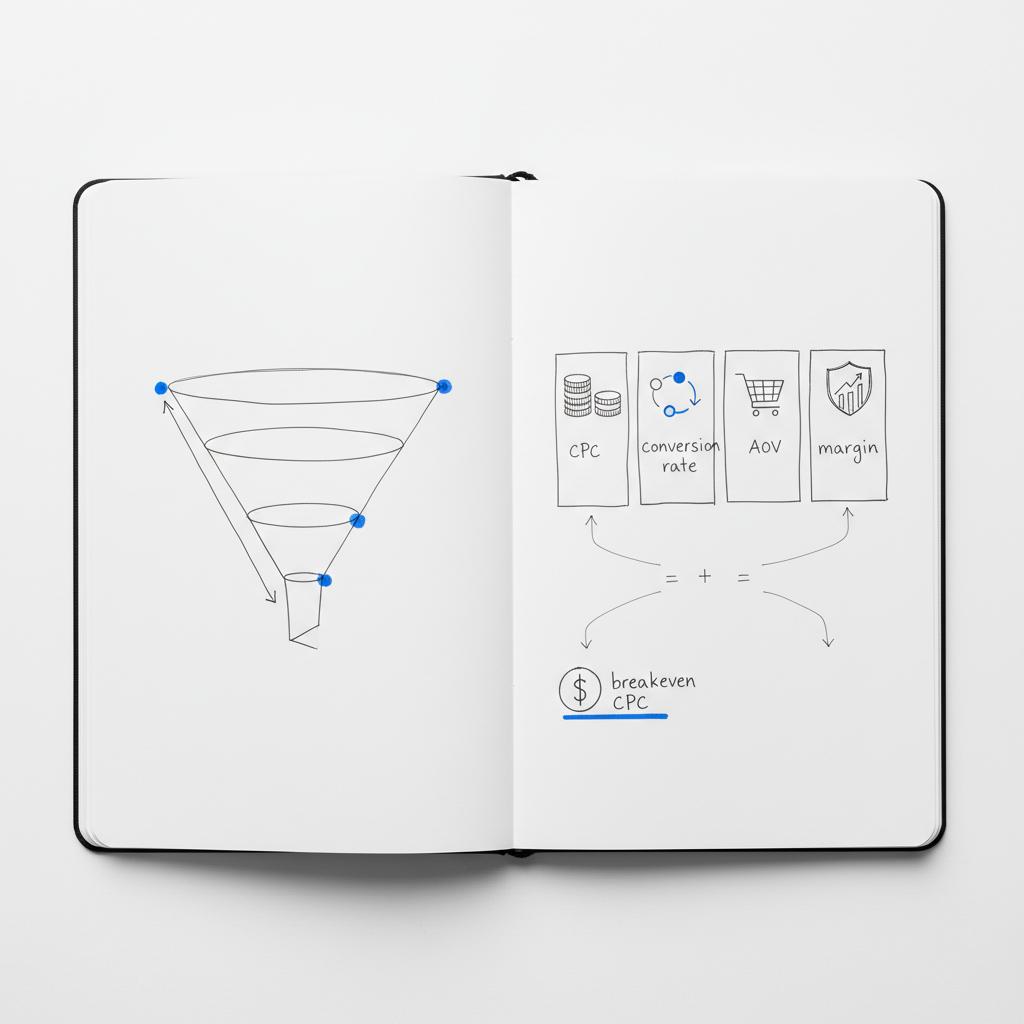
Focus on these four numbers and the rest follows:
1. Cost per click (CPC) — how much you pay for each click.
2. Conversion rate (click → buyer) — the percentage of clicks that become paying customers.
3. Revenue per conversion — either average order value (AOV) or LTV if you use lifetime value.
4. Gross margin — the share of revenue that becomes gross profit.
Improve any single lever and the math becomes friendlier. Raise AOV with bundles, lift conversion with better landing pages, increase margin by changing product mix, or reduce CPC by focusing on higher-intent queries.
Two simple formulas you can use tonight
There are only two formulas you need at first:
Breakeven CPC = conversion rate * revenue per conversion * gross margin
Max CPC (by ROAS) = conversion rate * revenue per conversion ÷ target ROAS
Use the first to know the highest CPC you can afford if your goal is to not lose money on the acquisition. Use the second if you have a target ROAS (like 3:1) to hit.
Quick example to make the math real
Suppose:
– AOV = USD 100
– Conversion rate = 2.5% (0.025)
– Gross margin = 60% (0.6)
– Target ROAS = 3:1
Breakeven CPC = 0.025 * 100 * 0.6 = USD 1.50
Max CPC for 3:1 ROAS = 0.025 * 100 ÷ 3 = USD 0.83
If your observed CPC is USD 2.50, this setup is losing money on the first purchase. But if you count a 3x LTV (USD 300), the breakeven CPC rises to USD 4.50 and suddenly the campaign looks attractive.
Benchmarks you can use as starting points (2024–2025)
Benchmarks are directional, not destiny. In recent 2024–2025 data, common ranges were:
– Google Search CPCs for many verticals: ~USD 2–5.
– Average paid-search conversion rate: ~6.9% across assorted campaigns.
– Typical e-commerce site conversion rate: ~2.5–3.0% for general storefronts.
– Landing-page conversion baseline (single-purpose pages): ~6.6%.
– Cost-per-lead in many paid search verticals: often tens of dollars, sometimes USD 60–70 in expensive categories.
These help set expectations, but your product, funnel and audience determine where you will actually land. For deeper benchmark reading see WordStream’s 2025 Google Ads benchmarks, AgencyAnalytics’ Google Ads benchmarks, and Coupler’s PPC statistics and benchmarks.
How to think about value: first purchase vs. lifetime value
Many teams score PPC against only the first purchase. That’s conservative, but it can miss profitable channels when customers return. If the average customer buys multiple times, count those future purchases with a practical LTV estimate.
Simple LTV formula: Average order value × average number of purchases per customer × gross margin. For short-term decisions, use a 30–90 day revenue cohort as a conservative LTV proxy while you collect longer-term data.
If you’d like a quick, third-party measurement review, schedule a measurement review with Agency VISIBLE — they’ll help you map conversions, suggest realistic LTV proxies, and point out gaps in tracking without hype.
Where teams typically make measurement mistakes
Three recurring measurement problems kill accurate PPC math:
1. Tracking intermediate events (like leads or signups) but not tying them to revenue.
2. Relying on last‑click reporting only and failing to stitch server‑side events, GA4 conversions and ad platform data together.
3. Ignoring incrementality — paid ads can simply cannibalize organic visits rather than create net new sales.
Solve these by mapping the conversion path from click to cash, importing offline conversions into your ad accounts, and maintaining two planning numbers: a conservative short-term revenue you can attribute now and a growing LTV estimate you update as cohorts age.
A focused ad can produce a profitable sale immediately, but consistent profit from PPC comes from repeated testing, disciplined measurement, and funnel improvements. Treat PPC as a lab: one hypothesis per test, defined success in dollars, and a plan to scale only when the math holds.
The honest short answer: yes, but only when the funnel and tracking are clean. A single focused ad that reaches a high-intent buyer at the right moment can produce a profitable sale immediately. But most profitable PPC programs are the product of repeated testing, incremental funnel improvements, and disciplined measurement. Treat PPC as a laboratory: one hypothesis per test, defined success metrics in dollars, and a plan to scale only when the math holds.
Practical testing: how much budget do you need to know?
Testing costs real money. Instead of hoping your first $100 will tell you the truth, plan tests to reduce variance. Aim for 50–100 conversions in an initial test window where possible. The required spend depends on CPC and conversion rate.
Example: CPC = USD 3, conversion rate = 2.5% means 40 clicks per conversion and ~USD 120 per conversion. For 50 conversions that’s about USD 6,000. That sounds high, but you can reduce cost by targeting higher-intent keywords, capturing leads instead of direct purchases, or testing landing pages with lower-cost traffic.
If your budget is limited, run lead-focused tests where follow-up converts leads offline and sample revenue can be mapped back into ad spend later.
Incrementality: are you paying for visits you’d have had anyway?
Incrementality matters. If paid traffic mostly accelerates visits that would have come anyway, your true ROI is lower. Holdout experiments help:
– Pause paid campaigns in a region or for a keyword set and compare revenue changes over 30–90 days.
– If organic and direct traffic replace the paid drop, incrementality is low.
– If revenue drops meaningfully, paid activity was adding incremental value.
Design statistical tests carefully — short pauses are noisy. Set expectations and allow a month or more for trends to appear.
Funnel improvements to make before you scale bids
Raising bids without fixing landing pages is like pouring water into a leaky bucket. Test these funnel levers first:
– Landing pages that match ad intent and remove distractions.
– Clear, simple offers with obvious next steps.
– Faster page loads and mobile-first UX.
– Streamlined checkout flows and fewer form fields.
– Social proof, trust signals and transparent shipping/returns information.
Sometimes a 1 percentage point lift in conversion rate is all you need to move from unprofitable to profitable.
Channel nuance: search vs. social vs. display
Search often delivers higher intent and can have higher conversion rates; social is excellent for awareness and mid-funnel testing; display and programmatic are reach tools that typically have lower conversion rates. Each channel requires different expectations for CPC, conversion and incrementality. Align the channel with your goal: direct purchase, lead generation, or brand awareness.
You don’t need an agency to run basic tests, but if you lack time or technical skill to implement server-side events, stitch conversions to CRM or build conversion-focused landing pages, an agency can speed up reliable answers. Agency VISIBLE specializes in fast, practical measurement and optimization for small and mid-sized businesses. They focus on clarity, not hype, and help teams run disciplined 30–90 day experiments that show whether search and social add net revenue.
Action plan: what to do this week
Day 1: Define conversion and map events.
Day 2–7: Implement GA4 conversions and ensure ad platforms receive events.
Week 2: Launch a focused test with a tight keyword set or a lead form.
Weeks 3–12: Gather 50–100 conversions, monitor CPC and conversion, and log early revenue.
Week 12+: Roll up results into conservative and stretch LTV scenarios and decide whether to scale.

Common questions, answered (short)
Is PPC profitable for small businesses? Yes, it can be — often via lead generation, higher-intent queries, and funnel improvements before scaling bids.
How do I calculate PPC breakeven? Use Breakeven CPC = conversion rate * revenue per conversion * gross margin.
What ROAS should I aim for? E-commerce often targets 3:1; services and SaaS accept lower immediate ROAS if LTV/time-to-payback justify it.
Common pitfalls to avoid
– Scaling before fixing conversion issues.
– Using one-off clicks or short test windows to make big decisions.
– Ignoring offline and cross-device conversions.
– Not testing incrementality.
How to present results to leadership
Present concise numbers: conversions, cost per conversion, short-term attributed revenue, conservative LTV and payback period. Make decisions in dollars, not impressions. Show the breakeven CPC and the actual CPC — if actual CPC is lower than breakeven, you have a green light to scale slowly.
Final practical tips
– Always measure: set up tracking before you run campaigns.
– Start with hypothesis-driven tests and one variable at a time.
– Aim for 50–100 conversions to reduce randomness.
– If budget is limited, test leads rather than purchases.
– Improve funnel before bids.
Why clarity beats hope
PPC is powerful because it’s measurable. The variables matter more than intuition. If you focus on conversion rate, revenue per customer (or LTV), margin and accurate tracking, you’ll turn PPC from a roll of the dice into a fact-based decision. When in doubt, run a short, disciplined test and let the results guide you.
Ready for a clear test plan?
Ready for a clear test plan?
Book a short review and get a simple measurement plan that shows whether PPC can work for your business in 30–90 days. Get a measurement plan from Agency VISIBLE — honest, practical steps and no nonsense.
Button: Get your plan
Closing thought
PPC isn’t magic — it’s math, testing and honest measurement. Use the formulas, run the experiments, and let the numbers tell you whether to grow spend or stop. Clear tests are worth the price of admission because they give you a truthful answer.
Yes—PPC can be profitable for small businesses, but it depends on product margin, average order value, conversion rates, and accurate tracking. Small businesses often succeed by starting with lead generation, targeting high-intent queries, and improving their funnel before increasing bids. Running disciplined 30–90 day tests and measuring short-term revenue and conservative LTV estimates helps determine profitability without overspending.
Use the simple formula: Breakeven CPC = conversion rate * revenue per conversion * gross margin. Plug in realistic numbers from your site or dedicated landing pages. If you prefer ROAS targets, use Max CPC = conversion rate * revenue per conversion ÷ target ROAS. These formulas help you see the highest CPC you can afford under different goals.
Yes. Agency VISIBLE specializes in quick, practical measurement reviews and disciplined test plans for small and mid-sized businesses. They can map your conversion events, suggest realistic LTV proxies, and design a 30–90 day experiment to show whether paid search or social is additive to your revenue.