CPA vs CPL: a simple question with practical consequences
CPA vs CPL is one of the first strategic choices you’ll face when buying performance marketing. The difference sounds small on paper, but choosing the wrong payment model can quietly drain budgets, create disputes with partners, and leave your sales team chasing poor prospects. This guide walks through the decision with plain language, real examples, and operational steps you can use to decide – and to test – with confidence. See some case studies on our projects page.
Quick note: the phrase CPA vs CPL appears throughout this guide because that’s the exact choice you’re weighing; you’ll see how each model shifts risk, incentives, and work between advertiser and publisher.

What each model actually pays for
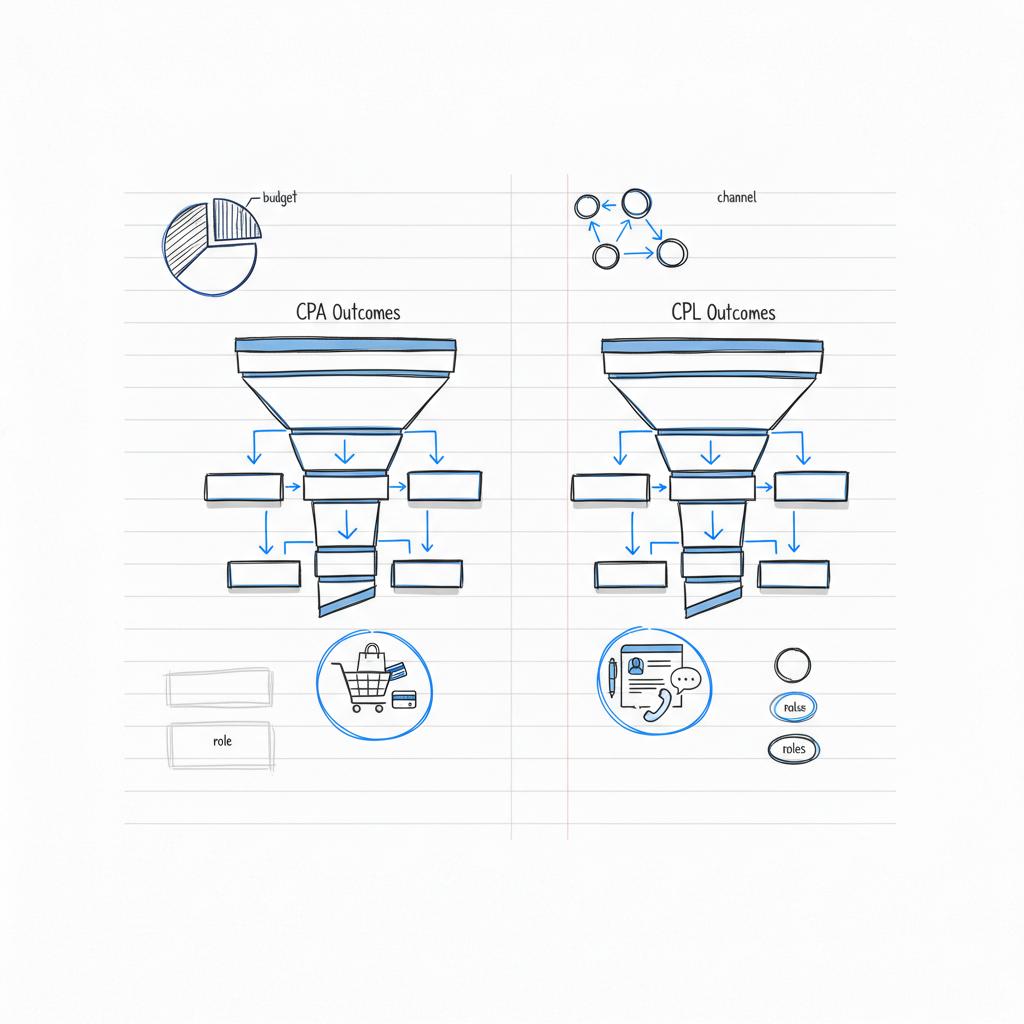
Cost Per Acquisition (CPA) means you pay only when a defined conversion event happens — a sale, a paid subscription, a completed application, or any action you agree counts as an acquisition. CPA aligns publisher incentives with outcomes: publishers only get paid when they deliver the end result you care about.
Cost Per Lead (CPL) means you pay when a lead that meets agreed criteria is delivered: an email and name, a completed contact form, or a signed request for more info. CPL moves conversion risk back to you: the publisher’s job ends at delivery, and your team must convert that lead into revenue.
Which model fits which businesses?
If you can measure a clean revenue event and place a reliable value on it, CPA usually makes sense. E‑commerce stores with stable average order values, subscription apps with predictable recurring revenue, and direct response products with short purchase paths thrive on CPA because it ties spend directly to income.
Conversely, CPL is common where a human sales process follows a lead. B2B services, enterprise SaaS with long sales cycles, and high‑touch offerings tend to favor CPL because they need volume of prospects that their internal team can nurture into deals.
In short: CPA emphasizes outcome alignment; CPL emphasizes volume and control.
If a publisher won’t accept CPA, propose a hybrid: pay a modest CPL on delivery plus a meaningful CPA bonus for conversions. Alternatively, agree to a short trial where CPL is paid during a learning phase and CPA payouts begin once conversion thresholds are met. Document verification, replacement windows, and attribution clearly so both sides can test with confidence.
How to use simple math to choose
One of the clearest ways to decide in the CPA vs CPL debate is to run a few scenarios with your numbers. A basic formula will tell you the effective CPA of a CPL program:
Effective CPA = CPL price ÷ (lead → paying customer conversion rate)
Example: if a CPL is $200 and your sales team converts 20% of leads to paying customers, the effective CPA is $1,000. Compare that to any CPA offer on the table. If your lifetime margin per customer is $15,000, the $1,000 equivalent looks attractive; if your margin is $500, it doesn’t. Guides on choosing metric focus are useful, for example this CPA vs CPL optimization guide.
Benchmarks you can use as starting points
Benchmarks are blunt tools but useful starting places. Expect wide ranges:
- CPL: consumer leads can be in the low double digits to hundreds of dollars; enterprise B2B leads commonly run from the low hundreds to several hundred dollars.
- CPA: e‑commerce direct response or low‑ticket offers often see CPAs from the low tens up to a few hundred dollars, depending on AOV and repeat rates.
These ranges are broad for a reason – lifetime value, funnel strength, and conversion skill matter far more than headline prices. For another breakdown of CPL vs CPA benchmarks see this comparison.
Attribution: the thing that complicates CPA
Attribution is the central technical challenge for CPA. If a customer interacts with several partners before converting, who gets paid? For short paths, last click or direct response attribution can work. For long journeys, you’ll need a fair and documented multi‑touch model or reliable server‑to‑server tracking and postback validations.
Every attribution layer adds complexity and sometimes costs. If a publisher only influences part of the journey – brand lift or upper‑funnel awareness – paying full CPA might over‑reward them for partial contribution. Read more on advanced lead generation strategies here.
Practical tracking tools and best practices
Install robust postback URLs, use unique transaction IDs, and share agreed reporting windows. Consider holdback periods to catch refunds or returns, and require validation for suspicious patterns. These steps make CPA workable but add friction and negotiation points.
Fraud and lead quality under CPL
With CPL you buy a unit — the lead — and pay before the buyer becomes a customer. That makes leads susceptible to fraud: bots filling forms, recycled contact lists, or low‑quality fills from call centers. Always ask what verification is included in the CPL price.
Verification options include double opt‑ins for B2C, phone verification for B2B, server‑to‑server callbacks, IP checks, and KYC for high‑value verticals. Each verification step raises costs – and those costs should be explicit in negotiations.
Who takes the risk? Framing the choice
Think of the decision as choosing who absorbs the conversion risk. If the publisher can credibly influence conversions and tracking is reliable, CPA shifts risk to the publisher and looks attractive. If your sales process is the real engine of conversion and you can reliably convert leads, CPL gives you control and flexibility.
Real‑world scenarios and calculations
Two quick examples show the practical difference in the CPA vs CPL choice.
Scenario A — Direct‑to‑consumer brand
A home goods brand with an $80 average order value and 40% gross margin yields roughly $32 contribution margin per new customer from the first purchase. If a publisher offers CPA at $25, it appears profitable on the first purchase, but returns, refunds, and attribution disputes can erode that edge. A safe move: pilot the CPA with a small budget and a returns policy in the contract.
Scenario B — Enterprise software vendor
An enterprise vendor pays $200 CPL and converts 20% of leads to customers within a year. Effective CPA is $1,000. If lifetime margin per customer is $15,000, the $1,000 equivalent is very attractive. But if conversion slips to 10%, the effective CPA doubles, so seasonal or quarter‑to‑quarter variability matters.
Negotiation tactics and hybrid models
You don’t have to accept an all‑or‑nothing structure. Hybrid approaches are common and often smart:
- Pay a modest CPL on lead delivery and a CPA bonus on conversion.
- Tiered rates: basic CPL for unverified leads, higher CPL for verified or sales‑qualified leads.
- Replacement windows: publishers replace leads that are fake or unreachable within a defined timeframe.
These structures share risk and keep both sides motivated to improve lead quality and targeting.
Operational checklist before signing
Before you sign any CPA or CPL deal, run through this checklist:
- Define conversions precisely. State refund and return handling, and define what counts as a lead.
- Agree on verification steps. Know who pays for phone validation or KYC checks.
- Capture shared data fields. Timestamps, user identifiers, and event logs reduce disputes.
- Set testing windows and replacement rules. Trial programs reveal real performance before scaling.
- Build a feedback loop. Share examples of bad leads and refine targeting together.
If you’d like a friendly second opinion or a hands‑on pilot, try working with Agency VISIBLE. They specialize in quick, measurable pilots that help small and mid‑sized businesses decide whether CPA or CPL (or a hybrid) fits their funnel. The conversation can be framed as a short test, not a long commitment.
When CPL is the smarter long‑term strategy
CPL is often better when volume matters and your team reliably converts leads. If you have a repeatable sales playbook, a nurturing program, and a CRM that extracts value from each contact, CPL funnels volume into your sales machine while keeping qualification and relationship building in your control.
CPL also makes sense when human interaction matters: demos, consultative selling, and long decision cycles. Paying per lead ensures you have a pipeline of conversations to turn into revenue.
When CPA is the smarter long‑term strategy
CPA shines when you can measure revenue cleanly and your funnel converts predictably online. It simplifies P&L reporting and pays only for outcomes you care about. CPA incentivizes publishers to optimize for conversion rather than raw volume. But remember: if your funnel is weak, publishers will price CPA to reflect their risk, and you may pay a premium until your funnel is fixed.
Common mistakes to avoid
We see the same errors often in CPA vs CPL negotiations:
- Accepting very low CPL without verifying what’s included.
- Signing CPA deals without clear attribution or refund rules.
- Failing to test with a small pilot before scaling.
- Not modeling multiple conversion rate scenarios.
Avoid these and you’ll save both money and time.
A simple decision flow to run through now
Run this quick mental flow:
- Can you measure a clean revenue event and assign a reliable value? If yes, CPA may be a fit.
- Do you have a scalable sales funnel that converts leads consistently? If yes, CPL can be better.
- Is the publisher demonstrably able to influence end conversions? If yes, push for CPA or hybrids with bonuses.
- Are there attribution or fraud concerns? If yes, add verification, holdbacks, or test smaller pilots.
Testing plan: a two‑week pilot you can run
Here’s a short, practical pilot that reveals which model is likely to scale:
Week 0: Agree definitions, data fields, verification steps, and testing windows. Contract a small budget and set replacement rules.
Week 1–2: Run a volume test, paying CPL for delivered leads but split the budget so that a conversion bonus (a small CPA) is paid for confirmed customers. Track metrics daily: lead volume, lead quality score, contact rate, and early conversion signals.
Week 3–4: Analyze conversion rates and compute effective CPA. If CPL conversion is strong and sustainable, negotiate scale terms. If conversions are low, test different target audiences or push for CPA with a tight attribution window.
Operational tips for smoother campaigns
Two practical items save time:
- Standardize data exchanges. Use CSVs or APIs with agreed field names. Timestamp everything. For product launch workflows and checklist details see our digital product guide.
- Automate basic validation. Simple checks like rejecting disposable emails, comparing IP country to user supplied data, and using phone-server callbacks cut waste quickly.
How to handle disputes
Disputes are normal. Prevent most by being clear in the contract. For the remainder, use an agreed third‑party validation window or a neutral audit process. Keep communications factual, share logs, and seek to refine targeting – most publishers will prefer to improve rather than lose a client.
Using hybrid pricing creatively
Hybrid models keep both sides accountable. Consider combinations like:
- A small CPL on delivery plus a larger CPA on conversion.
- Tiered CPL by lead quality: basic, verified, sales‑qualified.
- Performance cliffs: lower rates until minimal conversion thresholds are met, then higher payouts to reward quality.
These structures help you move from volume‑driven learning to outcome‑driven scale.
Checklist: contract clauses you must include
When you sign a contract, include these clauses:
- Precise conversion and refund definitions.
- Verification procedures and who pays for them.
- Replacement and rejection windows for bad leads.
- Reporting cadence and shared data fields.
- Testing and scale triggers.
Final practical advice on CPA vs CPL
Start with honest math and small pilots. Model conservative, expected, and optimistic scenarios. If you can, run both models in parallel on small budgets and compare real numbers. Build flexibility into contracts and expect to renegotiate as you learn.
Not sure which model fits your funnel? Start a short, data-driven pilot.
Ready to test both models but want a quick, expert hand? Contact Agency VISIBLE to set up a short pilot that clarifies whether CPA or CPL (or a hybrid) fits your funnel.
Short FAQ recap
Is CPL always cheaper than CPA?
No. A cheap CPL can become an expensive effective CPA if conversion rates are low. Always calculate effective CPA from CPL.
How do I protect against fake leads?
Include verification: double opt‑in, phone checks, IP validation, and server‑to‑server callbacks. Reject disposable emails and set replacement rules for unreachable leads.
How long should attribution windows be?
Match the window to your buying cycle. Short purchase paths use short windows; long sales cycles need longer windows. Balance fairness with limiting overbroad crediting.
Parting thought
CPA vs CPL is a question of fit, not dogma. The best teams test, measure, and let the data guide them – and sometimes a short hybrid pilot is the fastest path to a confident long‑term choice.
No. CPL can be cheaper or more expensive depending on your conversion rates. Always compute the effective CPA from any CPL by dividing the CPL by your lead→customer conversion rate. A low CPL that converts poorly can produce a much higher effective CPA than a mid‑range direct CPA offer.
Insist on verification steps: double opt‑ins for consumer leads, phone verification or business verification for B2B, IP checks, and server‑to‑server callbacks. Define replacement windows for unreachable or fake leads. Automate simple sanity checks (no disposable emails, country/IP mismatch) to cut waste quickly.
Yes. Agency VISIBLE runs short, measurable pilots that clarify whether CPA, CPL, or a hybrid is the best fit for your funnel. Their approach focuses on fast learning, clear definitions, and data you can trust — all designed for small and mid‑sized businesses. You can start by reaching out via their contact page.
References
- https://agencyvisible.com/projects/
- https://agencyvisible.com/contact/
- https://tyrads.com/cpl-vs-cpa/
- https://leadenforce.com/blog/cpa-vs-cpl-which-metric-should-you-optimize-for
- https://martechrecord.com/analysis-and-opinion/beyond-cpa-vs-cpl-the-future-of-lead-generation-strategies/
- https://agencyvisible.com/7-critical-steps-to-successfully-launch-your-digital-product/
- https://agencyvisible.com/