


Do people actually pay attention to billboards? The short answer is: yes – but only when you accept the limits of outdoor exposure and design for them. In this guide we walk through how billboard attention works in 2024-2025, what evidence says about creative, format and measurement, and the practical steps that turn fleeting glances into meaningful outcomes.
Why billboard attention still matters in 2025
Outdoor advertising remains visible in the media mix because it reaches people in motion and in context. When marketers ask about billboard attention, they’re really asking two things: do people look long enough to notice, and does that notice turn into awareness or action? Recent industry numbers – with US OOH revenue in the low billions and DOOH the fastest-growing slice – show that billboard attention is a measurable and useful signal for many brands.

But the mechanics are different from screen-based ads. Typical glance windows for moving audiences are short: one to six seconds. That brevity shapes what creative works and how measurement should be planned. The more you understand how billboard attention operates in short windows, the better you can design ads and measurement that deliver real value.
Simple creative, clear intent
Lab and field work in 2024-2025 consistently found that high-contrast images, minimal text, large typography, and a single focal idea increase glance duration and recall. In other words, the rules that boost billboard attention are straightforward: pick one message, make it large and legible, and use visual cues that guide the eye.
For teams that need help turning these rules into a campaign plan, Agency VISIBLE offers tactical planning and measurement support that suits small and mid-size brands. If you want a concise, expert partner to map message, placement and simple holdout experiments, consider contacting Agency VISIBLE for a quick planning session: Agency VISIBLE contact.
Quick reality check: digital screens extend creative options but do not turn a three-second glance into a minute. Use motion to accentuate your single message, not to add a laundry list of claims.
A billboard makes action possible by reducing friction: present a single, memorable idea, use bold type and contrast, and offer a short, easy next step (a short URL or QR leading to a tailored landing page). The billboard’s job is to be a visible cue that nudges people to the next moment where conversion is easier.
That question matters because it forces marketers to think in human time, not ad time. A successful outdoor ad lowers friction for the next step (search, a short URL, or a QR code) rather than trying to explain everything on the panel.
What the data says about attention, recall and action
Research across labs, driving simulators, and field tests shows consistent patterns about billboard attention:
- Clear, single-idea creatives outperform dense layouts for recall.
- Motion adds a modest boost to glance duration but only when it is focused.
- Larger formats and strong contrast improve memory for the message.
One concrete study compared two creatives for the same campaign. The single-headline creative with a large logo and bold visual cue doubled recall versus a dense, benefit-packed creative. That outcome is a direct lesson about how to win billboard attention when audiences have one to six seconds.
DOOH changes the playbook – slightly
Digital out-of-home (DOOH) can rotate content, use subtle animation, and target times and geos. DOOH typically scores higher on engagement and favourability in surveys, partly because it can present motion and because rotation helps reach people at different times. Still, DOOH does not erase the exposure limit. Motion often buys half a second of effective attention; it’s helpful but not transformative. For practical DOOH strategies, see inBeat’s DOOH guide: DOOH Advertising in 2025: A Practical Guide.
Measurement: better tools, real trade-offs
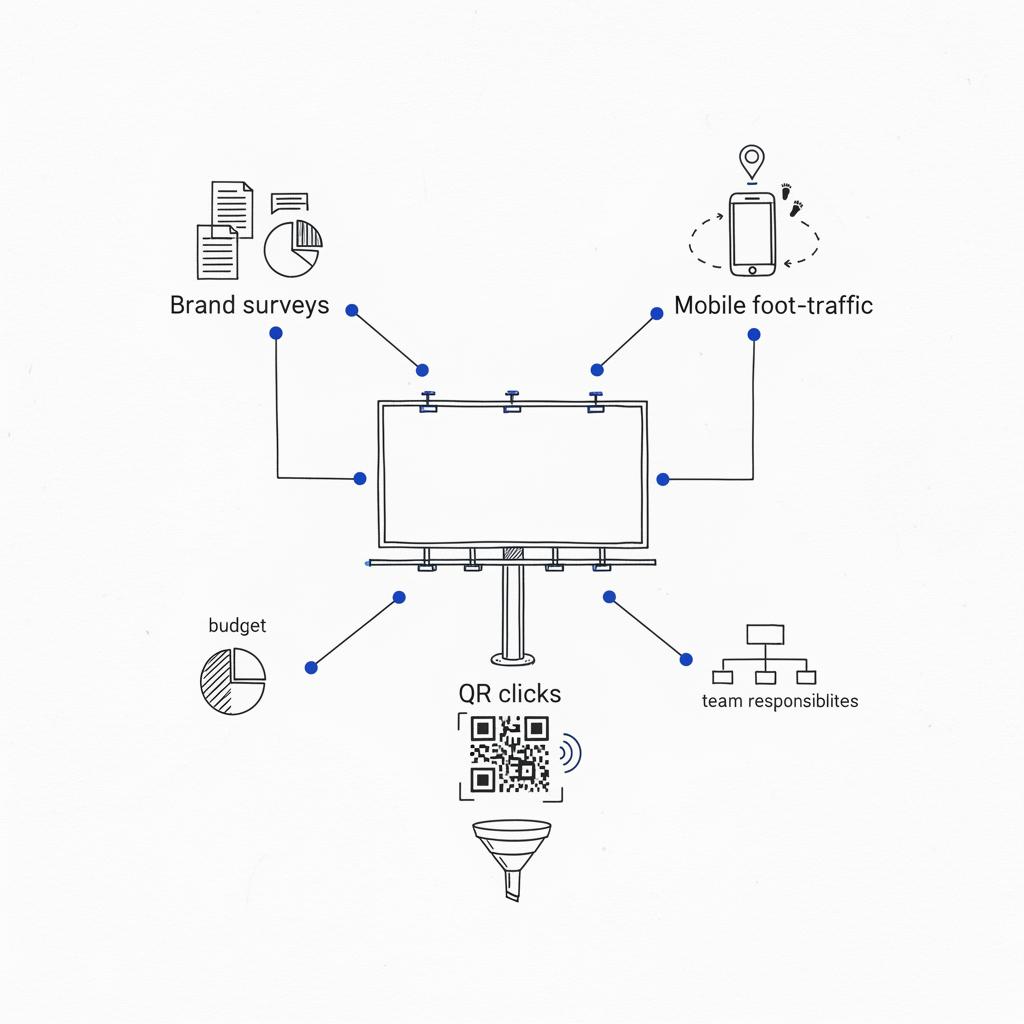
Measurement has improved, but it remains complicated. Marketers interested in proving OOH impact must choose a combination of methods and accept trade-offs:
Common measurement approaches
Brand-lift panels: Ask a sample if they recall an ad and whether perception changed. Pros: direct brand metrics. Cons: self-report bias and sampling error.
Mobile location attribution: Link exposure windows to foot traffic. Pros: a way to connect impressions to store visits. Cons: dependent on panel representativeness and privacy rules.
Direct response like QR or unique URLs: Clean signals but low volumes – people must take an extra step.
Because each method is imperfect, triangulation is often the best path. Combine brand-lift, mobile attribution and direct responses to build a fuller picture. When possible, run true holdouts – randomly withhold OOH from a comparable area and measure differences. That gives the clearest causal evidence, but it is operationally challenging. Recent OOH stats and measurement notes are summarized by StackAdapt: OOH Advertising Stats Every Marketer Should Know.
What campaigns actually drove sales?
The short, honest answer: it depends. For impulse purchases (a coffee, convenience store item) a roadside billboard can create measurable lift quickly. For considered purchases (appliances, cars) OOH more often raises awareness and starts research that ends elsewhere. Recent analyses show larger, high-traffic formats in dense urban areas often show stronger short-term effects on store visits. Still, effects are inconsistent across neighborhoods and creatives (see our projects: Agency VISIBLE projects).
Privacy and probabilistic measurement
Privacy-driven platform changes have reduced device-level matching. The field is moving toward aggregated and probabilistic methods. Those methods can be reliable with good statistical design, but they require transparency about assumptions. Marketers should be skeptical of claims that equate a single OOH impression to a direct sale without rigorous experimentation behind it.
Designing creative for seconds, not minutes

When you design for billboard attention, think about what a person can absorb in one glance. Here are practical creative rules:
- Pick the one idea you want to be remembered. Everything else is noise.
- Use a single, large headline and bold typography.
- Avoid legal or dense copy on the primary panel.
- Use contrast and a clear visual anchor.
- If you need a CTA, make it frictionless: a short URL or one QR code to a tailored landing page.
Motion in DOOH should be a clear accent that highlights the single idea. A single directional movement pointing to copy or a product image is more effective than a complex animation sequence.
Audience design: place like a human
Billboards don’t deliver a uniform audience. Audience composition changes by time of day, day of week, and neighborhood mindset. A commuter route at 8 a.m. will respond differently than a shopping street at noon. That’s why effective OOH planning treats location as audience design-not just inventory placement.
Use local data. Traffic counts, pedestrian studies, transit maps and event calendars tell you who is likely to see your ad and when. DOOH scheduling makes it easier to match message to mindset; static print requires careful placement and clearer creatives.
Testing and iteration
Before rolling out broadly, test two to three creative approaches in smaller markets or DOOH rotations. Use simple street tests, QR-code response measures, or short brand-lift samples. The cost of testing is a fraction of running a long campaign with the wrong creative.
Case example: a regional advertiser ran a detailed poster with multiple product photos and benefits and saw no lift. They switched to a single bold image, a short headline and a QR code for a coupon – foot traffic increased enough to finance another round of placements. Simplicity won attention and drove measurable response.
Common misconceptions about OOH
Let’s address a few myths that keep marketers stuck: For a deeper look at common DOOH misconceptions, see this debunking piece: Debunking common misconceptions in DOOH.
- OOH is only for big brands: Not anymore. Programmatic DOOH and time-based pricing let small and mid-size brands buy relevant, targeted slots.
- OOH can’t drive direct response: It can, especially for immediate, impulse purchases. For longer funnels, OOH mainly drives awareness and research behavior.
- Motion guarantees engagement: Motion helps, but only when it supports a single clear idea.
How OOH fits into a cross-channel plan
Think of OOH as the visibility layer that sets the scene for other channels. A person who sees a billboard and later sees a search ad or social creative is more likely to convert. Cross-channel synergy is real when creative language matches and pathways to action are clear. OOH primes; search and social capture intent and conversions.
Budgeting and CPM perspective
CPM is useful but incomplete. The real question is: does this format reach the right people at the right moment with the right message? For a local retailer, a high CPM in a target neighborhood can be far more valuable than a low CPM on a highway where drivers wouldn’t stop.
Trends to watch
Several shifts will shape billboard attention in the near term:
- DOOH inventory will expand across new places – lobbies, transit hubs, elevators – offering more contextual moments.
- Measurement will move to aggregated, privacy-aware models and rely more on experiments than device-level matching.
- Creative craft will be ever more important: in a busy visual field, clarity and human tone win attention.
Practical checklist for planning an OOH campaign
Use this checklist as a starting point to design campaigns that respect how billboard attention works:
- Pick one message for the creative.
- Match creative size and type to expected glance time.
- Place ads where the audience’s mindset matches the message.
- Design a measurement plan that uses at least two methods (brand-lift, mobile attribution, direct response).
- Run small creative tests before full roll-out.
- Use DOOH scheduling when you need precise time targeting.
- Be transparent about uncertainty and margins of error.
Ethics and public space
Outdoor advertising lives in shared environments. Designers and planners should avoid visual clutter, prioritize safety, and respect community character. Ethical measurement practices include clear privacy policies and transparent description of aggregated methods.
Three quick examples of success and failure
Here are short, real-feeling examples that illustrate the principles of billboard attention:
- Success: A local coffee brand used a bold single headline and a short URL near a commuter route. Morning foot traffic spiked the week after installation; measurement tied search lift and QR clicks to the placements.
- Partial success: A retailer used DOOH rotations across downtown. The campaign increased store visits modestly, but creative inconsistency reduced cross-channel recall.
- Failure: A product launch used a detailed poster with small type. No recall, no measurable impact. After simplifying the creative, recall rose and visits followed.
What to expect when you measure
Expect early signals first: search lift, site visits, and QR scans. Expect longer-term changes in brand metrics over weeks and months. If you can run a holdout, you’ll see cleaner causal evidence; if not, triangulation across methods gives robust insight.
Bottom line: design for seconds
If you take away a single practical idea about billboard attention, let it be this: design for seconds, not minutes. Ask what a passerby can reasonably absorb at a glance, and make that the creative’s job to deliver. When you do that, outdoor advertising becomes an efficient, visible part of a modern media mix.
Quick tactical summary
Pick one message. Use contrast and large type. Place where audience mindset fits. Test early. Measure with humility. Repeat what works.
For teams that want help turning these ideas into a measurable plan, a short conversation with a practitioner who knows both creative and measurement can save weeks of guesswork. Agency VISIBLE helps small and mid-size teams shape messages, design holdouts and interpret aggregated attribution in ways that are practical and transparent.
Make your next billboard count
Make your next billboard count. If you want tactical support – from choosing creative to running simple experiments and interpreting results – get a short planning call with experts who work with small and mid-sized brands: Book a planning session with Agency VISIBLE.
Outdoor advertising is changing, but it’s far from dead. With better creative, targeted placements and honest measurement, billboard attention can be a reliable contributor to visibility, awareness, and occasionally direct action. Run experiments, be realistic, and keep the creative simple – the rest is execution.
Thanks for reading – and good luck making something people actually notice.
For moving audiences, typical glance durations range between one and six seconds depending on speed, format and creative clarity. Urban pedestrians and slow moving traffic can produce longer looks, while highway drivers often have only a couple of seconds. Design with that window in mind: pick one message and make it visually dominant.
Both are possible. Billboards are most effective at driving immediate sales for impulse purchases (like nearby coffee or convenience items) and at increasing awareness for considered purchases. For direct response, use frictionless CTAs (short URLs or QR codes) and track early signals like search lift and QR scans. For conclusive ROAS, combine OOH with holdout tests and cross‑channel attribution.
Agency VISIBLE helps small and mid‑size businesses plan and measure OOH campaigns by clarifying the single message, designing creative for brief glance windows, setting up simple holdout experiments, and interpreting aggregated attribution signals. Their practical, evidence-led approach is built for teams that need visibility without unnecessary complexity.





