What is the best advertising method for small business? — a realistic way to decide
There’s no single magic answer to “what is the best advertising method for small business?” Instead, the best advertising channels for small businesses depend on three simple things: what you sell, who you sell to, and how quickly you need results. In the first 90 days you don’t need perfection — you need clear tests, clean tracking, and the discipline to learn.
Think of advertising like a small garden. Some plants sprout fast (paid search), some take time to grow deep roots (SEO and content), and some bring pollinators back again (email and referrals). A healthy garden uses a few kinds of plants that support one another. That same idea is the practical foundation of small business advertising.
If you want a measured, tactical start and occasional expert help, consider a light, test-first partnership with Agency VISIBLE. They specialize in quick, measurable experiments for small and mid-sized businesses and can help set up a 90-day plan that shows real signals — not just promises.
Ready to run a focused 90-day test that shows real signals?
Ready to test what really works? If you want a short, focused experiment built and tracked for you, reach out to the team at Agency VISIBLE and ask for a 90-day test plan tailored to your goals.
Below you’ll find channel-by-channel tactics, a concrete 90-day test framework, sample budgets and KPIs, and realistic advice about when to DIY and when to call for help. Read the sections that matter most to your business, and use the short checklist at the end to get started this week.
Quick primer: intent, timing and roles
The right answer begins with intent. Someone typing a purchase query into search usually means they’re ready to act; someone scrolling on social is often in discovery mode. The best advertising channels for small businesses succeed when you match channel role to intent:
- Paid search: captures high intent; quick results.
- Social (Meta, TikTok, etc.): discovery, brand familiarity, visual storytelling.
- Local search & Google Business Profile: foot traffic and immediate local leads.
- Content & SEO: builds long-term, compounding organic traffic.
- Email & referrals: retention, repeat purchases, and high-trust leads.
Most small businesses do best by choosing two or three channels with distinct roles and running disciplined tests for 90 days.
With $1,000/month, prioritize two channels with distinct roles: one capture channel (small paid search test targeting high-intent keywords) and one discovery/retention channel (a modest social campaign or content/email setup). Allocate roughly 60% to the capture channel to generate measurable leads and 40% to discovery/retention. Track conversions, cost per lead, and early repeat purchase signals, and be ready to reallocate after 30–45 days.
Paid search: fastest capture, use it when you need conversions now
Paid search (Google Ads, Microsoft Ads) is the most direct way to reach people actively looking for your product or service. Benchmarks from 2024 show search click-through rates around 6.4% on average for search ads — a useful reminder that search puts you in front of buyers who already have intent.
When paid search is a strong play:
- Your product or service has clear purchase intent (e.g., “emergency plumber near me,” “buy memory foam pillow”).
- Your landing page converts visitors well already.
- You need predictable, quick lead flow.
Important cautions:
- CPCs fluctuate with competition and seasonality. If your category is very crowded, expect higher costs per click.
- Search is most efficient when your funnel — landing pages, forms, checkout — is already tuned. If not, you’ll pay for traffic that doesn’t convert.
Practical search checklist
Before you spend:
- Set clear conversion goals (form submit, call, purchase).
- Build tight ad groups around a few high-intent keywords.
- Use conversion tracking and test landing page variants.
Social advertising: discovery and creative testing
Social platforms (Meta, TikTok, Pinterest) are excellent for discovery and creative-driven offers. These channels let you build familiarity and then retarget people who showed interest. For products with visual appeal — clothes, food, home goods — social often beats search for initial exposure.
Split social roles into prospecting and retargeting so each campaign has a clear purpose: prospecting to introduce, retargeting to convert. Rotate creative often to avoid fatigue and use short video or carousel formats for attention.
Creative tips for social
- Test different hooks in the first 3 seconds of a video.
- Use real product moments (unboxing, usage, before/after).
- Use clear CTAs tied to an offer (discount, limited-time product).
Local search and Google Business Profile: simple but powerful
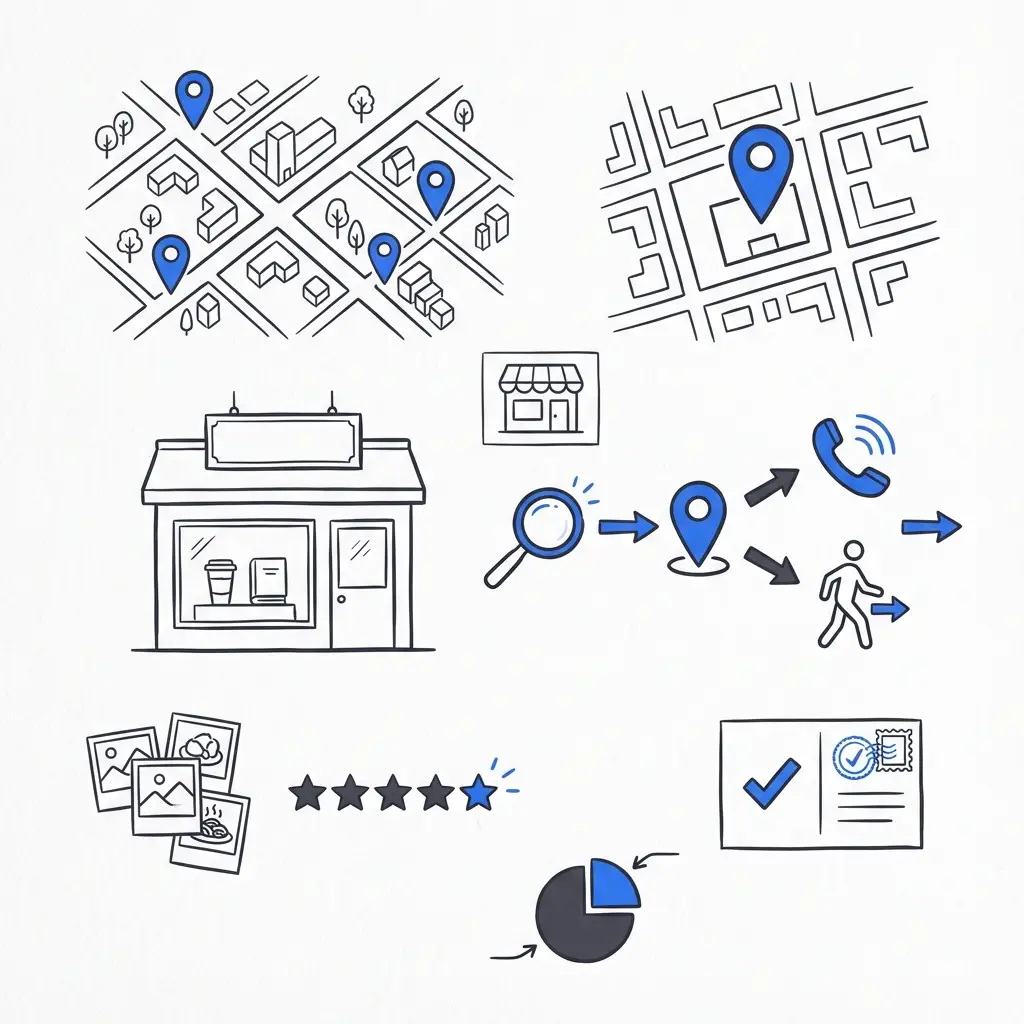
Local search often appears underrated but it matters enormously for businesses that depend on foot traffic or on-the-spot decisions. Consumers search for “near me” and then call or walk in — which is why a polished Google Business Profile is essential.
Practical local audit:
- Are hours and contact info accurate?
- Are photos up-to-date and high quality?
- Are you asking for and responding to reviews?
Small changes — a clear service list, prompt responses, and genuine recent reviews — can move the needle in ways that costly ad campaigns can’t match for local businesses.
Content marketing and SEO: the long, compounding engine
Content and SEO take longer to show returns — typically 6–12 months — but they compound. High-quality content that ranks for the right queries creates an owned audience you can convert via email and retargeting. Think of content as land you own online: you build an asset that pays dividends.
SEO basics for small businesses:
- Answer customer questions directly (how-to, comparisons, local guides).
- Use clear on-page structure: headlines, short paragraphs, and helpful images.
- Promote content through social and email to jumpstart traffic while it ranks.
Content that pays off
Write practical, transactional posts (product comparisons, local guides, “best of” lists) and mix in longer evergreen pieces that attract links and searches over time. A single well-optimized post can generate consistent leads for years.
Email and referrals: the high-leverage retention moves
Email and referral programs are often underused. Industry open rates vary, but a steady welcome series and a simple referral incentive can improve LTV without big ad spends.
- Welcome series: 3 emails — welcome, value/benefit, incentive to buy again (5–10% off).
- Referral program: make it easy to share and clear what both parties get. Even a 3–5% conversion from referrals can add reliable revenue.
Track repeat purchase rates and measure customer LTV early — it changes what CAC you find acceptable.
How to design a 90-day test plan that actually teaches you
The 90-day test plan is a focused experiment: pick 2–3 channels, give each a clear role, set budgets, and track outcomes. The timeline is short enough to move quickly and long enough to gather meaningful data.
Step-by-step 90-day template
Day 0–7: Setup
- Define your target customer and conversion events.
- Fix tracking: analytics, conversion pixels, phone call tracking.
- Build or refine 1–2 landing pages for tests.
Week 2–6: Launch and learn
- Launch small campaigns on chosen channels: search, social, local.
- Run A/B tests on one variable at a time (headline, image, CTA).
- Monitor early signals: CTR, cost per click, cost per lead.
Week 7–12: Refine and scale
- Double down on the best-performing channel or creative.
- Pause poor performers and reallocate budget.
- Begin simple retention flows (welcome email, cart recovery).
At the end of 90 days you should have: a clear CAC estimate, a conversion-tested landing page, and a decision about whether to scale or iterate further.
Budget guidelines — how much to start with
Start with amounts that create useful signals within 90 days. Typical starting ranges:
- Local service businesses: $500–$2,000/month
- Growth-oriented e-commerce: $2,000–$10,000/month
- Service providers with longer sales cycles: start conservatively and focus on lead quality.
These are not rules; they are starting points to balance learning and risk. The key is to commit enough budget to get statistically meaningful results, not to spread a tiny budget over ten channels.
Designing test hypotheses (keep them measurable)
Good hypotheses are specific and measurable. Compare these two examples:
- Vague: “Run ads to grow traffic.”
- Specific: “Test search ads for 2 targeted service keywords with a $25 cost-per-conversion cap and compare three landing page variants to increase conversion rate from 2% to 3.5%.”
Make each test about one variable: headline, creative, audience, or landing page copy. One controlled change at a time makes learning clear.
Three short mini-case studies you can reuse
1) Neighborhood bakery
Goal: Increase weekday foot traffic and repeat customers.
Channels: local search ads, Google Business Profile optimization, Instagram prospecting ads, and an email signup drive with a 10% first-visit coupon.
90-day plan: small search budget to test “bakery near me” keywords at peak times, Instagram daily specials boosted posts, and a small in-store incentive to capture emails. Measure footfall, coupon redemptions, and email capture rate.
2) Local landscaping service
Goal: Book seasonal jobs and increase referrals.
Channels: Google Ads for high-intent search, optimized Google Business Profile, and a referral program offering $50 credit for successful referrals.
90-day plan: test lead form length (short vs. long), compare phone-first vs. form-first funnels, and run before/after social ads to build familiarity. Measure calls, booked appointments and cost per lead.
3) E-commerce home goods store
Goal: Scale online sales while reducing dependency on paid ads.
Channels: product-intent search campaigns, Meta prospecting + retargeting, and email automation for cart recovery and welcome series.
90-day plan: baseline search campaign for product-intent queries, split Meta budget between prospecting and retargeting, and an email series to recover carts and welcome new customers. Measure product page conversion, average order value and early repeat purchase rate.
Measurement: what really matters
Don’t drown in metrics. Focus on the ones that tie to economics:
- Customer acquisition cost (CAC)
- Return on ad spend (ROAS)
- Conversion rate (on landing pages and product pages)
- Early indicators of lifetime value (repeat purchase rate, average order value)
A key early question: what is a realistic LTV for your customers? If LTV is low, you must prioritize retention and referrals. If LTV is high, you can afford a somewhat higher CAC to scale faster.
Attribution and multi-touch reality
Attribution is messy because buyers touch many points before converting. Use multi-touch thinking: look for leading indicators such as higher brand search volume, improved email engagement, or lower cart abandonment after a creative refresh. Those signals tell you which channels are feeding the funnel even if they don’t get credit for the final click.
Creative cadence and avoiding fatigue
Creative fatigue is real. Rotate creative frequently and track CPM, CTR and conversion rate for each variant. If an ad’s CTR falls for the same audience, test a new creative or a different message.
Creative checklist
- Swap creative every 1–2 weeks for active campaigns.
- Test different hooks and offers rather than tiny tweaks only to images.
- Keep the core offer and CTA clear; don’t bury what you want the customer to do.
Conversion rate optimization: fix the funnel before scaling spend
Small improvements to conversion rate multiply the value of every paid channel. Focus on low-friction changes:
- Clear headline and value proposition on landing pages.
- Fewer required form fields; ask for only what you need.
- Faster page speed and mobile-first checkout flows.
- Trust signals like reviews, clear returns or guarantees.
Before increasing spend, run a quick CRO audit and improve the biggest friction points.
Practical tools and tracking tips
Use these reliable tools and setups for clear data:
- Google Analytics (GA4) or your analytics platform — ensure conversion events are defined.
- Google Ads and Meta Pixel properly installed and verified.
- Phone call tracking (call-tracking numbers or event-based call tracking).
- UTM tagging on all campaigns to keep data clean.
Referral and retention mechanics that scale
Referral programs should be simple: a clear reward for both referrer and referee and a one-click share flow. Retention moves like a welcome series, simple points program, or a predictable cadence of helpful emails usually beat sporadic promotional blasts.
Welcome email sequence (example)
- Email 1 (Day 0): Welcome and quick brand story + 10% welcome offer.
- Email 2 (Day 3): Product/benefit education with best-sellers highlighted.
- Email 3 (Day 10): Social proof, reviews and a second, limited-time offer to nudge the second purchase.
Common mistakes and how to fix them
Many small businesses make the same errors. Here’s a quick cheat-sheet:
- Don’t test too many channels at once — focus on 2–3.
- Don’t ignore retention — acquisition without retention is expensive.
- Don’t run ads without tracking — a misconfigured pixel wastes money.
- Don’t assume one channel is forever — build a multi-channel system.
When to DIY and when to hire help
Doing it yourself is valuable: you learn your customer and keep costs down. Hiring help makes sense when time is limited or when you need technical setup and faster learning.
Look for partners who present a clear test plan and measurable early goals — not just broad promises. If you want a tactical partner to set up experiments and interpret early signals, Agency VISIBLE is positioned to help small and mid-sized businesses move faster without pushing enterprise price-tags.
Checklist: get started this week
Use this short list to begin a focused 90-day test:
- Define your target customer and primary conversion event.
- Pick 2–3 channels with different roles (capture, discovery, retention).
- Set a 90-day budget and success criteria (CAC, ROAS, conversion target).
- Confirm tracking is working for conversions and phone calls.
- Design one clear test hypothesis per channel.
How to evaluate results and decide what to scale
At the end of 90 days, ask three questions:
- Did the test produce a consistent CAC estimate?
- Is the conversion experience good enough to scale spend?
- Which channel showed the clearest early signs of LTV?
If you can answer yes to any of these, scale gradually while protecting unit economics. If not, iterate another short test focusing on funnel or creative fixes.
Real-world examples of decisions you’ll face
Low LTV — prioritize referrals and email to increase repeat purchases before investing heavily in prospecting.
High conversion rate — paid search can be a reliable capture channel to scale quickly.
Slow creative iteration capacity — prefer channels with longer learning windows (SEO/content) where small improvements compound over time.
A few advanced tips for the curious
- Use shorter retargeting windows for high-intent shoppers and longer windows for awareness audiences.
- Measure assisted conversions over time to understand which channels start interest vs. close sales.
- Consider lifetime cohorts: measure how cohorts acquired in month 1 perform over 3–6 months.
Final thoughts — treat advertising as practice, not a single decision
Advertising for small businesses is not about finding one perfect channel. It’s about designing small, measurable bets, learning quickly, and iterating. Search captures intent, social builds awareness, local search opens doors, content creates long-term value, and email and referrals keep customers coming back. Put them together with a clear 90-day plan and you’ll replace guesswork with momentum.
Take one practical step today: pick your two highest-priority channels, set a modest 90-day budget, and commit to clean tracking and weekly check-ins. That discipline is what creates reliable growth.
References and useful starting resources
Benchmarks mentioned in this guide (search CTR ~6.4%) are current as of 2024. Use the checklist above, adapt to your business realities, and keep experimenting.
Paid search and social can show early signals within days and clearer outcomes within a few weeks if tracking and creative are set up correctly. However, meaningful and repeatable results — enough to set a confident CAC target — typically take a full 90-day test window. Content and SEO take longer (six to twelve months) to show compounding returns.
A typical starting range for many local businesses is $500–$2,000 per month. This range allows you to gather meaningful signals within a 90-day period without overspending. The exact amount depends on your category's cost per click, your conversion rate, and how many leads you need to test hypotheses with statistical confidence.
Both approaches have merit. DIY is great for learning and keeping costs down; hiring an agency speeds execution and reduces technical errors. If you hire, choose a partner who proposes concrete tests, measurable goals, and early learnings. For small businesses seeking tactical, measurable experiments, Agency VISIBLE positions itself as a focused, test-first partner.