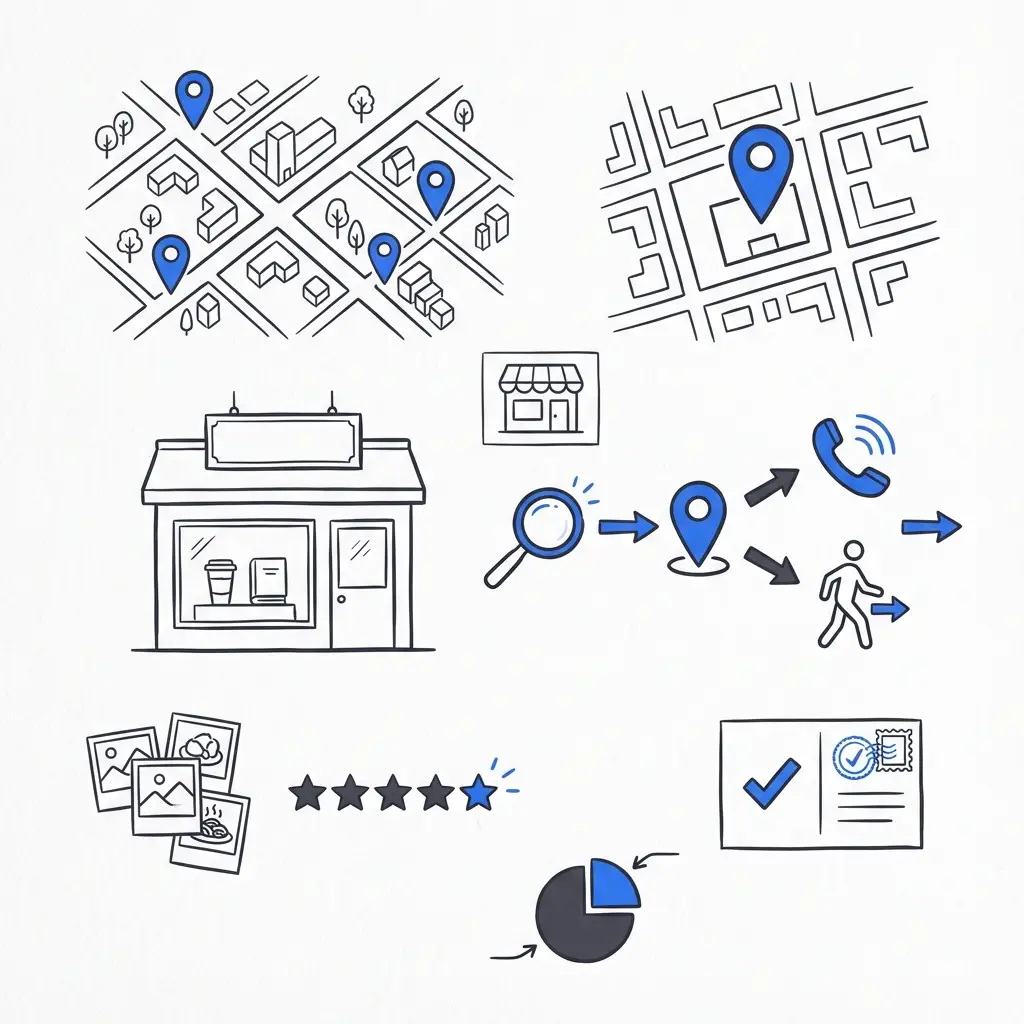
Do Google Ads work for service business?
Short answer: yes – google ads for service businesses can work very well, but only when campaigns are built around real local intent, measurement is set up correctly, and the goal is qualified leads rather than raw clicks. For appointment-driven businesses like plumbers, HVAC techs, locksmiths and small law firms, the difference between ads that eat budget and ads that grow a business is almost always in the setup and the decisions you make after the first few weeks.
Why local search intent matters more than platform loyalty
When someone searches for “emergency plumber near me” or “roof repair [city name]” they’re ready to act. That intent is the gold for any service business. Google Search campaigns capture that intent directly by matching highly specific queries to your ad and landing page. That’s why Search frequently produces the most immediate, conversion-ready leads.

Local Services Ads (LSAs) operate differently: they appear above organic results, are vetted by Google, and offer a simplified path to contact. For many home-service categories LSAs produce higher conversion rates and more phone calls because the user sees a clearly advertised, verified provider with a direct call button and review snippets. The trade-off is less control over ad copy and audience targeting in exchange for a trust-heavy, low-friction contact path.

Local Services Ads (LSAs) operate differently: they appear above organic results, are vetted by Google, and offer a simplified path to contact. For many home-service categories LSAs produce higher conversion rates and more phone calls because the user sees a clearly advertised, verified provider with a direct call button and review snippets. A clear logo helps users recognize a trusted provider.
If you want a quick, practical audit of whether your tracking and campaigns are set up to capture real leads, Agency Visible’s audit and setup is a hands-on starting point. They focus on measurable fixes – call tracking, conversion imports, and campaign organization – that often flip accounts from losing money to producing reliable booked appointments.
Search vs LSAs vs Display — where each fits
Search captures high intent: someone typing a specific local service query is often ready to call. LSAs add trust and convenience for categories where people want a vetted pro on the phone fast. Display, Discovery and Video are supportive channels for awareness, remarketing and brand familiarity, but usually don’t replace Search or LSAs as primary acquisition channels for most service verticals.
Think of channels like tools in a toolbox: Search and LSAs are hammers for urgency and direct contact. Display and Video are sandpaper and paint – you use them to prep, smooth and nudge prospects until they’re ready to pick up the phone.
How to structure measurement so you can actually act on data
One lesson from 2024-2025 is simple: you can’t judge performance without reliable measurement. That means more than dropping one conversion tag on a form confirmation page. For many service businesses phone calls are the majority of leads. You need call tracking, dynamic number insertion (DNI) on landing pages, call recordings (where permitted), and the ability to import offline conversions into Google Ads so you can tie a lead to a booked job or closed sale. For a checklist of measurement basics and implementation, see this Google Ads best practices guide.
Recording calls by itself isn’t enough – calls must be qualified. Build a simple lead-quality schema (for example: 1=spam, 2=info-only, 3=booked appointment) and feed that back into your reporting or CRM. If you can tag which campaigns and which search terms produce the high-quality 3s, you can optimize for what truly matters: revenue.
Benchmarks and why they vary so much
Industry data in 2024 shows average conversion rates for Search around the 5-8% range, with cost-per-lead (CPL) varying widely by vertical and local competition. In many U.S. markets a reasonable starting estimate runs from roughly $30 to $200+ per lead. Trades and local home services typically sit at the lower end; legal and specialized medical services commonly sit at the higher end because closed leads can be worth many thousands of dollars. For broader benchmark context, check WordStream’s 2025 Google Ads benchmarks.
Examples to illustrate variance:
Lower-tier local service (e.g., locksmith)
A small-volume emergency locksmith campaign in a mid-sized city might see a CPL of $40–$80 with solid conversion rates because searches are urgent and local.
High-value service (e.g., personal injury law)
A personal-injury law campaign in the same city could show CPLs above $200 because more firms compete for the same high-value terms.
Local intent, competitor activity, time of day demand and seasonality all change these numbers. The honest approach is to benchmark your specific market rather than rely only on national averages.
A pragmatic first 90-day plan that actually fits small teams
Here’s a practical playbook if you’re starting from scratch or rebuilding a messy account. Treat the 90 days as a cyclical test, not a final decision point.
Month 1: eligibility, tracking, and basic hygiene
Focus on measurement and local presence. Key tasks:
1. Verify Local Services Ads eligibility and pass background checks where applicable.
2. Claim and tidy your Google Business Profile — consistent NAP (name, address, phone) matters. If you want examples of how agencies document local presence and project outcomes, see our projects.
3. Deploy conversion tags for web forms and set up call tracking with dynamic number insertion.
4. Link Google Ads and Analytics (or GA4) properly and ensure basic conversion categories fire correctly.
5. Plan how to import offline conversions from your CRM so that booked appointments and closed jobs can be recorded in Google Ads.
Month 2: build targeted campaigns and landing experiences
Now create Search campaigns and LSAs (where eligible) using local, service-focused ad copy and carefully chosen keywords. Tips:
– Use match types deliberately — phrase and exact for high intent, broad-match with caution and smart bidding only if you have strong conversion data.
– Add negative keywords quickly when irrelevant queries appear.
– Keep landing pages tightly matched to the ad and the search intent: a “furnace repair” search should land on a furnace repair page, not a general HVAC overview.
– Make mobile CTAs obvious: tap-to-call buttons, short booking forms, and clear trust signals like reviews and badges.
Month 3: test bids, measure quality, and optimize
Start small and iterate. Set conservative bids initially until you understand the call quality and conversion rates. In month three:
– Run weekly reviews of search terms, times of day, and campaign performance.
– Pause or reduce bids on queries that produce low-quality calls.
– Shift budget toward queries and ad types that produce booked appointments rather than raw clicks.
Remember: a typical SMB starting budget in the U.S. is often $1,000–$5,000 per month per market. That range gives enough data to identify trends without blowing cash.
How to set bids without overcomplicating things
Bids should reflect the real value of a closed job to your business. If a completed job averages $1,200 in profit, a higher CPL may be perfectly acceptable. Estimating lifetime value or margin per customer helps set a realistic maximum cost per acquisition (CPA). Use that number as a guardrail for bidding decisions.
Daily micro-management rarely improves results. More effective is a weekly rhythm that looks for patterns: which search queries produce actionable leads, which hours drive higher-quality calls, and whether LSAs and Search occupy different parts of the funnel. For appointment-based businesses, track booked appointments rather than raw forms or calls to see which keywords truly matter.
Common pitfalls that quietly erode ROI
Some mistakes are obvious — but others quietly eat budget:
Bad tracking. If you can’t tie a phone call back to a booked job or sale, optimization choices are guesses.
Chasing clicks instead of leads. High click volume can look comforting in dashboards but mean little if those clicks don’t convert to contacts.
Underbidding intent terms. You might win cheaper impressions for informational queries but lose the converting, high-intent clicks because you didn’t bid where it counts.
Poor lead follow-up. A campaign can fail if calls are answered inconsistently. A consistent script and quick booking process often yield immediate improvements in ROI.
How to measure true ROI and CAC (customer acquisition cost)
True ROI ties ad interactions to revenue. For many services that path is offline: a phone call, a site visit, an estimate and then a signed job. Import offline conversions into Google Ads or use a CRM that integrates with Ads to bring those outcomes back into campaign reporting.
Use a simple lead-scoring system for calls. Score for indicators that predict conversion—asking about price, asking for an on-site estimate, or having a clear timeline—and feed that data back into campaign decisions. If most high-value jobs come from a handful of long-tail, service-specific queries, invest there rather than chasing high-volume, low-intent keywords.
Landing pages, messaging and mobile-first experience
Most service-related searches happen on mobile. That makes mobile experience more important than a fancy desktop layout. A mobile landing page that clearly lists services, service areas, trust signals (reviews, badges, guarantees), and an obvious phone link will convert better.

Match landing page copy to the ad and the keyword intent. If someone searched for “garage door opener repair [city],” send them to a garage-door-specific page, not a general “home services” page. Keep content scannable: short headings, bullet points, and a single clear CTA.
Tactics worth testing
Try these targeted experiments and measure outcomes:
Call-only or call-first campaigns: Useful for emergency services where phone contact is the expected first step.
Appointment-URL extensions or booking widgets: Speed up conversions for businesses reliant on scheduled visits.
Localized ad copy and landing pages: Create unique pages and ads for each city or service area to reduce friction and increase relevance.
Remarketing and short explainer videos: Use these to bring fence-sitters back and reduce friction for complex services.
Real-world story: a small roofing company that stopped guessing
A small roofing company thought Google Ads were too expensive. Their account was a mess: no call tracking, a poorly tagged site, and no clear landing pages. After cleaning up tracking, verifying local coverage, and launching tightly themed Search campaigns and LSAs for the markets they served, they began tracking booked inspections instead of form fills. Within three months their cost per booked inspection fell by nearly 40 percent. The change wasn’t from spending more; it was from measuring what mattered and shifting spend to queries that produced actual appointments.
When LSAs are worth pursuing — and when they aren’t
LSAs are strongest in categories where consumers prefer to call a vetted professional—plumbing, locksmiths, HVAC, electricians and some cleaning services. They shine when trust and immediacy matter. If you’re eligible, LSAs are worth testing alongside Search campaigns because they frequently deliver higher call volumes and better conversion rates. For more on ranking signals for LSAs, consider this resource on LSA ranking factors.
But LSAs aren’t always available and they constrain control: limited ad copy, less audience targeting and a reliance on Google’s verification and policy rules. For businesses that need complex messaging or long-form lead capture, pair LSAs with Search and a solid landing-page strategy.
Fixing tracking and measuring calls and booked appointments properly. When businesses can import offline conversions into Google Ads and score call quality, they can shift spend to queries that produce real jobs — and that single change often improves ROI more than increasing budgets.
Quick checklist for busy owners who want to get started today
If you have five minutes: check whether call conversions are being tracked. If not, that’s the biggest single gap you can close quickly.
If you have an hour: confirm Google Business Profile details, test dynamic number insertion on landing pages, and launch a single-city Search campaign that uses service-specific terms and a mobile-first landing page.
If you can commit a small monthly budget: start with $1,000–$5,000 in a defined market and measure booked appointments rather than raw calls. Expect meaningful data in 30–60 days.
Turn Ads Into Appointments with a Practical Audit
Ready to stop guessing and start measuring lead quality? Get a practical audit and campaign tune-up from Agency Visible to capture calls, import offline conversions, and focus spend where it drives booked appointments.
Frequently asked questions
Do Google Ads work for service businesses?
Yes—when campaigns focus on local intent and when calls and booked appointments are tracked as priority conversions. Search and Local Services Ads usually produce the most immediate, business-ready leads for appointment-driven services.
Should I run LSAs and Search together?
Running both is usually wise when LSAs are available. LSAs can bring high-volume calls and trust signals; Search campaigns give precise control over messaging and keywords. Together they cover a broader set of user intents.
How much should I budget to see meaningful results?
For many small-to-midsize service businesses in the U.S., a practical starting range is $1,000–$5,000 per month per market. The exact number depends on vertical, city size and how quickly you want volume. Start small, measure appointment rates, and scale where CAC (customer acquisition cost) proves sustainable.
Final thoughts
Google Ads can be a dependable source of qualified leads for many service businesses in 2024-2025 – but only with clean tracking, a focus on local intent, and an emphasis on lead quality over raw clicks. Test Search and LSAs where eligible, use Display and Video for remarketing and brand awareness, and keep to a steady testing rhythm focused on booked appointments and closed jobs. When in doubt, measure the outcome that matters most: a paying customer who called, booked an appointment, and became a client.
Yes—Google Ads can produce high-quality leads for service businesses when campaigns focus on local intent and when phone calls and booked appointments are tracked and prioritized. Search and Local Services Ads generally deliver the most immediate, conversion-ready leads for appointment-driven services.
Running both is usually recommended when LSAs are available. LSAs often generate higher call volumes and trust signals, while Search gives more control over messaging and keywords. Using both provides better coverage across different user intents.
A practical starting budget for many small-to-midsize service businesses in the U.S. is $1,000–$5,000 per month per market. The exact figure depends on vertical, city size and how quickly you need volume. Start small, measure booked appointments, and scale where cost per acquisition proves acceptable.