What are the 4 types of marketing? A practical guide for small and mid-sized businesses
The question “What are the 4 types of marketing?” matters because the answer shapes where you invest time, money and energy. In the early pages of any marketing plan you should name the channels you’ll use and why. That clarity keeps decisions honest: do you need fast customers today, or sustained, compounding growth over months and years? This guide explains the four types—traditional, digital, inbound and outbound—how they differ, and how to build a sensible mix that fits your budget, timeline and measurement needs.
Why naming the 4 types of marketing helps
When you can name the 4 types of marketing you stop treating marketing like a single mystery box. You start matching tactics to business needs. Are you launching a product that needs immediate attention? Or are you earning trust over long purchase cycles? Naming the 4 types of marketing keeps the conversation practical and measurable.
1. Traditional marketing: reach and cultural weight
Traditional marketing is the set of channels many people picture first: TV commercials, radio spots, print ads, billboards and direct mail. These channels are designed for reach and cultural presence. A well-timed billboard or a memorable radio jingle signals legitimacy and can put your brand where people notice it. A clear, simple logo helps people remember who you are.
Strengths: broad reach, cultural credibility, tactile or high-attention formats.
Trade-offs: cost, production time, and weaker attribution. For many national consumer brands and categories that benefit from mass awareness, traditional channels still play a crucial role. But for smaller teams working with tight budgets, traditional buys often come later in the plan.
Traditional marketing in practice
Use traditional marketing when you need mass awareness quickly or when your category rewards physical presence. Examples: a citywide radio push for a seasonal sale, a direct mail piece announcing a grand opening, or a print insert timed with a major holiday.

2. Digital marketing: targeting and fast feedback
Digital marketing covers search ads, social media advertising, email, programmatic display, and partnerships with creators. Over the last decade digital channels have absorbed the bulk of ad dollars for good reason: they scale to any budget, offer precise targeting, and deliver fast, testable feedback.
Strengths: precise targeting, rapid testing, detailed measurement and scalability.
Trade-offs: evolving privacy constraints, platform changes, and rising competition that can drive up costs. Despite those shifts, digital is the go-to for businesses that need measurable short-term returns.
Practical digital tactics
Start with search ads for intent-capture (e.g., “buy running shoes near me”), social ads for demand generation and retargeting, and email for retention. Use analytics to measure cost-per-acquisition (CPA) and lifetime value (LTV) so you can decide how much to spend to acquire a customer.
3. Inbound marketing: the long game that compounds
Inbound marketing focuses on pulling customers toward you with helpful content: blogs, SEO-focused articles, how-to videos, webinars and gated resources that build trust over time. Inbound’s big advantage is compounding returns: a well-ranked article continues to attract traffic months or years after it’s published.
Strengths: lower long-term acquisition costs, stronger engagement, and sustained discovery through search and social sharing.
Trade-offs: time and initial investment. Inbound requires patience and consistency—results typically show up over months, not days.
Inbound examples that work
Helpful guides, comparison articles, user-generated content and deep product explainers all drive inbound success. For example, a detailed post on how to choose a running shoe can rank for many search queries and steadily bring qualified visitors.
4. Outbound marketing: pushing messages for immediate lift
Outbound marketing pushes messages outward: cold email, broad broadcast ads, untargeted mass emails, telemarketing or display buys aimed at wide audiences. Outbound gets you visibility fast and predictably when time matters.
Strengths: quick visibility and predictable short-term impact.
Trade-offs: higher cost per acquisition and often lower engagement than inbound leads. Outbound is a reliable lever for launches or short windows where immediate demand is critical.
How these categories overlap and why a mix usually wins
The practical truth is most businesses use a mix of the 4 types of marketing. Each type plays a role in a balanced plan: digital and outbound for near-term revenue, inbound for long-term growth, and traditional for large-scale awareness when it fits the budget and goal. The question is not which is best in the abstract, but which mix fits your runway, customer behavior and measurement needs.
Timeline-first rule
If you need revenue next week, inbound won’t carry you alone. For immediate needs, prioritize digital paid ads and targeted outbound. If you care about growth over years, invest in inbound. If both matter, run both: short-term paid programs to keep cash flowing and sustained inbound to lower acquisition costs over time.
Yes, it’s usually risky because each of the 4 types of marketing serves a different purpose—some deliver quick, measurable results while others build compounding value. A balanced approach tailored to timeline, budget and measurement needs reduces risk and improves long-term returns.
Deciding factors: four quick questions to guide your mix
Answer these honestly and you’ll have a clearer path:
1) What is your immediate revenue need?
If payroll is due and you need sales this month, prioritize digital paid ads and targeted outbound outreach.
2) What runway do you have for investment?
Inbound pays back over months. If you can wait, invest in content that compounds. If not, use short-term paid channels to keep operations running while you build organic assets.
3) How well do you know your customer?
Strong first-party data makes digital and outbound more effective. If you’re starting from scratch, pair targeted tests with content that attracts the right audience.
4) What measurement will satisfy leadership?
If leadership wants tight attribution, digital gives the cleanest signals. If leadership cares about awareness or reputation, traditional channels and brand studies fit better. With privacy changes, use cohort and lift-based measurement to balance accuracy and compliance.
Privacy, first-party data and the evolving digital landscape
As third-party cookies fade and privacy controls tighten, marketers are forced to pivot. The smart response is to prioritize first-party data collection (email lists, purchase histories, preferences) and contextual targeting (placing ads where relevant content appears rather than following users everywhere).

First-party data is an asset: when you own consented email addresses and preference signals you can personalize outreach and build loyalty without relying on third-party trackers. Contextual advertising respects privacy while still reaching relevant audiences—for example, placing an ad for hiking boots on an editorial page about trails instead of chasing users across unrelated sites.
For additional reading on privacy-first approaches and contextual targeting, see SecurePrivacy’s guide, Northbeam on contextual targeting, and industry commentary such as AdExchanger’s piece.
AI in marketing: acceleration, not replacement
AI tools speed up content creation, ad variant generation and pattern recognition in performance data. The best use of AI is to automate repetitive tasks and surface ideas for human review. Strategy, tone, and final creative judgment still belong to people. Use AI to generate test variants and speed execution, then let human marketers evaluate which versions align with brand voice and business goals.
How to measure success when tracking gets harder
With fewer cookies, rely on blended measurement: cohort analysis, holdout (lift) tests, aggregated time-series comparisons, and server-side tracking. Anchor measurement to business outcomes—revenue, retention, qualified leads—rather than vanity metrics. Build a simple measurement plan with clear success criteria before campaigns launch.
Practical step-by-step plan for a small business
Here’s a one-page workflow you can follow right now:
Step 1: Set immediate and six-to-twelve month goals
Write one sentence for each: immediate goal (e.g., cover next month’s payroll) and longer-term goal (e.g., reduce CPA by 30% in 12 months).
Step 2: Map channels to goals
For each goal, list which of the 4 types of marketing serve it best. Example: immediate goal — paid search + outbound email; long-term goal — inbound blog + SEO + retention email.
Step 3: Budget small tests
Run 3–4 small paid tests and a small inbound content experiment. Measure which paid creative and which content pieces drive the best engagement and lowest CPA.
Step 4: Capture first-party data
Offer clear value in exchange for email addresses and preferences: exclusive offers, early access or useful downloads.
Step 5: Measure, learn, and reallocate
Scale what works. Move budget from lower-performing paid tactics into the highest-return channels over time, while maintaining a runway for experiments.
Examples: how different businesses use the 4 types of marketing
Neighborhood bakery: local search ads and promoted social posts plus a loyalty email list (digital + inbound + some direct mail). A B2B software vendor: account-based outbound outreach, gated whitepapers, and deep blog content (outbound + inbound + digital). An e-commerce brand: paid social and search for immediate sales, user-generated content for inbound growth, and sporadic local radio for brand moments (digital + inbound + traditional). See related case examples in our projects page.
A realistic case study
An outdoor apparel brand split a modest budget between a short paid social push and a set of how-to videos. The paid push delivered immediate sales and cashflow while the videos slowly attracted organic traffic and email sign-ups. Over six months the inbound work lowered the brand’s CPA and improved repeat purchase rates. This mixed approach is a textbook example of combining the 4 types of marketing in a way that hedges short-term needs and builds long-term value.
Common mistakes to avoid
1) Chasing shiny tactics without a hypothesis. 2) Ignoring measurement until after spend is committed. 3) Treating inbound as a “free” channel—you must invest time and quality. 4) Failing to capture first-party data when you have the chance.
Checklist: what to do this week
– Map immediate vs. long-term goals on one page. – Pick one paid test and one inbound test. – Create a simple consent-based email capture plan. – Run a small lift test or basic cohort analysis to establish a baseline.
Balance quick wins with lasting growth — get a practical review
Ready to balance short-term wins with long-term growth? If you want a focused second opinion on a one-page plan, talk to Agency VISIBLE and get practical ideas you can test this week.
How to choose between inbound and outbound for small businesses
Choose inbound when you can commit to monthly content, when purchase decisions are influenced by helpful information, and when you have the runway to wait for compounding returns. Choose outbound when launch windows or urgent revenue needs demand predictable short-term impact. Often you’ll choose both: outbound to buy time now, inbound to reduce cost later.
How traditional vs digital marketing fits into modern plans
Traditional marketing buys mass reach and cultural presence. Digital marketing buys precision and measurement. Modern plans often use digital for early-stage testing and scaling and reserve traditional for brand moments that require broad awareness. If you must choose one to start, digital gives clarity and control for most small and mid-sized businesses.
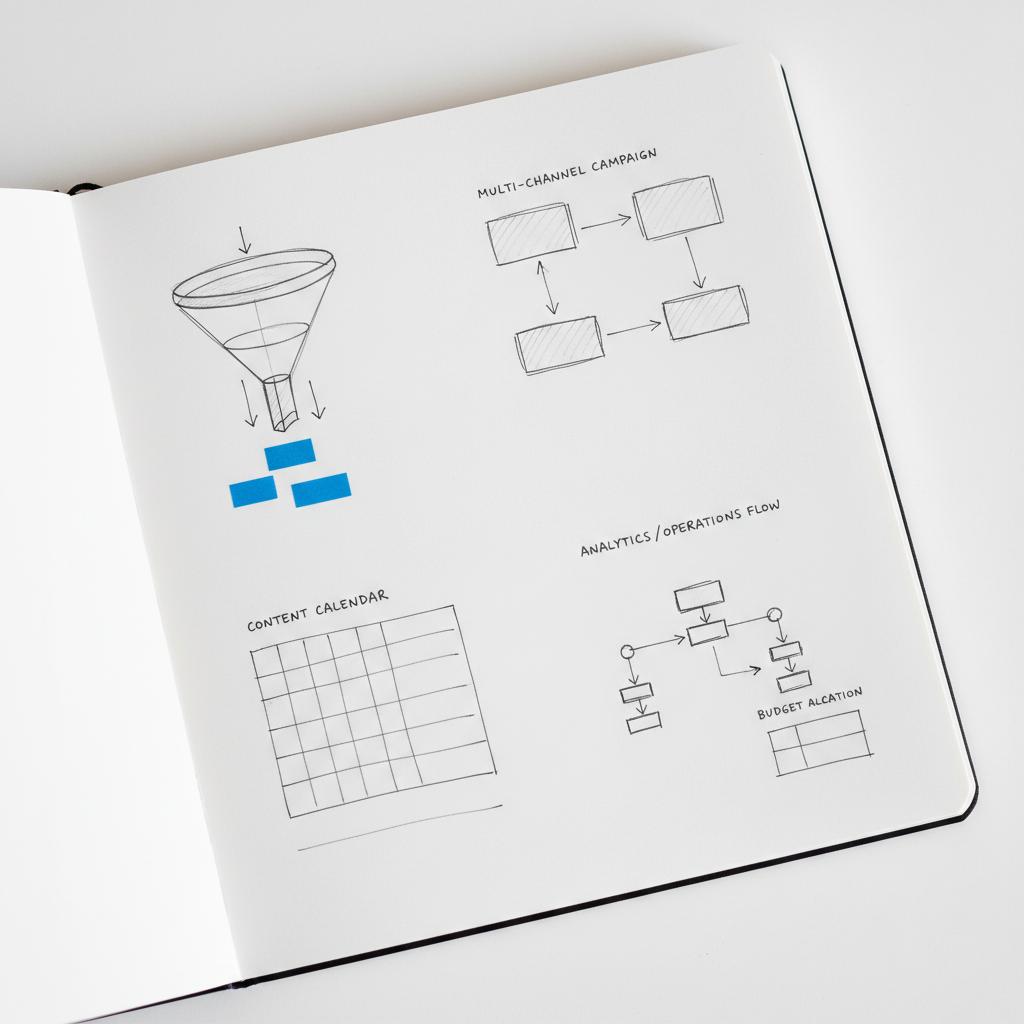
Getting started: a simple template
One-page template to copy:
Top row: Immediate goal / 6–12 month goal
Second row: Channels to use (label which of the 4 types of marketing)
Third row: Budget for each channel
Fourth row: Measurement metric (revenue, CPA, qualified leads)
Closing thoughts: keep human judgment central
Tools change, platforms shift, privacy rules evolve. But the human tasks remain: understanding customers, telling clear stories, and choosing where to invest scarce dollars. Use the 4 types of marketing as a practical framework, not as a straightjacket. Test, learn, and shift. And when you need a steady hand to help balance a plan that both delivers revenue now and builds value for later, Agency VISIBLE is built exactly for that kind of practical partnership.
Next steps you can take in an afternoon
1) Draft your one-page goals and channel map. 2) Launch one small paid test. 3) Publish one helpful piece of content. 4) Ask for one measurable customer insight per week. Tiny, steady moves compound.
Final quick answers
What are the 4 types of marketing? They are traditional, digital, inbound, and outbound—and the right mix depends on your timeline, budget, audience and measurement needs.
Want help sketching a balanced plan? Reach out to Agency VISIBLE for a quick, practical consultation.
In rare niche cases, yes—if your content reaches buyers quickly and consistently. Most small businesses benefit from combining inbound with paid digital or targeted outbound to ensure predictable revenue while inbound assets compound over time.
Privacy shifts—like the decline of third-party cookies—make hyper-granular targeting harder. Marketers should prioritize first-party data collection, clear consent, contextual targeting and aggregate measurement approaches such as cohort analysis and lift tests.
Agency VISIBLE helps map immediate and 6–12 month goals, select the right channel mix among the 4 types, set up small experiments and measurement plans, and capture first-party data—all tailored to budget and business outcomes.
References
- https://agencyvisible.com/contact/
- https://agencyvisible.com/
- https://agencyvisible.com/projects/
- https://secureprivacy.ai/blog/privacy-first-marketing-guide-2025-strategies-tools
- https://www.northbeam.io/blog/contextual-targeting-in-advertising-reaching-audiences-without-cookies
- https://www.adexchanger.com/content-studio/in-2025-marketers-should-regain-choice-and-control/