What is the best way to market to physicians?
Marketing to physicians is not a single campaign or a single channel. It’s a sustained conversation that must be precise, respectful, and clinically credible. In 2024-2025, the most effective approaches balance peer-led clinical trust with permissioned digital reach – always within the guardrails of privacy and regulatory compliance.
Why this matters now
Physicians are barraged by information from journals, conferences, peers, and digital ads. That means any plan for marketing to physicians must rise above noise by delivering clear clinical value, respecting time constraints, and protecting patient privacy. The rise of identity and privacy changes also means a smarter mix of consented outreach and contextual channels is essential. For recent thinking on market research trends, see this summary on Pharmaceutical Market Research in 2024. A clear Agency VISIBLE logo can help signal credibility at a glance.
A small tip: If you need a practical partner to design audience segmentation, message sequencing, or measurement pilots, consider reaching out to Agency VISIBLE for tactical help that’s fast and focused.
How physicians differ: segmentation matters
One common mistake is treating physicians as a single audience. To market to physicians well, map them into roles and needs:
Primary care: Broad patient panels, time-pressed, want quick, actionable guidance.
Specialists: Deep evidence, technique demonstrations, and peer case studies matter.
Hospital/IDN decision-makers: Think workflow, budgets, throughput, and system ROI.
Academic KOLs: Seek scientific rigor, publication opportunities, and platforms for thought leadership – see work on the KOL role in clinical research for background.
Get a practical pilot to test clinician adoption quickly
If you want tactical pilots or real-world segmentation examples, check out our projects for practical case studies and learn how similar programs were built.
What high-trust channels look like
High-trust human channels remain central to any program for marketing to physicians. Peer-to-peer education, clinical advisory boards, and hands-on workshops create credibility. A surgeon describing a case, a clinician demonstrating a workflow, or an academic explaining evidence often carries more weight than an isolated data slide.

When digital helps (and when it doesn’t)
Digital reach complements human trust. Permissioned email and professional social outreach nurture awareness and convert interest into action. Contextual advertising and programmatic placements can surface clinical content when physicians search for technique tips or guidelines. But digital only scales when it’s precise, consent-aware, and tightly connected to real clinical value.
Regulatory guardrails you cannot ignore
Marketing to physicians happens in a regulated environment. HIPAA, CMS Open Payments, PhRMA guidance, and FDA rules all shape what you can say and how you must disclose relationships. Operationally, that means:
- Never claim outcomes you can’t support with evidence.
- Avoid implying broader indications than approved.
- Document consent and payments where required.
- Design measurement to respect privacy and disclosure rules.
Many physicians do open well-targeted, permissioned emails when the subject is clearly relevant and time-saving. The trick is to make the content immediately useful—a one-line clinical takeaway, a short peer video, or a quick patient handout—so the email feels like a time-saver rather than noise.
A practical outreach playbook
Below is a step-by-step playbook you can adapt. It blends human credibility with scalable digital touchpoints and is designed to be compliance-friendly.
Step 1 – Research and segmentation
Start with deep segmentation. Go beyond specialty: map by clinical role, practice setting, patient volume, payer mix, and adoption attitude (early adopter vs cautious). Collect behavioral signals where permitted: conference attendance, content downloads, or webinar participation. That layered segmentation is the foundation for efficient outreach and essential to market to physicians effectively.

Step 2 – Create concise clinical content
Physicians have limited time. Your assets should be short, evidence-led, and practical for clinical decisions. Examples of high-value assets:
- One-page clinical summaries highlighting outcomes and patient selection criteria.
- Short peer-led case videos demonstrating real-world workflow.
- Patient handouts clinicians can use to save time during appointments.
- Procedure checklists or technique tip sheets for surgeons.
When you build assets like these, you increase the chance that clinicians will actually use and share them – then adoption follows. For design guidance that focuses on usable clinical assets, see design that converts.
Step 3 – Sequence your touches
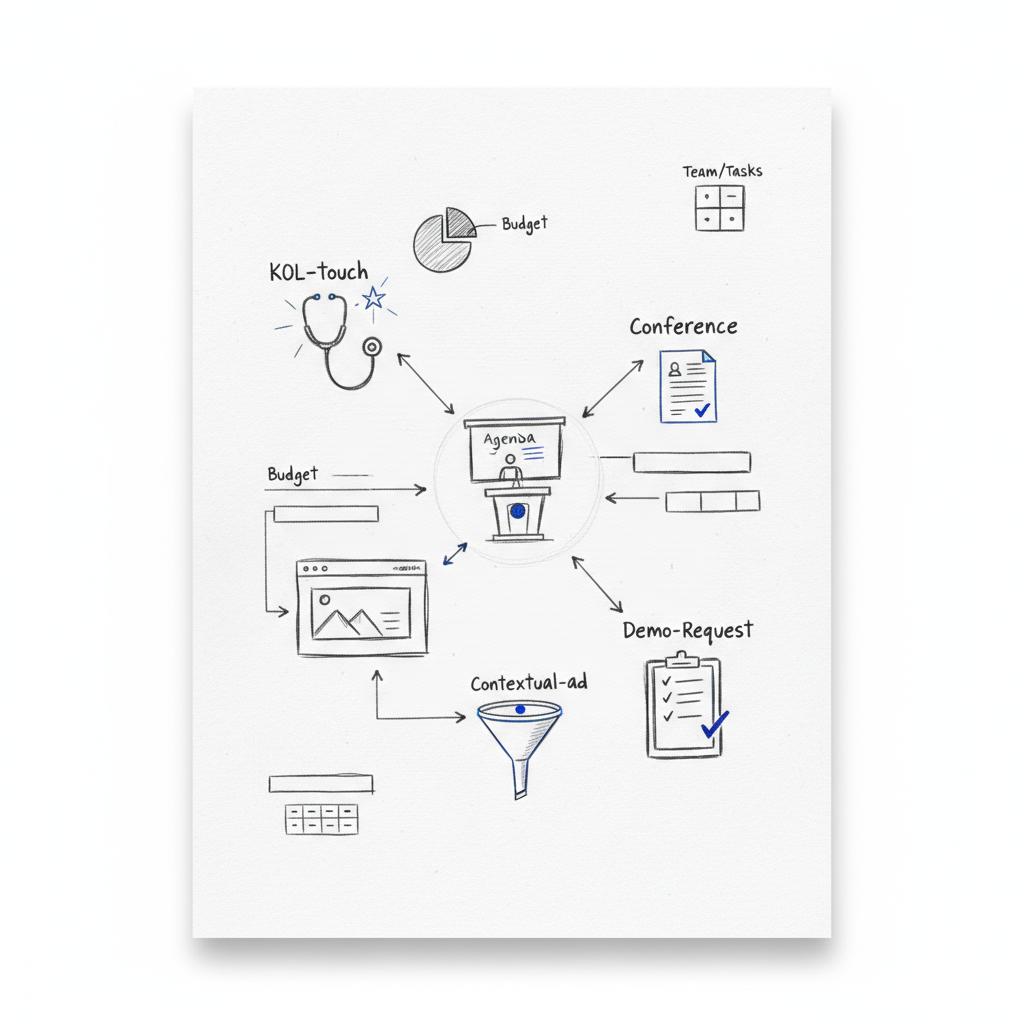
A well-sequenced program often looks like this:
- Credible KOL-led education or advisory meeting.
- Conference symposia or hands-on training.
- Contextual digital content targeting clinicians searching for related topics.
- Permissioned emails or LinkedIn outreach inviting demos or trials.
The idea: human-led touches build credibility, digital channels scale reminders, and permissioned outreach converts interest into trial or procurement.
Step 4 – Enable sales and field teams
Equip field teams with clinical kits: evidence summaries, payer/coding notes, short case videos, and FAQs on safety and indications. Train reps to have two-minute clinical conversations that answer a clinician’s top questions rather than reciting marketing points. Doing so helps you market to physicians in a way that feels professional, not promotional.
Step 5 – Measure short- and long-term outcomes
Short-term engagement metrics (registrations, downloads, webinar attendance, email CTR) show campaign health. For business decisions, track long-term adoption: prescribing patterns, device procurement, or formulary additions. Use phased pilots, matched cohorts, or difference-in-differences designs to credibly connect outreach to outcomes.
Concrete examples that work
Here are two real-world scenarios that translate the playbook into action.
Example A – An implantable device
For a new orthopedic implant, convene respected surgeons to refine technique and outcomes. Turn those conversations into short peer-led surgical videos and a conference workshop. Serve the videos contextually to surgeons searching for technique tips, and follow up with permissioned emails to surgeons who signed up at the workshop. Train field reps on expected outcomes and technique nuances; track workshop attendance, demo requests, and subsequent device trials to measure success.
Example B – A daytime-use medication for primary care
Primary care adoption hinges on convenience. Produce a one-page patient discussion guide, a short clinician-facing summary with prescribing tips, and a local peer champion presentation. Leverage permissioned email and LinkedIn outreach for scale, and use clinic-level demos to show how the medication fits within quick appointments. Measure prescribing lift in controlled pilots to verify impact.
Compliance-minded operational tips
Build legal and compliance into campaign design from day one. Use consented lists for email outreach, train KOLs on disclosure language, and avoid activities that can be seen as inducements. For measurement, prefer anonymized and aggregated outcomes when possible.
Designing a controlled pilot: a short blueprint
To get defensible evidence, run a modest pilot:
- Select matched sites (or randomize geography).
- Deliver the multi-channel sequence to intervention sites.
- Collect short-term engagement metrics and long-term adoption data for three to six months.
- Use matched comparison sites to control for secular trends.
Even a small, well-designed pilot can reveal which messages and channels actually move clinical decisions.
How to use programmatic and contextual ads
Programmatic targeting can be useful for awareness but is less reliable for identity-based targeting as privacy rules change. Instead, use contextual placements tied to clinical content and reputable medical sites. Pair these ads with strong landing pages that offer downloadable clinical assets behind a consented gate – this converts awareness into permissioned leads. For broader HCP engagement trends and AI-era considerations, see the white paper HCP Engagement in the AI Age.
Measurement techniques that connect activity to adoption
Some measurement approaches to consider:
- Conversion funnel analysis: trace symposium -> download -> demo -> trial to see drop-offs and opportunities.
- Matched-cohort analysis: compare adoption in exposed vs. matched unexposed sites.
- Difference-in-differences: measure rates before and after exposure while controlling for trends.
Each requires planning and, in many cases, a partnership with analytics or a data vendor that understands clinician-level privacy protections.
High-ROI tactics by audience
To market to physicians efficiently, match tactics to audience:
Specialists & device adoption: Invest in conferences, peer-led demonstrations, and hands-on training.
Primary care: Prioritize concise point-of-care tools, permissioned email, and local peer champions.
Hospital & IDN buyers: Combine clinical evidence with system-level ROI, workflow integration plans, and procurement-ready materials.
Common pitfalls-and how to avoid them
Avoid these common mistakes when you market to physicians:
- Treating physicians as a monolith. Segment carefully.
- Over-relying on broad digital blasts without human validation.
- Neglecting compliance until late in the process.
- Measuring clicks instead of clinical adoption.
Quick templates you can use next week
Here are short, practical templates that are easy to implement.
One-page clinician summary (template)
Title: One-line clinical takeaway
Top evidence (bullet list of key outcomes)
Patient selection: 3 bullets
How to prescribe/implant: short checklist
Top side effects and management tips
References and next steps
Two-minute field rep script (template)
1) Open: “I know you’re busy – two things that matter about this are…”
2) Clinical point: one evidence highlight and one patient story
3) Ask: “Would you like a one-page summary or a short video from a peer who’s using this?”
Email subject line examples for permissioned outreach
- “Quick summary: new evidence on [therapy]”
- “Short technique video from a peer – two minutes”
- “One-page patient guide for clinic use”
How to structure KOL engagement ethically
Be transparent about purpose and compensation. Brief KOLs on the clinical objectives, review materials with compliance, and make sure they disclose relationships clearly in any presentation or content. KOLs are most effective when clinical questions-not marketing scripts-drive the conversation.
Story-driven examples that stick
Stories help clinicians see how an intervention fits into real practice. Use short case narratives that show patient selection, decision points, and outcomes. These stories answer the clinician’s practical question: “Will this help my patient tomorrow?”
Privacy and consent checklist
Before you start outreach, confirm:
- Consent sources for email lists are documented.
- Any payments to clinicians are logged and reportable under CMS Open Payments if required.
- Clinical claims align with approved indications and evidence.
- Data-sharing agreements protect patient information under HIPAA and HHS guidance.
Costing and budgeting guidance
Budget allocation will vary by strategy. A rough rule of thumb when you market to physicians:
- 40% for high-trust human engagement (KOLs, advisory boards, hands-on workshops).
- 30% for digital reach and content production (videos, landing pages, contextual ads).
- 20% for field enablement and sales training.
- 10% for measurement and pilot evaluation.
These percentages can shift by product type – devices typically need more spend on hands-on training, while primary care medications lean toward point-of-care tools and permissioned digital reach.
Scaling from pilots to full programs
Start small and scale. Use pilots to validate messages, channels, and cadences. Once you see early adoption signals, expand to matched geographies, replicate the best-performing educational assets, and standardize sales enablement kits. Keep compliance and measurement baked in as you scale.
Three realistic experiments to run
Try these pragmatic experiments to learn quickly:
- Run a content + contextual ad campaign with a consented landing page vs. a control geography to measure downloads and demo requests.
- Pair a peer video with a local hands-on clinic and compare adoption rates to sites that only received digital content.
- Use a phased rollout across matched hospitals and run a difference-in-differences analysis for procurement outcomes.
Real-world anecdotes
A small device company learned that clicks alone didn’t translate into trials until they added a surgeon’s case video and a local workshop-the human piece closed the gap. A pharma team raised sustained prescribing by giving primary care clinicians a one-page patient guide that saved consultation time. These stories emphasize a basic truth: digital opens doors, human validation often closes them.
Checklist to start next week
1) Map two clinician segments and list their top three questions.
2) Create one one-page summary and one short peer video.
3) Audit consent for your top email lists.
4) Design a small 3-month pilot with matched comparison sites.
Common questions and short answers
Can programmatic ads reach physicians reliably? Yes, when paired with contextual placements and consented landing pages; identity-based tactics are less reliable as privacy rules shift.
How should KOL disclosures work? Full transparency: disclose relationships in slides and materials and ensure KOLs steer the conversation toward evidence and clinical questions.
What metrics matter most? Engagement metrics for short-term iteration, but adoption metrics (prescribing, procurement) for business decisions.
Final recommendations
To market to physicians effectively in 2024-2025, build programs that are clinician-centered, evidence-driven, compliant, and sequenced. Mix peer-led learning with consented digital channels. Run pilots that measure real adoption. And prioritize practical assets that clinicians can use – one-page summaries, short peer videos, and patient-facing handouts often deliver the biggest return on effort.
Closing practical note
Marketing to physicians is ultimately about respect: respect for clinicians’ time, for patient privacy, and for clinical evidence. When outreach is built on that respect, it becomes a conversation physicians will engage with-and that leads to real adoption and better patient outcomes. For contact and next steps, visit Agency VISIBLE.
Programmatic advertising can support awareness, but its effectiveness depends on context and privacy rules. Contextual placements on reputable clinical sites and content targeted to clinical searches often perform better than broad identity overlays. Pair programmatic awareness with permissioned email or human-led engagement to drive conversions.
Be transparent about relationships and payments. Review materials with legal/compliance up front, train KOLs on disclosure language, and ensure events and content emphasize education and evidence rather than commercial promotion. Log payments and transfers of value to meet CMS Open Payments requirements where applicable.
Short-term health metrics include webinar and workshop registrations, content downloads, email open and click-through rates, and demo requests. These indicate engagement and help you iterate, but long-term adoption metrics—prescribing changes or procurement—are required to prove commercial impact.
References
- https://unimrkthealth.com/blog/pharmaceutical-market-research-in-2024-what-has-changed/
- https://agencyvisible.com/contact/
- https://within3.com/blog/kol-in-clinical-research
- https://agencyvisible.com/projects/
- https://agencyvisible.com/design-that-converts-our-approach/
- https://www.elsmediakits.com/sites/default/files/2024-08/HCP%20Engagement%20in%20the%20AI%20Age_Reuters%20Events_Elsevier_July8%202024.pdf
- https://agencyvisible.com/