The timing advantage: why minute-level scheduling matters on TikTok
best time to run TikTok ads is one of the most asked questions from marketers building campaigns. The short answer is: there’s no single magical hour – but there are patterns you can test, measure, and use to improve conversions without reworking your creative.
TikTok is a stream of short, habit-driven video. People open the app to be entertained, to kill time between tasks, and to discover things. That means attention appears in waves: short, sharp windows when viewers are relaxed and receptive, and periods when they’re distracted or facing heavy ad competition. If you place your ad into a receptive window, it costs less in wasted impressions and converts more often.
Start with a hypothesis, not a rumor
Headlines promising a single “best time to post TikTok ads” are tempting but misleading. What matters first is: who are you talking to, where they live, and what you’re trying to achieve. Use regional and audience-level instincts to set up controlled tests. Treat timing as a hypothesis – and then test it.
If you prefer hands‑on help, consider Agency VISIBLE’s campaign support — a pragmatic way to set up rigorous dayparting tests and translate findings into repeatable budget shifts without overcomplicating your stack.
Reliable patterns to use as starting points
Large-scale analyses from 2024-2025 point to consistent engagement clusters that work as starting points for tests: See large-scale analyses from Sprout Social, Buffer, and Hootsuite.
- Local evenings (17:00–23:00): Often the highest-engagement window for general audiences.
- Weekend mid-days (10:00–16:00): People browse more leisurely and discover new content.
- Gen Z late nights: Later windows, sometimes past 23:00, are common for younger audiences.
- Working adults: Spikes at lunch and after work – good for consideration and direct response.
These are averages – not rules. Different niches, countries, or subcultures behave differently. Use these patterns as a compass to set up experiments.
Get a quick dayparting setup with expert help
Need help running dayparting tests quickly? Contact Agency VISIBLE to set up a pragmatic test framework and start learning fast.
How timing changes campaign economics
Expect trade-offs. When engagement rises, competition usually rises too, which increases CPM. But higher CPM isn’t inherently bad: if the evening window delivers far higher conversion rates, a higher CPM can still give a lower CPA and better ROAS. Conversely, off-peak hours can be cheaper but less likely to convert.
Which metrics to watch together
Look at a set of metrics rather than one in isolation:
- CPM — how much you pay to reach people.
- CTR — does the creative get attention?
- Conversion rate — are clicks turning into the outcome you want?
- CPA / ROAS — the business-level outcome that matters.
If CPM rises but CPA improves, higher cost per thousand may be worth it. If CTR is high but conversions are low, check the landing experience before changing schedule.
Simple dayparting test you can run today
Testing timing does not require new creative. Use the creative you already know works and vary only the delivery windows. Here’s a practical template – no spreadsheet wizardry required.
Dayparting test template (step-by-step)
Follow these steps exactly to keep the experiment clean:
- Pick your objective: awareness, traffic, or conversions. Your success metric informs sample size.
- Choose your market and set local timezone: in Ads Manager use the timezone for the market you’re testing.
- Duplicate the ad set twice: keep creative, bid, budget, and audience identical.
- Set delivery hours: ad set A = midday block (e.g., 11:00–15:00 local), ad set B = evening block (e.g., 17:00–23:00 local).
- Decide sample size and run time: for many accounts, 2–4 weeks covers weekday and weekend behavior. For conversion goals, aim for dozens to hundreds of conversions per variant.
- Measure consistently: compare CTR, CPM, conversion rate, CPA, and ROAS. Segments by age, placement, and geography help find pockets of over-performance.
Don’t change more than one variable at a time. If you tweak creative and delivery simultaneously, the test won’t tell you which change drove results.
Practical rules for test lengths and budgets
How long should a timing test run? It depends on volume.
- Awareness tests: impressions in the low thousands can be informative. A one- to two-week run is often sufficient.
- Conversion tests: plan for enough conversions — dozens to hundreds — so results are less noisy. That typically means two to four weeks for small- to mid-size accounts.
- High-volume accounts: you can reach confidence faster but still sample across weekdays and weekends.
If traffic is low, extend the test rather than increasing variables. Patience beats noisy decisions.
Creative and format: pair them with timing
Timing and creative are partners. Think about the viewer’s mood at different hours and match the tone of your ad:

- Late-night discovery: short, playful, surprising clips that ask for a laugh or a share.
- Lunch break: clear benefit-driven creative and quick CTAs — people make deliberate choices.
- Evening consideration: demos, social proof, or discounts when people relax and consider purchases.
Also consider placement: in-feed ads blend with content and can benefit from passive browsing hours; more forceful formats can reach people at a variety of times but often at higher prices.
Scheduling across timezones without losing control
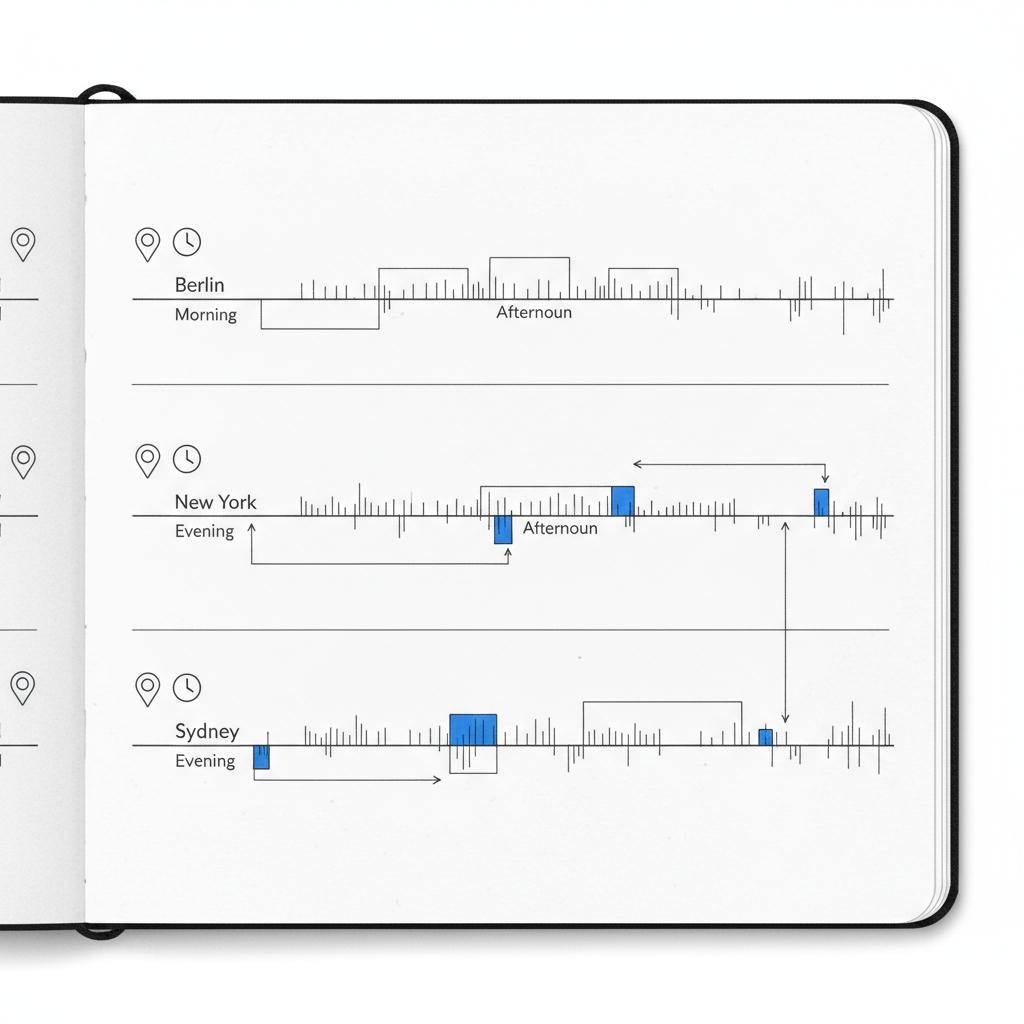
If you sell in multiple countries, use local-time scheduling. TikTok Ads Manager lets you set delivery windows by timezone so an ad can run at 19:00 Berlin and also at 19:00 New York in local time – without being tied to the advertiser’s account timezone.
Map your top markets and treat each as a mini-account for scheduling clarity. That will make your reporting easier and reveal whether a winning message in one city wins in another.
Quick checklist for multi-timezone scheduling
When planning a multi-market schedule, follow this checklist:
- Set timezone per market in Ads Manager
- Duplicate ad sets per market rather than relying on one global clock
- Test the same windows across markets to compare performance
- Keep creative wins consistent, but localize messaging when necessary
Example templates you can copy
Here are three real-world templates you can paste into Ads Manager as a starting point.
Template A: Evening vs Midday (general consumer goods)
Ad set 1: 11:00–15:00 local (midday) — Objective: conversions — Budget split 50/50
Ad set 2: 17:00–23:00 local (evening) — Objective: conversions — Budget split 50/50
Run for 21 days, measure CPA and ROAS.
Template B: Gen Z discovery test (entertainment / fashion)
Ad set 1: 14:00–20:00 local — Ad creative: playful short hook — Budget 60%
Ad set 2: 22:00–02:00 local — Ad creative: late-night vibe, shareable clip — Budget 40%
Run for 14 days and prioritize CTR and add-to-cart events.
Template C: Global roll-out across timezones (multi-market)
Duplicate top creative per market. For each market run: 12:00–14:00 and 18:00–21:00 windows for two weeks. Compare segments by country and age.
Interpreting the results: what to trust
When your test finishes, read the data with this rubric:
- High CTR + high conversion: clear winner — increase budget.
- High CTR + low conversion: check landing page and offer clarity before shifting budget.
- Low CTR + low CPM: good for reach but weak for direct response.
- Higher CPM + better CPA: acceptable if business outcomes improve.
A practical threshold: if one window shows 20–30% better CPA consistently over multiple days and segments, treat it as a reliable signal and reallocate budget gradually.
Think of TikTok as both. Morning and midday can act like coffee: purposeful, short bursts of attention especially for working adults. Late night is the midnight snack: relaxed, discovery-focused browsing common among Gen Z. Test both styles: clear, benefit-driven creative for midday and playful, shareable clips for late night. Use identical creatives across windows to see which mood converts better.
Common mistakes that waste budget
Budget gets wasted in a few predictable ways:
- Stopping tests too soon — a Wednesday-only snapshot misses weekend habits.
- Changing multiple variables at once — creative and timing changes together create noise.
- Using advertiser timezone instead of user local time for multi-market campaigns.
- Not segmenting results — averages can hide pockets of strong performance.
Seasonality, events and platform shifts
Remember that daily patterns shift across seasons, holidays, school calendars, and major events. What works in January might be different in July. Keep a calendar of market-specific events and plan tests around them. Also monitor platform updates: changes in ad inventory or algorithm tweaks can shift CPMs and engagement.
Advanced tips for optimization
Once you find a promising window, use these advanced tactics:
- Micro-segmentation: split by age or city within the winning window to find hyper-performing pockets.
- Creative sequencing: serve discovery creative first in the late-night window and follow up with direct-response creative during the evening consideration window.
- Placement optimization: test in-feed versus other supported placements to see where the window performs best.
- Adaptive budgets: gradually increase budget to winning windows rather than shifting all at once — this avoids market shocks and keeps CPMs manageable.
Real, anonymized case study
A mid-sized apparel brand that was running ads evenly across afternoons and evenings ran a simple test: identical creative and audience, two time windows. After 21 days they discovered the 19:00–23:00 window produced a 35% lower CPA for their 18–24 segment while midday hours had lower CPM but weaker conversion. They reallocated budget to evening for that age group and maintained a small midday test budget to keep top-of-funnel discovery going. Over the next month they saw improved sales without higher total ad spend.
Practical checklist to launch a timing test today
Use this checklist to avoid the common errors:
- Choose objective and success metric (CPA, ROAS, CTR)
- Set local timezone per market in Ads Manager
- Duplicate ad set and only vary delivery hours
- Run for 14–28 days depending on volume
- Measure CTR, CPM, conversion rate, CPA, and ROAS
- Segment results by age, placement, and geography
- Reallocate budget gradually to winners

When to call in help
Timing tests are low-risk and usually inexpensive. But if you want to move faster, avoid false positives, or scale learnings across many markets, a partner speeds implementation. Agency VISIBLE combines strategy and execution — they design tests, manage dayparting, and translate findings into campaign structures that scale. See examples of their work on the projects page.
Myths and quick answers
Myth: There is one perfect hour for all ads.
Answer: No — it depends on audience, market, and creative.
Myth: Always run ads at peak engagement.
Answer: Not always. Peak engagement can mean higher competition and higher CPMs; balance CPM with CPA and conversion rate.
Final playbook: an easy path to smarter scheduling
Start small, test deliberately, and let data guide you. Use local times, keep creative constant for timing tests, and prioritize outcome metrics. Over time, your account will develop a scheduling playbook that fits your product, market and creative voice – much more valuable than chasing a single perfect hour.
Quick TL;DR checklist
- Hypothesize windows, don’t assume a one-size-fits-all hour.
- Use local timezones per market.
- Test identical creatives across different windows.
- Run tests for 2–4 weeks or until you reach conversion thresholds.
- Look at CPA and ROAS first; use CTR/CPM as supporting signals.
Want a helper to set this up quickly? Scroll to the CTA above to get in touch with a team that runs tight dayparting tests for fast learning and measurable growth.
If your audience skews heavily Gen Z, prioritize later evening and late-night windows, and test weekend late nights. Gen Z tends to engage when other responsibilities are lower and social routines are active. Use identical creatives in a late-night window (for example, 22:00–02:00 local) and a daytime window to compare CTR and add-to-cart or sign-ups. If conversions are low, focus on engagement signals first, then refine offers and landing pages.
For awareness tests, impressions in the low thousands over one to two weeks can be informative. For direct-response, aim for dozens to hundreds of conversions per variation — which commonly means two to four weeks for small- to mid-size accounts. If volume is low, extend the test duration rather than changing variables. Track CTR, CPM, conversion rate and CPA together to build confidence.
Yes. Agency VISIBLE provides pragmatic campaign setup and analysis for small and mid-sized businesses. They design dayparting tests, set up local-time schedules across markets, and translate results into ongoing budget rules that aim to improve CPA and ROAS without adding complexity.