What are the 5 P’s of healthcare marketing? For any healthcare organization—whether a clinic, a telehealth startup, or a community health program—this question matters because the right mix moves patients from awareness to trust and then to care. In this guide we’ll walk through each of the five P’s with clear examples, compliance tips, and practical steps you can use immediately.
Why a simple framework matters in healthcare
Healthcare is not just another market. It’s a space where trust, clarity, and safety are central. The five P’s — Product, Price, Place, Promotion, and People — give teams a compact way to check whether marketing choices respect patient needs and regulatory realities while still creating measurable growth. Use this framework as a checklist: it keeps the work human, legal, and effective.

How to use this guide:
read each P as a practical chapter. You’ll find short examples, tactical advice for digital channels, and a simple experiment you can run in 4–8 weeks.
Make your healthcare services easier to find and trust
For a fast, practical review of service pages and messaging, see Agency VISIBLE’s project examples and case studies at our projects to get inspired and find approaches you can adapt quickly.
Quick primer: the five P’s listed
Before we dive in, here’s the list you’ll return to often: Product (the service or care offered), Price (how cost and value are communicated), Place (where care is delivered and discovered), Promotion (how you reach and educate patients), and People (staff, clinicians, and patient relationships). Together these five P’s shape every patient interaction, online and offline.
1) Product — design healthcare services patients understand and want
In healthcare, “product” is rarely a single object. It can be a primary care appointment, a chronic-care program, a telehealth subscription, or a preventative screening package. Good product design starts with clarity: what problem does this service solve, who benefits most, and what outcomes are realistic?
Practical steps:
- Write a one-sentence product promise. Example: “We help busy parents get pediatric care in 24 hours, with clear follow-up notes.”
- Map the patient journey. What does a patient need to know before booking, during the visit, and after discharge?
- Create simple outcome examples. Use real scenarios: “If you join our diabetes coaching program, expect monthly check-ins and a measurable A1C improvement plan within 3 months.”
Product clarity also reduces confusion in follow-up care, billing questions, and online reviews. When people know what to expect, trust grows.
Design tip: modular services
Offer modular options (baseline service + add-ons) rather than a crowded menu of nearly identical choices. Simplicity improves conversions and reduces administrative strain.
2) Price — make cost and value transparent
Price in healthcare carries emotional weight. Hidden fees or confusing insurance language erode trust fast. Pricing isn’t just a number; it’s a message about fairness, accessibility, and respect for the patient’s time and money.
Tactical guidance:
- Publish clear pricing tiers. If insurance applies, explain typical out-of-pocket ranges and the steps patients should take to confirm coverage.
- Offer examples. Show three realistic patient scenarios that explain typical costs.
- Provide alternatives. Sliding scale, payment plans, or a low-cost initial consult can reduce friction for patients deciding to engage.
When you present price transparently, you reduce calls and abandoned bookings—and you strengthen perceived fairness.
3) Place — meet patients where they are
Place includes physical locations, telehealth platforms, pharmacies, or community pop-ups. In digital terms, place also means the channels where people discover care: search engines, local directories, referral networks, and patient portals.
Key actions:
- Audit discovery paths. How do patients find you online? Which search terms bring people to your site? Prioritize high-intent pages: “Book same-day urgent care” vs. vague homepage traffic.
- Optimize local presence. Ensure your practice is listed correctly across maps, directories, and local medical networks. Small errors in address or hours cost visits.
- Design for convenience. Offer online booking, clear directions, and parking information. For telehealth, make the login flow as frictionless as possible.
Place decisions should reduce friction—both physical and digital. A well-designed place strategy reduces missed appointments and improves patient satisfaction.
4) Promotion — educate gently, don’t sensationalize
Promotion in healthcare must balance clarity, empathy, and compliance. Education leads. Fear sells—but it’s a poor foundation for long-term patient relationships. Promotion is about helping people understand their options and feel safe taking the next step.
Promotion tactics that work:
- Content that answers patient questions. Use blog posts, short videos, FAQ pages, and downloadable guides that explain common conditions, what to expect, and next steps.
- Patient stories and case narratives. When appropriate and with consent, case studies build credibility. Tell the problem, the steps taken, and the outcome—without sensationalizing.
- Targeted local campaigns. Use search and social ads to reach people actively searching for help, and direct them to clear landing pages.
Promotion should always include compliance checks (HIPAA, local advertising rules) and a plain-language privacy note when collecting information. For research-backed perspectives on the impact of marketing strategies in health settings see this study and for a research agenda on health marketing read this article.
Balance visibility and presence
Visibility for visibility’s sake feels noisy in healthcare. Focus on presence: show up in the places patients already trust (local groups, physician referral networks, patient portals) and make each interaction useful.
5) People — the human core of healthcare marketing
People are the decisive P in healthcare. Staff behavior, clinician communication, and how patient messages are handled all become part of the brand. Marketing promises meet reality through people.
Here’s what to focus on:
- Train for empathy and clarity. Scripts help, but real empathy is adaptable. Teach staff how to listen, explain next steps, and confirm understanding.
- Highlight clinician expertise clearly. Short bios with what each clinician specializes in, and a sentence about why they do the work, build trust faster than long CVs.
- Measure patient experience. Use brief post-visit surveys that ask a few simple questions: Was it easy to book? Did you understand next steps?
People shape repeat visits, referrals, and reviews. Invest in hiring and training that supports calm, clear communication.
Integrating the five P’s online: practical checklist
Use this checklist to quickly audit a healthcare site or campaign:
- Product: One-sentence service promise on each service page.
- Price: Example scenarios for cost and insurance FAQ.
- Place: Correct local listings; mobile-first site; clear booking CTA.
- Promotion: Patient-focused content; compliant consent flows; targeted landing pages.
- People: Staff bios, patient follow-up, trained front-desk scripts.
Completing this checklist takes time, but small fixes—clear headings, a short FAQ, a booking widget—compound quickly.
Compliance, privacy, and trust: the hidden P’s
Healthcare marketing is bounded by rules that protect people. Compliance and privacy are not optional design choices; they are core responsibilities. Privacy policies should be readable and short. Consent forms should match the data you actually collect. If you collect patient details through a form, explain why and how you will follow up.
Accessibility matters too. An accessible website with readable fonts, good contrast, alt text, and simple navigation is not only fair—it improves discovery and conversion for everyone.

Further reading and resources
Consider a short content sprint: three FAQ pages, one case story, and an optimized booking page. If you want help shaping that plan, a focused partner like Agency VISIBLE can make the work faster and more measurable. A simple, recognizable logo can help visitors trust a partner at a glance.
Digital visibility: SEO and patient discovery
Search is often the first place people look for care. Technical health—fast load times, mobile responsiveness, and clear page structure—matters more than chasing the latest algorithm. Use clear headings, descriptive URLs, and patient-focused content that answers real questions. Local SEO—structured data, consistent NAP (name, address, phone)—drives visits to clinics.
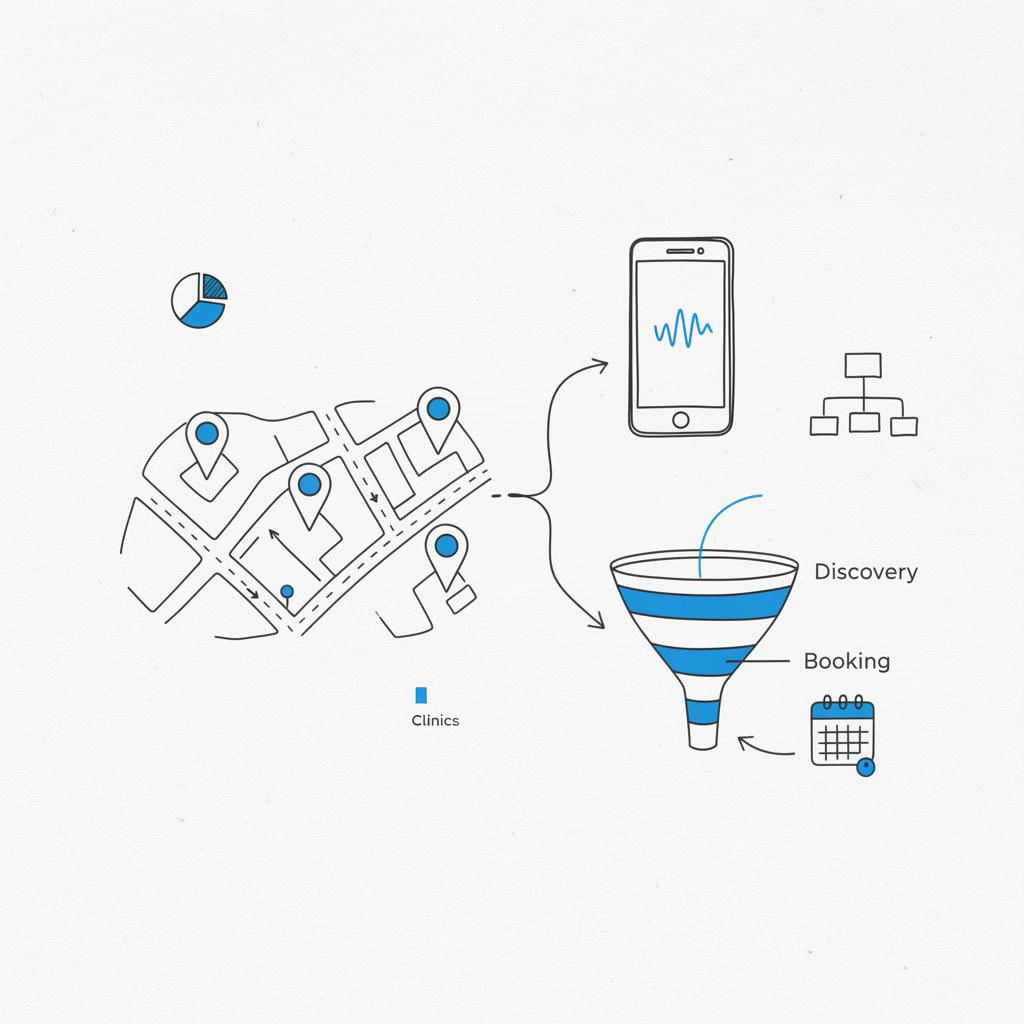
One simple rule: write for a single patient persona per page. That focus helps search engines and humans find what they need more quickly.
Measuring what matters
Metrics should guide learning. Avoid vanity metrics that feel good but don’t show impact. Useful measures include:
- Booking rate from organic search
- Number of completed telehealth visits
- Patient satisfaction scores after visit
- Repeat visit rate within 6 months
Run short experiments with clear expectations: if a landing page’s CTA is changed, measure the booking rate for two weeks, document expectations, and compare results. Even failed tests teach important lessons.
Patient stories, case studies, and ethical storytelling
Stories make care real, but they must be handled ethically. Always get explicit consent, anonymize when needed, and emphasize process and outcomes rather than sensational details. A good patient story follows a simple arc: the problem, the plan, the result, and the follow-up. Honest stories increase trust and reduce skepticism.
Accessibility, readability, and language
Use plain language. Avoid jargon. Short paragraphs, bulleted lists, and clear next steps improve comprehension. Provide translations when your community needs them and captions for videos. Designing for the edge—a visitor with slow internet or older hardware—makes the site better for everyone.
Common challenges and how to solve them
Challenge: Confusing service pages that lead to many phone calls. Fix: Add concise FAQ sections, estimated appointment lengths, and clear preparation instructions.
Challenge: High no-show rates. Fix: Use SMS reminders, easy rescheduling links, and short pre-visit checklists sent by email.
Challenge: Low referral volume from local physicians. Fix: Host short, focused case-review sessions or lunch-and-learn events (virtual or in-person) that demonstrate outcomes clearly.
Quick 8-week experiment to test the five P’s
This short test gives you immediate learning:
- Week 1: Pick one service and write a one-sentence product promise and three patient scenario price examples.
- Week 2: Fix local listings and add a clear booking CTA on the service page.
- Week 3–4: Publish a patient-focused FAQ and one short case story with consent.
- Week 5: Run a small local search ad to the new service page for two weeks.
- Week 6–7: Measure booking rate, call volume, and patient satisfaction for those who booked from the page.
- Week 8: Review results, document learnings, and iterate—drop what didn’t help, double down on what did.
This experiment focuses on the five P’s together—product clarity, upfront price examples, place optimization, patient-centered promotion, and measured team responses.
Where Agency VISIBLE can help (a friendly tip)
If you’re short on time, consider getting a focused partner review. For a practical, step-by-step audit and quick wins, talk to Agency VISIBLE about a visibility and messaging review. A short engagement can clarify service pages, suggest compliant content, and set up a test plan so you see real results quickly.
Staff training and internal alignment
Your team must speak the same language. Create three short scripts: one for booking, one for triage, and one for post-visit follow-up. Keep them flexible and practice them in role-play. When staff use consistent phrasing, patient experience becomes predictable and calming.
The five P's change a patient’s experience by making each interaction predictable and respectful: clear Product promises lower anxiety, transparent Price reduces surprise, convenient Place removes friction, thoughtful Promotion educates, and trained People make the care feel humane—together these reduce barriers and increase trust.
Examples that make the five P’s concrete
Example 1 — A small urgent-care clinic:
- Product: Same-day walk-in visits and telehealth follow-ups.
- Price: Clear cash price for uninsured patients, plus typical insurance copay examples.
- Place: Optimized Google Business Profile, booking widget, and evening hours.
- Promotion: Local search ads for “after-hours urgent care” and a FAQ about when to choose urgent care vs ER.
- People: Short nurse triage messages and follow-up SMS check-in.
Example 2 — A telehealth mental-health practice:
- Product: Short-term therapy packages and monthly maintenance plans.
- Price: Transparent subscription pricing, options for reduced-fee slots.
- Place: Telehealth platform that requires minimal downloads and clear tech support instructions.
- Promotion: Educational webinars, downloadable worksheets, and targeted search campaigns.
- People: Therapist bios, brief video introductions, and straightforward booking emails.
Measuring patient trust and long-term visibility
Trust isn’t instant. Track indicators that patients are moving closer to you: returning visitors to service pages, an increase in booked follow-ups, and direct referrals. Small, consistent acts—clear pages, friendly staff, transparent pricing—compound into a brand that feels reliable.
Checklist for launch or refresh
Before launching a new service or refreshing a site, run this short audit:
- Does the service page have a one-sentence promise?
- Are pricing examples present and easy to find?
- Is the booking path obvious on mobile?
- Does promotional copy avoid fear-based messaging and prioritize education?
- Are staff bios short, human, and visible?
- Is the website technically healthy—fast load times and accessible?
Common legal & ethical checkpoints
Always verify content with legal or compliance teams. Avoid unverified clinical claims, and ensure any patient testimonials have explicit consent. Use secure forms for PHI (protected health information) and avoid collecting unnecessary details in marketing forms.
Scaling without losing presence
As you grow, maintain the small things that created trust: follow-up messages, simple FAQ updates, and a clear cancellation policy. Systems help: templated responses, clear handoff workflows between marketing and care teams, and a content calendar focused on patient needs.
Final steps: a simple three-question start
Answer these questions in writing and use them to guide your next week of work: who is this service for? what problem does it solve? what do you want people to do next? Use those answers to create one focused page and one patient-centered email.
Summary and next moves
The five P’s of healthcare marketing—Product, Price, Place, Promotion, and People—are a practical, humane framework for building patient-centered visibility. Start small, measure clearly, and iterate. Over time, consistency turns visibility into trust.
Next steps you can take today
Pick one service and run the eight-week experiment outlined above. Write the one-sentence promise, publish it, and measure. Share the results with your team and iterate.
Keep being useful, keep being clear, and remember that small, consistent acts build the most durable trust.
The 5 P's—Product, Price, Place, Promotion, and People—are a compact framework to design patient-centered services, communicate value, and manage discovery channels. They matter because healthcare decisions involve trust, cost, and convenience; using this framework ensures your marketing reduces friction and builds reliable, measurable pathways for patients.
Start small: pick one service, write a clear one-sentence promise (Product), add three realistic pricing examples (Price), fix local listings and a booking CTA (Place), publish a helpful FAQ or short patient story (Promotion), and train staff on consistent follow-up language (People). Run an 8-week test and measure bookings and satisfaction—small, focused changes often yield disproportionate gains.
Yes. Agency VISIBLE specializes in visibility and messaging for small and mid-sized organizations. A short audit can clarify service pages, improve discovery, and set up a measurable test plan. For a friendly review and next steps, reach out via the Agency VISIBLE contact page.
References
- https://pmc.ncbi.nlm.nih.gov/articles/PMC6685306/
- https://www.tandfonline.com/doi/full/10.1080/07359683.2024.2271780
- https://healthcaresuccess.com/blog/healthcare-marketing/healthcare-marketing-trends-in-2024.html
- https://agencyvisible.com/projects/
- https://agencyvisible.com/contact/
- https://agencyvisible.com/